
Switzerland's Most Famous Hikes Now Require Advance Reservations as Oeschinensee and Stoos Introduce Smart Access Controls
Switzerland's Oeschinensee and Stoos Ridge Trail are implementing digital time-slot reservations and transport-based visitor management to protect alpine ecosystems and redistribute hiking crowds.
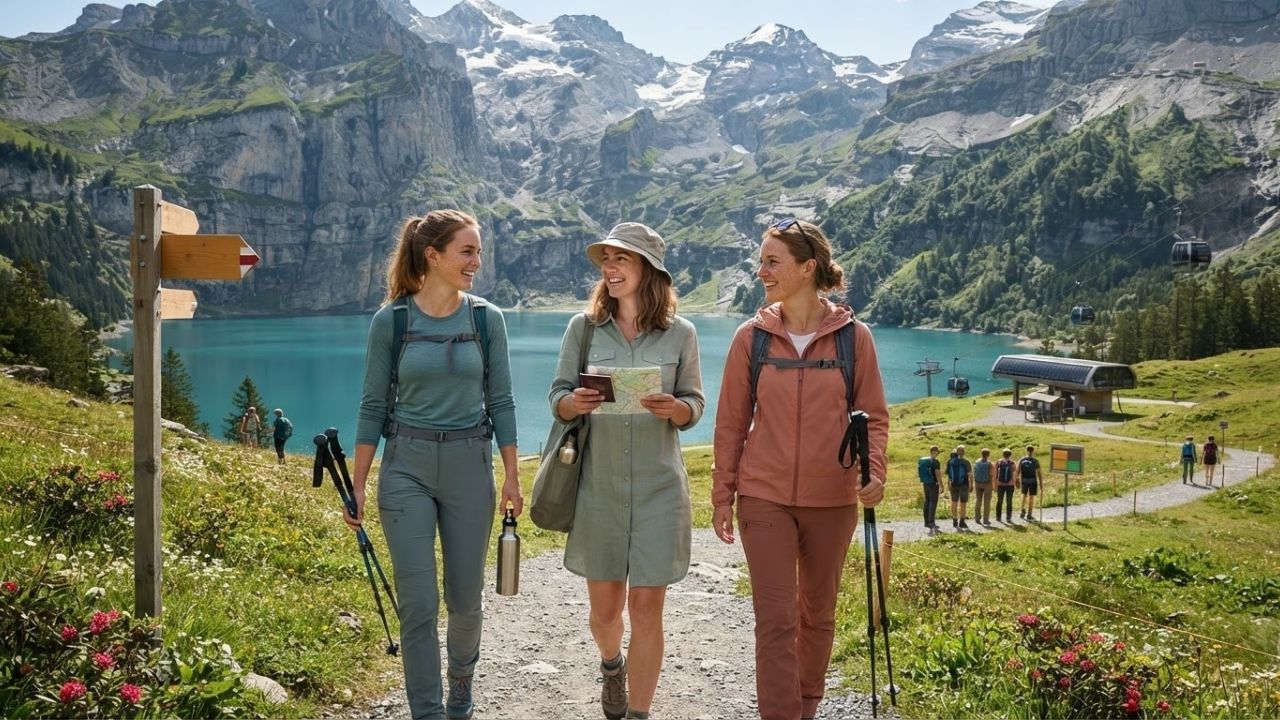
Image generated by AI
Two of Switzerland's most photographed alpine destinations — Oeschinensee above Kandersteg and the Stoos Ridge Trail above Lake Lucerne — now require advance digital reservations to manage visitor flow, joining Mount Fuji and Italy's Dolomites in a global pivot away from unrestricted access.
Why Switzerland's Open-Trail Era Is Over
For generations, Swiss alpine hiking operated on a simple premise: arrive at a trailhead, buy your cable car ticket, and go. That model served Switzerland well when summer hiking was a regional pastime. It no longer functions when social media turns a single turquoise lake into an internationally viral destination overnight.
Oeschinensee, located above the village of Kandersteg in the Bernese Oberland, is one of Switzerland's most reproduced mountain images — high alpine cliffs flanking a vivid turquoise lake at 1,578 metres. The destination has become a victim of its own visual appeal. During peak summer periods, cable car queues stretched to unworkable lengths, trailside congestion reduced what should be a meditative mountain experience to something resembling a commute, and parking in Kandersteg village became genuinely unreliable.
The response from destination managers is direct: if you want to ascend by cable car during busy summer windows, you now need a reserved time slot. Official visitor information for Oeschinensee confirms that cable car transport is not available without a valid reservation when capacity is reached. No spontaneous queue. No last-minute walk-up option. The system enforces arrival distribution before problems form rather than managing chaos after it arrives.
This is not a Swiss experiment in isolation. Italy's Dolomites have introduced vehicle and visitor restrictions in their most densely visited valleys. Japan's Mount Fuji implemented daily capacity limits and a blanket entry fee on its most-used trail section in 2024. Switzerland is adapting the same philosophy to its own alpine context — and doing it with characteristically precise organisation.
How the New Access Systems Work at Each Destination
Oeschinensee, Bernese Oberland
The Kandersteg cable car system now operates on a time-slot model during summer peak periods. Visitors reserve an ascent window digitally in advance, allowing the destination to distribute arrivals across the day rather than allowing thousands of people to converge simultaneously at the same transport station.
For travellers who prefer not to interact with the booking system — or who find their preferred slot full — there is a practical alternative that many visitors are unaware of. You can hike directly from Kandersteg village up to Oeschinensee on foot, bypassing the cable car entirely. The route requires genuine effort and significantly more time, but it rewards with quieter conditions and a far more authentic alpine experience. Hikers who depart the village before 7:30am on this route are likely to reach the lake before the cable car crowds begin arriving for the day.
The destination management approach also addresses parking directly. Kandersteg's parking areas reach capacity on busy summer days, and visitors are advised to arrive by train — the village has its own railway station on the Bern–Lötschberg–Simplon line — rather than driving. Switzerland Tourism promotes this rail-first approach as both an environmental measure and a practical congestion solution.
Stoos Ridge Trail, Central Switzerland
The Stoos Ridge Trail runs between Fronalpstock and Klingenstock above the canton of Schwyz, offering panoramic views across Central Switzerland's lakes and peaks from an exposed alpine ridge. Access depends on the famous Stoos funicular — at certain sections among the steepest in the world — plus connecting chairlifts that carry hikers to the ridge starting points.
These mechanical systems are not merely transport infrastructure. They function as natural visitor regulators. When chairlift capacity is managed carefully, the number of people arriving at sensitive ridge sections at any given time stays within sustainable limits. Travel planners increasingly recommend reversing the traditional route: begin from Fronalpstock rather than Klingenstock to immediately spread out from the majority of arriving hikers who follow the conventional direction.
The Stoos area also benefits from an underused afternoon window. Visitors who start hiking after 1:00pm — once the morning surge has passed — typically encounter quieter ridge conditions and better light for photography in the west-facing sections. The firm caveat is chairlift operating hours: always verify the last ascent and descent times for the specific day before committing to an afternoon start, as these vary by season and can catch unprepared hikers.
Cultural and Environmental Value: What These Restrictions Actually Protect
The Swiss Alps are not merely scenic backdrop. The Bernese Oberland region around Kandersteg has maintained active farming communities for centuries, with the lake circuit at Oeschinensee sitting inside an ecosystem that includes protected wildflower meadows, nesting zones for alpine choughs, and snowmelt-fed stream systems that flow into the Kander River below. Unrestricted footfall directly degrades these features — compacted soil resists wildflower regeneration, and human noise displaces breeding birds during June and July.
At Stoos, the ridge itself sits within the wider Mythen mountain group, an area significant to Swiss cultural identity. The twin peaks of the Mythen — Grosser Mythen and Kleiner Mythen — appear in cantonal heraldry and in literature dating to the nineteenth century. Managing tourist volume on the ridge is therefore not only an ecological decision but a cultural one, protecting the integrity of a place that holds meaning well beyond its Instagram coordinates.
For the visitor, the real impact of these systems is most tangible in the quality of the experience received. A morning arrival at Oeschinensee with controlled visitor numbers means actually hearing the lake — the wind across the water, the distant rockfall from the surrounding cliffs — rather than the ambient hum of several hundred simultaneous conversations. That quality of sensory access is what the reservation systems exist to preserve.
The Swiss Federal Office for the Environment (BAFU) has published carrying-capacity guidance for sensitive alpine zones, and regional destination managers in the Bernese Oberland and Canton Schwyz are aligning their visitor management policies with these frameworks. This top-down coordination distinguishes Switzerland's approach from ad-hoc destination-level responses.
Visitor Insider Tips for Hiking Switzerland in 2026
Book the Oeschinensee cable car time slot as soon as your travel dates are confirmed. Peak summer windows — particularly July and August weekends — fill several weeks in advance. The official reservation system is operated through the Kandersteg cable car website. Third-party resellers do not have access to time slots.
Arriving by train removes one major planning variable. Kandersteg station is served regularly from Bern, with the journey taking under 90 minutes. Arriving by rail means you do not need to secure parking — which can be genuinely difficult on busy summer days — and allows you to use your access window efficiently without sitting in a car queue.
Consider the Gasterntal Valley as your primary Kandersteg alternative. This narrow valley east of Kandersteg is one of the most atmospheric glacial corridors in the Bernese Oberland, ending at the Gasterenbach waterfall and Daubensee area via the Gemmi Pass. It attracts a fraction of Oeschinensee's visitor numbers and offers equally dramatic alpine geology. Similarly, the Blüemlisalp routes above Kandersteg provide challenging high-alpine terrain for fit hikers seeking complete solitude.
For Stoos, the "next-ridge-over" alternative is Niederbauen Chulm on the opposite shore of Lake Uri. The summit is reached by cable car from Emmetten and offers a 360-degree panorama across the Uri Alps and Vierwaldstättersee that directly rivals the Stoos ridge views, with a fraction of the visitor pressure.
Never carry single-use plastics onto Swiss mountain trails. Many alpine hut operators near Oeschinensee and along the Stoos ridge have removed disposable plastic cups entirely. Mountain huts expect walkers to carry reusable bottles — the spring water at alpine huts is typically glacial-source and of excellent quality.
Late May and early September are the optimal windows for both destinations. Snow has generally cleared from the main paths by late May, wildflower bloom is at its peak, and visitor numbers run 40–60% below July levels. Early September brings clearer atmospheric conditions and the visual reward of early alpine colour change before the main larch-turning season in October.
Tourism Outlook: Switzerland's Long-Term Alpine Strategy
The changes at Oeschinensee and Stoos are early implementations of a direction that Switzerland's mountain tourism will follow at an increasing number of destinations through 2027 and beyond. The pressure driving this shift is structural: global social media engagement with Swiss mountain content has grown consistently over the past five years, driving demand to specific, visually identifiable locations rather than distributing it across the full width of the Alps.
Destination managers across the Bernese Oberland, the Valais, and Central Switzerland are now actively developing what the industry terms "next-ridge-over" strategies — formal promotion of near-identical experiences at lower-profile sites to draw volume away from saturated icons. In the Kandersteg area, this means active promotion of the Gemmi–Daubensee circuit and the Gasterntal as co-equal alternatives to Oeschinensee rather than secondary options.
The long-term economic argument for this approach is strong. Destinations that maintain environmental quality and visitor experience standards sustain premium accommodation pricing and higher per-visitor spending over time. A degraded Oeschinensee — one where the lakeside path is eroded, the wildflower meadows are compacted, and the ambience is indistinguishable from an urban public park — loses the qualities that justify premium Swiss alpine pricing entirely.
Switzerland Tourism has integrated visitor distribution principles into its 2026 campaign messaging, explicitly promoting regional alternatives rather than defaulting to the same flagship images. This represents a meaningful departure from the volume-growth model that has dominated destination marketing for two decades, and it positions Switzerland well for the stricter sustainability expectations that European travellers are increasingly applying when choosing destinations.
The Swiss Alps will remain among the world's most compelling hiking destinations for 2026 and beyond. The difference is that reaching their best experiences will now require more intentional planning — which, for most serious hikers, is likely to improve the trip considerably.
Related Travel Guides
Nine Countries Introduce Visitor Caps and Tourism Fees as Overtourism Reshapes Global Travel Rules
El Hierro: Spain's Sustainable Volcanic Island Is Redefining Slow Travel in the Atlantic
Switzerland Alpine Huts and Backcountry Routes: A First-Timer's Reservation Guide 2026
Disclaimer
This article is for informational and educational purposes only. It does not constitute legal, financial, or professional advice. While we strive to provide accurate and up-to-date information, travel policies, regulations, and conditions change rapidly. Always verify information with official sources before making travel decisions. Nomad Lawyer makes no representations about the accuracy, reliability, completeness, or suitability of the information provided. Readers should consult qualified professionals for advice specific to their circumstances. The views expressed in this article are those of the author and do not necessarily reflect the views of Nomad Lawyer.