
Australia’s First Mass Timber Terminal Takes Shape as Sunshine Coast Airport Advances $170M Redevelopment for 2027
Sunshine Coast Airport installs 30 tonnes of engineered timber for its $170M terminal redevelopment, delivering Australia's first mass timber airport departures hall in 2027.

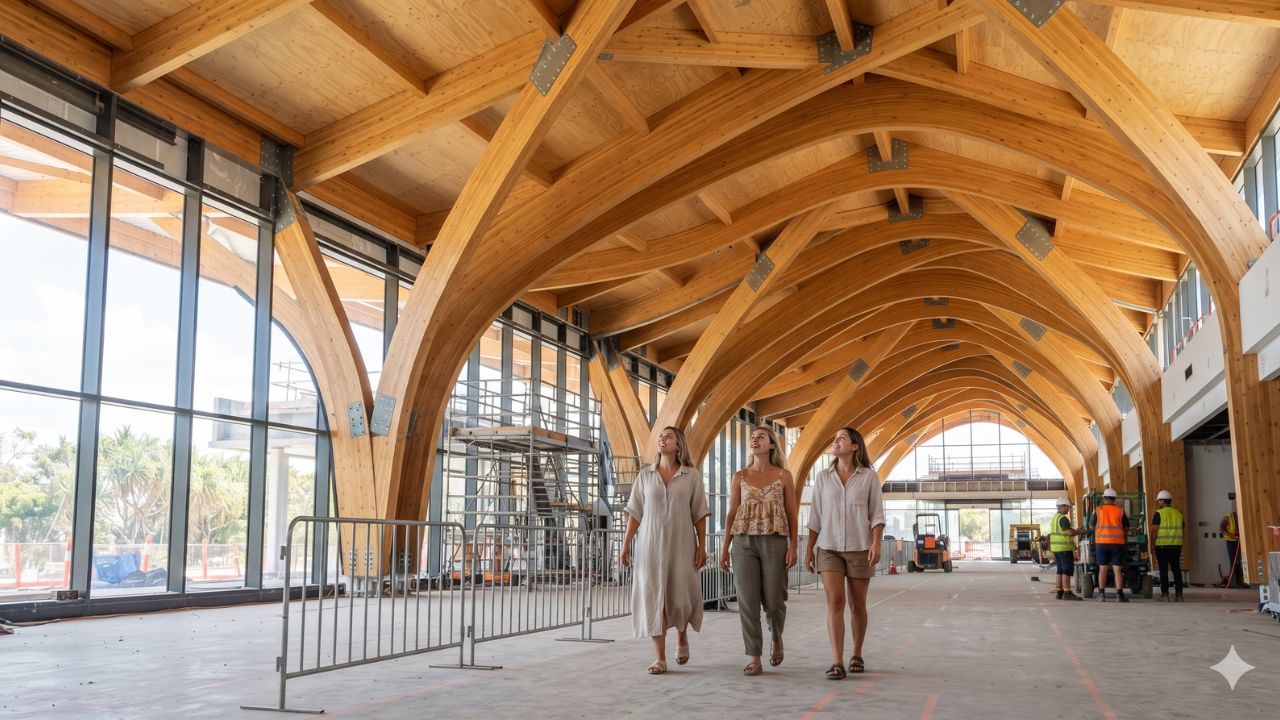
Thirty tonnes of engineered glue-laminated timber frame the departures hall at Sunshine Coast Airport ahead of 2027 completion
Installing approximately 30 tonnes of structural glue-laminated timber—an engineered mass equivalent to an adult humpback whale migrating off the Queensland coast—the Sunshine Coast Airport has reached a defining milestone in its $170 million terminal redevelopment. Positioned for structural completion in 2027, the regional aviation facility will stand as Australia's first mass timber airport terminal, fundamentally departing from traditional steel and concrete industrial architecture. Guided by the design team of Populous: Fentress Studios and builder McNab, with specialist engineering from Theca Timber, the new departures hall introduces sustainable structural design to serve expanding domestic and international passenger routes.
The deployment of exposed timber frames marks a structural shift in regional aviation infrastructure across the Asia-Pacific territory. While international mega-terminals frequently depend on energy-intensive steel trusses and synthetic cladding, the Sunshine Coast project leverages regional timber engineering to establish a distinct sense of place. For travelers passing through Queensland's subtropical tourism corridor, the project transforms the departure experience into an architectural gateway that reflects the natural environment of the surrounding coastline.
Architectural Engineering: Assembling the Glulam Raking Roof Structure
The central visual and engineering feature of the $170 million upgrade is its raking roof structure, manufactured from glue-laminated timber, commonly known as glulam or GLT. As installation proceeds across the departures hall over coming weeks, the structural woodwork will fulfill dual responsibilities: serving as the primary load-bearing roof support while providing warm, exposed architectural surfaces visible to departing passengers.
Robin Mace, general manager of projects and planning at Sunshine Coast Airport, described the milestone as a tangible step toward realizing an aviation vision shaped directly by local community input. The scale of the timber installation remains rare within Australian commercial aviation. According to Matt Findlay, principal and head of aviation for Asia-Pacific at Populous: Fentress Studios, comparable airport facilities across Australasia rely almost universally on structural steel beams and precast concrete slabs. Selecting engineered glulam at this volume establishes an architectural benchmark for regional airport construction.
The project incorporates biophilic design principles—an architectural philosophy that integrates natural materials and organic lighting to support psychological comfort. Sean Powyer, associate principal and architect at Populous: Fentress Studios, noted that the sloping timber frames were conceived as a calming transition zone between commercial travel pressures and the relaxed coastal atmosphere of Queensland. The design directly references the local biosphere: the airport functions as a primary air gateway to three designated Australian UNESCO Biosphere Reserves, reinforcing the connection between transport infrastructure and environmental stewardship.
Decarbonization and Environmental Metrics: Reducing Embodied Construction Emissions
Beyond visual aesthetics, the selection of engineered wood delivers measurable environmental benefits in embodied carbon. Compared to conventional airport construction models utilizing structural steel and Portland cement, life-cycle assessments indicate a Global Warming Potential (GWP) reduction of approximately 40 tonnes of carbon dioxide equivalent (CO2e).
This saving relates specifically to embodied emissions—the greenhouse gases generated during raw material extraction, processing, and assembly—rather than operational fuel burn from scheduled aircraft flights. By sequestering atmospheric carbon within the wood fibers throughout the building's operational lifespan, the mass timber departures hall aligns with broader sustainability initiatives outlined by Infrastructure Australia.
The infrastructure upgrade takes place alongside growing passenger demand across regional Queensland. Managed in close alignment with destination objectives from Tourism and Events Queensland, the airport currently hosts scheduled connections linking the Sunshine Coast to Adelaide, Auckland, Cairns, Melbourne, and Sydney, alongside one-stop international access to Singapore via Bali. Flight operations are maintained by five major carriers: Air New Zealand, Alliance Airlines, Jetstar, Qantas, and Virgin Australia. While the current construction milestone introduces no immediate route expansions or fare alterations, the expanded facility provides the physical gate capacity needed to support future trans-Tasman and domestic flight growth.
Structural and Operational Blueprint: Sunshine Coast Airport Terminal Redevelopment
The following matrix synthesizes the structural specifications, environmental benchmarks, and route connectivity governing the $170 million project:
| Project Dimension | Technical Specification | Engineering Comparison | Long-Term Passenger & Environmental Benefit |
|---|---|---|---|
| Capital Investment | $170 million comprehensive upgrade | Standard regional terminal expansion | Modernized gate lounges and expanded capacity |
| Timber Installation | Approximately 30 tonnes of glulam | Comparable to adult humpback whale | Eliminates heavy synthetic ceiling panels |
| Embodied Carbon Impact | ~40 tonnes CO2e GWP reduction | Outperforms steel and concrete builds | Long-term carbon sequestration in building frame |
| Architectural Partners | Populous: Fentress Studios & McNab | Specialist timber design by Theca Timber | Biophilic acoustics and warm visual environment |
| Target Completion | Scheduled delivery in 2027 | Multi-phase active terminal build | Seamless passenger flow without service pause |
| Direct Route Network | Adelaide, Auckland, Cairns, Melbourne, Sydney | Interline link to Singapore via Bali | Eliminates transit detours through Brisbane |
| Operating Airlines | Air NZ, Alliance, Jetstar, Qantas, Virgin | Full domestic mainline and LCC presence | Robust pricing competition across trunk routes |
Expert Analysis: Biophilic Aviation Hubs and the Future of Regional Passenger Yields
The transition toward mass timber terminal design represents an astute commercial realignment for regional airports seeking independence from metropolitan hubs. For travelers booking this route, the direct consequence is an immediate shift away from the sterile, industrial stress of high-density metropolitan terminals toward an acoustically dampened, naturally illuminated environment that reduces transit anxiety.
Regional airports in Australia have historically struggled with passenger leakage, as travelers living in coastal communities drove 90 minutes southward to Brisbane Airport (BNE) to access broader flight schedules and competitive ticket prices. The pricing pressure this creates means that regional airports can justify capital improvement charges without pricing out low-cost carriers like Jetstar or regional feeder operators.
By creating an architecturally distinguished, 2027-ready terminal that embodies the Sunshine Coast's relaxed coastal identity, the airport enhances its direct catchment appeal. High-yield leisure travelers bound for Noosa, Maroochydore, and the Glass House Mountains increasingly favor landing directly in the heart of the region. Furthermore, mass timber interiors provide superior acoustic dampening compared to expansive glass and polished granite halls, substantially reducing ambient noise levels at boarding gates.
As international aviation faces mounting scrutiny regarding sustainability, terminals that demonstrate tangible reductions in embodied carbon establish a competitive advantage for attracting environmentally conscious airlines and corporate conference travel. The Sunshine Coast Airport model illustrates that regional gateway terminals can achieve commercial scale while actively reducing their ecological footprint.
Key Takeaways
- First Mass Timber Terminal: Sunshine Coast Airport’s $170 million redevelopment will deliver Australia’s first mass timber airport terminal upon completion in 2027.
- 30-Tonne Glulam Roof: Approximately 30 tonnes of glue-laminated engineered timber—comparable in weight to an adult humpback whale—are being installed across the new departures hall.
- Embodied Carbon Reduction: Material selection yields an estimated 40 tonnes of CO2 equivalent reduction in Global Warming Potential versus conventional steel and concrete.
- Biophilic Architecture: Designed by Populous: Fentress Studios and built by McNab, the terminal integrates natural wood aesthetics reflecting the region's three UNESCO Biosphere reserves.
- Expanding Network: The airport currently connects passengers to Adelaide, Auckland, Cairns, Melbourne, Sydney, and Singapore via Bali across five major carriers.
FAQ: Sunshine Coast Airport Mass Timber Terminal 2027
What makes the Sunshine Coast Airport terminal unique in Australia?
It is Australia's first airport terminal built using mass timber, incorporating roughly 30 tonnes of glue-laminated timber (glulam) into its departures hall roof structure.
When will the Sunshine Coast Airport redevelopment be completed?
The $170 million terminal upgrade is scheduled for overall completion in 2027, with timber roof installation marking a major mid-stage construction milestone.
How much carbon does the timber terminal design save?
The engineered timber structure achieves an estimated embodied carbon reduction of approximately 40 tonnes of carbon dioxide equivalent compared to conventional steel and concrete.
Which airlines fly into Sunshine Coast Airport?
Sunshine Coast Airport is served by Air New Zealand, Alliance Airlines, Jetstar, Qantas, and Virgin Australia, connecting to major domestic cities and international routes.
[By replacing cold industrial concrete with warm living timber, the Sunshine Coast proves that the future of aviation architecture can be rooted in nature.]
Related Travel Guides
Disclaimer
This article is for informational and educational purposes only. It does not constitute legal, financial, or professional advice. While we strive to provide accurate and up-to-date information, travel policies, regulations, and conditions change rapidly. Always verify information with official sources before making travel decisions. Nomad Lawyer makes no representations about the accuracy, reliability, completeness, or suitability of the information provided. Readers should consult qualified professionals for advice specific to their circumstances. The views expressed in this article are those of the author and do not necessarily reflect the views of Nomad Lawyer.
Raushan Kumar
Founder & Lead Developer
Full-stack developer with 11+ years of experience and a passionate traveller. Raushan built Nomad Lawyer from the ground up with a vision to create the best travel and law experience on the web.
Learn more about our team →