
Bordeaux Airport Ground Electrification: €6.5M 400 Hz Upgrade Eliminates APU Emissions Across 29 Aircraft Stands
Bordeaux Airport completes a €6.5 million ground electrification project across 29 parking stands, eliminating auxiliary power unit emissions and cutting 4,100 tonnes of annual CO2.

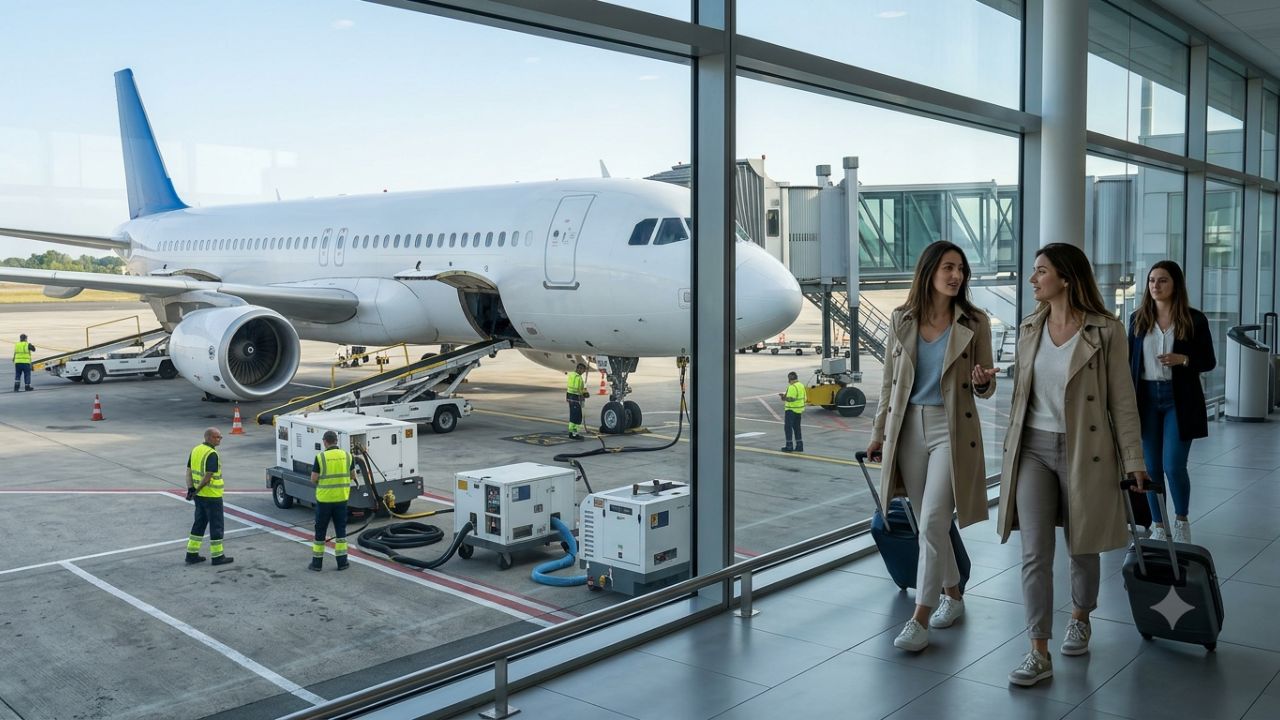
Bordeaux Airport apron outfitted with fixed 400 Hz electrical power connections and mobile Pre-Conditioned Air units across all 29 commercial stands
[BORDEAUX, Oct 22, 2026] — Bordeaux Airport has finalized a €6.5 million ($7.05 million) airside electrification initiative across all 29 commercial aircraft parking stands, installing 400 Hz fixed electrical power and 20 mobile Pre-Conditioned Air units to eliminate auxiliary power unit fossil fuel combustion and cut 4,100 tonnes of annual carbon emissions by 2027.
[!NOTE] Operational Snapshot: Bordeaux-Mérignac Airport (BOD) now supplies 100% renewable electricity to stationary commercial aircraft, allowing flight crews to shut down their kerosene-burning auxiliary power units (APUs). Supported by the European Union’s Alternative Fuels Infrastructure Facility (AFIF) through CINEA and backed by a €2.2 million mezzanine loan from Banque des Territoires, the project ensures full operational compliance with the EU's Alternative Fuels Infrastructure Regulation (AFIR) well ahead of mandatory deadlines.
BORDEAUX AIRPORT GROUND ELECTRIFICATION ARCHITECTURE
| Column 1 |
|---|
| [ 100% Renewable Regional Grid ] |
| v |
| [ Substation & 50 Hz -> 400 Hz Static Frequency Converters ] |
| +--------+------------------------------------+ |
| v v |
| [ Fixed 400 Hz Apron Outlets ] [ 20 Mobile Pre-Conditioned Air (PCA) Units ] |
| (29 Total Stands / 20 Newly Electrified) (High-Capacity Variable-Refrigerant Chillers) |
| v v |
| +--------------------------------------------------------------------------------------+ |
| +--------------------------------------------------------------------------------------+ |
Technical Hardware Deployment: 400 Hz Ground Power and Pre-Conditioned Air
The technical modernization of Bordeaux-Mérignac Airport centers on replacing the internal jet-fuel turbines of parked airliners with fixed airside utility infrastructure. When commercial airliners land and taxi to their assigned parking stands, their main turbofan engines are shut down immediately. However, an aircraft requires substantial energy during turnarounds to maintain electronic instrumentation, charge emergency battery systems, operate galley food chillers, illuminate passenger cabins, and circulate climate-controlled air through the cabin interior.
Historically, flight crews met these energy demands by firing up the auxiliary power unit (APU)—a compact, fuel-thirsty gas turbine engine nestled inside the tailcone of the fuselage. Operating an APU consumes between 100 and 250 kilograms of aviation kerosene per hour, generating intense local emissions of carbon dioxide, nitrogen oxides, fine particulate matter, and acoustic noise.
To eliminate this operational practice, Bordeaux Airport completed an infrastructure overhaul covering all 29 passenger parking stands on its commercial apron. The installation introduced 20 newly electrified stand positions alongside nine upgraded legacy positions. Every stand now houses high-capacity 400 Hz electrical connection pits or telescoping bridge boom arms. Aviation electrical systems operate on a three-phase 115/200-volt alternating current at a standardized frequency of 400 Hertz, compared to the 50 Hertz standard of the European civilian electrical grid. Bordeaux’s substation network features advanced static solid-state frequency converters that step down grid voltage and transform 50 Hz current into stable, surge-protected 400 Hz power delivered straight to the aircraft receptacle.
AIRCRAFT TURNAROUND ENERGY CONSUMPTION PATHWAY
| Column 1 |
|---|
| CONVENTIONAL TURNAROUND (LEGACY): |
| Aviation Kerosene -> Tailcone APU Gas Turbine -> 150-250 kg/hr Jet A-1 Burn |
| -> Heavy Local CO2, NOx & Particulates |
| -> 85-95 dB High-Pitched Acoustic Whine |
| BORDEAUX ELECTRIFIED TURNAROUND (2026 STANDARDS): |
| French Grid (Renewables) -> 50 Hz/400 Hz Converter -> Fixed Stand Plug-in -> Avionics Running |
| Airport Energy Depot -> Mobile Chilled Air Unit-> Underfloor PCA Hose -> Cabin Conditioned |
| -> 0 kg Jet A-1 Fuel Consumed on Apron |
Complementing the electrical connections is a dedicated fleet of 20 mobile Pre-Conditioned Air (PCA) units. Providing clean electricity solves the flight deck and galley power requirements, but modern airliners cannot regulate cabin temperatures without active pneumatic or air-conditioning compression. The mobile PCA units deployed at Bordeaux are specialized ground refrigeration and heating plants. Equipped with variable-speed electric compressors, these units connect via flexible insulated ducting to the underside of the aircraft fuselage. Clean, filtered, pre-cooled or heated air is pumped directly into the aircraft's environmental control system (ECS) distribution manifold, maintaining cabin temperatures at 21 degrees Celsius without requiring the APU to drive onboard air-cycle machines.
The entire technical deployment conforms to rigorous operational specifications supervised by the French Civil Aviation Authority (Direction Générale de l'Aviation Civile - DGAC) and certified under standards established by the European Union Aviation Safety Agency (EASA). Flight crews receive plug-and-play ground utility connections within three minutes of chock placement, ensuring that ground handling turnarounds remain on schedule.
Addressing Scope 3 Emissions: The Environmental Accounting Ledger
In international carbon accounting protocols, airport greenhouse gas emissions are categorized into three distinct operational boundaries:
AIRPORT CARBON EMISSIONS BOUNDARIES (GHG PROTOCOL)
| Column 1 |
|---|
| [ SCOPE 1: DIRECT EMISSIONS ] |
| Airport-owned fleet vehicles, onsite natural gas heating boilers, emergency diesel backup systems. |
| [ SCOPE 2: INDIRECT PURCHASED ENERGY ] |
| Offsite electricity purchased by the airport authority to illuminate passenger terminals. |
| [ SCOPE 3: TENANT & PARTNER VALUE-CHAIN EMISSIONS ] |
| Aircraft landing/takeoff cycles, auxiliary power unit taxi/stand burns, passenger surface access. |
| * REPRESENTS OVER 90% OF AN AIRPORT'S TOTAL CARBON IMPACT * |
While airport operators directly control their own administrative buildings and baggage transport tractors, tenant airlines generate the overwhelming majority of emissions on airport property. An airport cannot unilaterally order new airline aircraft engines, but it holds direct responsibility for providing the physical infrastructure that enables airlines to minimize their fuel burn while parked.
By outfitting 29 stands with fixed 400 Hz electrical power and 20 mobile PCA units, Bordeaux Airport eliminates the justification for carriers to operate APUs during ground stopovers. Environmental modeling shows this initiative will slash carbon dioxide emissions by 4,100 tonnes annually by 2027.
| Environmental Metric | Legacy APU & Diesel GPU Operation | Electrified Stands & PCA System | Net Operational Variance |
|---|---|---|---|
| Kerosene Fuel Burn | 100 to 250 kg per stopover hour | 0 kg per stopover hour | 100% reduction in ground jet fuel use |
| Annual CO2 Emissions | Baseline airfield ground footprint | Slashed by 4,100 tonnes per year | Meets 2027 sustainability projection |
| Local Air Contaminants | Elevated NOx, SO2, and unburnt hydrocarbons | Zero point-source apron emissions | Cleans terminal perimeter air shed |
| Acoustic Signature | 85–95 dBA at aircraft tail perimeter | Under 65 dBA from silent electrical supply | Dramatic reduction in ramp ambient noise |
| Airliner ESG Accounting | Recorded as Scope 1 carrier fuel burn | Logged as verified ground decarbonisation | Boosts airline fleet environmental index |
The World Travel & Tourism Council (WTTC) has commended the Bordeaux installation as an actionable blueprint for regional gateways. For commercial airlines operating into Bordeaux—including Air France, easyJet, Ryanair, Volotea, and British Airways—utilizing electrified stands directly improves their corporate environmental, social, and governance (ESG) reporting. Carriers document measurable fuel savings on flight dispatch sheets, lowering their operational carbon tax liabilities under the European Union Emissions Trading System (EU ETS) while satisfying passenger demand for sustainable travel.
Financial Structuring: CINEA Grants and Banque des Territoires Mezzanine Capital
Completing a comprehensive €6.5 million airside overhaul at a regional transport node required a sophisticated multi-tiered capital structure. Regional hubs often operate on lean financial margins, making large-scale electrical infrastructure investments challenging without institutional co-financing.
The capital stack for the Bordeaux project blends European Union grant mechanisms with domestic institutional investment instruments:
BORDEAUX AIRPORT €6.5M CAPITAL FINANCING STACK
| EUROPEAN UNION: ALTERNATIVE FUELS INFRASTRUCTURE FACILITY (AFIF) GRANT | ||
|---|---|---|
| - Strategic Project Management & Operational Oversight: CINEA | ||
| - Non-repayable capital grant dedicated to European transport energy transition | ||
| BANQUE DES TERRITOIRES: €2.2 MILLION MEZZANINE DEBT FACILITY | ||
| - Subordinated long-term growth loan mitigating commercial default risks | ||
| - Anchored to regional ecological and public utility modernization objectives | ||
| AÉROPORT DE BORDEAUX-MÉRIGNAC: EQUITY & OPERATIONAL CAPITAL RESERVES | ||
| - Direct infrastructure expenditure for transformer stations, apron civil works & cabling |
The European Climate, Infrastructure and Environment Agency (CINEA) managed the primary grant allocation through the Alternative Fuels Infrastructure Facility (AFIF). AFIF functions under the Connecting Europe Facility (CEF) transport funding envelope, targeting transport projects that accelerate alternative power deployment across trans-European transport networks (TEN-T). CINEA’s engineering oversight verified that Bordeaux’s hardware installations satisfied strict European energy interoperability and environmental performance metrics.
To bridge the remaining capital requirements without overleveraging the airport's standard balance sheet, Banque des Territoires—a division of France’s public investment institution Caisse des Dépôts—supplied a €2.2 million mezzanine loan. Mezzanine financing operates as subordinated debt, sitting between senior bank loans and equity. This blended model reduced financing costs and distributed commercial risk across public institutions, the regional airport operating authority, and European Union agencies.
| Funding Partner | Instrument | Capital Contribution / Mandate | Strategic Objective |
|---|---|---|---|
| European Union (AFIF) | Direct Capital Grant | Primary co-funding through Connecting Europe Facility | Accelerate TEN-T transport node decarbonisation |
| CINEA | Institutional Oversight | Technical audits and milestone tracking | Ensure technical compliance with EU energy criteria |
| Banque des Territoires | Mezzanine Loan | €2.2 million subordinated loan facility | Foster territorial cohesion and green public utility growth |
| Bordeaux Airport Authority | Operational Equity | Balance of €6.5 million project expenditure | Install resilient airside infrastructure for long-term viability |
This financing approach provides a replicable blueprint for dozens of secondary and regional European airports that must upgrade their aprons ahead of strict European legal deadlines.
Regulatory Alignment: EU Fit for 55 and the AFIR Mandate
The completion of Bordeaux’s electrification project is directly aligned with European climate legislation. As part of the European Green Deal, the European Union enacted the "Fit for 55" legislative package, aiming to reduce the bloc's net greenhouse gas emissions by at least 55% by 2030 compared to 1990 levels.
Within this regulatory framework, the Alternative Fuels Infrastructure Regulation (AFIR) established statutory mandates governing stationary commercial aircraft at European airports:
AFIR STATUTORY ELECTRIFICATION TIMELINE (ARTICLE 12)
| Column 1 |
|---|
| JANUARY 1, 2025: |
| Initial regulatory adoption and standardization of aircraft electrical plug interfaces across EU. |
| JANUARY 1, 2027: |
| Mandatory provision of electricity to stationary aircraft at all contact stands (jet bridges) |
| at core TEN-T airports across Europe. |
| JANUARY 1, 2030: |
| Mandatory extension of electricity supply to all remote aircraft stands used for commercial |
| passenger operations across both core and comprehensive TEN-T network airports. |
| BORDEAUX AIRPORT STATUS: |
| Fully completed in 2026 across ALL 29 stands (both contact and remote positions). |
| -> 100% COMPLIANT YEARS AHEAD OF STATUTORY DEADLINES |
Under AFIR Article 12, European airports that handle specified commercial passenger volume thresholds must ensure that all aircraft parked at gates receive external ground electricity. Non-compliance carries severe regulatory consequences. The French Ministry of Transport and European regulators hold statutory authority to impose heavy environmental penalty fines, restrict peak-hour departure slots, or limit the expansion of commercial flight authorizations for non-compliant airfields.
By completing the electrification of all 29 passenger parking positions in 2026, Bordeaux Airport has eliminated compliance risk. Tenant airlines operate with full certainty that their flights will not face administrative penalties or slot restrictions, safeguarding regional flight schedules across domestic and international route networks.
Ramp Environmental Health: Air Quality and Acoustic Mitigation
The operational benefits of eliminating auxiliary power unit usage extend to the health and comfort of ground personnel, flight crews, and boarding passengers.
In traditional airport configurations where aircraft idle their APUs on the ramp, the apron environment becomes heavily polluted with combustion byproducts. The physical location of the APU exhaust orifice—high on the tailcone of narrowbody aircraft like the Airbus A320 or Boeing 737—disperses concentrated plumes across adjacent passenger gates, service roads, and boarding stairs.
APRON AIR QUALITY & ACOUSTIC FOOTPRINT COMPARISON
| Column 1 |
|---|
| TRADITIONAL RAMP ENVIRONMENT (APUs & DIESEL GPUs RUNNING): |
| - Tailcone Exhaust: Disperses Nitrogen Dioxide (NO2), Sulfur Dioxide (SO2) & Ultrafine Particles |
| - Ramp Air Quality: Unpleasant kerosene odor enters passenger boarding stairs and jet bridges |
| - Noise Signature: Continuous 85-95 dBA high-frequency scream, causing apron auditory fatigue |
| - Baggage & Refueling Crews: Exposed to constant occupational inhalation hazards |
| ELECTRIFIED RAMP ENVIRONMENT (BORDEAUX 400 HZ & PCA DEPLOYED): |
| - Tailcone Exhaust: INACTIVE (Zero local emission point sources) |
| - Ramp Air Quality: Clean, unpolluted ambient air across all 29 boarding stands |
| - Noise Signature: Subdued 60-65 dBA operational hum; ground teams communicate safely |
| - Passenger Experience: Fresh boarding environment free of burning aviation fuel fumes |
For travelers boarding flights via open-air tarmac stairs, walking past idling jet engines often involves breathing noxious kerosene fumes. Ground handling staff, including baggage handlers, pushback drivers, catering loaders, and aircraft refuelers, spend entire eight-hour shifts exposed to these emissions. Bordeaux’s transition to 100% renewable ground power removes these point-source pollutants, improving occupational health standards across the airport's airside perimeter.
Acoustic dampening is equally noticeable. A running APU produces an abrasive, high-frequency whine that easily penetrates terminal boarding lounges and creates severe auditory fatigue. Switching off APUs across 29 stands lowers ambient ramp noise levels by up to 25 decibels, creating a calmer atmosphere for passengers waiting at boarding gates and allowing ramp personnel to communicate with greater clarity and safety.
Operational Reliability, Turnaround Times, and Passenger Rights (EU261)
In modern commercial aviation logistics, gate turnarounds are among the most operationally delicate segments of any flight rotation. Tight turnarounds—often scheduled between 30 and 45 minutes for short-haul low-cost carriers—leave minimal margin for mechanical disruption.
GROUND POWER RELIABILITY VS. APU FAILURE SEQUENCE
| Column 1 |
|---|
| SCENARIO A: ONBOARD APU SYSTEM FAILURE |
| [ Airliner Lands ] -> [ APU Fails to Start / Overheats ] -> [ Cockpit Electronics Shut Down ] |
| -> [ Cabin Heating/AC Fails ] -> [ Flight Crew Calls Maintenance ] |
| -> [ Dispatch Delay Incurred ] -> [ 3-Hour Threshold Exceeded ] |
| -> [ EU261 Liability: €250-€400 per passenger owed by carrier ] |
| SCENARIO B: BORDEAUX 400 HZ & PCA REDUNDANCY |
| [ Airliner Lands ] -> [ Dual-Channel 400 Hz Cable Connected ] -> [ Stable Avionics Power ] |
| -> [ Mobile PCA Hose Attached ] -> [ Immediate 21°C Airflow ] |
| -> [ APU Inactive / Undisturbed ] -> [ Pre-Flight Checks On Time ] |
| -> [ Scheduled Pushback Achieved ] -> [ Zero Delay Liabilities ] |
Onboard APUs are complex, high-maintenance micro-turbines. They are prone to ignition failures, pneumatic bleed air valve sticking, and thermal shutdowns, particularly when cycling frequently on multi-leg daily itineraries. When an APU experiences a technical abort on the gate, the aircraft loses its autonomous power and climate control. Ground crews must scramble to find mobile diesel generators and air-start carts, often resulting in departure delays that ripple through an airline's subsequent flight network.
Under European Union Regulation (EC) No 261/2004 (EU261), mechanical failures of onboard components such as APUs are legally classified as carrier-controllable operational disruptions rather than extraordinary circumstances. If an APU malfunction triggers a flight delay exceeding three hours upon arrival at the destination, tenant airlines are legally mandated to pay passenger compensation ranging from €250 to €600 per traveler, in addition to providing complimentary meals, refreshments, and hotel accommodations if delays stretch overnight.
By providing dependable, surge-protected fixed 400 Hz electrical lines and dedicated PCA units across every stand, Bordeaux Airport insulates carriers from APU-related gate failures. Flight instruments stay powered without interruption, avionics boot up reliably, and turnarounds remain punctual. For passengers, this structural reliability prevents missed connecting flights, protects regional travel plans, and maintains predictable airline operations.
Passenger Cabin Thermal Protection and Airline Duty of Care
Airlines operating in southern Europe face mounting operational challenges due to rising summer temperatures. During July and August in the Nouvelle-Aquitaine basin, ambient tarmac temperatures regularly exceed 38 degrees Celsius (100 degrees Fahrenheit), with dark asphalt surfaces radiating heat up to 55 degrees Celsius.
When an airliner is parked in these conditions without adequate air conditioning, cabin temperatures can escalate past 40 degrees Celsius within 15 minutes. This creates dangerous conditions for vulnerable travelers, including infants, elderly passengers, and individuals with underlying cardiovascular conditions.
CABIN THERMAL REGULATION: SUMMER TARMAC HEAT MANAGEMENT
| Column 1 |
|---|
| WITHOUT EXTERNAL PCA UNITS (HEATWAVE RISK): |
| - Exterior Tarmac Temperature: 38°C (Asphalt radiant heat reaches 55°C) |
| - Cabin Heat Soak: Metal fuselage acts as a greenhouse; internal cabin rises above 40°C |
| - APU Limitations: Onboard air-cycle machines struggle against extreme ambient intake heat |
| - Consequence: Medical distress, heat exhaustion, deplaning orders, and emergency boarding halts |
| WITH BORDEAUX MOBILE PCA UNITS DEPLOYED: |
| - Chilled Air Injection: Variable-speed refrigeration injects constant 10°C air into ducts |
| - Internal Cabin Climate: Maintained at a continuous, comfortable 21°C |
| - Passenger Safety: Protects passenger health, avoids medical deplaning, ensures calm boarding |
| - Airline Compliance: Satisfies strict passenger duty of care mandates under European air law |
Airlines maintain a non-negotiable legal and ethical duty of care toward passengers once boarding commences. In several high-profile European incidents, passengers trapped aboard uncooled aircraft during ground delays have experienced severe heat exhaustion, requiring emergency paramedic response and forced deplaning.
The deployment of 20 high-capacity mobile Pre-Conditioned Air units at Bordeaux guarantees that arriving and departing aircraft remain comfortable regardless of external temperatures. By directly feeding cold air into the aircraft's ventilation system, PCA units eliminate cabin heat soak during boarding and disembarkation, protecting traveler health and allowing flight crews to fulfill their passenger care obligations without burning tons of aviation kerosene.
Continental Benchmarks: Ground Decarbonization Across European Hubs
Bordeaux Airport’s comprehensive electrification is part of a broader continent-wide transformation of airport ground operations. While major European hub airports handle higher total passenger volumes, regional gateways are often able to execute complete apron transitions more swiftly due to their focused operational footprints.
EUROPEAN AIRPORT GROUND DECARBONISATION LANDSCAPE
| [ BORDEAUX AIRPORT - BOD ] -> 29 Stands Electrified (100%) | 20 PCA Units | 2026 Ready |
|---|---|---|
| [ AMSTERDAM SCHIPHOL - AMS ] -> 73 Stands Electrified | Pier D e-GPUs | 2030 Zero-Emission Net |
| [ PARIS CHARLES DE GAULLE - CDG]-> CLEARCDG28 Project | Heavy Widebody Focus | 2028 Target Target |
| [ VENICE MARCO POLO - VCE ] -> Apron Electrification | Lagoon Heritage Protection | ENAC Mandate |
| European Airport & Country | Scale & Infrastructure Scope | Technical Equipment Deployed | Target Timeline | Oversight & Regulatory Body |
|---|---|---|---|---|
| Bordeaux Airport (BOD, France) | 29 commercial passenger stands (100% of commercial apron) | Fixed 400 Hz electrical outlets + 20 mobile Pre-Conditioned Air (PCA) units | Completed in 2026; 4,100t CO2 cut by 2027 | CINEA / DGAC / EASA |
| Amsterdam Schiphol (AMS, Netherlands) | 73 contact stands equipped; expansion to remote aprons | 400 Hz fixed power + electric Ground Power Units (e-GPUs) at Pier D | Zero-emission ground handling by 2030 | Dutch Ministry of Infrastructure / Royal Schiphol Group |
| Paris Charles de Gaulle (CDG, France) | CLEARCDG28 project targeting primary long-haul terminals | Heavy-duty widebody 400 Hz underground vaults + centralised PCA plants | Operational readiness across core terminals by 2028 | French Ministry of Transport / DGAC / Groupe ADP |
| Venice Marco Polo (VCE, Italy) | Electrification and Mobility Enhancement initiative | Electrified apron stands + all-electric airside baggage and pushback tractors | Full compliance phased through 2027–2028 | Italian Civil Aviation Authority (ENAC) / SAVE S.p.A. |
At Amsterdam Airport Schiphol, the Dutch hub has equipped 73 aircraft stands with fixed electrical installations and introduced specialized battery-powered e-GPUs at Pier D to replace diesel generators for regional flights, working toward complete zero-emission ground operations by 2030. In France, Paris Charles de Gaulle (CDG) is executing the CLEARCDG28 project, which addresses the demanding electrical loads of widebody long-haul airliners such as the Airbus A350 and Boeing 777. In Italy, Venice Marco Polo Airport secured AFIR-backed financing to electrify its apron, where cutting airborne pollutants is critical for preserving historic UNESCO World Heritage lagoon architecture.
Bordeaux's completion of all 29 commercial stands places the Nouvelle-Aquitaine hub in an elite tier of European regional airports that have met full AFIR compliance years ahead of statutory mandates.
Regional Economic and Tourism Impacts Across Nouvelle-Aquitaine
Airport operational efficiency directly influences the broader regional tourism and hospitality economy. Bordeaux-Mérignac serves as the primary international aviation gateway for the entire Nouvelle-Aquitaine region—a destination renowned for prestigious wine estates in Saint-Émilion and the Médoc, historic coastal retreats around the Arcachon Bay, and corporate conferences throughout metropolitan Bordeaux.
REGIONAL TOURISM CORRIDOR BENEFIT PATHWAYS
| Column 1 |
|---|
| [ Reliable Electrified Turnarounds at BOD ] |
| +-----------+------------------------------------+ |
| v v |
| [ Smooth Air Traffic Inflow ] [ Consistent Flight Departures ] |
| - Border Police (PAF) avoid crowd surges - Turnarounds meet scheduled route slots |
| - Baggage delivery remains on schedule - No cascading network delay propagation |
| v v |
| [ On-Time Tourist Transit ] [ Carrier Schedule Stability ] |
| - Visitors reach regional hotels smoothly - Airlines maintain and expand Bordeaux base routes |
| - Seamless transfers to Bordeaux Saint-Jean - Strengthened year-round international links |
British travelers represent one of the most vital international visitor demographics for the Aquitaine region, arriving on high-frequency routes connecting London Gatwick, London Luton, Manchester, and Birmingham to Bordeaux. Operational delays at the airport historically triggered cascading congestion throughout local transport networks. Late-evening arrivals often disrupted check-in schedules at regional boutique hotels and bed-and-breakfasts across the countryside, while sudden arrivals of multiple delayed aircraft overwhelmed border control checkpoints operated by the French Interior Ministry’s Border Police (Police aux Frontières - PAF).
By eliminating gate equipment failures and streamlining ground turnarounds, Bordeaux Airport stabilizes terminal passenger flows. Arriving international travelers clear border control checkpoints predictably, collect luggage without delay, and transition smoothly into regional rail networks departing from Bordeaux Saint-Jean railway station or onward rental car routes.
The French Ministry for Europe and Foreign Affairs notes that sustainable, highly dependable airport infrastructure strengthens a destination's commercial competitiveness. Major international airlines prioritize expanding route frequencies to airports that provide reliable, green ground services, securing critical tourism and business travel revenues for Nouvelle-Aquitaine well into the future.
Beyond Electrification: Paving the Way for SAF and Hydrogen
Ground electrification represents the primary initial phase in a broader, multi-decade technological transition for European aviation. While eliminating ground auxiliary power unit emissions addresses localized pollution during turnarounds, decarbonizing the flight phase requires next-generation aviation fuels.
THE MULTI-TIERED AVIATION ENERGY TRANSITION
| Column 1 |
|---|
| [ PHASE 1: COMPLETED (2026) ] |
| Ground Electrification: 400 Hz Fixed Power & Mobile PCA Units across all 29 stands. |
| -> 100% elimination of stationary aircraft fossil fuel burn during airport turnarounds. |
| [ PHASE 2: ACTIVE TRANSITION (2025-2035) ] |
| Sustainable Aviation Fuels (SAF): Drop-in biofuels & synthetic e-kerosene infrastructure. |
| -> ReFuelEU Aviation blending mandates: 2% in 2025 -> 6% in 2030 -> 20% in 2035. |
| [ PHASE 3: FUTURE HORIZON (2035-2050) ] |
| Cryogenic Hydrogen & Hybrid-Electric Aviation: New aircraft architectures for regional routes. |
| -> Dedicated airfield cryogenic storage, fuel-cell logistics & high-voltage fast-charging. |
Under the European Union’s ReFuelEU Aviation initiative, fuel suppliers at EU airports must incorporate increasing proportions of Sustainable Aviation Fuels (SAF) into their conventional Jet A-1 supply. The blending requirement starts at 2% in 2025, rises to 6% in 2030, and progressively climbs to 70% by 2050. SAF produced from hydroprocessed esters and fatty acids (HEFA) or synthetic e-fuels can reduce lifecycle carbon emissions by up to 80% compared to conventional fossil fuels.
The electrical modernization at Bordeaux Airport establishes the organizational and technical framework required to handle these subsequent energy shifts. Operating an all-electric apron requires close coordination with regional high-voltage transmission operators, smart energy management software, and dynamic load-balancing systems. These same technical capabilities will be indispensable when European aviation introduces hybrid-electric regional turboprops and hydrogen-powered commercial aircraft in the late 2030s.
Bordeaux Airport’s successful deployment proves that forward-thinking infrastructure investments, backed by collaborative European and national financing, can turn statutory environmental mandates into operational advantages that benefit airlines, ground teams, and international travelers alike.
Frequently Asked Questions (PAA)
What is airport ground electrification and why does Bordeaux Airport use 400 Hz power?
Airport ground electrification replaces an aircraft's internal, fuel-burning auxiliary engines with clean utility power while parked at the terminal stand. Commercial airliners use a specialized electrical frequency of 400 Hertz alternating current (AC) rather than the standard 50 Hertz civilian grid frequency. Bordeaux Airport uses high-capacity static frequency converters to convert 50 Hz renewable power from the French electrical grid into 400 Hz electricity, allowing airliners to power flight-deck avionics, emergency systems, and passenger cabin lighting without burning jet fuel on the ground.
How do mobile Pre-Conditioned Air (PCA) units help reduce carbon emissions?
While 400 Hz electrical lines provide electrical power, aircraft passenger cabins still require continuous ventilation and climate control during boarding and disembarkation. Traditionally, pilots ran the auxiliary power unit (APU) to drive onboard air conditioning compressors. Bordeaux’s 20 mobile Pre-Conditioned Air (PCA) units are ground-based electric chillers that pump conditioned, temperature-controlled air directly into the aircraft's internal ventilation ducts through insulated hoses, maintaining a comfortable 21°C cabin temperature without burning any aviation kerosene.
What are Scope 3 emissions in the context of commercial airports?
Scope 3 emissions represent indirect greenhouse gas emissions that occur within an airport’s operational boundaries but are produced by independent third parties, primarily commercial airlines. While Scope 1 covers the airport's direct vehicle fleet and Scope 2 covers purchased terminal heating and lighting, Scope 3 accounts for over 90% of total aviation-related emissions, including aircraft engine idling, taxiing, and APU operation on the apron. Bordeaux’s electrification directly targets and reduces airline partner Scope 3 emissions.
How does the EU Alternative Fuels Infrastructure Regulation (AFIR) affect travelers?
The Alternative Fuels Infrastructure Regulation (AFIR) legally requires European airports to provide external electrical power to stationary commercial aircraft at passenger stands by 2027 for contact gates and 2030 for remote positions. For travelers, AFIR compliance translates into quieter boarding environments, significantly cleaner air around aircraft boarding stairs, and fewer mechanical flight delays caused by auxiliary power unit failures, protecting passengers under European consumer rights laws (EU261).
Who funded Bordeaux Airport's €6.5 million airside electrification project?
The €6.5 million project was financed through a blended public-private framework. The European Union contributed substantial grant funding through the Alternative Fuels Infrastructure Facility (AFIF), managed by the European Climate, Infrastructure and Environment Agency (CINEA). Banque des Territoires provided a €2.2 million subordinated mezzanine loan, while the Aéroport de Bordeaux-Mérignac operating authority supplied the remaining equity and operational capital reserves.
Related Travel Guides
Disclaimer
This article is for informational and educational purposes only. It does not constitute legal, financial, or professional advice. While we strive to provide accurate and up-to-date information, travel policies, regulations, and conditions change rapidly. Always verify information with official sources before making travel decisions. Nomad Lawyer makes no representations about the accuracy, reliability, completeness, or suitability of the information provided. Readers should consult qualified professionals for advice specific to their circumstances. The views expressed in this article are those of the author and do not necessarily reflect the views of Nomad Lawyer.
Raushan Kumar
Founder & Lead Developer
Full-stack developer with 11+ years of experience and a passionate traveller. Raushan built Nomad Lawyer from the ground up with a vision to create the best travel and law experience on the web.
Learn more about our team →