
Sri Lanka Tourism Eyes New Air Connectivity as OCERA Airlines Plans Airbus A220 Expansion Across Asia and Middle East
Sri Lanka Tourism Eyes New Air Connectivity as OCERA Airlines Plans Airbus A220 Expansion Across Asia and Middle East

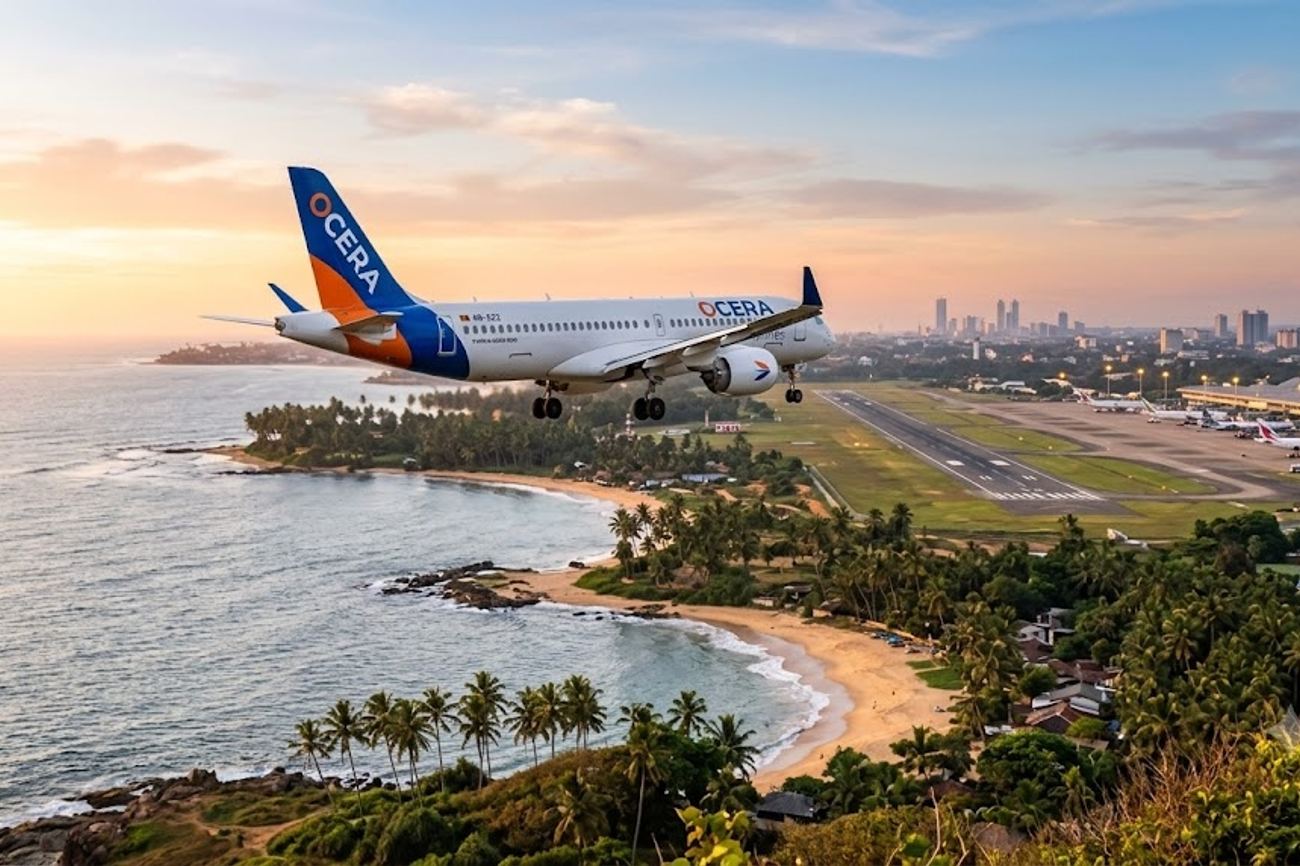
Image generated by AI
1.535 million visitors arrived in Sri Lanka during the first eight months of 2026, providing the economic impetus for a significant shift in the nation's aviation architecture. The Civil Aviation Authority of Sri Lanka (CAASL) has confirmed a strategic project to launch OCERA Airlines, an international expansion of the domestic carrier DP Aviation, aimed at transforming Bandaranaike International Airport into a more aggressive regional hub.
The Transition from Domestic Feed to International Reach
OCERA Airlines is not a startup entering a vacuum; it is the international evolution of DP Aviation, an established operator already integrated into the Civil Aviation Authority of Sri Lanka (CAASL) regulatory framework. Currently, DP Aviation maintains a lean domestic operation utilizing a Cessna 208B Grand Caravan EX (registration 4R-DPA). This 12-passenger aircraft serves a critical "last-mile" tourism function, connecting Ratmalana International Airport to key regional nodes including Jaffna, Sigiriya, Anuradhapura, Koggala, Trincomalee, and Hingurakgoda.
The leap from a single-engine turboprop to a jet-powered international fleet represents a massive scaling of ambition. In September 2026, leadership from DP Aviation and their investment partners met with Captain Daminda Rambukwella, the Director General of Civil Aviation and CEO, to formalize the transition to the OCERA brand. While the CAASL has signaled the strategic importance of this project, the airline currently exists in a pre-operational phase. The transition from a domestic operator to an international carrier requires not only local certification but the procurement of traffic rights and bilateral agreements from every destination country in the proposed network.
Fleet Specifications and Regional Ambitions
The cornerstone of OCERA’s growth strategy is the adoption of the Airbus A220, a narrow-body jet designed specifically for the "thin" routes that are too large for regional turboprops but too small for the Airbus A320 or Boeing 737. The airline has set a target of expanding its fleet to 10 aircraft by 2030.
The selection of the A220 is a calculated move to balance fuel efficiency with range. According to Airbus, the A220 family offers a 25% reduction in fuel burn and CO2 emissions per seat compared to older generation aircraft, making it an economically viable choice for the volatile pricing of regional aviation.
| Airbus A220 Variant | Typical Passenger Capacity | Maximum Published Range |
|---|---|---|
| A220-100 | 100-120 | 3,600 nautical miles |
| A220-300 | 120-160 | 3,450 nautical miles |
By utilizing these aircraft, OCERA intends to link Bandaranaike International Airport (BIA) with markets across India, South Asia, Southeast Asia, and the Middle East. The strategic intent is to create a dual-layer connectivity system: BIA serves as the primary international gateway, while the existing domestic network feeds passengers from the cultural heartlands directly into the international stream.
Expert Analysis: The "Jaffna-India" Geopolitical Pivot
For the seasoned traveler and industry analyst, the most significant detail in the CAASL announcement is not the fleet size, but the specific emphasis on increasing connectivity between Jaffna and India.
Historically, Sri Lankan tourism has been heavily weighted toward the "Southern Circuit"—beaches and the central highlands. By aggressively linking Jaffna to Indian cities, OCERA is attempting to decentralize the tourism economy. Jaffna offers a distinct cultural and religious product that appeals specifically to the Indian diaspora and cultural tourists, providing a diversification of the national tourism portfolio.
For travelers booking these routes, the direct consequence of this expansion will be a reduction in "transit friction." Currently, moving from a northern destination like Jaffna to an international hub often requires arduous road travel to Colombo. If OCERA successfully integrates its domestic Cessna operations with its international A220 fleet, it creates a seamless "hub-and-spoke" model.
However, the pricing pressure this creates is complex. The introduction of 100-160 seat jets on routes previously served by smaller aircraft or limited carriers typically leads to a temporary dip in fares due to increased seat capacity. But because international operations are still pending approval from foreign authorities, there is a high risk of "phantom scheduling"—where routes are announced for strategic signaling but delayed by regulatory bureaucracy. Until the International Air Transport Association (IATA) or local regulators confirm approved slots and timetables, these routes remain theoretical.
Key Takeaways
- Fleet Scaling: OCERA Airlines aims to operate 10 Airbus A220 aircraft by 2030, moving from a 12-seat domestic model to a 100-160 seat international model.
- Strategic Hub: Bandaranaike International Airport will serve as the primary center for flights to the Middle East, Southeast Asia, South Asia, and India.
- Regional Focus: A priority is being placed on the Jaffna-India corridor to diversify tourism away from the southern coast.
- Regulatory Status: While CAASL has approved the project's strategic importance, specific international routes and timetables are not yet finalized or bookable.
- Efficiency Gains: The use of A220s targets a 25% reduction in emissions and fuel burn, lowering the operational overhead for regional expansion.
FAQ: OCERA Airlines Sri Lanka 2026
When can I book flights with OCERA Airlines? Currently, you cannot. While the CAASL has confirmed the project, the airline is still awaiting final regulatory approvals for international operations. No official timetable or ticket sales have been released.
Which aircraft will OCERA Airlines use for international flights? The airline plans to utilize the Airbus A220 family, specifically the A220-100 and A220-300 models, which accommodate between 100 and 160 passengers.
Will OCERA Airlines fly to India? Yes, the proposed network specifically includes India, with a strategic focus on increasing connectivity between Indian destinations and Jaffna in northern Sri Lanka.
Is OCERA Airlines a new company? It is an international expansion of DP Aviation, which already operates domestic flights within Sri Lanka using Cessna 208B aircraft.
A bold bet on the A220 could either unlock the untapped potential of northern Sri Lanka or leave the carrier fighting for slots in a crowded regional sky.
Tags: OCERA Airlines, DP Aviation, Bandaranaike International Airport, Airbus A220, Sri Lanka Tourism 2026, Jaffna-India Route
Related Travel Guides
Disclaimer
This article is for informational and educational purposes only. It does not constitute legal, financial, or professional advice. While we strive to provide accurate and up-to-date information, travel policies, regulations, and conditions change rapidly. Always verify information with official sources before making travel decisions. Nomad Lawyer makes no representations about the accuracy, reliability, completeness, or suitability of the information provided. Readers should consult qualified professionals for advice specific to their circumstances. The views expressed in this article are those of the author and do not necessarily reflect the views of Nomad Lawyer.
Naina Thakur
Contributor & Travel Specialist
Travel enthusiast and legal writer covering visa regulations, responsible tourism, and cultural journeys across global destinations.
Learn more about our team →