
Spain Halts Madrid to Andalusia High-Speed Rail Following Deadly Renfe and Iryo Train Collision Near Toledo
Spain halts Madrid-Andalusia high-speed rail after a collision between Renfe and Iryo trains near Toledo causes casualties and triggers emergency rescues.

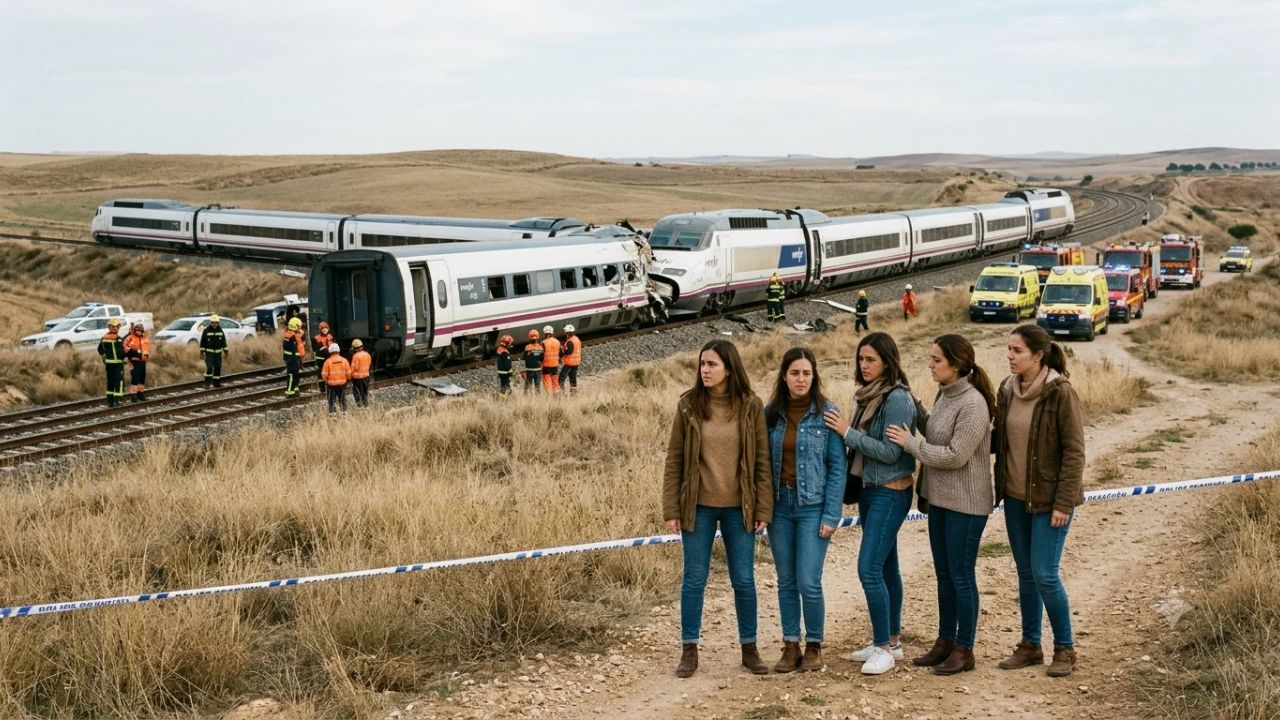
Image generated by AI
Spain's national rail network has suffered a severe disaster after two high-speed passenger trains operated by Renfe and Iryo collided near Urda in Toledo province on Wednesday, 28 October 2026, prompting a complete shutdown of the Madrid–Andalusia high-speed rail corridor and triggering a massive multi-agency rescue effort.
TOLEDO, Spain — The collision occurred along Spain's flagship Madrid–Seville high-speed line between the municipalities of Los Yébenes and Urda in the Castilla-La Mancha region. Two passenger trains travelling in the same direction were involved when one train approached from behind and struck a stationary train ahead of it, derailing at least two carriages and trapping scores of travelers inside heavily damaged coaches.
National rail infrastructure manager Adif immediately suspended all high-speed rail operations between Madrid and southern Spain. The sudden stoppage has stranded thousands of passengers across Madrid-Atocha, Seville-Santa Justa, Córdoba, and Málaga-María Zambrano stations. State rail operator Renfe and private high-speed carrier Iryo have initiated emergency support procedures while judicial authorities and technical rail inspectors launch an urgent investigation into train-control signaling protocols.
          MADRID–ANDALUSIA HIGH-SPEED CORRIDOR COLLISION ARCHITECTURE
          ===========================================================

       [ MADRID ATOCHA ALMUDENA GRANDES ] ──► Northern Terminal Hub
                     │
                     ▼
       [ TOLEDO PROVINCE (URDA / LOS YÉBENES) ] ──► COLLISION SITE (08:54 LOCAL)
       • High-Speed Renfe & Iryo Services on Madrid–Seville Corridor
       • Same-direction rear-end impact; minimum 2 carriages derailed
       • 544 total passengers aboard (397 Renfe / 147 Iryo reported initially)
       • PLATECAM emergency plan activated; 3 helicopters & medical units deployed
                     │
                     ▼ [ COMPLETE CORRIDOR SUSPENSION BY ADIF ]
                     │
       ┌─────────────┴─────────────┬──────────────────────────┐
       ▼                           ▼                          ▼
 [ CIUDAD REAL ]             [ CÓRDOBA ]                [ SEVILLE ]
 Interrupted Services        Transit Disrupted          Corridor Terminus
       │                           │
       ▼                           ▼
 [ PUERTOLLANO ]             [ MÁLAGA & GRANADA ]
 Southern Branch Closed      Costa del Sol Connections Severed
Emergency Rescue Operation Mobilized Across Castilla-La Mancha
Emergency response centers received the initial distress call at approximately 08:54 local time on Wednesday morning. The violent impact took place in rural farmland near Urda, complicating ground vehicular access and requiring rapid deployment of aerial medical evacuation teams.
Castilla-La Mancha regional authorities activated the territorial emergency plan, PLATECAM (Plan Territorial de Emergencias de Castilla-La Mancha), granting incident commanders direct authority to mobilize regional medical, fire, and logistical assets:
- Firefighting & Heavy Extrication Units: Specialized crews from Alcázar de San Juan and Orgaz were among the first first-responders on the scene, utilizing hydraulic cutting tools to access derailed and crushed passenger carriages.
- Aerial Medical Evacuation: Three emergency medical helicopters were dispatched alongside two advanced mobile intensive care response units (UVI Móvil) to stabilize critically injured passengers and airlift them to regional trauma centers in Toledo and Ciudad Real.
- Civic Coordination in Urda: Manuel Galán, Mayor of Urda, confirmed that municipal authorities prepared the town's public sports pavilion to function as an emergency triage center, psychological support station, and reception shelter for uninjured survivors.
- Regional Leadership Deployment: Castilla-La Mancha Regional President Emiliano García-Page travelled directly toward the accident zone to supervise emergency operations alongside senior Civil Protection officials.
Regional government spokeswoman Esther Padilla confirmed that emergency personnel initially verified at least ten deaths at the scene, cautioning that fatality numbers could rise as rescue teams cut through compacted wreckage. Spanish media reports subsequently cited higher potential casualties, including unconfirmed reports of 46 fatalities and 179 injuries. Official investigators stressed that conclusive casualty figures will only be released once the train manifests are fully cross-referenced and search operations conclude.
Collision Dynamics: Renfe and Iryo High-Speed Trains in Same-Direction Impact
The disaster represents a rare and deeply concerning occurrence on a modern European dedicated high-speed railway: a rear-end collision between two commercial passenger trains operating on the same track.
Initial regional reports established that approximately 544 passengers were aboard the two services:
- Renfe Train: Carried 397 passengers according to initial regional accounts.
- Iryo Train: Carried 147 passengers on the Italian-Spanish private consortium service.
- Combined Passenger Manifest: 544 travelers exposed to the incident.
- Impact Consequences: Severe structural deformation of the rear and lead carriages, resulting in at least two coaches leaving the rails and blocking both running tracks.
While certain subsequent reports inverted the passenger counts between the two respective carriers, the verified total remained fixed at 544 passengers. The presence of two competing operators on the same track reflects Spain's high-speed rail liberalization, which introduced private operators like Iryo and Ouigo alongside state-owned Renfe to increase rail options.
Adif Suspends Madrid-Andalusia High-Speed Corridor: Widespread Travel Disruptions
Following confirmation of the collision, railway infrastructure manager Adif halted all traffic on the Madrid–Ciudad Real–Andalusia high-speed artery to secure the track, clear the wreckage, and allow judicial authorities to document the site.
The Madrid–Seville line was Spain's inaugural high-speed corridor, inaugurated for the 1992 Seville Expo. Today, it forms the backbone of passenger transit linking central Spain to the southern autonomous community of Andalusia.
| Travel Corridor Route | Operational Status | Passenger Advisory & Practical Impact |
|---|---|---|
| Madrid–Seville | Completely Suspended | Primary high-speed corridor closed; ticket changes or bus substitutions required |
| Madrid–Ciudad Real | Suspended Near Urda | Regional high-speed services halted south of Toledo; local transit restricted |
| Madrid–Córdoba | Traffic Blocked | Direct high-speed links halted; travelers advised not to proceed to stations |
| Madrid–Málaga | Severe Disruption | Costa del Sol connections severed at Ciudad Real junction; alternative transit advised |
| Madrid–Granada | Indefinitely Delayed | High-speed bypass closed; passengers urged to check Renfe and Iryo portals |
| Madrid–Puertollano | Route Restricted | Commuter and intercity high-speed runs cancelled pending track clearance |
The suspension has paralyzed domestic business travel and international holiday itineraries. Travelers heading to Andalusia's premier cultural hubs—including Seville's historic cathedral district, the Mezquita of Córdoba, and Málaga's coastal resorts—face extended delays or cancellations.
Railway Signalling and LZB Automated Train Control Under Investigation
The central focus of the emerging technical investigation centers on how two high-speed trains could occupy the same physical track block without automatic emergency braking systems intervening to prevent an impact.
High-speed rail safety in Spain relies on layered electronic defense mechanisms:
- LZB (Linienzugbeeinflussung) Train Control: The Madrid–Seville line historically utilizes the German-developed LZB continuous cab-signaling and train-protection system, which continuously calculates safe stopping distances and automatically applies emergency brakes if a train approaches a occupied block.
- ETCS/ERTMS Level 2 Overlays: Modern European train control protocols designed to supersede legacy signaling, providing real-time telemetry between track transponders (balises) and onboard computers.
- Investigation Hypotheses: Investigators from the Comisión de Investigación de Accidentes Ferroviarios (CIAF) are examining whether the first train experienced a sudden mechanical failure or brake-lock, whether trackside signaling loops malfunctioned, or whether manual override procedures were authorized during a localized technical failure.
| Technical Component | Core Safety Function | Investigative Focus Following Toledo Collision |
|---|---|---|
| LZB Signaling System | Enforces continuous speed curves and automatic train separation | Checking whether signal telemetry failed to register the stationary lead train |
| ETCS / ERTMS Protocols | Digital cab signaling and continuous computerized speed supervision | Evaluating track transponder data and onboard event recorder logs |
| Track Block Occupancy | Detects train presence on discrete electrical rail circuits | Investigating possible relay failures or false clear-signal indications |
| Driver Communication | Radio contact between central train dispatchers and train drivers | Reviewing voice recordings to verify whether stop warnings were transmitted |
| Passive Carriage Safety | Crush zones and anti-telescoping couplers on passenger cars | Assessing structural deformation of derailed Renfe and Iryo coaches |
Authorities emphasized that while technical theories regarding signaling anomalies are being actively explored, no definitive conclusion can be drawn until onboard data recorders (black boxes) from both trainsets are extracted and analyzed.
Echoes of the Adamuz Disaster: Heightened Scrutiny on Spanish Rail Safety
The Toledo collision comes at a sensitive time for Spain's railway administration. In January 2026, a catastrophic train collision near Adamuz in Córdoba province claimed approximately 46 lives when a derailing train collided with an oncoming service on the same broad Madrid–Andalusia high-speed corridor.
The Adamuz disaster had already triggered national parliamentary debates regarding infrastructure maintenance schedules, the strain of increased rail traffic following market liberalization, and the pace of signaling modernizations. The fact that the October accident near Urda involved the same two railway operators—Renfe and Iryo—has amplified scrutiny from passenger associations and transport unions.
While both accidents occurred on the southern rail corridor, transport engineers caution against drawing premature parallels. The Adamuz disaster involved opposing-direction traffic following an initial derailment, whereas the Urda incident appears to be a same-direction rear-end impact. Nevertheless, two mass-casualty rail accidents within a single calendar year represent an unprecedented crisis for Spain's high-speed rail network.
Passenger Rights, Ticket Policies, and Practical Guidance for Travelers
In response to the operational shutdown, Spanish rail carriers have enacted emergency ticketing and customer assistance measures:
Renfe Ticketing Policies
State operator Renfe announced that all passengers holding tickets for travel along the Madrid–Andalusia corridor during the disruption can cancel their bookings for a 100% refund or rebook onto alternative dates at zero penalty. Travelers can process changes via the official Renfe smartphone app, website, or customer service desks at major stations.
Iryo Customer Advisory
Private operator Iryo has established an emergency passenger hotline and advised ticket holders to avoid traveling to Madrid-Atocha or southern stations until operational clearances are issued. Full refunds and flexible rescheduling options are being extended to all impacted customers.
Essential Steps for International Travelers
- Do Not Report to Stations Without Confirmation: Station concourses at Madrid-Atocha and Seville-Santa Justa are experiencing heavy congestion. Passengers should verify service status electronically before departing accommodations.
- Explore Alternative Regional Transit: Travelers with urgent departure schedules should examine domestic flights from Madrid-Barajas (MAD) to Seville (SVQ) or Málaga (AGP), or investigate scheduled intercity bus services operated by regional carriers such as ALSA.
- Document Travel Disruption Costs: Retain all original tickets, cancellation notifications, accommodation receipts, and emergency meal expenses to facilitate claims under EU Passenger Rights Regulation (EC 261/2004 framework for rail) or private travel insurance policies.
Why This Matters: The Critical Reliability of Spain's High-Speed Rail Network
Spain operates the second-longest high-speed rail network in the world, surpassed only by China. For more than three decades, the Alta Velocidad Española (AVE) network has served as a global benchmark for engineering precision, safety, and energy efficiency, diverting millions of passenger journeys away from domestic aviation and highways.
The Madrid–Andalusia corridor is the historical cornerstone of this network. The operational collapse following the Toledo collision tests not only the emergency response protocols of regional authorities, but also the structural resilience of Spain's multi-operator rail ecosystem.
With international tourism accounting for over 12% of Spain's gross domestic product, maintaining unquestioned confidence in high-speed rail safety is paramount. The coming weeks will require full transparency from Adif, Renfe, and Iryo as technical investigators uncover the precise sequence of failures that allowed two high-speed trains to collide on one of Europe's most heavily monitored rail corridors.
Frequently Asked Questions: Spain High-Speed Train Collision
What happened in the train accident near Toledo, Spain?
On Wednesday, 28 October 2026, two high-speed passenger trains operated by Renfe and Iryo collided in a rear-end impact near Urda in Toledo province, derailing at least two carriages and prompting a suspension of the Madrid–Andalusia rail line.
How many passengers were aboard the trains involved in the collision?
A total of approximately 544 passengers were traveling aboard the two services, with initial regional accounts reporting 397 passengers aboard the Renfe train and 147 passengers on the Iryo service.
Which rail routes are affected by the corridor shutdown?
Adif has suspended high-speed services across the Madrid–Andalusia corridor, halting direct rail transit between Madrid, Ciudad Real, Puertollano, Córdoba, Seville, Málaga, and Granada.
Can affected passengers get a refund on their train tickets?
Yes. Both Renfe and Iryo have introduced emergency ticket policies allowing impacted passengers to cancel their bookings for a full refund or exchange tickets for future travel dates at no additional fee.
Related Travel Guides
- Belgium Hosts IMCA Global Summit 2026 in Antwerp: Uniting Maritime Leaders on Offshore Safety, Wind Energy, and Subsea Innovation
- JW Marriott Mussoorie Walnut Grove Resort Appoints Rahul Valsakumar as Director of Food and Beverage to Lead Himalayan Luxury Dining
- Princess Cruises 50-Night Mediterranean Odyssey: Ports, Itinerary, and Atlantic Route Details
Disclaimer
This article is for informational and educational purposes only. It does not constitute legal, financial, or professional advice. While we strive to provide accurate and up-to-date information, travel policies, regulations, and conditions change rapidly. Always verify information with official sources before making travel decisions. Nomad Lawyer makes no representations about the accuracy, reliability, completeness, or suitability of the information provided. Readers should consult qualified professionals for advice specific to their circumstances. The views expressed in this article are those of the author and do not necessarily reflect the views of Nomad Lawyer.
Kunal K Choudhary
Co-Founder & Contributor
A passionate traveller and tech enthusiast. Kunal contributes to the vision and growth of Nomad Lawyer, bringing fresh perspectives and driving the community forward.
Learn more about our team →