Southwest Airlines Bag Fees and Rising Fares Squeeze US Holiday Travel Budgets for Thanksgiving and Christmas 2026

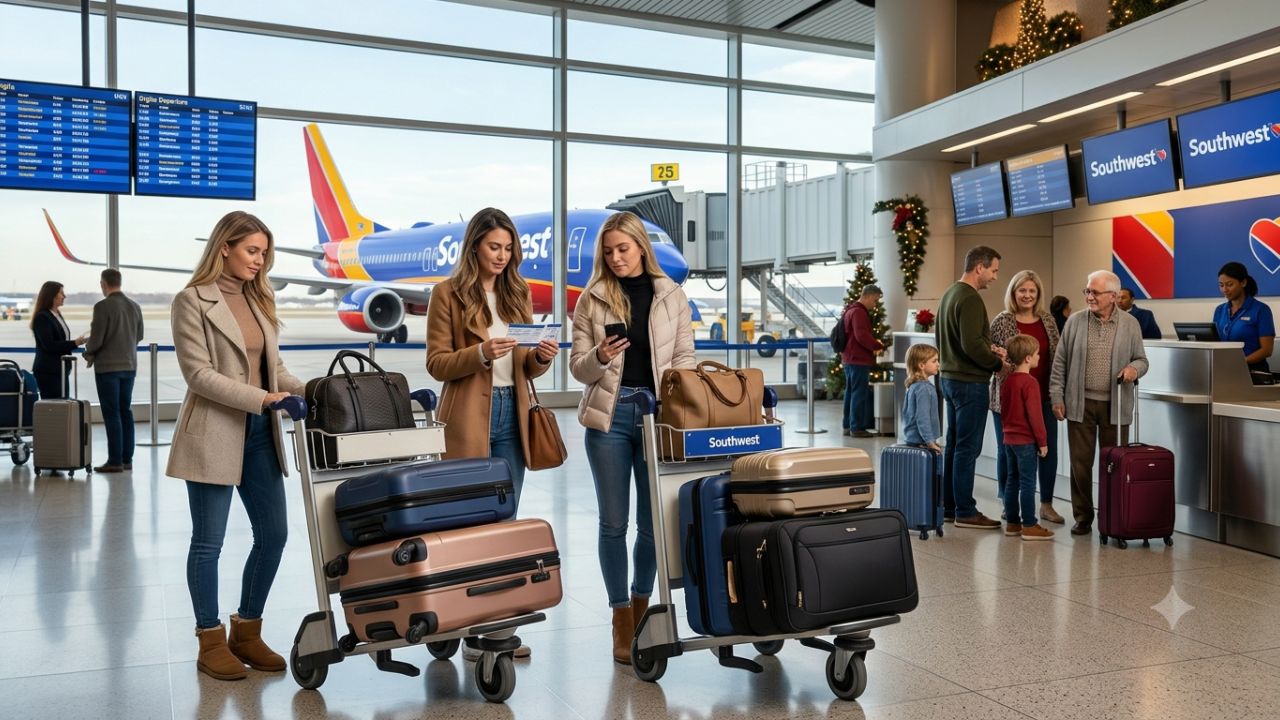
Southwest Airlines introduces checked luggage fees and assigned seating, altering the economic calculus for Thanksgiving and Christmas holiday journeys.
DALLAS, November 3, 2026 — American holiday travelers finalizing flights for Thanksgiving and Christmas 2026 are confronting a historic transformation in domestic air travel economics as Southwest Airlines enforces mainland checked baggage fees of $45 for a first bag and $55 for a second bag. The sweeping restructuring of the carrier's traditional operating model ends decades of universal complimentary luggage, presenting traveling households with return baggage charges ranging from $90 for solo flyers up to $800 for families of four, and forcing consumers to evaluate full door-to-door journey costs rather than headline airfares.
[!NOTE] Southwest Airlines' official mainland fee schedule establishes charges of $45 for a first checked bag and $55 for a second checked bag each way across Basic, Choice, and Choice Preferred fare classes. While the carrier reported record third-quarter 2026 operating revenues of $8.4 billion—up 21.2% year-on-year—and historical peak passenger yields, the unbundling of checked luggage and the debut of assigned seating on January 27, 2026, place immediate pressure on domestic holiday travel budgets.
SOUTHWEST AIRLINES ANCILLARY & FARE ARCHITECTURE
| Metric / Service Tier Traditional Policy Baseline Active 2026 Policy Model |
|---|
| First Checked Bag Free for All Passengers $45 Each Way ($90 Return) |
| Second Checked Bag Free for All Passengers $55 Each Way ($110 Return) |
| Two Checked Bags Return $0 Cumulative Outlay $200 Total Per Passenger |
| Family of 4 (1 Bag/Pax) $0 Surcharge $360 Return Surcharge |
| Family of 4 (2 Bags/Pax) $0 Surcharge $800 Return Surcharge |
| Carry-On Overhead Bag 1 Free Carry-On + 1 Personal 1 Free Carry-On + 1 Pers. |
| Seating Format Open General Boarding Assigned Seating System |
| Seat Categories Single Economy Configuration Standard, Preferred, Leg. |
The End of 'Bags Fly Free': Unpacking Southwest's Mainland Baggage Fee Architecture
For nearly two decades, the Dallas-based carrier positioned its trademark "Bags Fly Free" pledge at the center of its consumer identity, distinguishing itself from legacy network peers by allowing every passenger two complimentary checked bags. That foundational promise has yielded to commercial pressures and shareholder demands for enhanced capital returns. Under Southwest's official optional charges schedule, checked baggage on mainland domestic routes is systematically unbundled across the majority of ticketing classes, establishing standard charges of $45 for a passenger's first checked bag and $55 for a second checked bag each way.
These charges apply directly to passengers booking the carrier's primary commercial fare tiers, including Basic, Choice, and Choice Preferred tickets. When calculated over a standard roundtrip journey, checking a single suitcase generates an incremental cash outlay of $90 per traveler, while checking two standard bags adds $200 per person. The cumulative arithmetic becomes particularly stark for leisure travel groups and multi-generational families journeying across the United States during the peak winter holiday corridors.
For a traveling family of two adults and two children, each checking one standard suitcase to transport winter clothing, holiday gifts, and personal necessities, the return baggage bill totals $360. If that same four-member household checks two bags per person—a routine scenario for extended stays spanning Thanksgiving week through the New Year—the cumulative baggage charges reach an astounding $800. These figures represent direct out-of-pocket expenses calculated using published first- and second-bag charges, assuming standard weights without exemptions, oversized items, or overweight penalty surcharges.
The departure from complimentary baggage represents a profound psychological and operational realignment for domestic leisure flyers. Where consumers once viewed Southwest as an all-inclusive low-cost carrier whose headline ticket price covered the entire travel experience, passengers must now approach every flight reservation as a multi-variable financial calculation. The base airfare listed on an airline booking portal or flight aggregation engine no longer reflects the true capital outlay required to reach a holiday gathering.
Illustrative Mainland Return Journey Baggage Costs
To assist holiday travelers in forecasting their true seasonal travel expenses, published mainland baggage fee schedules can be modeled across standard passenger party sizes. The following calculations illustrate return travel costs based strictly on published standard first- and second-bag rates, without loyalty exemptions, credit card waivers, or excess weight penalties:
| Passenger Configuration | Standard Checked Bags Checked | Calculated Roundtrip Baggage Total |
|---|---|---|
| One Passenger | One bag each way | $90 |
| One Passenger | Two bags each way | $200 |
| Two Passengers | One bag each, each way | $180 |
| Two Passengers | Two bags each, each way | $400 |
| Four Passengers | One bag each, each way | $360 |
| Four Passengers | Two bags each, each way | $800 |
Calculations use published standard mainland charges ($45 first bag each way / $55 second bag each way) with zero oversized or overweight penalties applied.
These figures demonstrate that luggage costs can equal or exceed the base ticket price for secondary travelers on discounted itineraries. In a scenario where an off-peak one-way Basic ticket is priced at $120, checking two bags adds $100 in baggage charges on that single leg alone, nearly doubling the effective cost of passenger conveyance.
Consequently, travel planners and consumer finance analysts emphasize that comparing airline choices on base fare alone produces deceptive budget estimates. For families managing strict holiday financial ceilings, an initial reservation that appears economical can swiftly become the most expensive option once luggage fees are tabulated at checkout.
Record Financial Yields Versus Household Affordability: Inside Southwest's Q3 2026 Performance
The implementation of checked luggage charges coincides with landmark commercial performance for the airline. In its third-quarter 2026 financial earnings announcement released on October 21, Southwest revealed that operating revenues climbed to a record $8.4 billion, representing a robust 21.2 percent expansion compared to the corresponding period in 2025. Concurrently, the carrier recorded the highest passenger yield in its fifty-five-year corporate history, underscoring its capacity to command elevated average fares across its nationwide route network.
Southwest posted net income of $270 million for the quarter alongside an adjusted operating margin of 5.4 percent. These earnings achievements materialized despite significant operating headwinds, including an $821 million nominal increase in total fuel expenses. In executive commentary accompanying the release, airline leadership highlighted that underlying travel demand remained vigorous across both leisure and corporate segments, asserting that commercial restructuring and ancillary revenue initiatives were successfully expanding operating margins in a challenging macroeconomic climate.
However, airline commercial prosperity and consumer household affordability reflect entirely different economic realities. While strong passenger yields demonstrate that commercial flights remain heavily booked, they do not indicate that American families are absorbing ancillary fee increases with ease. Rather, the coexistence of record revenue performance and elevated baggage fees illustrates how leisure carriers are capturing a higher percentage of disposable household income during peak holiday transit cycles.
With consumer price inflation elevating everyday expenses for groceries, utilities, and auto insurance over recent years, household discretionary budgets for seasonal travel face intense pressure. For working- and middle-class travelers, absorbing an unexpected $360 or $800 baggage assessment requires reallocating capital away from gifts, local dining, or holiday activities. The airline's commercial success reflects operational pricing power in high-demand periods rather than an absence of financial strain on traveling consumers.
The True Cost Calculation: Why Headline Base Fares Mask Real Holiday Expenses
The unbundling of checked luggage fundamentally alters comparative shopping across domestic airlines. When evaluating flights between major metropolitan pairs, travelers frequently encounter ticket listings where Southwest displays a lower headline price than competing full-service network carriers like Delta Air Lines, United Airlines, or American Airlines, or hybrid carriers like JetBlue and Alaska Airlines.
To evaluate genuine travel economics, consider a realistic comparative scenario. A traveler researching a Thanksgiving roundtrip flight identifies an itinerary on a discount carrier priced at $320, whereas a legacy competitor quotes $380 for identical dates and route timings—creating the appearance of an immediate $60 saving. However, if the traveler requires a checked suitcase and the discount itinerary incurs $90 in return baggage fees ($45 each way), while the alternative airline's fare includes luggage or charges a lower introductory fee, the initial $60 saving completely vanishes. The traveler ultimately spends $410 on the discount carrier, paying a net premium of $30 for what appeared to be the cheaper ticket.
HYPOTHETICAL AIRFARE & BAGGAGE ARITHMETIC COMPARISON
| Booking Element Unbundled Discount Carrier Included / Lower-Fee Carrier |
|---|
| Headline Base Fare $320 Return Base $380 Return Base |
| Initial Apparent Saving $60 Advantage Baseline Comparison |
| Checked Bag Return Fee +$90 ($45 each way) $0 (Included in Ticket) |
| Net Total Journey Cost $410 Final Outlay $380 Final Outlay |
| True Economic Result $30 Financial Penalty $30 True Customer Savings |
This mathematical dynamic underscores why modern travel procurement requires calculating all anticipated fees prior to ticket purchase. In addition to checked bags, consumers must factor in prospective expenditures for carry-on luggage allowances, seat assignments, in-flight connectivity, and airport ground transportation. Without a holistic accounting of these ancillary components, consumers risk making booking decisions based on incomplete and misleading price signals.
Digital travel aggregators and fare search platforms have progressively introduced filter tools that permit users to input expected luggage counts before viewing search results. Consumer advocacy groups strongly recommend that holiday travelers utilize these comprehensive calculation tools, neutralizing the masking effect of unbundled base airfares.
Navigating Fare Tiers and Loyalty Exemptions: Who Still Flies With Free Luggage?
While standard Basic and Choice fares subject passengers to published baggage charges, Southwest's revised commercial framework preserves specific avenues through which passengers can retain baggage benefits. Understanding these exemptions enables informed travelers to mitigate or eliminate luggage fees through strategic ticket selection, loyalty status, or financial services partnerships.
Within the carrier's branded fare matrix, the premium Choice Extra fare category incorporates two complimentary checked bags into the base purchase price, alongside enhanced ticket flexibility, priority boarding, and elevated Rapid Rewards points earning rates. When pricing a holiday journey, travelers intending to check two bags should calculate the price delta between Choice and Choice Extra. If the fare differential is less than the $200 roundtrip baggage fee, upgrading to Choice Extra provides immediate cost savings alongside superior ticket flexibility.
Beyond ticket classes, elite members of the carrier's frequent-flyer ecosystem receive structural baggage protections:
- A-List and A-List Preferred Members: Qualifying frequent flyers holding active A-List or A-List Preferred status within the Rapid Rewards loyalty program are granted checked bag allowances under specific operational terms, insulating regular business commuters from retail baggage fees.
- Eligible Co-Branded Credit Cardholders: Customers maintaining qualifying Southwest Rapid Rewards credit cards issued through Chase Bank receive specific baggage allowances, such as a first checked bag fee credit or annual travel credits that offset ancillary costs.
- Active-Duty Military Personnel: Military service members traveling on official orders or personal leisure continue to receive dedicated military baggage exemptions in accordance with federal guidelines and carrier policies.
However, financial planners advise that acquiring a premium credit card or purchasing an elevated fare tier simply to bypass baggage charges requires rigorous evaluation. If an upgraded fare tier costs $250 more than a basic ticket, spending that capital to save $90 or $180 in baggage fees represents poor financial optimization. Travelers must confirm their specific reservation requirements, cardholder terms, and loyalty eligibility before assuming benefits apply automatically.
The Assigned Seating Revolution: Retiring the Open-Seating Tradition in 2026
The introduction of checked baggage fees represents only one half of Southwest's commercial transformation. On January 27, 2026, the airline officially implemented assigned seating across its operational fleet, formally retiring the open-seating model that had defined its brand for more than five decades.
For generations, Southwest passengers secured their cabin position through an open-boarding ritual, lining up by numbered posts according to boarding groups A, B, and C. While celebrated by frequent flyers who mastered check-in timing, the open-seating process generated persistent anxiety for occasional holiday travelers, families traveling with small children, and passengers requiring seat certainty. The transition to assigned seating aligns Southwest with conventional global airline standards while creating a major new stream of ancillary revenue.
Under the active cabin architecture, passenger seating is partitioned into three distinct operational classifications:
- Standard Seating: Conventional economy seating located throughout the main aircraft cabin, featuring standard pitch and width.
- Preferred Seating: Strategically situated standard-pitch seats located in the forward sections of the cabin, offering swifter egress upon arrival.
- Extra Legroom Seating: Premium cabin seating offering up to several additional inches of seat pitch, situated in exit rows and forward bulkhead rows to compete directly with legacy carriers' premium economy products.
From an operational engineering perspective, transitioning away from open seating fundamentally alters Southwest's turn-time economics at busy airport gates. Historically, the airline maintained the fastest aircraft turn times in the global aviation sector, frequently refueling, cleaning, and boarding a Boeing 737 within twenty to twenty-five minutes because open boarding incentivized passengers to find seats swiftly without hunting for specific row placards. By adopting assigned seating, airport station managers are adjusting gate boarding sequences, deploying automated zone boarding scanners, and re-training ramp crews to prevent passenger aisle bottlenecks as holidaymakers stow winter coats and carry-on luggage.
For holiday travel parties, the interaction between assigned seating and fare classes introduces an additional layer of planning. Passengers purchasing Basic fares do not receive advance seat selection; instead, their seats are automatically assigned at check-in based on remaining cabin availability. For families traveling with children, this arrangement creates the risk of being seated apart unless they pay supplemental seat selection fees or rely on federal family seating protections. Travelers who prioritize sitting together must assess advance seat reservation charges alongside baggage fees when determining their total itinerary budget.
Destination-Level Economic Fallout: How Ancillary Fees Squeeze Local Tourism Spending
The broader macroeconomic implications of airline ancillary fees extend far beyond airport ticket counters. In holiday travel ecosystems, household travel budgets operate under finite limits. When transportation providers capture an expanded portion of total travel capital through mandatory ancillary fees, downstream destination businesses face a direct reallocation of consumer spending.
Consider the economic dynamics in major domestic leisure hubs such as Orlando, Las Vegas, Phoenix, Denver, and San Diego during Thanksgiving and Christmas. When a family of four absorbs an unanticipated $360 to $800 in return airline baggage fees, that expenditure directly diminishes the disposable capital available for destination commerce. Households naturally compensate by reducing spending on upscale restaurant dining, shortening lengths of stay, declining guided excursions, or curtailing purchases at retail shops and cultural venues.
DESTINATION REVENUE REALLOCATION DYNAMICS
| Column 1 |
|---|
| Fixed Holiday Household Budget: $3,500 |
| Traditional Ancillary Scenario: |
| - Airfare (4 Pax): $1,400 |
| - Baggage Fees: $0 (Complimentary) |
| - Remaining Destination Budget: $2,100 (Lodging, Dining, Attractions, Retail) |
| Active 2026 Ancillary Scenario: |
| - Airfare (4 Pax): $1,400 |
| - Baggage Fees (2 Bags/Pax Return): $800 |
| - Seat Assignment Fees (4 Pax Return): $160 |
| - Remaining Destination Budget: $1,140 (Significant -45.7% Compression in Spending) |
While macroeconomic data published through the third quarter of 2026 does not demonstrate an aggregate collapse in regional hospitality revenues or hotel employment, tourism associations are monitoring spending patterns closely. Destination marketing organizations and resort operators are responding by introducing bundled packages that emphasize inclusive value—such as waived resort fees, complimentary airport transfers, or free breakfast programs—designed to entice budget-conscious families whose travel funds have been strained by transportation surcharges.
Hotels, car rental agencies, and activity providers can optimize their market competitiveness by providing absolute pricing clarity. Transparent pricing structures that eliminate hidden resort charges enable holiday travelers to budget confidently without having to repeatedly revise their holiday spending models.
Consumer Rights and Federal Protections: US DOT Regulations on Delayed and Lost Luggage
As baggage fees become a mandatory component of travel spending, consumer rights and regulatory accountability gain heightened importance. When passengers pay substantial fees for luggage conveyance, they expect reliable and punctual baggage delivery. Federal regulations enforce clear statutory protections to compensate travelers when airlines fail to deliver luggage as promised.
Under regulations enforced by the United States Department of Transportation (DOT), commercial airlines operating domestic flights are legally mandated to issue a full refund of baggage fees if a passenger's checked bag is lost or significantly delayed. For domestic itineraries, federal guidelines establish the significant-delay threshold at 12 hours following flight arrival at the gate, subject to narrow exceptions. If an airline fails to return a checked suitcase to the passenger within 12 hours of touchdown, the fee paid for transporting that bag must be promptly refunded to the original form of payment.
To successfully claim a fee refund and protect rights to baggage delay compensation, passengers must follow strict operational procedures:
- Immediate Property Irregularity Reporting: If luggage fails to appear on the carousel, passengers must file a Mishandled Baggage Report at the airline's airport baggage service office before exiting the arrivals terminal. Obtaining a physical or digital copy of the report with a unique tracking file number is essential.
- Documenting Incidental Out-of-Pocket Expenses: Under federal rules, passengers whose baggage is delayed are entitled to reimbursement for reasonable, verifiable incidental expenses—such as necessary toiletries, pharmaceuticals, and essential clothing changes—incurred while awaiting their bags. Travelers must preserve itemized receipts for every expenditure.
- Understanding Federal Liability Ceilings: For domestic flights within the United States, the federal maximum liability limit for lost, damaged, or delayed baggage is established at $3,800 per passenger. Airlines cannot arbitrarily cap compensation below this statutory ceiling, though claims must reflect documented actual damages.
Familiarity with these consumer safeguards ensures that travelers do not absorb the financial burden of airline operational failures. In peak holiday travel windows characterized by winter weather disruptions and congested baggage handling hubs, asserting federal rights provides valuable recourse.
Future Strategic Horizons: Airport Lounges, Fleet-Wide Starlink, and Capital Markets Day 2027
Southwest's pivot to baggage fees and assigned seating forms part of an expansive, multi-year strategic modernization program designed to elevate passenger experience and strengthen competitive positioning against legacy network carriers.
In its October 2026 strategic updates, executive management detailed significant capital investments aimed at modernizing the passenger journey across multiple touchpoints:
- Debut of Airport Lounges in 2027: The carrier announced plans to inaugurate its first dedicated airport lounges in selected hub terminals during 2027. These premium spaces will provide business and premium leisure travelers with quiet workstations, upscale food and beverage selections, and dedicated customer service amenities, marking a dramatic departure from the airline's historic no-frills ground operations.
- Fleet-Wide Starlink Connectivity: The airline is accelerating the fleet-wide installation of SpaceX's high-speed Starlink satellite Wi-Fi system across its Boeing 737-700, 737-800, and 737 MAX aircraft. The high-bandwidth, low-latency connectivity is scheduled to achieve complete fleet-wide deployment by autumn 2027, offering gate-to-gate streaming capabilities for all passengers.
- Capital Markets Day on March 2, 2027: The company has scheduled a major Capital Markets Day for March 2, 2027, where executive leadership will present long-term financial targets, fleet modernization schedules, network optimization plans, and refined ancillary revenue roadmaps to the institutional investment community.
While these prospective initiatives indicate an airline investing heavily in modern infrastructure and customer amenities, they offer no promise of returning to universal complimentary baggage or reducing headline fares. Instead, they signal that Southwest is consolidating its transition toward a fully segmented, full-service hybrid airline model where premium amenities are monetized systematically.
Frequently Asked Questions: Navigating Southwest Baggage Fees and Seating Policies
How much should a traveler budget for one checked suitcase on a mainland return flight?
For a mainland roundtrip itinerary booked under standard Basic, Choice, or Choice Preferred fares, passengers should budget exactly $90 for a single checked bag ($45 each way). If a second suitcase is checked, the roundtrip fee increases by $110 ($55 each way), bringing the total return baggage cost to $200 per traveler, assuming standard weight limits are respected.
Can passengers still bring cabin luggage aboard free of charge?
Yes. Southwest's revised baggage policy maintains the standard cabin allowance permitting each passenger to carry aboard one standard carry-on bag for overhead bin storage and one small personal item (such as a backpack, laptop bag, or purse) that fits beneath the seat in front of them, free of charge. Carry-on items must comply with published dimensional guidelines.
Does upgrading to a higher fare tier eliminate baggage fees?
Purchasing a Choice Extra fare includes two complimentary checked bags as part of the ticket package, alongside priority boarding and ticket flexibility. Travelers planning to check two bags should compare the fare differential between Choice and Choice Extra; if the price difference is less than $200 roundtrip, upgrading to Choice Extra provides overall financial savings.
What are a passenger's rights if a paid checked bag is significantly delayed?
Under US Department of Transportation regulations, if a checked bag on a domestic flight is delayed by 12 hours or more following gate arrival, the airline must issue a full refund of the baggage fee paid. Passengers must file an official Mishandled Baggage Report at the airport and retain all receipts for essential interim clothing and toiletries to claim incidental expense reimbursement up to the federal $3,800 liability limit.
How does the assigned seating policy affect families traveling with children?
Under assigned seating policies active since January 27, 2026, passengers on Basic fares receive seat assignments automatically at check-in. Families wishing to ensure adjacent seats should select flights offering adjacent open inventory early, consider purchasing seat assignments in advance, or review federal family seating guidance that encourages carriers to seat minor children alongside an accompanying adult without additional charges.
Why This Matters: The Practical Traveler's Blueprint for Holiday 2026 Flight Bookings
The unbundling of baggage and implementation of assigned seating represents the most profound operational turning point in Southwest Airlines' modern history. For the individual traveler, this shift alters the basic mechanics of trip planning:
- For the holiday traveler, the era of booking Southwest by default under the assumption of all-inclusive pricing is over. Every itinerary must be evaluated by calculating total door-to-door expenditures—combining base airfare, checked baggage surcharges, seat selection costs, and ground transit—before committing financial resources.
- From an airline economics standpoint, Southwest's record Q3 2026 revenue of $8.4 billion and historic passenger yields demonstrate that unbundling generates substantial capital inflows, even amidst steep fuel inflation. The commercial model pioneered by ultra-low-cost carriers has now been adopted by America's largest domestic carrier, setting a new baseline for the entire US aviation industry.
- From a logistical perspective, traveling light delivers unprecedented financial dividends. A four-member family that masters carry-on packing strategies and fits their holiday clothing into compliant overhead bags saves an immediate $360 to $800 in return travel expenses, preserving vital capital for the holiday celebrations that await them at their destination.
By approaching holiday flight reservations with meticulous arithmetic, asserting federal consumer refund rights when luggage is mishandled, and confirming loyalty and credit card exemptions in advance, consumers can navigate the 2026 holiday travel landscape with confidence, financial control, and peace of mind.
Related Travel Guides
This article is for informational purposes. Flight routes, passenger regulations, visa rules, and transit advisories are subject to change by airlines and aviation authorities. Readers are advised to verify schedules and travel documentation with relevant carriers and border agencies before departure.
Related Stories
US Airlines Overhaul Overseas Routes: Nonstop Flights to Regional Europe and Asia Expand for 2027
Sri Lanka and Türkiye Sign Landmark Aviation Protocol to Overhaul Bilateral Air Services Agreement and Drive Tourism Connectivity