
Southeast Asia's Tourism Boom Threatens Historic Landmarks Ahead of 201M Arrivals Target
As ASEAN targets 201M visitors by 2030, rapid urban expansion threatens historic shophouses, rail stations, and colonial sites across Southeast Asia.

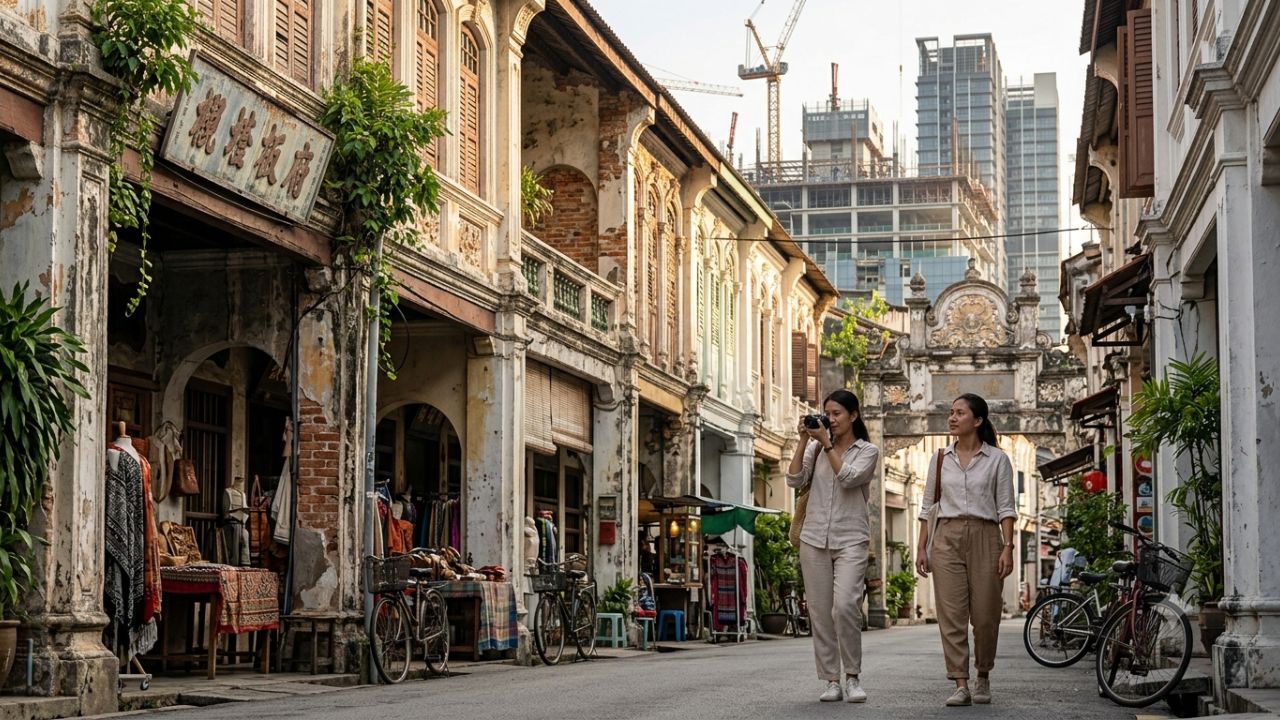
Image generated by AI
As ASEAN projects international arrivals to reach 201 million by 2030, rapid commercial development and infrastructure expansion are accelerating the demolition of historic shophouses, railway stations, and colonial landmarks across Southeast Asian capitals.
BANGKOK, Thailand — Urban centers across Southeast Asia are facing an escalating conflict between commercial modernization and heritage preservation as international travel demand rebounds. According to ASEAN tourism metrics, the region welcomed 127.1 million international visitors in 2024, generating US$150 billion in export revenues and supporting 42 million jobs (accounting for 9.7% of regional GDP). However, with regional arrivals recovering to 92% of pre-crisis levels by June 2025 and targeted to hit 201 million by 2030, finite architectural heritage is coming under unprecedented pressure.
The threat extends beyond world-famous monuments to include the everyday built environment—historic shophouses, century-old markets, civic buildings, and traditional residential neighborhoods—that form the visual identity of destinations like Manila, Singapore, George Town, Yangon, and Ho Chi Minh City. As land values escalate, municipal authorities face difficult policy decisions balancing infrastructure expansion with the preservation of cultural streetscapes.
Rapid Urbanisation vs. Cultural Preservation Across ASEAN Cities
The commercial pressure on Southeast Asian heritage reflects high land values outstripping conservation incentives. Property developers frequently achieve significantly higher financial returns replacing low-rise historic structures with high-density commercial towers or hotel blocks.
According to UNESCO, approximately one in three World Heritage sites is urban, while more than half of all State of Conservation reports evaluated by the organization relate directly to urban areas. UNESCO’s Historic Urban Landscape approach emphasizes that heritage encompasses not merely individual isolated monuments, but the broader spatial relationship between buildings, streets, public spaces, and living local communities.
When traditional streetscapes vanish, cities risk losing the distinct architectural character that differentiates them in international travel markets. Domestic tourism earnings across ASEAN reached US$132 billion in 2024, proving that local cultural identity represents a major economic asset for regional economies.
Matrix of Tourism Development Pressures and Heritage Consequences
The table below outlines how specific urban development pressures impact historic architecture and alter visitor experiences across Southeast Asian destinations:
| Tourism & Urban Pressure | Heritage Consequence | Traveller Impact |
|---|---|---|
| New hotels and towers | Historic skyline disrupted | Reduced sense of place and local character |
| Road expansion | Older buildings removed | Traditional streetscapes fragmented |
| Rising land values | Low-rise structures become vulnerable | Authentic historic neighbourhoods shrink |
| Commercial redevelopment | Local businesses displaced | Cultural experiences become less distinctive |
| Visitor growth | Wear on historic districts increases | Conservation and maintenance become more expensive |
Manila's Sta. Mesa Demolition Illustrates the Loss of Civic Memory
The Philippines provides a clear example of the tension between infrastructure growth and heritage protection. In June 2025, Manila’s 106-year-old Sta. Mesa Fire Station—built in 1919 and representing an important milestone in pre-war civic architecture—was demolished to make way for a road-widening project linked to elevated expressway infrastructure.
The removal of the Sta. Mesa structure highlights how transportation projects can permanently erase physical records of a city's evolution. A similar dynamic affects historic commercial corridors like Escolta, where early twentieth-century structures face ongoing redevelopment risks despite their architectural significance.
For travelers, a destination's appeal rarely depends solely on grand cathedrals or royal palaces. Vernacular structures, old fire stations, and neighbourhood markets provide the authentic urban texture that makes exploring historic districts memorable.
Singapore's Evolving Conservation Model and Monument Designations
Singapore offers a contrasting case study in urban management. Having demolished extensive numbers of historic buildings during early post-independence urban renewal, the city-state subsequently established comprehensive conservation frameworks covering historic districts like Chinatown and Little India.
Despite robust planning controls, heritage choices remain active. In 2025, Singapore designated the historic site of 38 Oxley Road as its 77th National Monument following an extensive evaluation of its national significance.
Simultaneously, healthcare infrastructure expansion required difficult trade-offs. In 2025, eight of nine remaining century-old pavilion wards at Tan Tock Seng Hospital were scheduled for demolition, with one ward preserved as a heritage marker. This adaptive approach demonstrates how cities can balance essential public infrastructure with targeted heritage retention.
George Town and Vigan Demonstrate Heritage as an Economic Resource
Malaysia and the Philippines provide strong evidence that architectural conservation can drive economic growth. UNESCO inscribed George Town and Melaka as World Heritage sites in 2008 after George Town pivoted from its former free-port economy (which ended in 1969) toward heritage-led regeneration.
Supported by multi-stakeholder management frameworks involving local communities and conservation groups, George Town’s restored shophouses now host boutique hotels, cafes, artisan workshops, and galleries. Tourism Malaysia reported 42.2 million international visitors in 2025, up from 38 million in 2024, demonstrating that preserved historic fabric attracts sustained travel volume.
Similarly, the Historic City of Vigan in the Philippines preserved its Spanish colonial grid plan and unique fusion of European, Chinese, and Filipino architecture. By establishing a local conservation council and linking building restoration to local livelihoods, Vigan transformed its historic core into a major economic engine for the region.
Lessons from Yangon Controversies and Vietnam's Urban Growth
In contrast, Yangon in Myanmar illustrates the vulnerabilities of fragile heritage frameworks. Despite housing one of Asia's dense concentrations of late nineteenth- and early twentieth-century colonial architecture, the city experienced controversy when the former Mayor’s Residence was removed from the Yangon City Heritage List and subsequently demolished.
The Yangon case demonstrates that heritage inventories require enforceable legal protections and funding mechanisms to remain effective. Furthermore, preserving only an exterior façade while gutting historic interiors often strips buildings of authentic spatial character.
In Vietnam, rapid urbanization across Ho Chi Minh City and Ha Noi has put historic French-era villas and traditional shophouses under pressure. UNESCO noted similar rapid growth in Yogyakarta, Indonesia, where the urban population share rose from 15 per cent in 1950 to over 50 per cent by 2020 alongside a 4.1 per cent annual urban growth rate.
Adaptive Reuse and Policy Tools for Sustainable Urban Heritage
To resolve the conflict between development and conservation, Asian Development Bank (ADB) research recommends adaptive reuse as a primary mechanism for urban revitalization across Ha Noi, Jakarta, and Manila. Converting old railway stations into cultural centers or former warehouses into commercial venues allows historic structures to generate private revenue while retaining embodied history.
The table below details effective policy tools used by municipal authorities to integrate heritage preservation into urban planning:
| Policy Tool | What It Achieves | Tourism Benefit |
|---|---|---|
| Heritage impact assessment | Measures development effects early | Protects destination character and scale |
| Adaptive-reuse incentives | Makes restoration commercially viable | Creates distinctive visitor venues & hotels |
| Conservation grants | Reduces restoration costs for owners | Supports local heritage businesses & trades |
| Height controls | Protects historic skylines & sightlines | Preserves visual identity and neighbourhood feel |
| Heritage mapping | Identifies vulnerable buildings early | Improves visitor planning & walking routes |
| Community participation | Gives residents an active planning role | Keeps tourism locally rooted & authentic |
Why This Matters for Cultural Travelers and Destination Identity
For the international traveler, the loss of historic streetscapes alters the fundamental experience of visiting Southeast Asia. When historic quarters are replaced by standardized glass towers and global retail chains, cities lose the architectural diversity that makes them unique.
From an economic perspective, preserving living communities alongside architecture prevents heritage districts from becoming sterile, artificial tourist enclaves. Community-based tourism programs supported by UNESCO in Malaysia, Indonesia, and the Philippines emphasize that traditional craftspeople, local markets, and resident families keep historic areas authentic.
As ASEAN approaches its target of 201 million annual arrivals by 2030, destinations that successfully implement adaptive reuse and height controls will retain a distinct competitive advantage over cities that allow indiscriminate redevelopment.
Traveler Action Guide: Supporting Heritage Conservation in Southeast Asia
Travelers visiting historic Southeast Asian cities can support heritage preservation through these conscious choices:
- Stay in Adaptive-Reuse Properties: Choose boutique hotels housed in restored shophouses, colonial villas, or repurposed heritage structures.
- Patronize Local Neighborhood Businesses: Spend dining and shopping funds at traditional markets, family-run eateries, and local craft workshops.
- Explore Heritage Walking Routes: Utilize municipal heritage maps to visit secondary historic districts beyond major monuments, spreading tourism spending across local communities.
- Respect Structural Integrity: Avoid entering fragile or restricted historic buildings without permission, supporting responsible heritage tours.
FAQ
Why are historic buildings in Southeast Asia facing demolition?
Rapid urbanization, rising land values, infrastructure expansion (such as road widening), and high commercial returns from high-rise redevelopment put historic shophouses, civic buildings, and villas under severe pressure.
How many international tourists visit Southeast Asia?
ASEAN recorded 127.1 million international visitors in 2024 (generating US$150 billion in export revenues) and projects international arrivals to reach 201 million by 2030.
What is adaptive reuse in heritage tourism?
Adaptive reuse involves updating an older building for a modern commercial or public purpose—such as converting a warehouse into a hotel or a railway station into a museum—while preserving its historic architectural character.
Which Southeast Asian cities serve as successful models for heritage conservation?
George Town in Malaysia and Vigan in the Philippines serve as primary models where UNESCO World Heritage status and community-led conservation guidelines transformed historic architecture into sustainable economic assets.
Related Travel Guides
Disclaimer
This article is for informational and educational purposes only. It does not constitute legal, financial, or professional advice. While we strive to provide accurate and up-to-date information, travel policies, regulations, and conditions change rapidly. Always verify information with official sources before making travel decisions. Nomad Lawyer makes no representations about the accuracy, reliability, completeness, or suitability of the information provided. Readers should consult qualified professionals for advice specific to their circumstances. The views expressed in this article are those of the author and do not necessarily reflect the views of Nomad Lawyer.
Raushan Kumar
Founder & Lead Developer
Full-stack developer with 11+ years of experience and a passionate traveller. Raushan built Nomad Lawyer from the ground up with a vision to create the best travel and law experience on the web.
Learn more about our team →