
Banana Milk and Culinary Tourism Drive South Korea Visitor Experience
Analysis of South Korea's food tourism surge, featuring Incheon Airport sales data for banana milk and global kimchi export statistics.

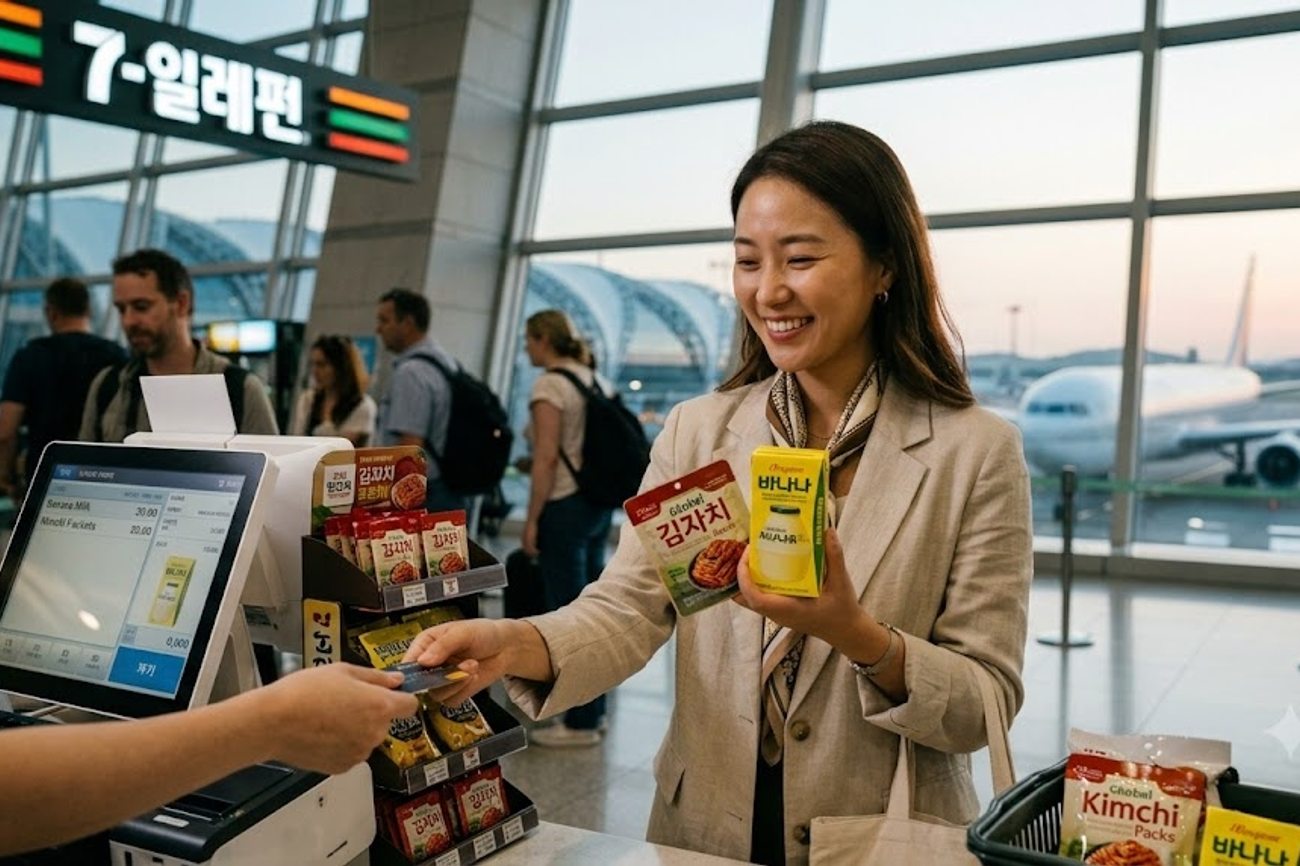
Image generated by AI
Culinary exploration is now the leading motivator for travel to South Korea. According to a 2025 international visitor survey by the Korean government, 61.7% of prospective visitors cited culinary tourism as their primary interest, surpassing shopping at 57.3%.
The trend is most visible at the point of entry. Banana milk has transitioned from a local staple to a viral "arrival ritual" for global tourists. At Incheon International Airport, the impact on convenience store logistics is measurable.
The Incheon Airport Effect
Data from CU stores located near arrival halls from January through August 17, 2026, ranks Binggrae banana-flavored milk as the second best-selling product. In departure-area CU stores, it holds the number one spot. Overall, airport-wide CU sales surged 43.1% year-on-year.
GS25 reports similar volume. One of its four airport locations sells roughly 1,200 bottles daily. To meet this demand, the retailer has increased inventory more than fivefold and implemented a dedicated central display.
A specific consumer trend has emerged via social media: the "Banana Milk Latte." Travelers combine banana milk, an Americano, and ice—a preparation now highlighted by the Korea Tourism Organization.
Key Food Tourism Indicators
Our analysis of the 2025 survey of 11,000 consumers across 22 international cities reveals a high conversion rate from cultural interest to consumption:
- Global Familiarity: 68.6% of respondents are familiar with Korean food.
- Satisfaction Rate: 94.2% of those who tried Korean food reported satisfaction.
- Retention: 80.6% intend to eat Korean food again.
- Cultural Catalyst: 65.1% of respondents developed an interest in the cuisine after consuming K-dramas, K-pop, or films.
- Accessibility: 71.7% have visited Korean restaurants in their home countries.
The Global Reach of Kimchi
While Korean-style fried chicken ranks as the top favorite dish internationally, kimchi remains a cornerstone of the experience, holding a 9.5% preference rate in recent rankings.
Export data confirms a growing global footprint. In 2024, kimchi exports hit a record USD 163.6 million, a 5.2% increase from USD 155.6 million in 2023.
2024 Export Distribution:
- USA: USD 48 million (up 20%)
- Japan: USD 54 million (down 12.1%)
- Netherlands: USD 9.6 million (up 29.9%)
South Korea Food Tourism at a Glance
| Indicator | Official Figure | Impact for Travelers |
|---|---|---|
| Culinary Tourism Interest | 61.7% | Primary travel motivation |
| Shopping Interest | 57.3% | Ranks below food |
| International Sample | 11,000 people / 22 cities | Broad global appeal |
| Food Satisfaction | 94.2% | High quality consistency |
| K-Culture Influence | 65.1% | Media drives dining choices |
| 2024 Industry Businesses | 504,657 | Vast domestic ecosystem |
| 2023 Industry Sales | KRW 152.9848 trillion | Massive economic scale |
| 2024 Food Exports | USD 9.98 billion | Expanding global demand |
Kimchi Export Trend (2020–2024)
| Year | Export Value |
|---|---|
| 2020 | Strong growth (no comparable figure) |
| 2021 | USD 159.9 million |
| 2022 | Continued international demand |
| 2023 | USD 155.6 million |
| 2024 | USD 163.6 million |
Why This Matters
From a logistical perspective, the "Banana Milk" phenomenon demonstrates how low-cost, convenience-store items can become high-value tourist touchpoints. For the aviation and retail sectors at Incheon Airport, this shift requires a move away from traditional duty-free luxury toward "experience-based" convenience retail.
The data suggests that South Korea has successfully leveraged "soft power" (K-pop/K-drama) to create a tangible economic pipeline into the food and beverage sector. For travelers, the shift is away from curated fine dining and toward "everyday culture"—meaning convenience stores and street markets are now primary destinations, not just stops between sights.
Industry Outlook
Expect further integration between digital content and physical food retail. As 65.1% of tourists are driven by media, we anticipate more "set-inspired" menus and curated food trails. The record-breaking export figures for kimchi and the surge in airport retail sales indicate that the "K-Food" brand is moving from a niche trend to a permanent global dietary staple.
Internal Link Suggestions:
- Guide to Incheon International Airport Transit Services
- Top K-Culture Destinations in Seoul
- South Korea Visa Requirements for 2026
Related Travel Guides
Disclaimer
This article is for informational and educational purposes only. It does not constitute legal, financial, or professional advice. While we strive to provide accurate and up-to-date information, travel policies, regulations, and conditions change rapidly. Always verify information with official sources before making travel decisions. Nomad Lawyer makes no representations about the accuracy, reliability, completeness, or suitability of the information provided. Readers should consult qualified professionals for advice specific to their circumstances. The views expressed in this article are those of the author and do not necessarily reflect the views of Nomad Lawyer.
Kunal K Choudhary
Co-Founder & Contributor
A passionate traveller and tech enthusiast. Kunal contributes to the vision and growth of Nomad Lawyer, bringing fresh perspectives and driving the community forward.
Learn more about our team →