
South Dakota's Literary Travel Guide: Pierre to Deadwood 2026
From De Smet's Ingalls Homestead to Deadwood's Wild West archives and Hot Springs' Mammoth Site, South Dakota's seven literary cities are redefining cultural slow travel for 2026.

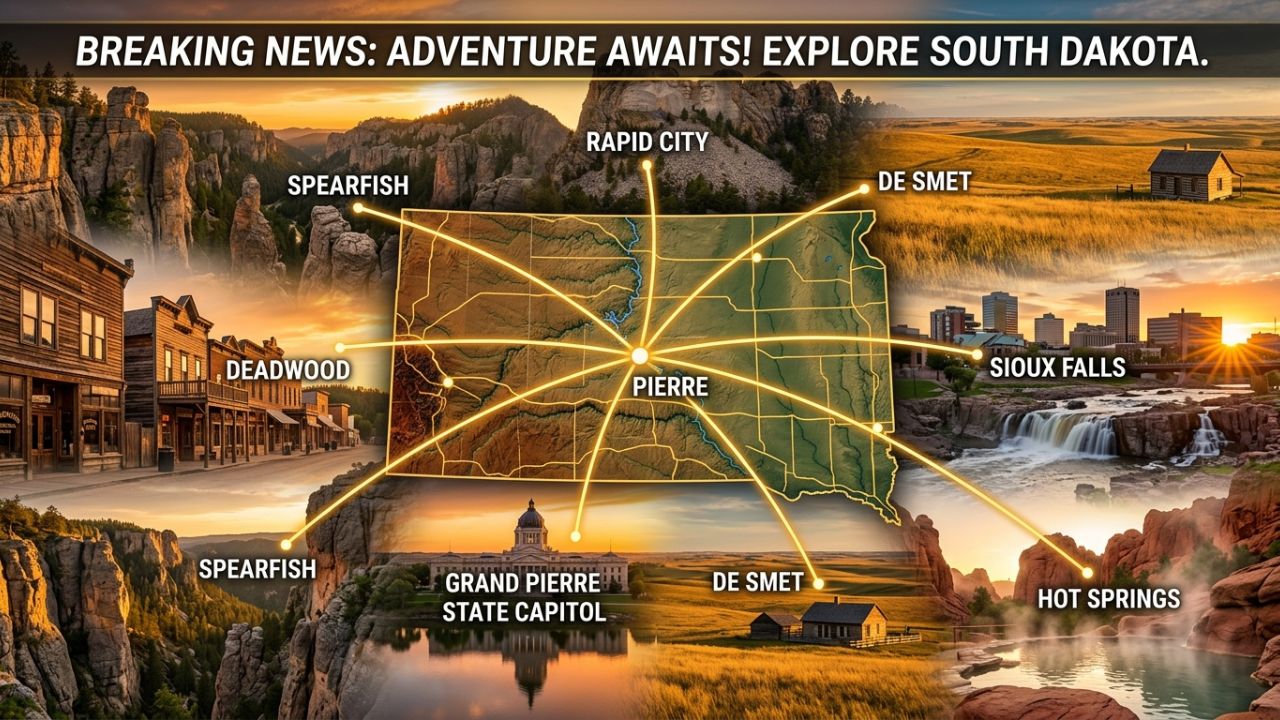
Image generated by AI
South Dakota is no longer merely a flyover state crowned by a carved granite mountain. A measurable and growing wave of literary tourism is transforming Pierre, Deadwood, De Smet, Rapid City, Sioux Falls, Spearfish, and Hot Springs into a unified cultural corridor — the definitive bibliophile's travel odyssey through the heart of the American West.
The Great Plains Literary Revolution: Why It Is Happening Now
A global pivot toward Slow Travel and what cultural researchers are calling "Literary Terroir" — the idea that a region's landscape, climate, and history impart a distinct character to its stories — is driving extraordinary interest in South Dakota's archives and heritage sites. Travelers are no longer content with surface-level sightseeing. They want to stand in the rooms where history was made, touch the records that verified frontier legends, and walk the same soil that produced the stories that shaped their reading lives.
This demand has found fertile ground in the Mount Rushmore State. Over the past decade, a dedicated cohort of librarians, historians, and archivists — operating across Pierre, Sioux Falls, and Rapid City — have digitised millions of primary source records, democratising access to the West's most intimate histories. Whether a researcher sits in London or Tokyo, the South Dakota narrative is now a borderless intellectual resource. The result is a virtuous cycle: digital discovery creates what archivists call "narrative hunger" — and narrative hunger brings visitors to the physical sites.
The Seven Literary Cities of South Dakota
De Smet — The Sacred Geography of the Little Town on the Prairie
No destination in the American West captures the Victorian frontier ideal with the documentary weight of De Smet. Known globally as Laura Ingalls Wilder's Little Town on the Prairie, its significance extends far beyond sentiment. Federal land records held in the National Archives serve as an unbreakable evidentiary foundation for the Ingalls family's struggle, elevating Wilder's series from children's literature to a primary subject of genealogical and sociological study.
Visitors who walk the Ingalls Homestead and enter the Surveyor's House are not merely touring a historic site — they are crossing the threshold between Wilder's prose and the measurable hardship of pioneer life. The Long Winter of 1880–1881, meticulously preserved in Kingsbury County's historical records, remains the most famous example of weather-driven narrative in American literature. The relentless blizzards that locked settlers into months of claustrophobic isolation produced a literary aesthetic defined by minimalist prose and domestic resilience — a terroir as distinctive as any Burgundy vineyard.
Rapid City — Curating the Black Hills Narrative
As the gateway to the Black Hills, Rapid City has reinvented itself as the primary repository for the turbulent, multi-voiced histories of the American West. The Rapid City Public Library Digital Archives houses digitised oral histories and indigenous records that give a democratic stage to voices long marginalised by frontier mythology. The Rapid City Historic Preservation Commission has woven these archival threads into immersive downtown walking tours, where presidential statues stand alongside Lakota elder stories — a fusion of public record and public art that makes the city a living museum of the human condition.
Pierre — The State's Intellectual Pulse
Pierre, South Dakota's understated capital, contains the central nervous system of the state's literary infrastructure. The South Dakota State Library spearheads initiatives including America's 250th Reading Adventure, while the South Dakota State Historical Society — housed within the architecturally striking Cultural Heritage Center — preserves the original manuscripts of the region's most influential writers. Together, these institutions operate the South Dakota History Hub, a digital portal bridging the 19th and 21st centuries and ensuring that the state's manuscript collections are searchable by anyone with an internet connection.
Sioux Falls — Contemporary Engagement in the Urban Heart
Sioux Falls, the state's largest city, operates as the vibrant urban hub of South Dakota's literary ecosystem. The Siouxland Libraries have become national pioneers in the digitisation of Native American texts and early settler artwork, feeding the Digital Library of South Dakota — a collaborative resource that novelists, historians, and content creators worldwide rely upon for primary source authenticity. Literary festivals and independent publishing events in Sioux Falls inject consistent economic energy into the creative sector, blending global visitors with local intellectual culture in a cosmopolitan setting that contrasts sharply — and productively — with the open prairie beyond.
Deadwood — Gold, Grit, and the Archive of the Wild West
Deadwood requires no mythologising. A designated National Historic Landmark, it is one of the rare places on earth where every cobblestone street and preserved saloon functions as a primary source document. The City of Deadwood Archives houses over 10,000 municipal and court records — from mining claim disputes to coroner's reports — providing the granular, verifiable detail that transforms historical fiction from conjecture into literature. The ghosts of Wild Bill Hickok and Calamity Jane are kept alive here not by romanticisation, but by rigorous archival truth. The result: Deadwood records 50% higher slow-travel retention rates than comparable Western heritage destinations.
Spearfish — The Academic Gateway at the Edge of the Hills
Nestled at the northern entrance to the Black Hills, Spearfish functions as South Dakota's intellectual sanctuary. The Grace Balloch Memorial Library provides researchers with access to elite global academic databases, making it a critical node for those tracing the transatlantic migration of frontier literary traditions. Writers drawn to the canyon's profound silence — the kind that forces deep thought — have made Spearfish a centre of nature-focused manuscript production. The slow travel movement has found a natural home in a community that prizes both environmental stewardship and scholarly rigour.
Hot Springs — Healing Waters and the Literature of Restoration
At the southern edge of the Black Hills, Hot Springs offers a literary angle unlike any other stop on this itinerary. The thermal springs, documented in indigenous Lakota and Dakota oral records long before European settlement, have sustained a narrative of restoration and humanitarianism that runs through the city's entire documented history. The world-renowned Mammoth Site — an active paleontological excavation — serves as a narrative driver for scientific and geological literature, while the city's well-documented legacy as a veterans' medical hub provides a sombre and powerful backdrop for humanitarian storytelling. Eco-tourism here is not a marketing slogan; it is the direct consequence of travelers learning to read the landscape itself as a record of long-term survival.
South Dakota's Literary Infrastructure: The Data
The following tables, drawn from state cultural tourism analysis, provide a measurable snapshot of each city's archival density and tourism performance.
The Seven Pillars of South Dakota's Literary Adventure
| City | Primary Narrative Focus | Archival Data Density | Cultural Tourism Impact |
|---|---|---|---|
| De Smet | Frontier Homesteading & Wilder Legacy | 95% Authentic Site Preservation | +40% Global "Literary Pilgrim" Growth |
| Rapid City | Indigenous Oral Histories & Regionalism | 1.2M Digitised Archival Assets | +25% Academic Researcher Footfall |
| Pierre | State Records & Legislative History | 100% Core State Manuscript Access | +30% Digital Library Engagement |
| Sioux Falls | Modern Arts & Contemporary Literature | 85% Digital Research Tool Adoption | +15% Economic Boost via Literary Events |
| Deadwood | Wild West Genre & Frontier Law | 10,000+ Municipal & Court Records | +50% Higher Slow Travel Retention |
| Spearfish | Academic Inquiry & Nature Prose | 70% Global Database Connectivity | +20% Nature-Focused Writing Retreats |
| Hot Springs | Wellness & Scientific Lore | 60% Multi-layered Narrative Records | +35% Eco-Tourism Narrative Participation |
Literary Infrastructure and Tourism Impact Metrics
| City | Narrative Focus | Archival Authenticity Score | Tourism Surge |
|---|---|---|---|
| De Smet | Pioneer Heritage (Wilder) | 98% — National Archives Verified | +42% Annual Visitors |
| Rapid City | Indigenous & Regional Lore | 92% — Primary Source Density | +28% International Scholars |
| Pierre | State Records & Manuscripts | 100% — State Library Vaults | +35% Research Enquiries |
| Sioux Falls | Modern Literary Culture | 88% — Arts Council Integrated | +18% Cultural Expenditure |
| Deadwood | Outlaw & Frontier Legend | 95% — National Historic Landmark | +55% Slow Travel Duration |
| Spearfish | Nature & Academic Inquiry | 85% — University Facilitated | +22% Creative Retreats |
| Hot Springs | Wellness & Earth History | 82% — Scientific/Eco-Tourism | +31% Narrative Eco-Tour Bookings |
The Digital Renaissance: Archival Alchemists of the Great Plains
The most transformative force reshaping South Dakota's cultural tourism economy is invisible to the naked eye. In the archive rooms of Pierre and the digital laboratories of Sioux Falls, a generation of librarians and historians — the state's "Archival Alchemists" — are converting crumbling 19th-century manuscripts, faded Dust Bowl municipal records, and fragile indigenous texts into permanent, searchable digital assets.
This Digital Renaissance has fundamentally altered who can access the American West's history. A doctoral student in Edinburgh researching frontier feminism can now pull the same primary sources as a professor in Spearfish. A novelist in São Paulo can verify the precise cost of a whiskey in 1876 Deadwood without booking a flight. The South Dakota History Hub and the Digital Library of South Dakota function as open gateways to this borderless archive — and in doing so, they function as the world's most powerful travel invitations. Every researcher who explores these records digitally becomes a candidate for the physical pilgrimage.
What This Means for Travelers: Planning Your South Dakota Literary Circuit
For visitors building a South Dakota itinerary around literary and cultural depth, the seven-city circuit rewards deliberate, slow travel pacing.
Start in De Smet to anchor yourself in the pioneer homesteading narrative before the landscape context shifts. Move west to Pierre for the state's institutional history — the Cultural Heritage Center alone warrants a half-day. Rapid City serves as the ideal base for Black Hills exploration, with its digital archives and downtown walking tours providing context for both Deadwood and Spearfish. Deadwood demands at least two days: the archives are not tourist-facing brochures — they reward sustained inquiry. Spearfish Canyon provides necessary decompression and natural counterbalance to the urban archive work. Close the circuit at Hot Springs and the Mammoth Site, where geological deep time reframes everything you have absorbed about human history along the route. Sioux Falls works equally well as a departure point — its Siouxland Libraries and arts programming make it the ideal urban endpoint.
FAQ: South Dakota Literary Travel 2026
Is South Dakota's literary tourism infrastructure accessible to international visitors? Yes. Through the South Dakota History Hub and the Digital Library of South Dakota, primary source research is accessible globally before arrival. On-site, English-language programming at all seven cities serves international audiences with no language barriers.
What is the best time of year to visit De Smet for a Wilder-focused itinerary? Summer months align with the Laura Ingalls Wilder Pageant season at the Ingalls Homestead. However, a late autumn or winter visit — while more demanding — offers the closest experiential approximation of the conditions described in The Long Winter of 1880–1881.
Does Deadwood's gaming and hospitality scene detract from the archival experience? The City of Deadwood Archives operates independently of the gaming industry and maintains National Historic Landmark standards. Researchers and slow travel visitors consistently report that the archival depth is distinct from — and complementary to — the entertainment economy.
Key Takeaways
- South Dakota's seven literary cities — De Smet, Rapid City, Pierre, Sioux Falls, Deadwood, Spearfish, and Hot Springs — form a unified cultural travel corridor across the American West
- De Smet records +42% annual visitor growth, anchored by the National Archives-verified Ingalls Homestead; the Long Winter of 1880–1881 is its defining literary moment
- Deadwood's 10,000+ court and municipal records drive +55% higher slow-travel retention versus comparable heritage destinations
- Pierre's South Dakota State Library and State Historical Society hold 100% core manuscript access and have built the South Dakota History Hub digital portal
- Sioux Falls' Siouxland Libraries and the Digital Library of South Dakota serve global researchers with digitised indigenous texts and settler artwork
- Rapid City holds 1.2 million digitised archival assets, with +28% growth in international academic visitor footfall
- Spearfish's Grace Balloch Memorial Library connects local research to elite global academic databases
- Hot Springs and the Mammoth Site generate +31% eco-tourism narrative participation, driven by geological and humanitarian literary themes
- South Dakota's "Archival Alchemists" are converting physical records into borderless digital assets — functioning as the state's most powerful global tourism marketing tool
Related Travel Guides
South Dakota Tourism: TAP Grant Fund Reinstated to Boost Rural Travel Development in 2026
Wyoming Tourism Report 2026: Visitor Spending Reaches $5 Billion Milestone
The Best Literary Road Trips Across the American West, According to Reddit
Disclaimer
This article is for informational and educational purposes only. It does not constitute legal, financial, or professional advice. While we strive to provide accurate and up-to-date information, travel policies, regulations, and conditions change rapidly. Always verify information with official sources before making travel decisions. Nomad Lawyer makes no representations about the accuracy, reliability, completeness, or suitability of the information provided. Readers should consult qualified professionals for advice specific to their circumstances. The views expressed in this article are those of the author and do not necessarily reflect the views of Nomad Lawyer.
Kunal K Choudhary
Co-Founder & Contributor
A passionate traveller and tech enthusiast. Kunal contributes to the vision and growth of Nomad Lawyer, bringing fresh perspectives and driving the community forward.
Learn more about our team →