
Foreign Workforce Drives Singapore's High-Value Tourism Success
Singapore's transition to a high-value visitor economy relies heavily on its 1.64 million-strong foreign workforce to support infrastructure, hotels, and services.

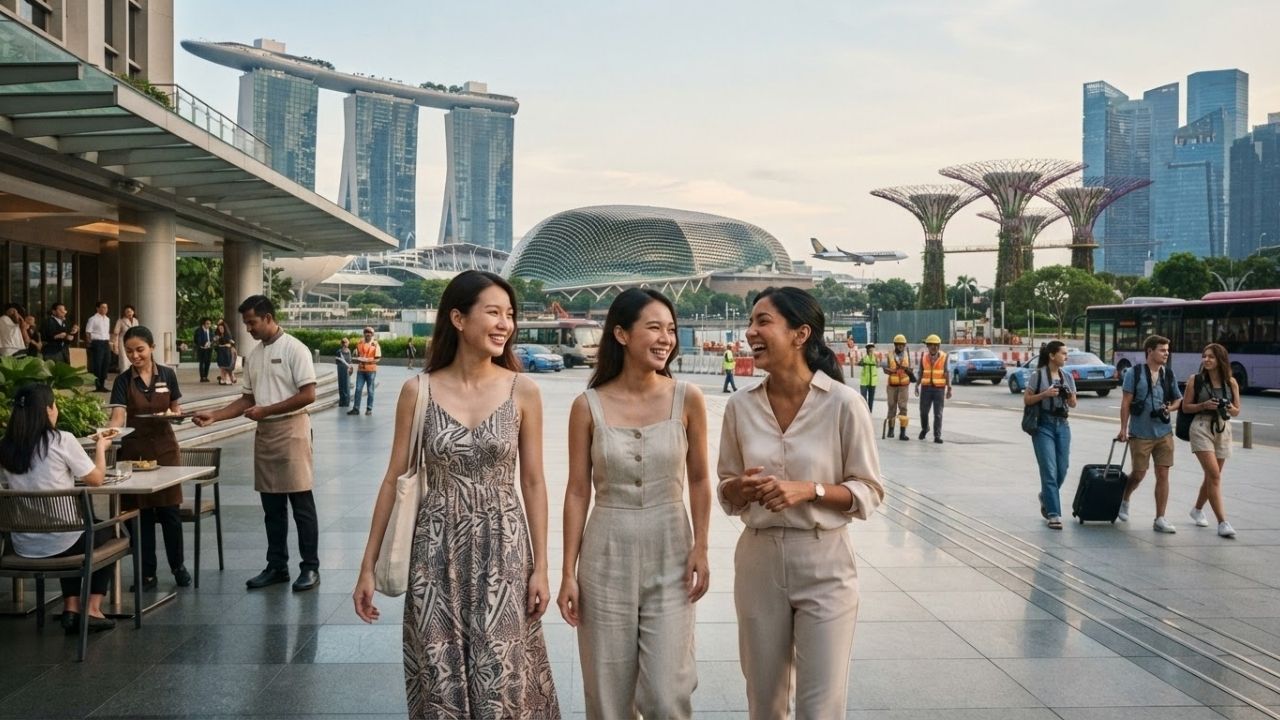
Image generated by AI
Singapore's high-value tourism recovery has been supported by a foreign workforce that reached 1,635,700 in December 2025, accounting for 39.7% of all employment.
Rebuilding the Visitor Economy: Value Over Volume
Singapore is transitioning toward a high-value visitor economy, focusing on increasing spending per traveler rather than driving arrivals alone. The city-state welcomed 16.9 million international visitors in 2025, representing a 2.3% increase from 16.5 million in 2024, although remaining below the 19.1 million arrival peak recorded in 2019. In terms of markets, China led 2025 arrivals with 3.1 million, followed by Indonesia (2.4 million), Malaysia (1.3 million), Australia (1.3 million), and India (1.2 million).
Tourism receipts reached S$29.8 billion in 2024, while H1 2025 performance suggests the full-year receipts will exceed the official forecast of S$29 billion to S$30.5 billion. Rebounding from only 330,000 visitors and S$1.9 billion in receipts in 2021, Singapore's focus on high-yield business travelers, international conventions, and premium events requires consistent service delivery across its hospitality, dining, and transit networks.
The Hidden Role of the Foreign Labor Network
Out of 4,117,000 total employment, Singapore's foreign workforce represented 39.7% (1,635,700 workers) in December 2025, up from 1,576,500 one year earlier. Ministry of Manpower data divides this workforce into several categories:
- Employment Pass (EP): 203,300 (highly skilled professionals, management).
- S Pass: 178,900 (skilled technicians, hospitality, aviation).
- Work Permit (WP): 1,222,700 (including 316,900 migrant domestic workers and 482,600 construction, shipyard, and process workers).
While these workers are distributed across the entire economy, their presence supports the travel sector by maintaining infrastructure, servicing commercial spaces, and supporting hospitality operations.
Singapore Foreign Workforce Allocation and Statistics (2024 vs. 2025)
| Workforce Category / Permit Type | December 2024 | December 2025 | Net Annual Change | Strategic Role in Tourism & Infrastructure |
|---|---|---|---|---|
| Employment Pass (EP) | 202,100 holders | 203,300 holders | +1,200 | Skilled managers, aviation, hospitality executives |
| S Pass holders | 178,200 holders | 178,900 holders | +700 | Mid-tier supervisors, culinary staff, technicians |
| Work Permit (WP) holders | 1,165,900 holders | 1,222,700 holders | +56,800 | Construction, service, and maintenance labor |
| Migrant Domestic Workers | 301,600 holders | 316,900 holders | +15,300 | Domestic home support and care services |
| Construction / Marine WP | 456,800 holders | 482,600 holders | +25,800 | Builds major infrastructure (Changi Terminal 5) |
| Other Work Passes | 30,400 holders | 30,800 holders | +400 | Specialized short-term projects and consultants |
| Total Foreign Workforce | 1,576,500 | 1,635,700 | +59,200 | Represents 39.7% of 4.117 Million total employment |
Infrastructure Expansion: Changi Terminal 5
Construction remains one of the clearest links between foreign labor and future travel capacity. The construction sector grew its permit holders by 25,800 to reach 482,600 in December 2025. According to official population reports, this growth has supported major national projects, including the construction of Changi Airport Terminal 5, which is essential to Singapore's long-term position as a global air hub.
A similar reliance is evident in the hotel sector. In 2024, Singapore added 1,421 hotel rooms, with average occupancy reaching 81.8%, average daily rates at S$276, and RevPAR at S$226. Managing this capacity requires consistent staffing across housekeeping, guest relations, property maintenance, and dining operations. While digital check-in systems and automated delivery robots reduce repetitive duties, human services remain central to premium hospitality.
Destination Specialist Local Insider Tips
To help travelers plan their visits, local specialists recommend the following insider tips:
- Use Digital and Contactless Check-In Options: Many Singapore hotels utilize automated check-in kiosks to reduce wait times; utilize these to bypass traditional front-desk queues.
- Explore Changi Airport’s Free Amenities: Take time to visit the Jewel Changi indoor waterfall or the terminal transit gardens before checking in, as they are fully accessible to passengers.
- Pre-Book Major Attraction Entry Tickets: Popular destinations like Gardens by the Bay or Universal Studios require advance reservations; book early to secure your preferred entry window.
- Utilize the Modern MRT Network: Avoid taxi queues by purchasing a Singapore Tourist Pass for unlimited rides on the clean public transit network.
- Observe Local Employment Guidelines: Remember that tourism policies remain separate from immigration rules. Visa and entry guidelines are strictly based on traveler nationality and passport validity.
Future Outlook
Singapore's population grew to 6.11 million in June 2025, with the non-resident population rising to 1.91 million. Balancing the demands of tourism growth with the resources of residents and workers requires infrastructure coordination. As Changi Terminal 5 construction progresses and local businesses adopt digital automation systems, Singapore's focus remains on maintaining high-value visitor services through structured integration of technology and human talent.
Related Travel Guides
Disclaimer
This article is for informational and educational purposes only. It does not constitute legal, financial, or professional advice. While we strive to provide accurate and up-to-date information, travel policies, regulations, and conditions change rapidly. Always verify information with official sources before making travel decisions. Nomad Lawyer makes no representations about the accuracy, reliability, completeness, or suitability of the information provided. Readers should consult qualified professionals for advice specific to their circumstances. The views expressed in this article are those of the author and do not necessarily reflect the views of Nomad Lawyer.
Preeti Gunjan
Contributor & Community Manager
A passionate traveller and community builder. Preeti helps grow the Nomad Lawyer community, fostering engagement and bringing the reader experience to life.
Learn more about our team →