
Singapore Changi Airport Capacity Blueprint: Terminal 3 Upgrades, Terminal 5, and Stopover Realities
Changi Airport processes 46.7M passengers through August 2026 while executing a multi-phase capacity expansion across Terminal 3, the 50M-passenger Terminal 5, and integrated maritime hubs.

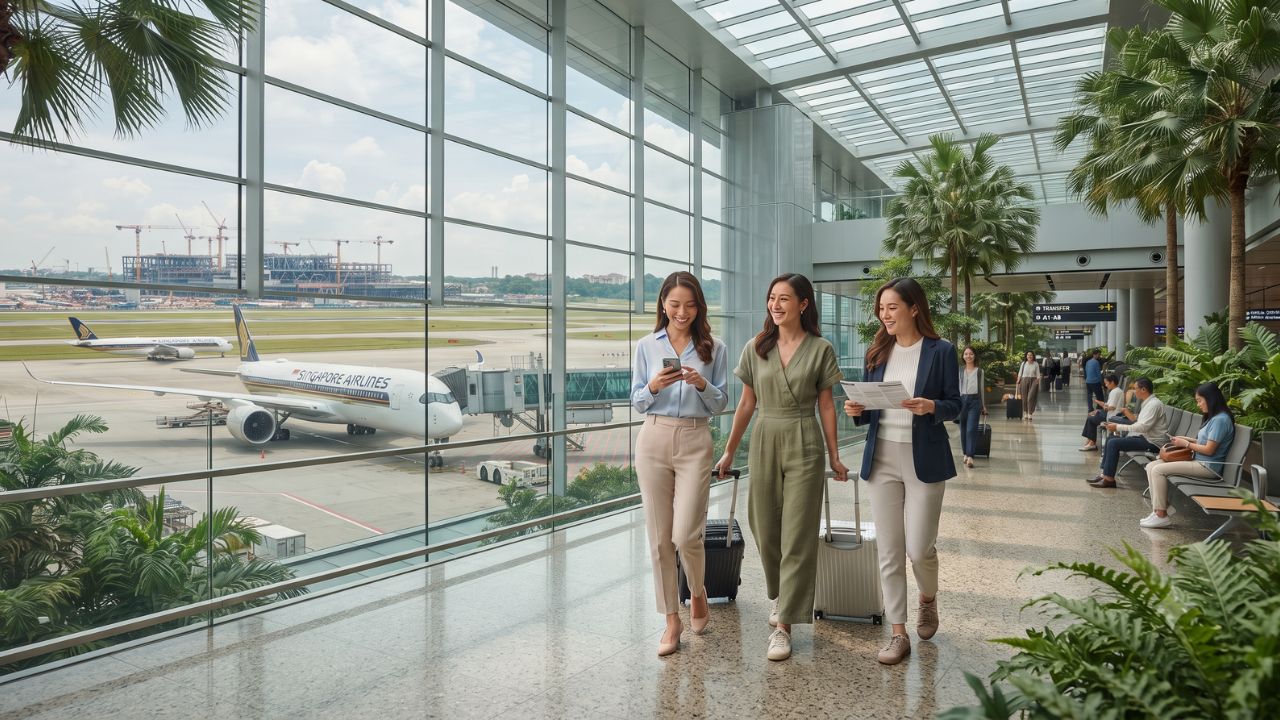
Processing approximately 46.7 million passenger movements across the first eight months of 2026 and connecting travelers to 175 global cities across nearly 100 airlines, Singapore's Changi Airport has initiated an aggressive multi-phase infrastructure expansion to safeguard its premier Asia-Pacific transit status. With August 2026 monthly traffic reaching 6.0 million passenger movements—a 1.5% increase over August 2025—the Southeast Asian gateway is moving to eliminate emerging peak-hour capacity constraints. By coordinating near-term automation tenders in Terminal 3 with the massive ground construction of Terminal 5, Singaporean aviation authorities are systematically scaling facilities to accommodate over 50 million additional annual travelers by the mid-2030s.
Yet physical terminal expansion represents only half of Singapore's strategic calculation. As international competition intensifies from expanding hubs in Bangkok, Kuala Lumpur, and the Persian Gulf, the city-state is binding airport operations directly to its maritime cruise networks and business event sectors. For transcontinental transit passengers evaluating stopovers, understanding the sequencing of these capital works, alongside the mandatory border entry requirements governing public spaces like Jewel Changi, is essential for seamless journey execution.
Strategic Phasing: Bridging the Terminal 3 Peak-Hour Bottleneck and Terminal 5 Mega-Development
Singapore's infrastructure strategy is structured across overlapping operational horizons designed to prevent mid-decade gridlock while mega-projects mature. Following the official groundbreaking of Terminal 5 on 14 May 2025 within the 1,080-hectare Changi East development, the Civil Aviation Authority of Singapore (CAAS) announced a major modernization program for Terminal 3 on 29 April 2026. With procurement tenders scheduled for release during the second half of 2026, the T3 upgrade targets high-density bottlenecks by deploying automated baggage systems, biometric self-service check-in kiosks, and autonomous robotic cleaning units.
These automated systems serve an dual purpose: they provide immediate relief during morning and late-night departure surges while functioning as an operational testing ground for systems destined for deployment in Terminal 5. When T5 opens in the mid-2030s, its projected 50 million annual passenger capacity will bring Changi's total annual throughput capability beyond 140 million passengers. Built with integrated mass rapid transit links, an autonomous airside transport network, and a dedicated ground transport center, the terminal is engineered to expand Changi’s network to more than 200 destination cities worldwide.
                    CHANGI AIRPORT INFRASTRUCTURE SEQUENCING BLUEPRINT

  [ Near-Term Bridge: H2 2026 ]        [ Mid-Term Expansion: 2027 ]        [ Long-Term Horizon: Mid-2030s ]
  Terminal 3 Modernization Tender      Downtown Business Events Hub        Terminal 5 (Changi East) Launch
  - Automated check-in robotics        - MICE facility RFP launch          - 50M annual passenger capacity
  - Biometric baggage drop units       - Integrated cruise study review    - 1,080-hectare development
  - Peak-hour screening upgrades       - Multi-modal fly-cruise links      - 200+ connected global cities
Simultaneously, the Singapore Tourism Board (STB) is executing complementary destination investments. Following 2025 performance data showing 16.9 million international visitor arrivals and tourism receipts of S$32.8 billion—a 10% annual increase—authorities outlined plans on 8 May 2026 for an integrated maritime terminal and a downtown business events hub. The maritime facility, currently undergoing feasibility reviews, proposes three cruise berths and up to ten ferry berths, expanding current national cruise capacity by 50% and doubling regional ferry handling to capture growing multi-modal "fly-cruise" travel demand.
Operational Milestones and Economic Metrics: The Changi East and Tourism Profile
The financial and operational scale of Singapore's aviation and tourism infrastructure reflects significant capital deployment across municipal and transport agencies.
| Project / Metric Dimension | Official Data Benchmark | Implementation Timeline | Strategic Function in Hub Network |
|---|---|---|---|
| Changi Passenger Throughput | 46.7 Million movements (Jan–Aug 2026) | 6.0 Million in August (+1.5% YoY) | Post-pandemic recovery baseline tracking toward capacity limits |
| Global Network Connectivity | 175 destination cities via ~100 airlines | Baseline confirmed April 2026 | Targeted expansion to over 200 cities upon T5 completion |
| Terminal 3 Upgrade Tender | Automated baggage and robotics | Tender release: Second half 2026 | Mitigates peak-hour bank crowding; pilot facility for T5 tech |
| Terminal 5 (Changi East) | 50 Million annual passenger capacity | Groundbroken May 2025; mid-2030s opening | 1,080-hectare development with autonomous airside links |
| 2025 National Tourism Receipts | S$32.8 Billion (+10% annual growth) | 16.9 Million foreign visitor arrivals | Underpins long-term sovereign capital deployment in aviation |
| MICE Business Event Receipts | S$2.3 Billion (35% increase over 2024) | Represents ~7% of total visitor spend | Drives high-yield corporate traffic through Changi's premium cabins |
| Proposed Maritime Terminal | 3 Cruise Berths & 10 Ferry Berths | Feasibility review ongoing | Increases national cruise capacity by 50% for fly-cruise travelers |
| Downtown Events Facility | Dedicated MICE infrastructure | Development proposals invited 2027 | Positions Singapore as primary corporate convention capital |
| Jewel Changi Border Status | Located landside (Public Zone) | Continuous regulatory enforcement | Requires formal immigration clearance and valid SG Arrival Card |
Expert Analysis: Southeast Asian Hub Hegemony, Fly-Cruise Integration, and Stopover Landside Friction
For travelers routing transcontinental journeys through Southeast Asia, the direct consequence of Changi's terminal phasing is operational consistency during peak travel waves. Major transfer hubs frequently suffer degradation of service when passenger volumes approach physical ceiling limits, leading to prolonged taxi times, gate holds, and baggage delays. By aggressively retrofitting Terminal 3 with advanced automated sorting and screening technologies years before Terminal 5 opens, Changi avoids the acute congestion currently plaguing competing gateways in the region.
The pricing pressure this creates means Singapore can maintain premium aeronautical charges while defending high passenger yields. The city-state is intentionally pivoting away from low-margin transit volume to capture high-value corporate travel. In 2025, business events (MICE) generated S$2.3 billion in spending—surging 35% year-over-year. By inviting development proposals for a massive downtown events hub in 2027, Singapore is ensuring that transiting corporate executives convert into multi-day hotel guests who inject high-margin revenue into the domestic economy.
However, a persistent operational friction point involves passenger misconceptions regarding transit stopovers. Many travelers mistakenly believe that iconic attractions like Jewel Changi can be visited while remaining in international transit. In reality, Jewel sits entirely landside, outside the sterile customs border. Under regulations enforced by the Immigration & Checkpoints Authority (ICA), international travelers wishing to exit the terminal must possess a passport valid for at least six months, secure an entry visa where applicable, and complete the electronic SG Arrival Card within the three days prior to arrival.
While foreign visitors departing Singapore can utilize automated biometric facial and iris lanes, physical passports remain strictly mandatory for identity verification and airline boarding. Passengers attempting quick four-hour layovers who fail to submit the electronic arrival card or miscalculate immigration clearance times risk missing onward connecting flights. For airlines and passengers alike, understanding that Changi's future architecture is designed around structured, multi-day stopovers rather than hurried airside transfers is critical to navigating Asia-Pacific travel.
Key Takeaways
- Changi Airport handled approximately 46.7 million passengers from January to August 2026, with August recording 6.0 million movements.
- Terminal 3 will undergo an extensive automated systems upgrade, with procurement tenders releasing in the second half of 2026.
- The 1,080-hectare Terminal 5 development broke ground in May 2025 and will add 50 million passenger capacity upon opening in the mid-2030s.
- Singapore is planning an integrated maritime terminal that would increase national cruise passenger handling capacity by 50%.
- Visiting Jewel Changi during a layover requires formal border clearance, an electronic SG Arrival Card, and six months of passport validity.
FAQ: Singapore Changi Airport Expansion and Stopovers 2026
When will the Terminal 3 upgrade at Changi Airport begin?
Procurement tenders for the Terminal 3 upgrade are scheduled for the second half of 2026, focusing on automated check-in systems, robotics, and screening technology to manage peak-hour passenger volumes.
Can transiting passengers visit Jewel Changi without passing through immigration?
No. Jewel Changi is located in the landside public area outside the transit zone. Transiting passengers must clear Singapore immigration, meet visa requirements, and submit an electronic SG Arrival Card to enter.
How much additional passenger capacity will Terminal 5 provide?
Terminal 5, located in the 1,080-hectare Changi East development, is engineered to handle 50 million passengers annually when it opens in the mid-2030s, expanding Changi's overall capacity beyond 140 million.
What are the entry requirements for a short Singapore stopover?
Travelers exiting transit must hold a passport valid for at least six months, obtain an entry visa if required by nationality, and submit the free electronic SG Arrival Card within three days before arrival.
Aligning terminal capacity with multi-modal maritime transit and automated border clearance ensures Singapore remains the preeminent aviation crossroads of the Indo-Pacific.
Related Travel Guides
Disclaimer
This article is for informational and educational purposes only. It does not constitute legal, financial, or professional advice. While we strive to provide accurate and up-to-date information, travel policies, regulations, and conditions change rapidly. Always verify information with official sources before making travel decisions. Nomad Lawyer makes no representations about the accuracy, reliability, completeness, or suitability of the information provided. Readers should consult qualified professionals for advice specific to their circumstances. The views expressed in this article are those of the author and do not necessarily reflect the views of Nomad Lawyer.
Kunal K Choudhary
Co-Founder & Contributor
A passionate traveller and tech enthusiast. Kunal contributes to the vision and growth of Nomad Lawyer, bringing fresh perspectives and driving the community forward.
Learn more about our team →