
Singapore Cruise Terminal Expansion and Fly-Cruise Logistics Power Southeast Asia's 2 Million Passenger Market Growth
Singapore expands cruise terminal capacity to 11,700 passengers while capturing a 48% market share across Southeast Asia.

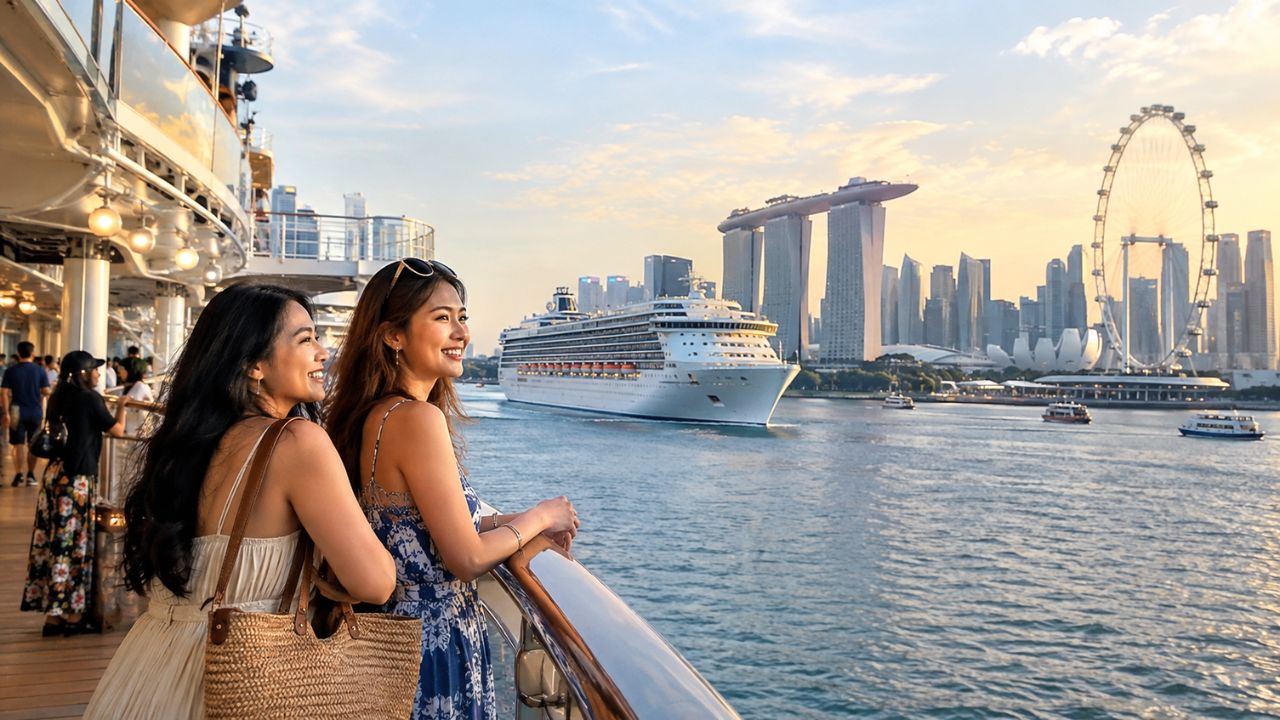
Image generated by AI
Singapore has solidified its position as Southeast Asia's principal luxury cruise gateway, supported by a S$40 million terminal expansion and verified national throughput exceeding two million annual passenger movements. Official tourism performance data released by the Singapore Tourism Board confirms that the nation handled 375 cruise ship calls—a 10 per cent increase year-on-year—while capturing 48 per cent of the total Southeast Asian cruise market.
Singapore Captures 48% Regional Share with 2 Million Passenger Movements
National tourism data confirms that Singapore's cruise sector logged over two million passenger movements during the full 2025 reporting period, representing a 9 per cent increase in terminal throughput. Port calls rose by 10 per cent to reach 375 ship calls. This cruise performance developed alongside broader inbound tourism growth, which saw international visitor arrivals reach 16.9 million—up 2.3 per cent from 2024.
Mainland China remained the top visitor source market with 3.1 million arrivals (18.3 per cent of total visitors), followed by Indonesia with 2.4 million (14.2 per cent), Malaysia with 1.3 million, Australia with 1.3 million, and India with 1.2 million. Combined, these five primary markets accounted for 55 per cent of Singapore's total inbound arrivals. Tourism receipts for the first nine months reached S$23.9 billion, a 6.5 per cent increase from the previous year.
Regionally, an economic impact assessment of Southeast Asian cruise operations revealed that the sector generated US$10 billion (S$12.9 billion) in total economic output, contributing US$4.5 billion (S$5.8 billion) directly to regional GDP across 3.9 million passenger visits. Singapore accounted for 48 per cent of these regional passenger visits, generating an average economic output of US$2,564 per passenger visit—2.4 times the global cruise industry average.
Singapore Cruise Terminal Capacity and Verified Performance Metrics
The operational framework of Singapore's cruise infrastructure combines expanded berthing facilities at Marina Bay and HarbourFront with dedicated fly-cruise logistics. The table below details key performance metrics, terminal specifications, and transfer parameters:
| Category / Parameter | Verified Performance / Specification | Reporting Period / Condition | Operational Impact |
|---|---|---|---|
| Cruise Passenger Throughput | >2,000,000 movements (+9%) | Full Year 2025 | Confirms terminal volume growth |
| Cruise Ship Calls | 375 ship calls (+10%) | Full Year 2025 | Demonstrates increased port activity |
| Principal Terminal Capacity | 11,700 passengers (Up from 6,800) | S$40 Million Expansion | +72.1% (+4,900 berths) capacity gain |
| Regional Market Share | 48% of Southeast Asian visits | Regional Benchmark | Ranks 1st in regional cruise market |
| Output Per Passenger Visit | US$2,564 per visit | Regional Assessment | 2.4x global industry average |
| Changi Airport Transfer Standard | S$120 per person | 5-Hour Minimum Layover | Direct air-to-sea baggage & transfer |
| Changi Airport Transfer Premium | S$220 per person | 10-Day Advance Booking | Priority ground & terminal check-in |
Traveler Logistics Guide: Navigating Singapore Fly-Cruise Transit
Connecting air and sea transit through Singapore requires strict adherence to airport layovers, immigration clearance windows, and port terminal assignments. Passengers planning fly-cruise itineraries should follow these logistics guidelines:
- Fly-Cruise Transfer Booking: Changi Airport provides seamless air-to-sea luggage transfers and ground transport to cruise terminals. Passengers must allow a minimum 5-hour layover between flight landing and scheduled ship departure. Reserve transfer packages (S$120 standard / S$220 premium) at least 10 days before arrival.
- Terminal Verification: Confirm departure berth details early. Ocean-going vessels and large luxury liners dock at Marina Bay Cruise Centre Singapore (handling up to 11,700 passengers), while regional cruise liners and ferry connections utilize the HarbourFront Centre terminal.
- SG Arrival Card Submission: All incoming international passengers must complete Singapore's electronic SG Arrival Card within 3 days prior to arrival (including arrival day). The digital submission is free and mandatory for immigration clearance.
- Multi-Port Visa Audits: Voyages originating in Singapore frequently disembark across neighboring jurisdictions in Malaysia, Thailand, Indonesia, or Vietnam. Passengers must verify passport validity (minimum 6 months) and individual entry visa rules for every scheduled port call along the cruise itinerary.
Regional Cruise Tourism Infrastructure and Economic Impact
The completion of the S$40 million terminal expansion added 4,900 passenger processing spaces, increasing single-terminal capacity from 6,800 to 11,700 passengers. This 72.1 per cent capacity increase allows Singapore to accommodate larger ocean liners and dual-ship homeporting operations simultaneously.
Homeporting operations generate high-value economic activity for the local hospitality sector, as international passengers book pre-cruise and post-cruise hotel stays, dining, and retail services. Survey data indicates that 85 per cent of cruise passengers rate their Southeast Asian sailing experience positively, with 47 per cent expressing intent to return for extended land-based holidays.
Looking ahead, national tourism forecasts project 17 million to 18 million international visitor arrivals for the full 2026 calendar year, generating S$31 billion to S$32.5 billion in tourism receipts. Expanded terminal operations will play a central role in absorbing this projected growth across Southeast Asian maritime routes.
FAQ: Singapore Cruise Travel 2026
What is the passenger handling capacity of Singapore's main cruise terminal? Following a S$40 million expansion, passenger handling capacity at the principal Marina Bay terminal increased from 6,800 to 11,700 passengers—a 72.1 per cent capacity boost.
How far in advance must passengers book Changi Airport fly-cruise transfers? Fly-cruise baggage and ground transfer packages (S$120 standard / S$220 premium) should be reserved at least 10 days prior to arrival, with a mandatory 5-hour minimum layover between flight landing and ship departure.
What entry documents are required for cruise passengers arriving in Singapore? Passengers must hold a valid passport (minimum 6 months validity), obtain necessary entry visas based on nationality, and submit the electronic SG Arrival Card within 3 days prior to arrival.
Related Travel Guides
Disclaimer
This article is for informational and educational purposes only. It does not constitute legal, financial, or professional advice. While we strive to provide accurate and up-to-date information, travel policies, regulations, and conditions change rapidly. Always verify information with official sources before making travel decisions. Nomad Lawyer makes no representations about the accuracy, reliability, completeness, or suitability of the information provided. Readers should consult qualified professionals for advice specific to their circumstances. The views expressed in this article are those of the author and do not necessarily reflect the views of Nomad Lawyer.
Preeti Gunjan
Contributor & Community Manager
A passionate traveller and community builder. Preeti helps grow the Nomad Lawyer community, fostering engagement and bringing the reader experience to life.
Learn more about our team →