
Breaking Airline News: Severe Travel Chaos as American Airlines Flight AAL1033 Executes Abrupt U-Turn Back to Charlotte
Breaking airline news: Amidst an environment of extreme operational fragility, American Airlines Flight AAL1033 abruptly aborted its route to Indianapolis, returning to Charlotte and plunging passengers into severe travel chaos.

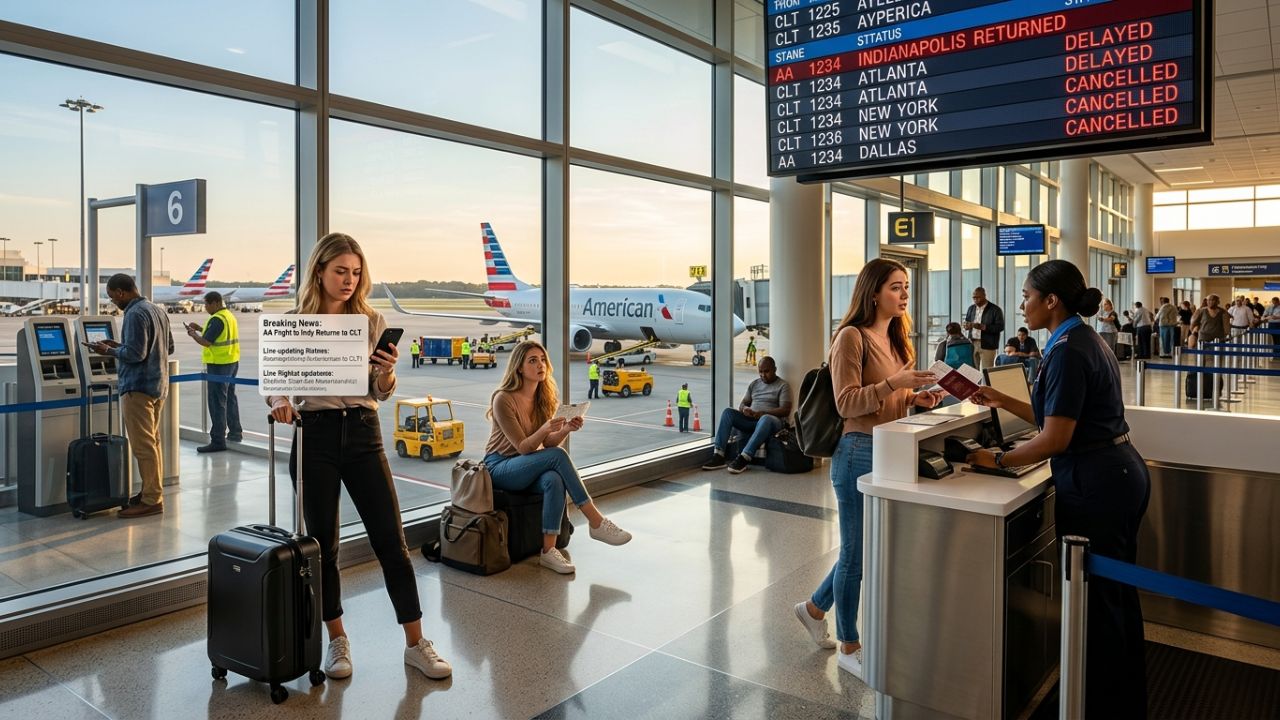
Image representing the intense operational shock as American Airlines Flight AAL1033 suddenly aborts its route to Indianapolis, executing an abrupt U-turn back to Charlotte and trapping unsuspecting passengers in a terrifying surge of travel chaos.
Breaking Airline News: Severe Travel Chaos as American Airlines Flight AAL1033 Executes Abrupt U-Turn Back to Charlotte
As paralyzing terminal bottlenecks, severe airspace congestion, and catastrophic operational fragility violently transform domestic transit into a grueling endurance test, a sudden mid-air route abort has just triggered severe anxiety for domestic passengers. On the late evening of June 11, 2026, American Airlines Flight AAL1033 completely abandoned its intended destination. Operating a Boeing 737-823, the massive commercial jet was scheduled to fly from Charlotte, North Carolina, to Indianapolis, Indiana. Instead, after spending over an hour airborne, the aircraft executed an unexpected and dramatic U-turn, altering its flight path entirely to return to Charlotte Douglas International Airport. This sudden operational shift left desperate passengers seeking immediate answers late at night, instantly transforming a routine Midwest hop into a terrifying wave of travel chaos and highlighting the extreme volatility currently plaguing the US aviation grid.
In a brutal demonstration of how rapidly commercial itineraries can violently fracture without warning, this localized diversion instantly threw passenger schedules into complete disarray. While aviation observers actively tracked the Boeing 737’s sudden change in trajectory, the lack of an immediate public explanation from American Airlines created a massive vacuum of information. Passengers expecting a seamless arrival at Indianapolis International Airport were suddenly thrust back into the sprawling, congested infrastructure of their departure hub. This terrifying incident underscores the absolute necessity for aggressive contingency planning, proving that escaping global travel chaos now requires intense operational discipline and absolute flexibility from every single passenger boarding a commercial jet.
Expanded Overview: The Anatomy of a Mid-Air U-Turn
The terrifying reality of sudden flight diversions brutally exposes the extreme consequences of fragile airline schedules. Serving as a critical link between massive domestic markets, the sudden loss of trajectory forces the airline's broader infrastructure to instantly absorb the disruption, resulting in immediate delays, missed ground transport, and total uncertainty for the travelers trapped onboard.
Section-Wise Breakdown: Decoding Flight AAL1033
To fully comprehend the massive logistical challenges facing the aviation industry, corporate travel planners and stranded passengers must rigorously review exactly how this explosive disruption tore through the network.
Charlotte to Indianapolis: The Severed Route To understand the absolute severity of this sudden shock, one must look at the exact operational telemetry. Flight AAL1033, operated by a Boeing 737-800 (registration N925AN), departed Charlotte Douglas International Airport late in the evening. The aircraft left the gate and took off on time, beginning what was expected to be a straightforward journey. Instead of continuing smoothly toward Indianapolis, tracking records confirm the aircraft violently reversed course. The Boeing 737 spent approximately one hour and twenty-six minutes airborne before ultimately landing safely back at its origin airport, completely severing the planned route.
The Return to Charlotte (CLT): Emergency Assessment When a commercial flight network collapses mid-air, pilots must immediately locate a secure harbor to assess the threat. Returning to a major departure hub like Charlotte Douglas is a recognized, heavily fortified aviation procedure. Because Charlotte operates as a massive operational fortress for American Airlines, returning to CLT allows immediate access to specialized maintenance engineers, spare equipment, and operational support teams that simply do not exist at smaller destination airports. This ensures that any technical or operational threat can be addressed immediately upon landing.
The Unanswered Operational Threat At the time of reporting, American Airlines had not publicly disclosed the precise operational threat that forced Flight AAL1033 to abort its journey. Aviation specialists warn that returning to a departure airport can be triggered by a massive array of severe factors: technical indications, mechanical maintenance considerations, weather developments, or crew observations warranting immediate ground inspection. Crucially, tracking data indicates no formal emergency declaration was made, suggesting the flight crew managed the terrifying diversion in a highly controlled, cautious manner.
Flight AAL1033 U-Turn Telemetry Matrix
To guarantee that travelers can aggressively track the specific telemetry of this operational shock, the following matrix details the exact, verified flight data available through public tracking networks.
| Flight Operational Metric | Verified Telemetry Data |
|---|---|
| Operating Carrier | American Airlines |
| Flight Number | AAL1033 |
| Aircraft Type & Registration | Boeing 737-823 (737-800) / N925AN |
| Scheduled Origin | Charlotte Douglas International Airport (KCLT), NC |
| Intended Destination | Indianapolis International Airport (KIND), IN |
| Diversion Action | Executed U-turn; returned to Charlotte (KCLT) |
| Flight Date | Late evening, June 11, 2026 |
| Airborne Duration | Approximately 1 hour and 26 minutes |
Data reflects the verified flight trajectory that triggered sudden travel chaos for domestic passengers.
Passenger Impact and Industry Analysis
For the passengers trapped aboard Flight AAL1033, the effect was immediate and severe. A mid-air U-turn aggressively creates massive uncertainty; travel plans are violently destroyed within minutes, especially during late-night operations. Travelers expecting to arrive in Indianapolis faced severe delays, complex rebooking procedures, ruined ground transportation arrangements, and extended, grueling waiting periods inside Charlotte terminals while airline staff scrambled to secure alternative aircraft or accommodations.
Despite the horrifying inconvenience, the safe return of the Boeing 737 demonstrates the extreme safety protocols governing the US airspace. Anup Kumar Keshan, Founder and Editor-in-Chief of Travel And Tour World, observed that this incident highlights a critical reality regarding aviation safety:
“The return of American Airlines Flight AAL1033 to Charlotte highlighted the aviation industry’s strong safety culture. Precautionary operational decisions, even when disruptive to passengers, demonstrate how airlines continue to prioritise safety, risk management, and responsible flight operations above schedule commitments.”
Conclusion: Surviving the Chaos
As the extremely critical domestic transit network braces for further instability, the sudden U-turn of Flight AAL1033 represents a massive warning. Travelers affected by sudden route changes must immediately execute aggressive survival strategies: bypass paralyzed customer service lines by utilizing official airline apps to track onward connections, aggressively demand communication from ground staff, and maintain absolute flexibility. This intelligence proves that surviving the modern era of commercial aviation relies entirely on anticipating sudden operational failures, proving that anticipating travel chaos is the only defense against a volatile transit grid.
Key Takeaways
- Sudden Route Abort: American Airlines Flight AAL1033 unexpectedly executed a U-turn, abandoning its Charlotte-to-Indianapolis route.
- Flight Telemetry: The Boeing 737-823 (N925AN) remained airborne for approximately 1 hour and 26 minutes on the night of June 11, 2026, before returning to Charlotte.
- Hub Utilization: Charlotte Douglas International Airport (CLT) was utilized as the return site to access massive maintenance and operational support.
- Passenger Disruption: The U-turn triggered massive immediate uncertainty late at night, forcing passengers into complex rebooking scenarios and severe delays.
- Safety Precedent: Industry experts note that the safe return emphasizes the absolute priority of flight safety over strict schedule adherence.
Related Travel Guides
Disclaimer
This article is for informational and educational purposes only. It does not constitute legal, financial, or professional advice. While we strive to provide accurate and up-to-date information, travel policies, regulations, and conditions change rapidly. Always verify information with official sources before making travel decisions. Nomad Lawyer makes no representations about the accuracy, reliability, completeness, or suitability of the information provided. Readers should consult qualified professionals for advice specific to their circumstances. The views expressed in this article are those of the author and do not necessarily reflect the views of Nomad Lawyer.
Kunal K Choudhary
Co-Founder & Contributor
A passionate traveller and tech enthusiast. Kunal contributes to the vision and growth of Nomad Lawyer, bringing fresh perspectives and driving the community forward.
Learn more about our team →