
South East Central Railway Unveils Next-Generation Digital Operations Control Hub in Bilaspur
South East Central Railway has launched a digital monitoring hub in Bilaspur Division, using an ultra-narrow-bezel video wall to track 59 stations across Chhattisgarh.

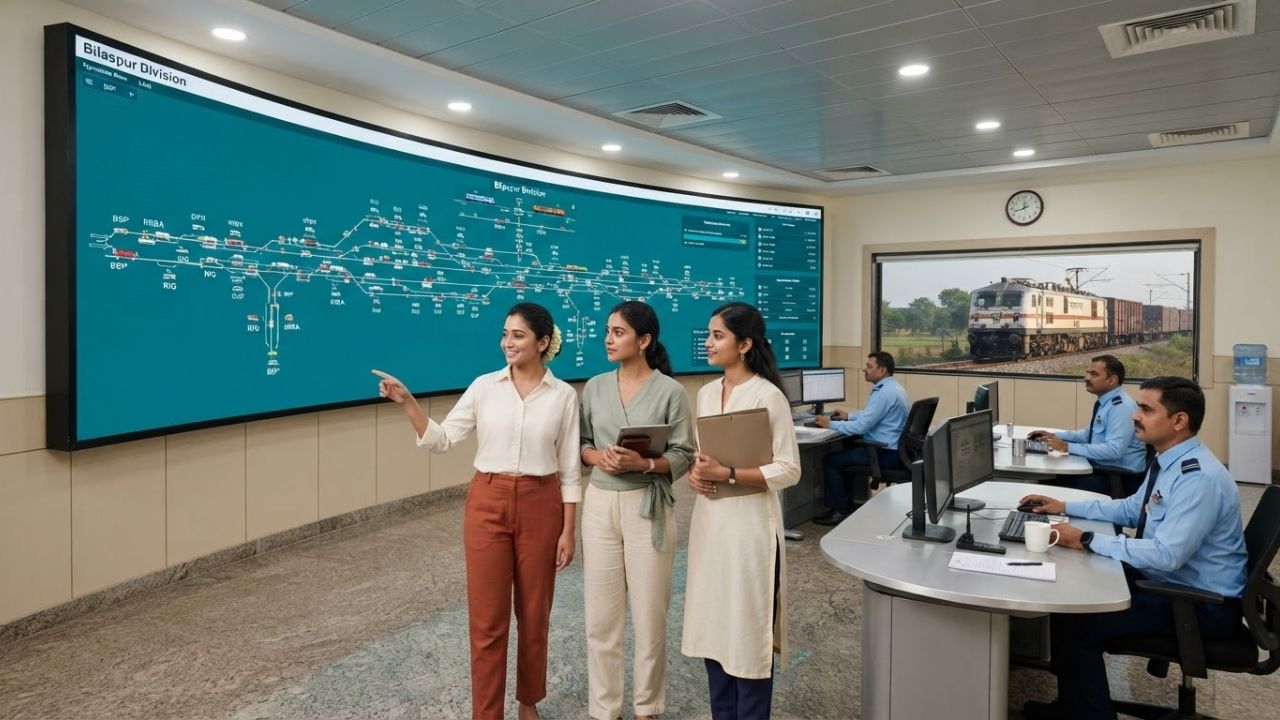
Image generated by AI
South East Central Railway has commissioned a centralized digital operations control hub at Bilaspur Division in Chhattisgarh, integrating real-time train tracking, signaling analytics, and yard monitoring across 59 stations.
BILASPUR, India — To modernize high-density freight and passenger transit across Central India, South East Central Railway (SECR) has deployed a digital operations monitoring hub at its Divisional Control Office in Bilaspur. The facility consolidates live train movement data, automatic signaling parameters, and rolling stock tracking into a single digital platform, allowing controllers to manage network traffic across heavy coal and passenger transport corridors in Chhattisgarh.
| Operations Hub Milestone | Technical Specification & Scope |
|---|---|
| Railway Zone / Division | South East Central Railway (SECR) / Bilaspur Division |
| Facility Location | Divisional Control Office, Bilaspur, Chhattisgarh |
| Total Stations Monitored | 59 stations (47 in Bilaspur Division + 12 in Raipur Division) |
| Display Technology | Ultra-narrow-bezel video wall (Largest display in Indian Railways) |
| Core Functions | Live train tracking, yard analytics, signaling status, disruption control |
Ultra-Narrow-Bezel Video Wall Provides Real-Time Visual Command
A defining feature of the new Bilaspur control hub is an ultra-narrow-bezel video wall, recognized as the largest unified display wall currently operating across Indian Railways. Replacing fragmented CRT monitors and isolated department displays, the video wall presents controllers with a continuous visual representation of inter-station block sections, station yards, and active train movements.
Controllers monitor live train positions alongside interlocking signaling conditions, enabling instant detection of developing bottlenecks along high-density freight and passenger corridors.
| Visual Interface Component | Technical Capability | Operational Advantage |
|---|---|---|
| Ultra-Narrow-Bezel Video Wall | High-definition continuous digital display | Eliminates visual seams between multi-screen feeds |
| Live Train Tracking Feed | Real-time GPS & track circuit movement feeds | Tracks precise train location in block sections |
| Interlocking Signal Status | Integrated automatic signaling indicators | Displays signal aspects & point positions simultaneously |
| Centralized Control Console | Multi-departmental shared data dashboard | Coordinates traffic, safety & traction power teams |
Centralized Oversight Spans 59 Stations Across Bilaspur and Raipur Divisions
The monitoring hub integrates 47 stations within Bilaspur Division alongside 12 stations in neighboring Raipur Division, bringing 59 stations under unified control-room oversight.
Consolidating data across divisional boundaries gives controllers broader situational awareness, preventing localized delays at one station from cascading through adjacent block sections.
| Division Coverage | Station Count | Strategic Network Role |
|---|---|---|
| Bilaspur Division | 47 stations | Primary coal, iron ore, and passenger transport corridor |
| Raipur Division | 12 stations | Key industrial and regional passenger interchange points |
| Combined Network Total | 59 stations | Integrated central control over high-density SECR tracks |
Live Train Tracking and Automated Rolling Stock Analytics
The platform integrates automated rolling stock tracking algorithms with real-time field data, monitoring locomotive utilization, freight wagon distribution, and passenger train punctuality.
During peak travel hours, controllers use predictive analytics to sequence fast express trains, local passenger services, and heavy freight rakes through crowded station yards.
| Operational Analytics Module | Monitored Railway Asset | Functional Value |
|---|---|---|
| Live Train Movement Tracking | Passenger & freight train formations | Real-time position tracking across 59 stations |
| Signalling Parameter Monitor | Automatic signaling & electronic interlocking | Immediate alert generation for signal failures |
| Station Yard Visualizer | Yard tracks, sidings, and platform lines | Streamlines shunting & platform allocation |
| Disruption Analytics Dashboard | Delays, speed restrictions & track maintenance | Faster decision-making during unexpected delays |
Optimizing Station Yards and Inter-Station Block Sections
Station yards represent some of the most complex operational nodes on the railway network, requiring simultaneous management of passenger boarding, freight loading, locomotive changes, and empty rake movements. The Bilaspur monitoring platform provides high-resolution yard layouts, allowing dispatchers to allocate platforms and clearing lines efficiently.
Simultaneously, live block section monitoring tracks train headway spacing between stations, maximizing track capacity utilization without compromising safety standards.
| Network Section | Operational Challenge | Digital System Solution |
|---|---|---|
| Complex Station Yards | Conflicting movements of passenger & freight trains | Clear visual yard maps to prevent platform bottlenecks |
| Inter-Station Block Sections | Maintaining safe train spacing during heavy traffic | Continuous signal monitoring to optimize train headway |
| Industrial Freight Sidings | Timely dispatch of coal & mineral freight trains | Automated tracking of freight rake loading & departure |
Faster Disruption Management and Punctuality Protection
Maintaining on-time performance across shared passenger and freight corridors requires rapid response when technical disruptions occur. When track maintenance, weather delays, or signaling faults arise, the centralized dashboard aggregates ground data to help controllers re-route or regulate train services quickly.
By reducing the time required to diagnose field issues, SECR minimizes delay propagation across the wider South East Central Railway network.
| Disruption Response Phase | Traditional Manual Process | Digital Control Hub Process |
|---|---|---|
| Fault Detection | Delayed phone reporting from station masters | Instant visual alert on centralized video wall |
| Situation Assessment | Manual gathering of departmental reports | Single-screen view of signals, trains & track status |
| Operational Decision | Lengthy coordination between separate offices | Joint real-time decision-making on shared console |
| Punctuality Impact | Delays propagate across multiple train routes | Proactive re-sequencing prevents cascading delays |
A Blueprint for High-Density Indian Railways Freight Corridors
The Bilaspur digital control hub serves as a model for future control room upgrades across high-density Indian Railways routes. As freight corridors expand and passenger train speeds increase, data-driven control centers will play an essential role in maximizing network capacity, enhancing operational safety, and maintaining timetable reliability.
Frequently Asked Questions
What is the new digital monitoring hub launched by South East Central Railway?
It is a centralized digital control facility located at the Divisional Control Office in Bilaspur, Chhattisgarh, featuring Indian Railways' largest ultra-narrow-bezel video wall to monitor live train operations across 59 stations.
How many stations are monitored by the Bilaspur digital control center?
The hub monitors 59 stations in total, including 47 stations within Bilaspur Division and 12 stations within Raipur Division.
What are the main features of the video wall display in Bilaspur?
The ultra-narrow-bezel video wall provides a continuous high-definition display of live train positions, automatic signaling status, station yard layouts, and operational analytics across a single interface.
How does this technology improve train punctuality and safety?
By providing real-time visibility over train movements and signaling parameters, control teams can identify potential bottlenecks early, make faster decisions during disruptions, and optimize track capacity utilization.
Related Travel Guides
Disclaimer
This article is for informational and educational purposes only. It does not constitute legal, financial, or professional advice. While we strive to provide accurate and up-to-date information, travel policies, regulations, and conditions change rapidly. Always verify information with official sources before making travel decisions. Nomad Lawyer makes no representations about the accuracy, reliability, completeness, or suitability of the information provided. Readers should consult qualified professionals for advice specific to their circumstances. The views expressed in this article are those of the author and do not necessarily reflect the views of Nomad Lawyer.
Kunal K Choudhary
Co-Founder & Contributor
A passionate traveller and tech enthusiast. Kunal contributes to the vision and growth of Nomad Lawyer, bringing fresh perspectives and driving the community forward.
Learn more about our team →