
Saudi and Egypt Economic Corridor Shows the Bilateral Trade Impacting Tourism Landscape with The New Wealth Divide
Saudi and Egypt Economic Corridor Shows the Bilateral Trade Impacting Tourism Landscape with The New Wealth Divide

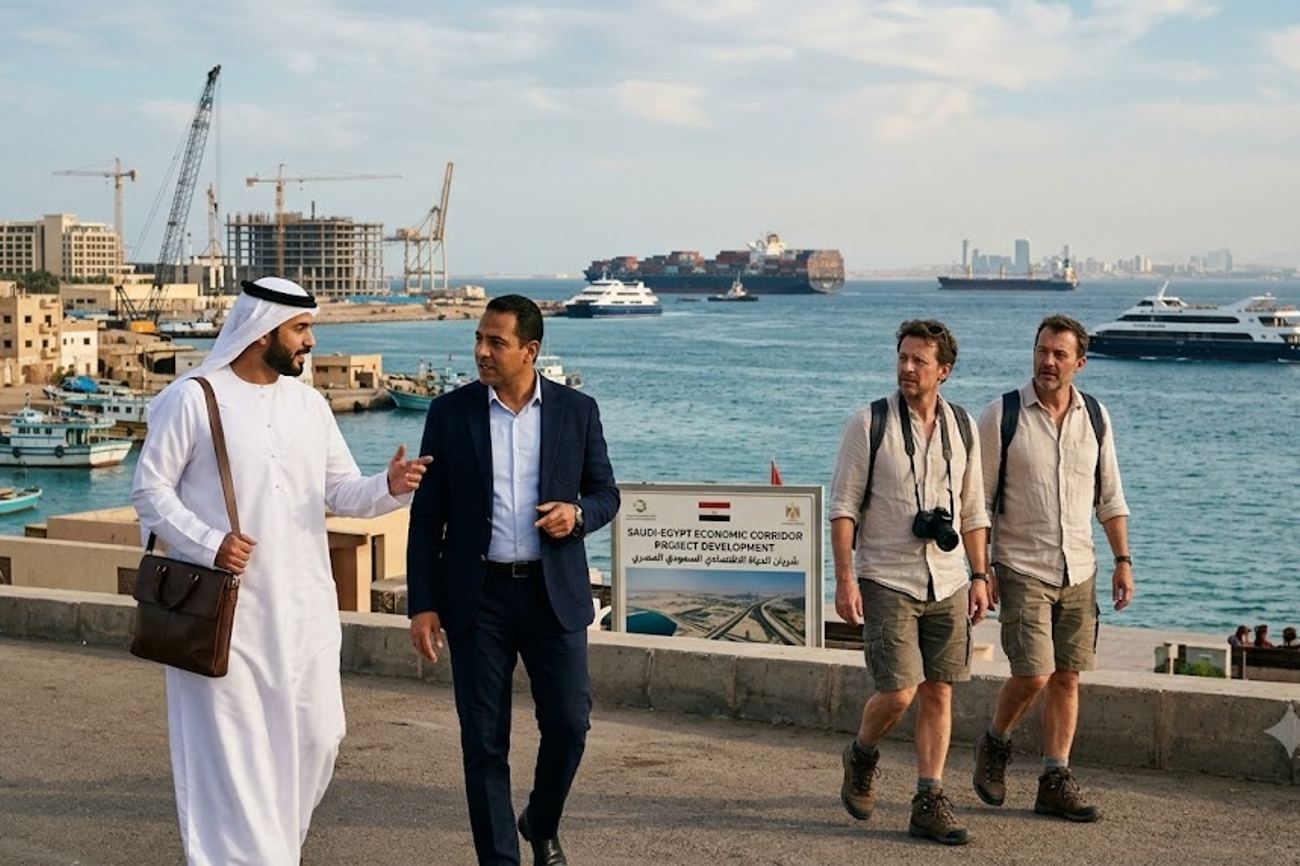
Image generated by AI
SAR 54 billion in trade exchange volume recorded by the Federation of Saudi Chambers serves as the baseline for a corridor that has evolved from simple commodity trading into a sophisticated financial engine. By September 2026, the Saudi Egypt economic corridor has transitioned into a multi-layered ecosystem of sovereign wealth investments and green energy grids, yet this growth has masked a deepening demographic fracture. The region is no longer a monolithic market; it is a bifurcated economy split between high-net-worth Gulf nationals and a remittance-driven expatriate workforce.
The Structural Evolution of the Red Sea Axis
The contemporary economic relationship between the Kingdom of Saudi Arabia and the Arab Republic of Egypt is the result of a calculated alignment between Saudi Vision 2030 and Egypt Vision 2030. This strategic convergence was designed to decouple both nations from volatile traditional revenue streams—specifically Saudi Arabia's dependence on crude oil and Egypt's reliance on Suez Canal tolls and agricultural exports.
This partnership is not a sudden development but the scaling of a historic foundation. To date, the two nations have ratified over 160 bilateral agreements. These treaties were designed to dismantle customs barriers and facilitate the movement of capital and labor across the Red Sea. By 2026, these agreements have shifted from basic trade facilitation to the creation of integrated digital financial platforms and large-scale infrastructure projects. However, the rapid scaling of this corridor has created a "market gap" where corporate strategies have failed to keep pace with the actual demographic composition of the workforce and investor class.
The Bifurcated Consumer Market: Data and Divergence
The most critical shift identified in 2026 is the collapse of the "single block" theory. For decades, multinational firms treated the MENA region as a unified consumer base. Current market analytics prove this approach is now a liability. The corridor is currently defined by two entirely different economic profiles with opposing motivations and spending patterns.
| Metric/Behavior | Gulf National Profile | Expatriate Resident Profile |
|---|---|---|
| Primary Economic Driver | Sovereign wealth & state welfare | Remittance obligations & long-term savings |
| Demand Elasticity | Inelastic (Premium/Luxury) | High Elasticity (Essential/Budget) |
| Real Estate Focus | Luxury coastal/Commercial assets | Urban family housing (Cairo/Alexandria) |
| GDP Per Capita (Approx) | Over $35,000 | $3,340 (Egypt baseline) |
| Key Spending Categories | Wealth management, High-end tourism | Telecoms, Budget aviation, FMCG |
This discrepancy is most evident in Purchasing Power Parity (PPP). With a GDP per capita gap of over $31,000 between the Saudi national average and the Egyptian baseline, the "average" consumer in the corridor is a mathematical fiction. The Gulf national operates within a framework of luxury consumption and domestic diversification, while the Egyptian expatriate operates on a transnational model, where every financial decision is filtered through currency exchange rates and the cost of living in two different countries.
Expert Analysis: The Remittance Trap and Market Miscalculation
For travelers and business operators moving within this corridor, the direct consequence of this divergence is a fragmented service economy. When a region is treated as a "single block," services are often priced for the top tier, effectively alienating the massive expatriate workforce that actually powers the infrastructure.
The pricing pressure created by this split means that we are seeing the rise of "parallel strategies." For example, an aviation provider cannot successfully serve this corridor with a single cabin configuration. The demand for budget aviation among Egyptians returning home for annual leave is fundamentally different from the premium travel requirements of Saudi investors visiting the North Coast.
Furthermore, the reliance on remittance-driven consumption creates a volatility loop. Because the expatriate population is highly sensitive to currency fluctuations, a dip in the Egyptian Pound or a shift in Saudi labor laws immediately impacts the FMCG (fast-moving consumer goods) and telecommunications sectors. Businesses that fail to segment their data—treating a Saudi citizen and an Egyptian resident as the same "customer"—will find their margins eroded by a lack of price sensitivity in the lower tier and a lack of perceived value in the upper tier. The corridor's prosperity depends not on the volume of trade, but on the ability of policy-makers to address these two distinct economic realities simultaneously. To ensure continued stability, the International Air Transport Association (IATA) and similar regulatory bodies must recognize that labor mobility in this corridor is not just a logistical challenge, but a socio-economic divide.
Key Takeaways
- End of the Monolith: The "Arab Market" is no longer a viable business segment; the Saudi Egypt corridor is now two distinct markets (High-Net-Worth Nationals vs. Remittance-Based Expatriates).
- Extreme PPP Gap: A massive disparity exists between Saudi Arabia's $35,000+ GDP per capita and Egypt's $3,340, dictating entirely different consumption patterns.
- Investment Divergence: Capital flow is split between luxury commercial assets on the Red Sea (Gulf investors) and essential urban housing in Cairo and Alexandria (expatriates).
- Strategic Alignment: The corridor is underpinned by 160+ bilateral agreements and the synchronization of the respective 2030 national visions.
- Operational Risk: Companies using unified pricing or marketing strategies are being outmaneuvered by competitors using data-driven, cohort-specific targeting.
FAQ: Saudi Egypt Corridor 2026
Why is the "single block" theory no longer working for businesses? Because the purchasing power and motivations of Gulf nationals (luxury, investment) differ fundamentally from Egyptian expatriates (remittances, essential goods). Treating them as one group leads to mispriced products and ineffective marketing.
What are the primary investment differences between the two groups? Gulf nationals typically target high-end commercial real estate and luxury resorts on Egypt's North Coast. Egyptian expatriates focus on securing family residential properties in major urban centers like Cairo to ensure long-term stability.
How does GDP per capita affect travel in this corridor? It creates a split demand: high-end, inelastic demand for premium tourism and wealth management from Saudi citizens, and high elasticity for budget aviation and telecommunications from the expatriate workforce.
What role do the "2030 Visions" play in this economic corridor? Both Saudi Vision 2030 and Egypt Vision 2030 aim to diversify economies away from oil and toll revenues, sparking a surge in joint ventures, green energy, and digital financial integration.
The Red Sea is no longer just a geographic divide, but a mirror reflecting two vastly different economic worlds.
Tags: Saudi Vision 2030, Egypt Vision 2030, Saudi Egypt Economic Corridor, MENA Market Analytics, Red Sea Trade 2026, Federation of Saudi Chambers
Related Travel Guides
Disclaimer
This article is for informational and educational purposes only. It does not constitute legal, financial, or professional advice. While we strive to provide accurate and up-to-date information, travel policies, regulations, and conditions change rapidly. Always verify information with official sources before making travel decisions. Nomad Lawyer makes no representations about the accuracy, reliability, completeness, or suitability of the information provided. Readers should consult qualified professionals for advice specific to their circumstances. The views expressed in this article are those of the author and do not necessarily reflect the views of Nomad Lawyer.
Preeti Gunjan
Contributor & Community Manager
A passionate traveller and community builder. Preeti helps grow the Nomad Lawyer community, fostering engagement and bringing the reader experience to life.
Learn more about our team →