
Sashastra Police Praised for Heroic Roshi River Rescue of 89 Stranded Passengers
Armed security forces executed a dramatic overnight rescue of 89 passengers trapped by flash flooding on Nepal's BP Highway in May 2026. Sashastra police coordinated a multi-agency response that saved lives without casualties.

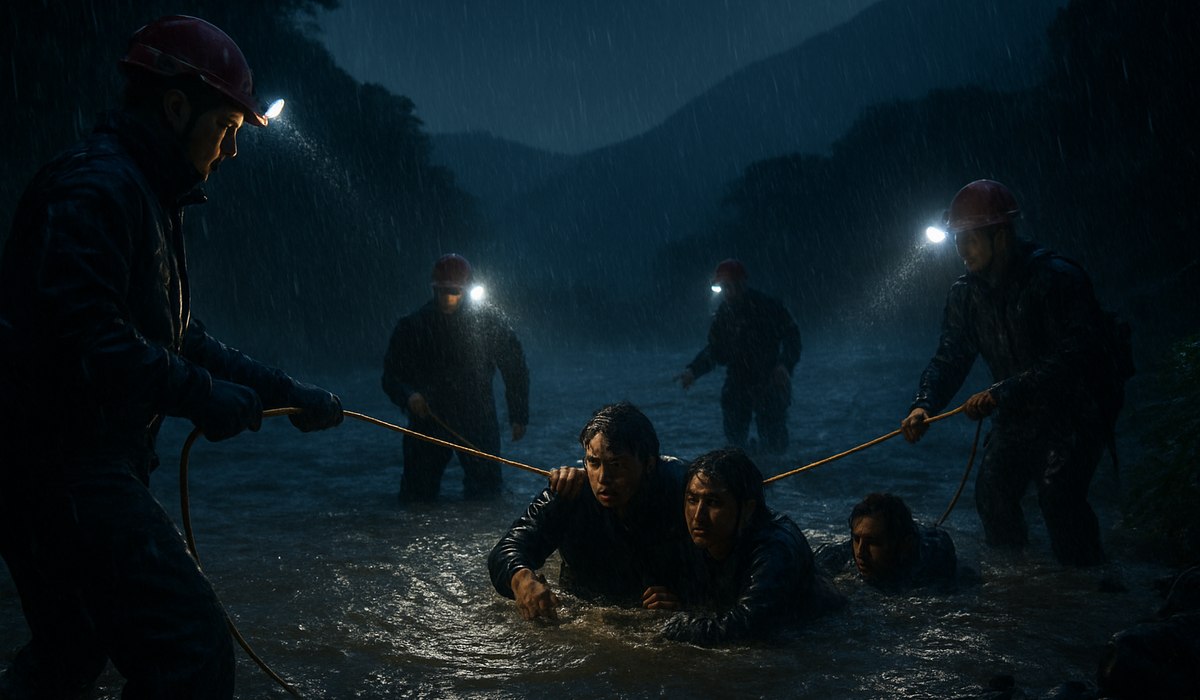
Image generated by AI
Dramatic Overnight Rescue Unfolds on Nepal's BP Highway
Sashastra police forces executed a coordinated multi-agency rescue operation that saved 89 passengers trapped by flash flooding in Nepal's Roshi River on the evening of May 4, 2026. Five microbuses traveling from Tarai and hill districts toward Kathmandu became stranded on a temporary riverside diversion when heavy rainfall triggered a rapid surge in water levels. Working through darkness and treacherous conditions, armed security personnel deployed ropes, portable lighting, and improvised access routes to evacuate all passengers to safety by approximately 1 a.m. The incident has drawn widespread praise for the Sashastra police response and renewed focus on disaster preparedness along Nepal's vulnerable highway corridors.
Overnight Drama Unfolds on BP Highway
The crisis began when monsoon rains intensified upstream, causing the normally manageable Roshi River to swell into a dangerous torrent. The temporary diversion connecting Laskot and Ghumaune—established during long-term repairs to the main BP Highway carriageway—became progressively submerged as floodwaters rose. Drivers in the five microbuses quickly realized they could not advance safely or retreat to higher ground. What started as a traffic delay transformed into a life-threatening emergency as darkness fell and visibility diminished to near zero. Local residents immediately contacted emergency services, alerting authorities to the trapped passengers. The Nepali Army, Nepal Police, and Armed Police Force mobilized rapidly, demonstrating the coordination mechanisms that have increasingly defined disaster response in the Himalayan region. Read more about Nepal travel safety protocols
Coordinated Response by Sashastra Police Forces
Sashastra police forces showcased exceptional inter-agency coordination during the operation. Personnel from multiple security branches worked seamlessly to establish safe passage across the flooded terrain. Teams used specialized ropes and manual guidance systems to lead passengers single file through chest-deep water. The operation required precise timing and communication, as each group needed careful coordination to prevent individuals from being swept away by the current. Field commanders established staging areas on higher ground where evacuees could rest and receive preliminary assistance. Medical personnel from the armed forces stood ready to treat anyone showing signs of shock or injury. The successful execution of this complex rescue under pressure has become a reference model for future disaster response training. According to disaster management officials, the speed of the Sashastra police deployment—approximately one hour from initial alert to on-site coordination—significantly enhanced survival outcomes.
All 89 Passengers Evacuated Successfully
By 1 a.m., all 89 passengers had been safely removed from the stranded microbuses and relocated to secure locations away from the flood zone. The rescue proceeded without a single fatality or major injury—an outcome that officials attribute to the Sashastra police's rapid mobilization and disciplined evacuation procedures. The operation continued throughout the night as water levels gradually receded. Once conditions stabilized at dawn, recovery teams used heavy equipment to retrieve the five microbuses from the riverbed. Passengers were provided temporary shelter, medical screening, and transportation to their intended destinations. Local residents offered hospitality to many evacuees, demonstrating the community solidarity that often emerges during emergencies. The absence of casualties during such a high-risk operation has been highlighted in Nepali media coverage as evidence of how sashastra police praised efforts are reshaping disaster response standards in the region.
Renewed Focus on Disaster Response Capabilities
The Roshi River rescue has sparked important conversations about climate-related emergencies along Nepal's major transportation routes. Disaster management agencies now cite the incident as proof that multi-agency training, shared communication systems, and pre-positioned equipment can dramatically improve rescue outcomes. The operation demonstrated how military and police units function as frontline responders to weather and geological hazards. From landslide clearance on mountain passes to flash flood evacuations in river valleys, the Sashastra police increasingly shoulder responsibility for emergency management. Regional officials have announced plans to conduct more joint drills involving the Nepali Army, Nepal Police, and Armed Police Force. Investment in portable lighting systems, rope rescue equipment, and waterproof communication devices has been prioritized for remote highway segments. The Roshi incident is already being incorporated into disaster response curricula at training academies nationwide. Explore Nepal's emergency preparedness initiatives
The BP Highway's Troubled History and Ongoing Challenges
The temporary diversion across the Roshi riverbed has posed hazards for over two years, since earlier flooding damaged the main BP Highway carriageway in Kavrepalanchok district. The approximately 18-kilometer stretch where the river routinely threatens the roadway remains problematic during intense rainfall. Authorities established the gravel track as an interim solution, but engineers have long recognized its vulnerability during monsoon season. Drivers traveling this route frequently report anxiety about conditions, particularly after dark or during weather deterioration. Traffic advisories regularly warn motorists to monitor weather forecasts and avoid attempting the crossing when rain intensifies upstream. Following the May 2026 incident, disaster risk reduction agencies have intensified calls for a permanent engineering solution—likely involving bridge construction or road elevation—to eliminate seasonal vulnerability. Some drivers who ignored weather warnings during the emergency have faced investigation, underscoring efforts to encourage responsible travel decisions during hazardous conditions.
Key Facts: Roshi River Rescue Operation Summary
| Metric | Details |
|---|---|
| Date of Incident | May 4-5, 2026 |
| Location | Roshi River crossing, BP Highway, Kavrepalanchok District, Nepal |
| Passengers Trapped | 89 total from five microbuses |
| Vehicles Involved | 5 microbuses traveling toward Kathmandu |
| Cause | Flash flooding triggered by heavy monsoon rainfall |
| Evacuation Timeline | Approximately 6 hours (evening of May 4 to 1 a.m. May 5) |
| Casualties | 0 fatalities, 0 major injuries |
| Responders | Nepali Army, Nepal Police, Armed Police Force (Sashastra forces) |
| Recovery Status | All vehicles recovered once water levels receded |
| Highway Status | Main diversion closed during emergency; reopened May 5 |
What This Means for Travelers
The Roshi River rescue offers critical lessons for anyone planning to travel Nepal's highways, particularly during monsoon season (June–September):
-
Monitor Weather Forecasts Actively: Before traveling the BP Highway or other routes crossing swollen rivers, check real-time weather alerts from the Nepal Meteorological Department. Flash flooding can develop within minutes once upstream rainfall intensifies.
-
Respect Road Closure Advisories: When authorities warn that temporary diversions or vulnerable stretches are closed due to weather, treat these warnings as non-negotiable. The drivers in this incident faced life-threatening conditions because they proceeded despite hazardous circumstances.
-
Travel During Daylight Hours: Negotiate challenging road segments only during daylight when visibility is optimal. Darkness combined with flooded terrain eliminates escape options and complicates rescue operations.
-
Use Established Transport Services: Licensed bus operators maintain updated weather protocols and driver training. Private or informal transport arrangements may lack emergency communication systems.
-
Carry Communication Devices: Ensure your mobile phone is fully charged and that you have contact numbers for local authorities, your embassy, and your accommodation. During emergencies, communication can mean the difference between rapid rescue and prolonged crisis.
-
Register Travel Plans: Inform your accommodation, tour operator, or travel companion of your intended route and expected arrival time. If you become stranded, others can alert
Disclaimer
This article is for informational and educational purposes only. It does not constitute legal, financial, or professional advice. While we strive to provide accurate and up-to-date information, travel policies, regulations, and conditions change rapidly. Always verify information with official sources before making travel decisions. Nomad Lawyer makes no representations about the accuracy, reliability, completeness, or suitability of the information provided. Readers should consult qualified professionals for advice specific to their circumstances. The views expressed in this article are those of the author and do not necessarily reflect the views of Nomad Lawyer.
Raushan Kumar
Founder & Lead Developer
Full-stack developer with 11+ years of experience and a passionate traveller. Raushan built Nomad Lawyer from the ground up with a vision to create the best travel and law experience on the web.
Learn more about our team →