
Rafael Núñez International Airport CTG Terminal Map Guide for Arrivals and Taxis 2026
A practical layout guide to Rafael Núñez International Airport in Cartagena, covering arrivals, baggage claim, taxi exits, pickups, parking and car rentals.

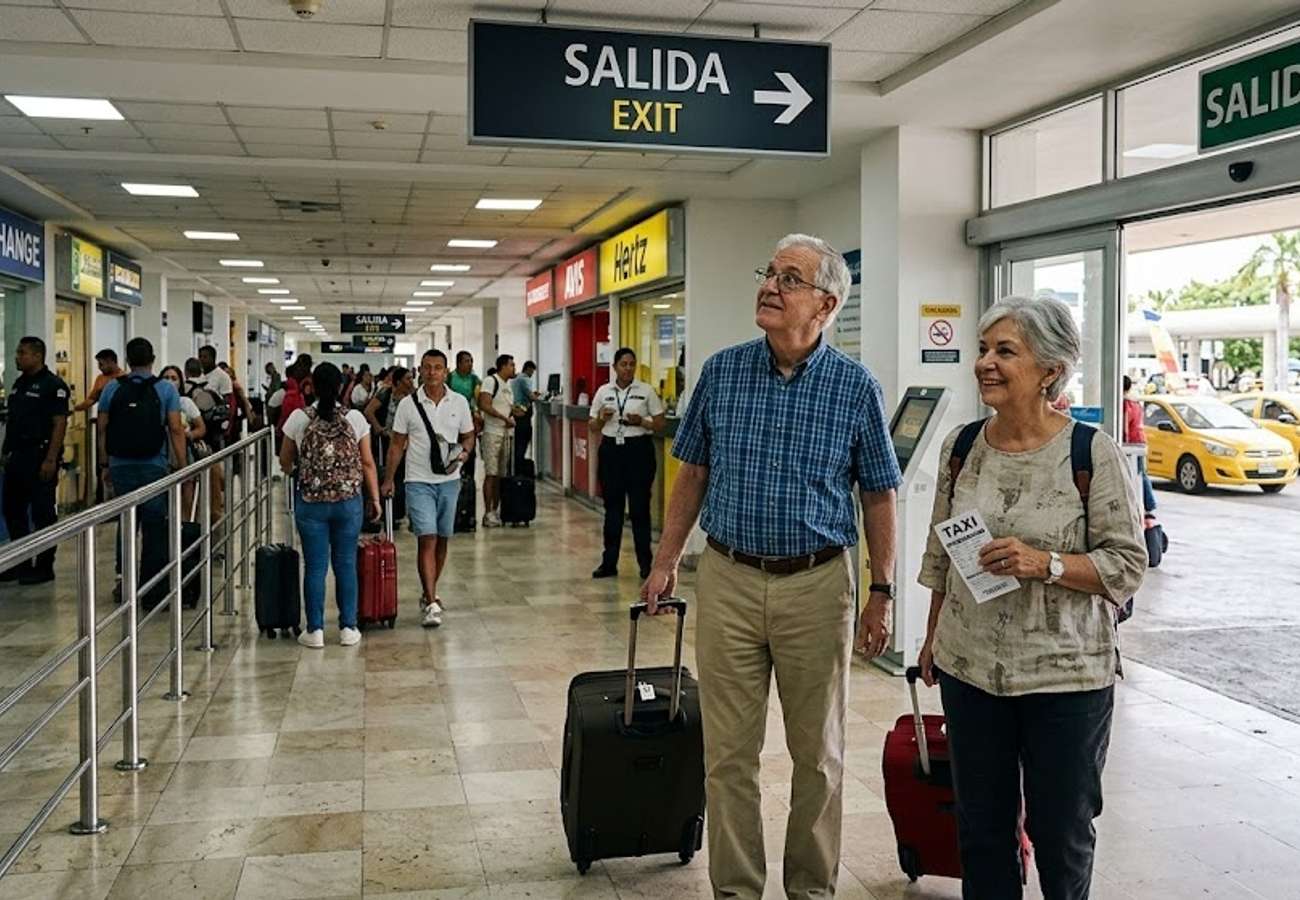
Image generated by AI
Navigating Rafael Núñez International Airport can feel chaotic during peak hours, but understanding its compact layout ensures a smooth arrival in Cartagena. Here is exactly where to find baggage claim, official taxis, and car rentals.
Understanding the Overall Layout of Rafael Núñez Airport
Rafael Núñez International Airport (CTG) sits along Avenida Santander in the Crespo neighborhood, just a short drive north of Cartagena’s walled city. While smaller than major international hubs, the terminal handles both domestic and international zones within one continuous building. Ongoing expansion works and a planned new international terminal mean some areas are under remodeling, but the fundamental arrival flow remains unchanged. Passengers deplane via jet bridge or stairs to buses, funnel into immigration, proceed to baggage claim, and enter a compact public arrivals hall.
For orientation, imagine the terminal as a rectangle parallel to the runway. Departures are located on the upper or front side of the building, while arrivals flow out at ground level toward the parking lots and main road. Travelers spend almost all their arrival time at ground level, moving from the aircraft side of the building to the street side in a straight line: immigration or domestic corridor, then baggage claim, then customs, and finally the public arrivals hall and exit doors.
Domestic arrivals typically feed into the western side of the terminal, serving frequent Avianca and LATAM routes from Bogotá and Medellín. International arrivals are processed on the eastern side, welcoming flights from Miami, Orlando, New York, Panama City, and Madrid. After clearing immigration or the domestic arrivals corridor, both passenger streams merge into a shared baggage and arrivals area. Here, travelers find currency exchange counters, small cafés, seasonal SIM card kiosks, car rental desks, and interior taxi booths before stepping outside.
Domestic vs. International Arrivals: What Changes
Domestic and international passengers at Rafael Núñez follow slightly different initial routes but ultimately converge in the same location. Domestic flights from Bogotá, Medellín, or Cali bypass passport control, leading directly to a short corridor and dedicated baggage belts. The space often feels more like a regional bus terminal than a large airport. Overhead signage in Spanish and English points travelers toward “Reclamo de Equipaje / Baggage Claim” and then “Salida / Exit.” Travelers with only carry-on luggage can reach the public arrivals hall in 10–15 minutes.
International arrivals must pass through immigration before reaching baggage claim. Depending on concurrent flight arrivals, immigration queues can last 30–45 minutes. After passports are stamped, passengers descend or walk forward into the baggage hall, where carousels serve both international and some domestic flights. From touchdown to exit, international travelers should expect to spend 30–60 minutes.
Both domestic and international travelers exit through the same general ground-level doors. Drivers, family members, and tour representatives wait behind barriers or just outside the sliding glass doors. A common point of confusion for mixed groups is assuming there are separate public exits for domestic and international arrivals. When coordinating a pickup, agree to meet “outside arrivals by the taxi kiosks” or “just beyond the main sliding doors near the parking lot crosswalk” rather than specifying domestic or international exits.
Inside Arrivals: Baggage Claim, Customs, and Services
The baggage claim area is compact, making it easy to spot all belts from the center of the room. Monitors can be slow to update, so look for your specific flight number on the screens rather than relying solely on staff announcements. Luggage carts may be scarce during peak times, making a simple wheeled suitcase a practical choice so you are not dependent on finding a cart.
After collecting bags, a short walk leads to customs. Officers sometimes wave passengers through in flows, and at other times require every bag to pass an X-ray. The corridor can narrow here, causing lines to back up. Keep your passport and customs form or QR confirmation ready, and avoid blocking the exit by stopping to repack bags until you have fully cleared into the public arrivals hall. If carrying duty-free liquids such as rum or perfume, keep them sealed in their original bags to avoid delays. Officers may briefly inspect bags, especially if you are carrying large electronics or boxed items.
Just beyond customs, travelers will find immediate arrival services. Depending on the season and hour, currency exchange desks, a small café, and telecom counters operated by Colombian operators such as Claro or Tigo offer prepaid SIM cards. Travelers frequently report paying the equivalent of 8 to 15 US dollars for a week of data. However, stock and pricing change, and kiosks do not always operate late at night, so having minimal roaming enabled on your main phone is advised.
Car rental counters are also located in this interior arrivals area. Brands serving Cartagena include international names alongside local firms, most operating small booths rather than full offices. If you have a reservation, follow the “Alquiler de Autos / Car Rental” signs after exiting customs. Staff will complete paperwork at the counter and then escort you or direct you to their parking slots in the lot across the road. Walk-up inventory can be tight during holiday periods, and walk-up prices can be significantly higher than pre-booked rates.
Exiting the Terminal: Taxi Doors, Pickup Points, and Rideshares
Almost every arriving traveler at Rafael Núñez eventually funnels toward the same set of sliding glass doors at the front of the arrivals hall. Immediately before these doors are official taxi kiosks or desks staffed by uniformed attendants. These kiosks serve as the starting point for most taxi rides into town.
To use this service, tell the attendant your destination, such as “Centro Histórico,” “Getsemaní,” or “Bocagrande.” The attendant consults a printed table of fixed fares and prints or hands you a ticket displaying the price. You then take this ticket outside, where an official taxi driver accepts it and drives you to your destination, usually with no need to negotiate again.
Outside, the terminal opens onto a one-way roadway that loops past the building with separate curb space for private vehicles, hotel shuttles, and official taxis. Surface parking is located directly across from the terminal, with additional long-stay lots slightly farther back. Because only one main road serves the airport, vehicles often stack up in several lanes, and there is little shade. Knowing ahead of time where you intend to meet your ride and which doors to use can save several confusing minutes navigating crowds and touts.
CTG Airport Terminal Quick Reference
| Airport Feature | Details |
|---|---|
| Airport Name | Rafael Núñez International Airport (CTG) |
| Location | Avenida Santander, Crespo neighborhood, Cartagena |
| Domestic Arrivals | Western side (Avianca, LATAM from Bogotá, Medellín) |
| International Arrivals | Eastern side (Miami, Orlando, New York, Panama City, Madrid) |
| Domestic Arrival Time | 10–15 minutes (carry-on only) |
| International Arrival Time | 30–60 minutes (depending on queues) |
| SIM Card Cost | 8 to 15 US dollars (approx. for one week of data) |
| Taxi Kiosk Locations | Immediately before the sliding glass doors at the front of arrivals |
Key Takeaways
- Rafael Núñez International Airport features a single continuous building for both domestic and international arrivals.
- Domestic passengers can exit the airport in as little as 10–15 minutes if they have carry-on luggage.
- International arrival times vary from 30 to 60 minutes based on immigration queue lengths.
- Official taxi kiosks inside the arrivals hall issue fixed-fare tickets, eliminating the need to negotiate with drivers.
- Car rental desks are located just beyond customs, but booking in advance is highly recommended during peak holiday periods.
FAQ
Is there a difference between domestic and international exits at CTG? No, both domestic and international passengers exit through the same general ground-level doors at the arrivals hall.
How much does a SIM card cost at Rafael Núñez Airport? Prepaid SIM cards from operators like Claro or Tigo typically cost the equivalent of 8 to 15 US dollars for a week of data, though availability can vary late at night.
Do I need to negotiate taxi fares at Cartagena Airport? No, you tell the attendant at the official taxi kiosk your destination, and they print a ticket with a fixed fare. You hand this ticket to the driver outside.
Are there luggage carts available at baggage claim? Luggage carts are available but may be scarce during peak arrival times. Travelers are advised to use wheeled suitcases if possible.
[Plan your ground transfer ahead of time to make the most of your trip to Cartagena's Caribbean coast.]
Related Travel Guides
Disclaimer
This article is for informational and educational purposes only. It does not constitute legal, financial, or professional advice. While we strive to provide accurate and up-to-date information, travel policies, regulations, and conditions change rapidly. Always verify information with official sources before making travel decisions. Nomad Lawyer makes no representations about the accuracy, reliability, completeness, or suitability of the information provided. Readers should consult qualified professionals for advice specific to their circumstances. The views expressed in this article are those of the author and do not necessarily reflect the views of Nomad Lawyer.
Raushan Kumar
Founder & Lead Developer
Full-stack developer with 11+ years of experience and a passionate traveller. Raushan built Nomad Lawyer from the ground up with a vision to create the best travel and law experience on the web.
Learn more about our team →