
Overturned SUV Crash Chokes Traffic Near Donald J. Trump International Airport in Palm Beach County Stranding Travelers on July 30 2026
An overturned SUV near the recently renamed Donald J. Trump International Airport in Palm Beach County caused major traffic gridlock, stranding travelers heading to flights and disrupting local commuters.

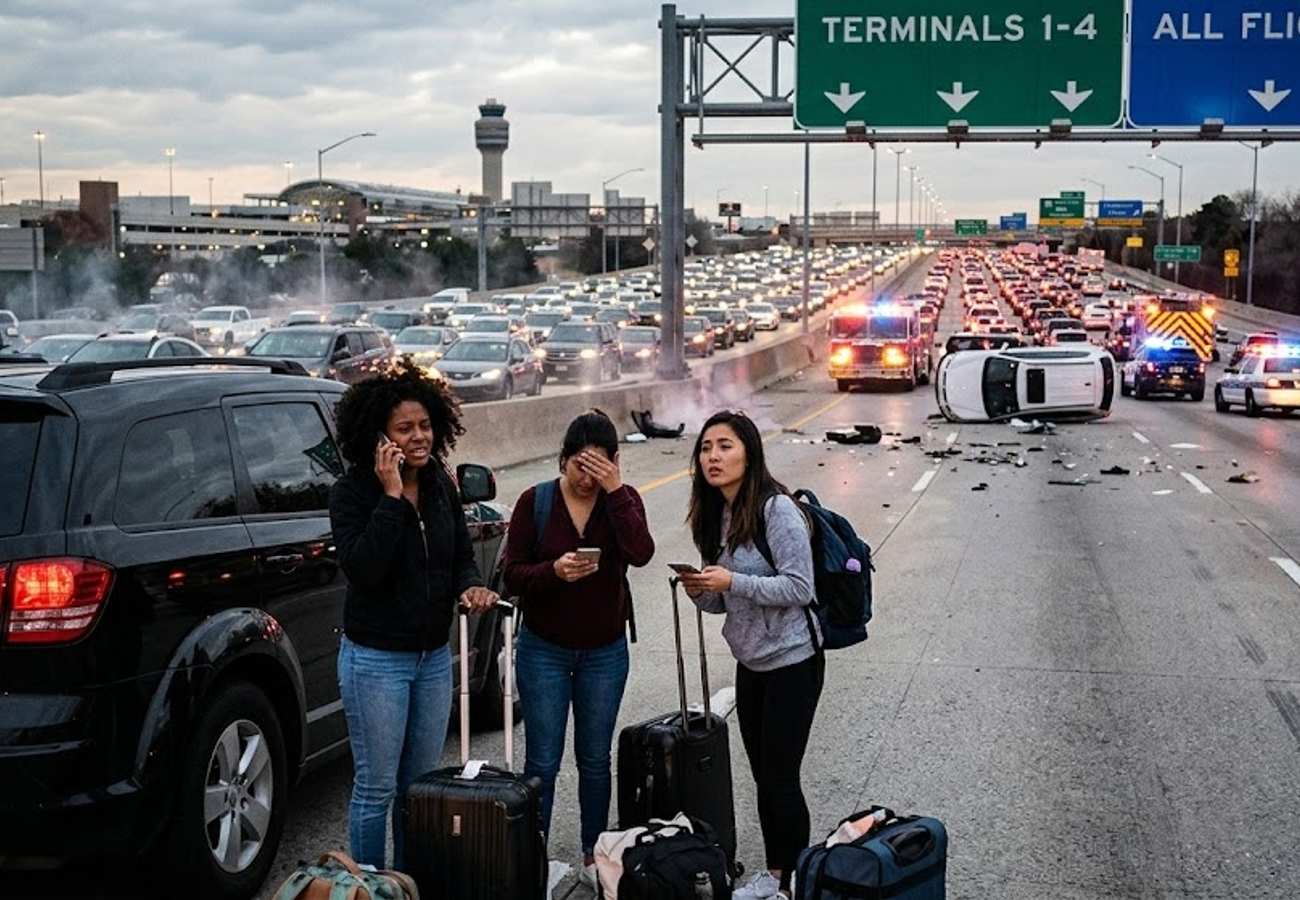
Image generated by AI
A single overturned SUV brought traffic to a near-standstill along the main access routes serving the newly renamed Donald J. Trump International Airport in Palm Beach County on July 30, 2026, leaving travelers stranded in gridlock while emergency crews worked to stabilize the vehicle and clear debris from the roadway. The incident, which unfolded during a peak travel window, forced lane closures, rerouted hundreds of vehicles, and raised fresh questions about the resilience of the airport's limited road network — just weeks after the facility's controversial rebranding drew national scrutiny to its infrastructure.
SUV Overturns Near Key Airport Connector in Palm Beach County
Traffic approaching the primary access roads feeding Donald J. Trump International Airport slowed to a crawl after an SUV overturned near the airport perimeter, according to early media reports and social media posts from motorists at the scene. The vehicle ended up resting on its side along a critical connector route that channels vehicles toward the terminal complex, prompting officials to block at least one direction of travel while first responders assessed the situation.
Images shared by stranded drivers showed long lines of brake lights stretching back toward nearby highway interchanges. Several travelers exited rideshares and taxis to gauge how far they remained from the terminals, with some reporting on social platforms that they were considering abandoning their vehicles altogether and walking the remaining distance. The crash site's proximity to the airport's main boulevard — a corridor that links the terminal area to the broader interstate network — meant that even vehicles not directly behind the overturned SUV were caught in the ripple effect.
Publicly available traffic camera feeds confirmed that congestion spread rapidly beyond the immediate crash zone. Intersections that typically function as relief routes during heavy airport traffic also became clogged as drivers attempted to bypass the blocked lanes, creating a cascading delay pattern that extended well into surrounding communities.
Travelers Face Missed Flights and Rebooked Departures
The crash occurred during a window when both commuter traffic and leisure travel around the Palm Beach area are typically at their heaviest, compounding the disruption for passengers attempting to reach Donald J. Trump International Airport for scheduled departures. Travel-planning platforms and airline guidance generally recommend arriving well ahead of flight times, but the sudden onset of gridlock left many drivers contending with delays that far exceeded standard buffer recommendations.
Reports from the scene described vehicles inching forward for extended stretches. Some rideshare drivers advised passengers to seek alternative drop-off points away from the central terminal loop, after which travelers walked along sidewalks and service roads to reach check-in counters before cutoff deadlines. The combination of late-arriving passengers and crew members commuting through the same congested corridors threatened to ripple through afternoon departure banks, even though there were no immediate indications of widespread flight cancellations directly tied to the crash.
Local hospitality businesses also felt the impact. Airport-adjacent hotels and off-site parking operators reported that courtesy shuttles and buses became trapped in the same congestion pattern, running significantly behind schedule. Several travelers posted on social media that their pre-arranged parking vans were delayed by what appeared to be more than an hour, adding another layer of uncertainty for those already cutting it close for departure.
Emergency Response and Phased Lane Reopenings Near Trump-Named Airport
Emergency crews arrived at the overturned SUV with fire engines, law enforcement vehicles, and medical units, further narrowing the available roadway space while stabilization and assessment work proceeded. Traffic advisories indicated that lanes remained closed for an extended period as responders evaluated vehicle stability and ensured that any occupants received appropriate medical attention.
Once the SUV was secured and lifted for removal, tow operators and road-maintenance personnel shifted focus to clearing glass and scattered debris that could pose hazards to high-speed, airport-bound traffic. Officials managing the roadway network appeared to implement phased lane reopenings, allowing a limited flow of vehicles through while heavy equipment remained on-site.
Traffic-mapping services showed gradual improvement as the scene was brought under control, but residual congestion persisted well after the overturned vehicle had been removed. The concentration of ramps, merges, and short weaving distances typical of major airport corridors means that bottlenecks often linger long after the primary obstruction is cleared. Observers noted that the complex layout of access roads feeding Donald J. Trump International Airport, combined with regular commercial truck traffic and local commuter flows, added to the difficulty of quickly dispersing the backlog created by the crash.
Renamed Airport Corridor Faces Early Infrastructure Stress Test
The traffic disruption unfolded against the backdrop of a recent legislative decision to rename Palm Beach International Airport as Donald J. Trump International Airport — a move that has drawn national attention and scrutiny to the facility and its surrounding infrastructure. With signage updates and navigation systems gradually reflecting the new name, the crash served as an early stress test of how well the access network manages sudden incidents under heightened public focus.
Transportation analysts have previously highlighted the challenges of balancing local commuter needs with the demands of an international airport situated close to dense residential and commercial districts. In the Palm Beach area, access is funneled through a small set of primary roads and interchanges, leaving motorists with few quick alternatives when a serious crash blocks lanes near the airport boundary. Route redundancy and clear wayfinding are widely regarded as essential for airports that depend on a limited number of highway corridors.
The heightened visibility surrounding the Trump-associated airport name is likely to keep future incidents in the spotlight, prompting renewed discussion about whether additional investments in signage, traffic control, and alternate access routes are warranted to improve resilience when crashes or other disruptions occur near the facility.
How Drivers Can Navigate Future Airport Access Disruptions
Following the incident, travel and transportation resources emphasized the importance of monitoring live traffic updates when approaching Donald J. Trump International Airport, particularly during peak travel periods and busy seasons. Many navigation apps now integrate real-time speed data and user-generated reports, offering drivers dynamic re-routing options when crashes or lane closures are detected.
Travel planners generally advise building in extra travel time and identifying backup routes in advance, especially in regions where a single corridor handles the majority of airport-bound traffic. Even minor incidents can quickly escalate into substantial delays in such configurations. Residents and frequent flyers in Palm Beach County are increasingly familiar with the constraints of the airport's access network, and many opt for earlier departures from home or hotel — particularly when weather or holiday travel adds risk to the drive.
Local transportation services, from taxis to premium car operators, frequently track road conditions and may adjust pick-up times when reports indicate major incidents near airport interchanges. While traffic around Donald J. Trump International Airport typically flows smoothly outside of rush hours and special events, the overturned SUV episode illustrated how rapidly conditions can shift, reinforcing the value of flexible planning and up-to-the-minute information for anyone relying on the busy corridors that frame the airport.
Why This Matters for Travelers and Airport Infrastructure Planning
For the traveler, this incident underscores a reality that flight-tracking apps and airline notifications cannot solve: ground access to airports is often the weakest link in the journey. A passenger can have a perfectly scheduled flight, an on-time boarding pass, and a confirmed rideshare — only to lose all of that to a single vehicle rolling onto its side a mile from the terminal. The Palm Beach County crash is a textbook example of how fragile airport access networks become when they rely on a limited set of road corridors with little built-in redundancy.
From an infrastructure and planning standpoint, the timing of this disruption is especially significant. The renaming of Palm Beach International Airport to Donald J. Trump International Airport has already placed the facility under a magnifying glass. Every traffic jam, every signage confusion, and every access-road failure now carries political and public-relations weight that extends well beyond standard transportation concerns. Local officials and aviation authorities will likely face increasing pressure to demonstrate that the rebranding is accompanied by tangible improvements to road capacity, wayfinding systems, and incident-response protocols — not just new signs on the terminal facade.
For frequent flyers and business travelers who depend on this airport, the practical takeaway is straightforward: treat ground access as a variable risk. Build in a buffer of at least 30 to 45 minutes beyond normal travel time during peak windows, identify at least one alternative route before leaving, and monitor real-time traffic feeds rather than relying on static GPS estimates. The difference between catching a flight and missing it may come down to a single overturned vehicle and whether you had a plan for getting around it.
When one SUV can paralyze an entire airport corridor, the conversation about infrastructure is no longer optional — it is urgent.
Related Travel Guides
Disclaimer
This article is for informational and educational purposes only. It does not constitute legal, financial, or professional advice. While we strive to provide accurate and up-to-date information, travel policies, regulations, and conditions change rapidly. Always verify information with official sources before making travel decisions. Nomad Lawyer makes no representations about the accuracy, reliability, completeness, or suitability of the information provided. Readers should consult qualified professionals for advice specific to their circumstances. The views expressed in this article are those of the author and do not necessarily reflect the views of Nomad Lawyer.
Raushan Kumar
Founder & Lead Developer
Full-stack developer with 11+ years of experience and a passionate traveller. Raushan built Nomad Lawyer from the ground up with a vision to create the best travel and law experience on the web.
Learn more about our team →