Oregon and Portland Thanksgiving Road Trip Guide 2026: Falling Gas Prices, I-5 Traffic, and Routes

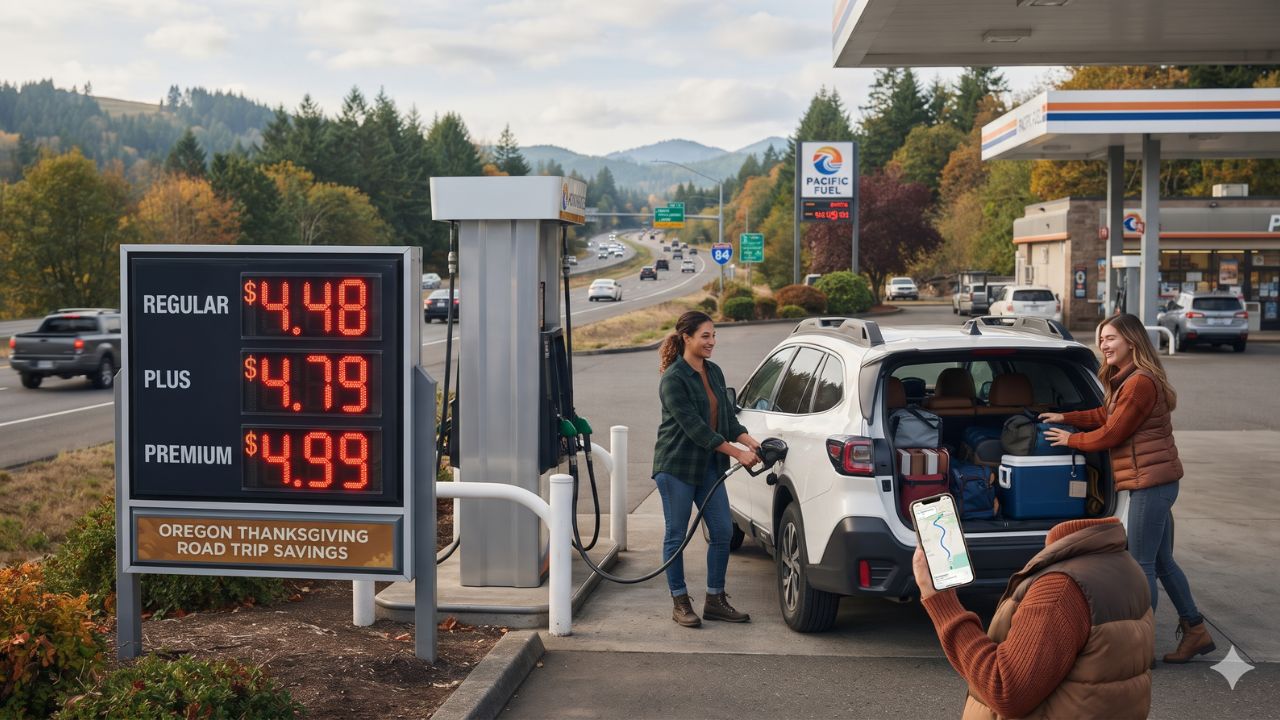
While nearly 73 million Americans take to the highways for Thanksgiving this year, motorists crossing the Interstate Bridge between Portland, Oregon, and Vancouver, Washington, face an immediate 20-cent-per-gallon pump jump simply by traversing state lines.
As families across the Pacific Northwest pack vehicles for the holiday exodus, a welcome shift in wholesale energy markets is easing pump prices at petrol stations from the Willamette Valley to the High Desert. According to monitoring from AAA, pump prices fell in all 50 states during the week ending 17 November 2026. Driven by softening seasonal consumption, falling crude oil benchmarks, and refineries transitioning to cheaper winter-blend fuel, Oregon's statewide average dropped to $4.427 per gallon. While Oregon remains the fifth most expensive state in the nation for motor fuel, the autumn price decline provides tangible financial relief for travelers planning journeys across Interstate 5, the Oregon Coast Highway, and US Route 26.
Fuel Economics: National Baselines vs. Pacific Northwest Realities
The national fuel market reveals significant cost relief compared to late autumn. Across the United States, regular petrol averaged $3.782 per gallon on 17 November 2026, down 19.7 cents from $3.979 the previous week and 52.7 cents lower than the October peak of $4.309. However, longer-term historical benchmarks illustrate that driving costs remain elevated: in November 2025, regular petrol averaged $3.073, meaning drivers still pay approximately 70.9 cents more per gallon than they did a year ago.
Independent data from the US Energy Information Administration confirmed the downward momentum, recording regular petrol at $3.805 and on-highway diesel at $5.937 on 16 November, each dropping 19 cents week-over-week.
Across Oregon, regional price variances create sharp distinctions between neighboring counties. Motorists filling a typical 15-gallon tank in Portland pay an average of $67.20 ($4.480 per gallon), whereas drivers in the mid-valley agricultural hub of Albany pay $61.55 ($4.103 per gallon)—a direct savings of $5.65 per fill-up.
| Location / Reporting Zone | Regular Petrol (17 Nov 2026) | One Week Earlier | One Month Earlier | Fuel Market Context |
|---|---|---|---|---|
| US National Average | $3.782 / gal | $3.979 / gal | $4.309 / gal | Nationwide decline across all 50 states |
| Oregon Statewide Average | $4.427 / gal | $4.620 / gal | $4.953 / gal | 5th highest priced state in the US |
| Portland Metro | $4.480 / gal | $4.657 / gal | $5.008 / gal | Urban supply and municipal transport fees |
| Salem | $4.243 / gal | $4.470 / gal | $4.812 / gal | Mid-valley transit corridor savings |
| Albany | $4.103 / gal | $4.331 / gal | $4.749 / gal | Lowest recorded metro average in western Oregon |
| Eugene & Springfield | $4.319 / gal | $4.573 / gal | $4.944 / gal | Gateway to the Southern Willamette Valley |
| Bend & Central Oregon | $4.335 / gal | $4.543 / gal | $4.862 / gal | Trans-Cascades mountain crossing fuel hub |
| Pendleton | $4.540 / gal | $4.708 / gal | $4.929 / gal | Eastern Oregon Columbia Plateau route |
| Vancouver, Washington | $4.678 / gal | $4.864 / gal | $5.219 / gal | Washington state carbon and fuel taxes apply |
Nationally, the western states dominate the highest fuel expenses in the country. Hawaii ranks first at $5.60 per gallon, followed by California at $5.54, Nevada at $4.88, Washington at $4.79, and Oregon at $4.43. Alaska ($4.41), Pennsylvania ($4.20), Washington D.C. ($4.14), Illinois ($4.12), and New York ($4.12) complete the ten most expensive fuel markets.
Thanksgiving Mobility: 81.5 Million Holiday Journeys
The relief at the pump arrives as American holiday travel approaches near-record volumes. AAA projects that 81.5 million Americans will travel at least 50 miles from home between 24 and 30 November 2026. Automobile journeys command 72.9 million of those travelers—representing 89.4 percent of all Thanksgiving movements nationwide.
Air travel accounts for 5.96 million domestic passengers, where average domestic round-trip airfares hover around $800, while buses, passenger trains, and cruises accommodate the remaining 2.6 million travelers. Although total travel numbers trail slightly behind the record 81.6 million logged in 2025, regional highways will experience intense pressure.
Traffic modeling conducted with transportation analytics firm INRIX identifies Tuesday, 24 November, and Wednesday, 25 November, as the most severe outbound departure days, particularly between 14:00 and 18:30. In Oregon, northbound Interstate 5 between Eugene and Portland is projected to suffer travel times approximately 64 percent longer than normal on Wednesday afternoon as university students and holidaymakers converge on the metropolitan core. Return traffic surges sharply on Sunday, 29 November, and Monday, 30 November.
What Makes an Oregon Road Trip Different
Driving through Oregon in late November means transitioning through diverse ecological and geological microclimates within hours. A morning drive starting along the misty coastal rainforests of Ecola State Park on Highway 101 can lead through the vineyards of the Willamette Valley by noon, before ascending the snow-dusted Douglas fir stands of Government Camp on Mount Hood along Highway 26.
Unlike California or Washington, Oregon historically maintained strict bans on self-service gasoline. While recent legislative revisions allow drivers in most counties the choice to pump their own fuel, full-service attendants remain on duty at virtually every station at no extra charge. Pulling up to an independent pump station in McMinnville or Hood River and having an attendant check your oil and clean road salt from your windshield remains an enduring Pacific Northwest travel tradition.
Visitor Insider Tips
- Cross-Border Fuel Arbitrage: If driving between Seattle and Portland, fill your tank south of the state line in Oregon. Washington’s state fuel and carbon fees make petrol in Vancouver, Washington ($4.678) roughly 20 cents more expensive per gallon than in Portland ($4.480) and 57 cents higher than in Albany ($4.103).
- Mountain Pass Traction Requirements: November storms over the Cascade Range require immediate traction tires or tire chains on passes like Santiam Pass (US 20) and Willamette Pass (OR 58). Before departing, consult real-time road cameras and traction tire mandates on TripCheck by the Oregon Department of Transportation.
- Thanksgiving Day Coastal Escapes: Beat the Interstate 5 gridlock by heading west. The Oregon Coast between Cannon Beach and Newport is serene in late November. Stop at local harbor docks in Garibaldi for freshly boiled Dungeness crab fresh off commercial fishing boats.
- Regional Discovery Portals: Find scenic byway itineraries, seasonal farm stands, and indigenous heritage sites through Travel Oregon.
Cultural and Environmental Context
The high volume of private vehicle journeys underscores the Pacific Northwest’s complex environmental balance. Oregon has been a pioneer in state-level climate initiatives, investing heavily in the West Coast Electric Highway, a dense network of high-speed electric vehicle charging stations spanning every major corridor.
While lower pump prices temporarily ease family budgets, burning tens of millions of gallons of petroleum along the Cascadia corridor increases particulate emissions in confined valleys. Practicing vehicle maintenance, checking tire pressures before climbing mountain passes, and carpooling minimizes environmental footprints. In rural timber towns across Douglas and Lane counties, supporting farm-to-table diners and independent cooperative markets ensures holiday spending directly supports multigenerational rural communities.
FAQ: Oregon Thanksgiving Travel 2026
What is the average price of gas in Oregon before Thanksgiving?
As of 17 November 2026, regular petrol averaged $4.427 statewide, with Portland averaging $4.480 and Albany recording the lowest metro average at $4.103 per gallon.
How many Americans are driving for Thanksgiving 2026?
AAA projects that 72.9 million Americans will travel by automobile between 24 and 30 November 2026, accounting for 89.4 percent of all holiday journeys.
When will traffic be worst on Oregon highways?
Outbound congestion peaks on Wednesday afternoon, 25 November, with I-5 northbound between Eugene and Portland taking 64 percent longer than usual. Return traffic peaks on Sunday, 29 November.
Do I have to pump my own gas in Oregon?
While recent law allows self-service petrol dispensing across Oregon, stations are legally required to offer full-service attendant fueling at identical prices.
Related Travel Guides
- American Airlines Ramps Up Caribbean Winter Hub at Miami
- Andean Slow Transit for Solo Female Travelers Across Peru and Chile
- Eastern US Warms Up Ahead of Thanksgiving Travel Rush Guide
By fueling up smartly in lower-cost valleys and timing mountain pass crossings ahead of peak congestion, holiday travelers can enjoy the untamed beauty of the Pacific Northwest with total peace of mind.
This article is for informational purposes. Flight routes, passenger regulations, visa rules, and transit advisories are subject to change by airlines and aviation authorities. Readers are advised to verify schedules and travel documentation with relevant carriers and border agencies before departure.
Related Stories

Eastern US Warms Up Ahead of Thanksgiving Travel Rush: Mild Forecasts, Florida Floods, and Route Guide

Andean Slow Transit for Solo Female Travelers: Luxury Rail, Bus-Cama Networks, and Safety Across Peru and Chile