
Northwest Airlines Flight 255 Memorial: Families Honor 156 Victims 39 Years After Michigan Crash
Families and first responders gathered in Romulus, Michigan, to commemorate the 39th anniversary of Northwest Flight 255, a disaster that claimed 156 lives and reshaped aviation safety.

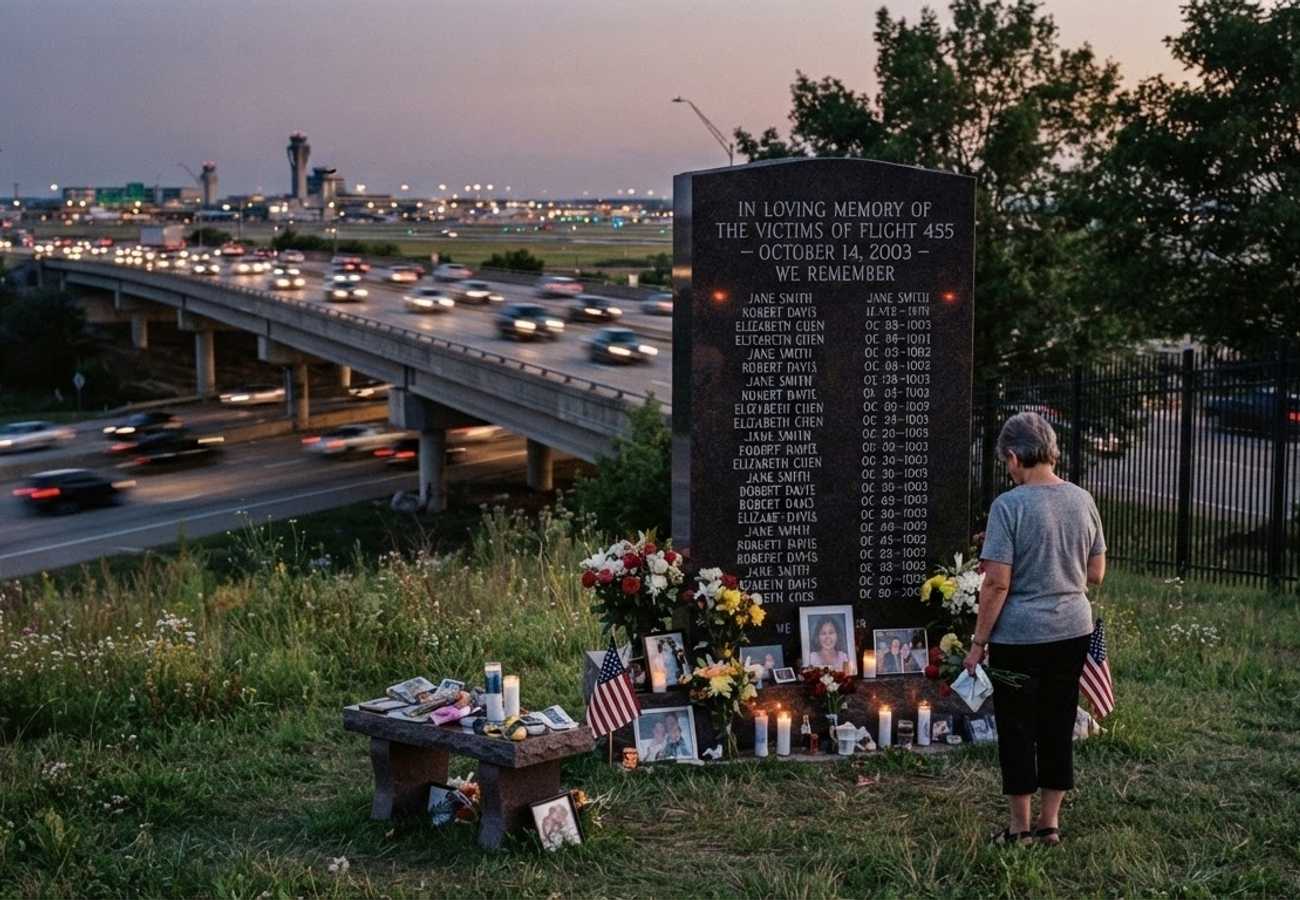
Image generated by AI
ROMULUS, MI — Families of the deceased and veteran first responders converged on a roadside sanctuary near Detroit Metropolitan Wayne County Airport this week to mark the 39th anniversary of the Northwest Airlines Flight 255 catastrophe. The gathering honored the 156 individuals who perished in one of the most devastating aviation accidents in Michigan's history, while remembering the single four-year-old survivor.
The tragedy occurred on the evening of August 16, 1987, when a McDonnell Douglas MD-82 plummeted shortly after takeoff, leaving a scar on the local community that remains visible nearly four decades later.
Roadside Remembrance Amidst Airport Traffic
The annual observance centers on a granite monument positioned by the eastbound on-ramp of Interstate 94 and Middlebelt Road. This site sits just a short distance from the precise location where the aircraft crashed 39 years ago. According to reports, the memorial was established in the mid-1990s to replace temporary tributes, providing a permanent sanctuary for reflection amidst the noise of one of the region's busiest transportation corridors.
During the 39th anniversary event, attendees were seen placing photographs and fresh flowers at the base of the stone marker, which bears the names of the 156 victims, including two individuals who were on the ground at the time of impact. As dusk approached, the group observed a period of silence, coinciding with the original 8:46 p.m. crash time.
Industry observers note that the memorial's location—tucked away from the main airport terminal—creates a paradoxical sense of peace. While the sounds of departing aircraft and highway traffic are constant, the physical separation from the airport's security lines and ticket counters allows grieving families to focus entirely on the memory of their lost loved ones.
Technical Failures and the Tragedy of Flight 255
Historical accident records reveal that Northwest Airlines Flight 255 was bound for Phoenix, Arizona, with a scheduled stop in Santa Ana, California. On the night of August 16, 1987, the aircraft attempted to lift off from Runway 3 Center. However, the jet failed to gain sufficient altitude, clipping light poles and vehicles along Middlebelt Road before crashing beside the interstate and erupting into a massive post-impact fire.
The human toll was staggering: 154 of the 155 passengers and crew on board were killed, alongside two people on the ground. The sole survivor was a four-year-old girl from Arizona, a detail that has been highlighted in numerous documentaries exploring the disaster's aftermath.
Official investigative reports pinpointed a combination of human error and mechanical failure. The findings indicated that the cockpit crew had failed to complete the mandatory taxi checklist, resulting in the wing flaps and slats not being properly set for takeoff. Furthermore, investigators found that the aircraft's takeoff warning system lacked electrical power, meaning the crew received no alert regarding the incorrect configuration before the wheels left the tarmac.
A Multi-Generational Commitment to Memory
The tradition of returning to Romulus every August began shortly after the crash. Over the decades, these gatherings have evolved from large, formal ceremonies to more intimate, private reflections. Significant milestones—including the 20th, 25th, 30th, and 35th anniversaries—saw larger organized events, while the 7th anniversary marked the unveiling of the permanent granite marker.
Reports indicate that relatives travel from across the United States to attend these observances. For many, the site serves as a vital connection point, allowing families to maintain bonds forged in the trauma of 1987. In recent years, the presence of grandchildren and children of the victims has increased, transforming the event into a living history lesson on resilience and aviation safety.
The Lasting Impact on First Responders
The anniversary is not only for the families but also for the police, fire, and medical personnel who first arrived on the scene. For these responders, the night of August 16 remains a professional and emotional watershed.
Contemporary accounts describe a scene of absolute chaos: wreckage scattered across residential areas and highways, downed power lines, and intense fires. The scale of the disaster pushed the triage and mutual aid systems of the entire Detroit metropolitan region to their absolute limits.
Many of these responders continue to visit the memorial to acknowledge the emotional weight of that night. By sharing their stories in books and documentaries, they seek to honor the victims and the recovery teams who worked for weeks in the debris long after the international media attention had faded.
Aviation Safety Legacy and Systemic Change
The fallout from Flight 255 extended far beyond the crash site, triggering a systemic shift in how airlines handle takeoff procedures. Aviation histories cite this disaster as a primary driver for the reinforcement of checklist discipline and the implementation of more rigorous Cockpit Resource Management (CRM) practices.
The failure of the takeoff warning system on the MD-82 led to a renewed industry focus on the redundancy of warning configurations. Today, the accident is frequently used as a case study in aviation training programs to illustrate how a "chain of errors"—combining human oversight with mechanical failure—can lead to catastrophe.
In the local community, the memory of the flight is preserved through school programs and church services. As the 40th anniversary approaches, the Romulus memorial stands as a testament to the enduring need for vigilance in the skies and the unbreakable bond of those left behind.
A silent vigil continues to stand guard over the lessons learned from a tragic August night.
Related Travel Guides
Disclaimer
This article is for informational and educational purposes only. It does not constitute legal, financial, or professional advice. While we strive to provide accurate and up-to-date information, travel policies, regulations, and conditions change rapidly. Always verify information with official sources before making travel decisions. Nomad Lawyer makes no representations about the accuracy, reliability, completeness, or suitability of the information provided. Readers should consult qualified professionals for advice specific to their circumstances. The views expressed in this article are those of the author and do not necessarily reflect the views of Nomad Lawyer.
Preeti Gunjan
Contributor & Community Manager
A passionate traveller and community builder. Preeti helps grow the Nomad Lawyer community, fostering engagement and bringing the reader experience to life.
Learn more about our team →