
Northeast Storms Trigger Nationwide Flight Chaos Stranding Passengers in West Palm Beach 2026
Severe weather in the Northeast corridor caused a systemic collapse of flight schedules, leading to massive diversions and overnight strandings at Palm Beach International Airport.

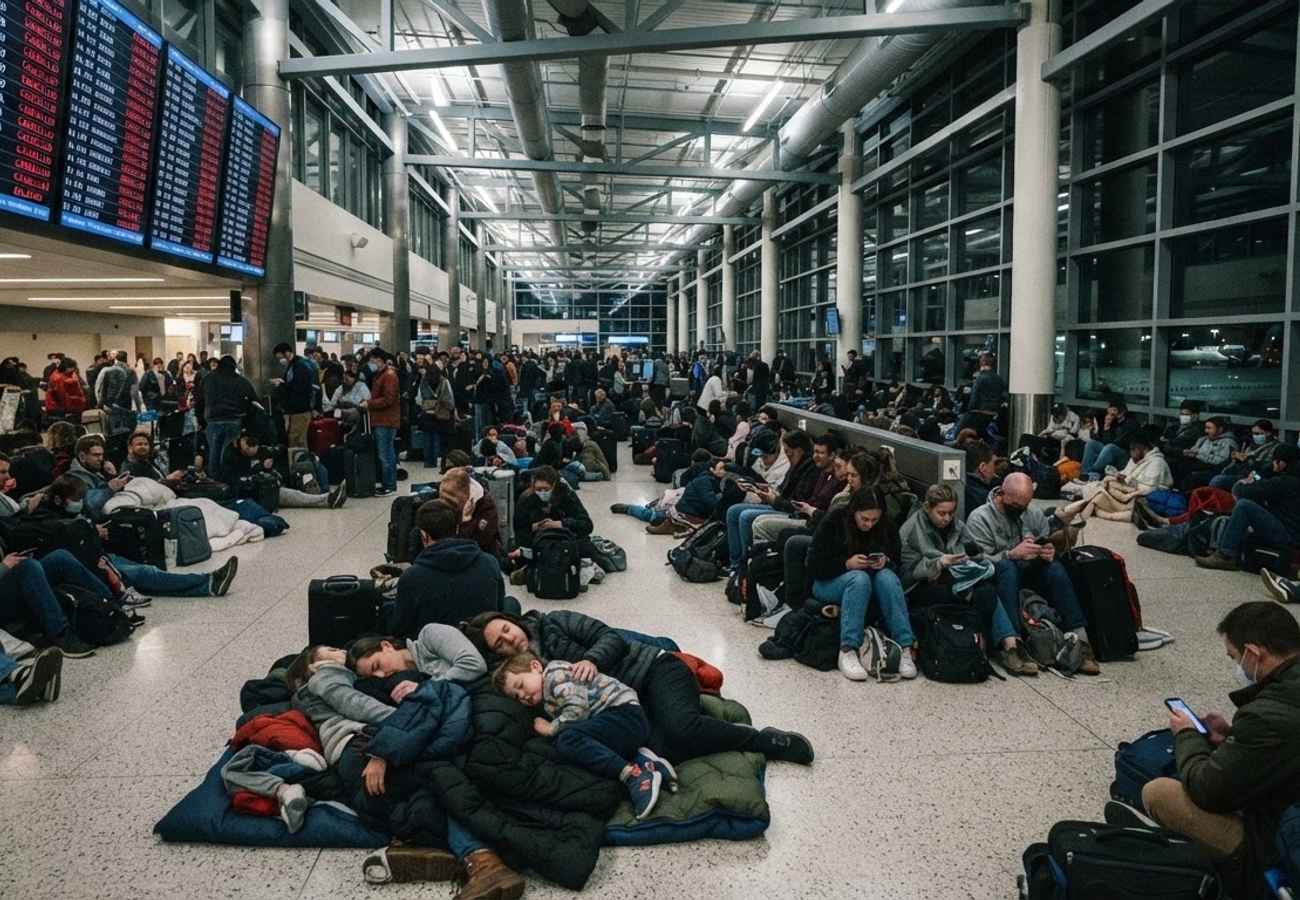
Image generated by AI
[City, September 2, 2026] — A series of violent convective storms across the Northeast United States has ignited a systemic failure in the national airspace, resulting in widespread cancellations and diversions that left hundreds of passengers stranded overnight in West Palm Beach. The disruption highlights the fragility of the U.S. aviation network, where weather events in one region can paralyze travel thousands of miles away.
The crisis began late last week when intense weather systems settled over the critical New York and New England air corridors. Because these hubs serve as the primary arteries for a vast portion of domestic and international traffic, the resulting bottlenecks created a "domino effect." As aircraft and flight crews were held on the ground or forced into lengthy detours to avoid storm cells, subsequent flight legs were canceled across the country, even in regions experiencing clear skies.
FAA Weather Avoidance Plans Paralyze Northeast Hubs
Data from the Federal Aviation Administration’s (FAA) Air Traffic Control System Command Center confirms that severe weather avoidance plans were triggered across the New York and New England regions on multiple days. These protocols, while necessary for safety, severely limit the volume of traffic that can enter or exit major hubs, often necessitating the implementation of ground delay programs.
Industry observers note that the concentration of air traffic in the Northeast makes it a single point of failure for the national schedule. When the FAA restricts routes into New York or Boston, aircraft are displaced from their scheduled rotations. This misalignment means that a plane scheduled to depart from a sunny city in the West or South may never arrive because it is stuck in a holding pattern or grounded in the Northeast, leaving passengers in non-affected cities facing unexpected cancellations.
Palm Beach International Airport Becomes Unplanned Hub
Despite being located hundreds of miles from the primary storm cells, Palm Beach International Airport emerged as a critical pressure point. The airport served as both a diversion site for flights unable to reach their destinations and an origin point for passengers who found themselves trapped by the systemic collapse.
The situation in South Florida was further complicated by localized weather. National Weather Service reports indicated that strong storms near West Palm Beach, characterized by gusty winds capable of downing tree limbs, hindered ground operations. Simultaneously, FAA advisories warned of airborne holding and arrival delays for major South Florida airports.
Travelers reported a chaotic scene at the terminal, with many forced to sleep on floors after flights were diverted into West Palm Beach while Miami and other regional fields were constrained. A significant factor in the overnight strandings was the "legal duty limit" for flight crews. Because many aircraft had been delayed for hours in the Northeast or the Bahamas, crews reached their maximum allowable working hours upon landing in Florida, making it legally impossible for them to fly the passengers to their final destinations until the following day.
Operational Constraints and Summer Congestion
The current disruptions are part of a broader pattern of late-summer volatility. FAA operational updates indicate that when convective activity spikes between New York and Boston, air traffic planners must employ special escape routes and limit the acceptance of offloaded traffic from the New York metro area.
This operational strain is exacerbated by the high demand of the summer travel season. When weather-related delays intersect with peak passenger volumes, the result is a rapid escalation of chaos. Passengers have reported flights returning to gates after excessive taxi times and last-minute diversions as storm cells shifted over destination airports.
| Disruption Factor | Operational Impact | Passenger Experience |
|---|---|---|
| Northeast Storm Cells | Ground Delay Programs & Route Restrictions | Missed connections and systemic cancellations |
| Crew Duty Limits | Aircraft grounded until crew resets | Unexpected overnight stays in diversion cities |
| South Florida Weather | Ground operation halts & airborne holding | Terminal congestion and boarding delays |
| Hub Saturation | Limited rebooking capacity | Long customer service lines and 24hr+ delays |
Legal Recourse and Passenger Rights in Weather Events
For the travelers stranded in West Palm Beach, the path to compensation is narrow. Under current United States aviation regulations, weather-related disruptions are classified as "outside the airline's control." Consequently, carriers are not legally mandated to provide hotel accommodations or meal vouchers when storms cause delays.
While passengers in the European Union benefit from strict mandates regarding financial compensation for long delays, U.S. travelers are largely limited to requesting refunds for the unused portions of their tickets if the flight is canceled. Legal experts suggest that the best course of action for affected flyers is to aggressively pursue same-day rebooking, utilize standby lists, or seek routing through alternate, non-affected hubs.
Future Outlook for East Coast Air Travel
While the most intense phase of the recent weather outbreak has subsided, the National Weather Service warns that typical September patterns—including scattered showers and thunderstorms in South Florida and pop-up afternoon storms in the Northeast—will persist.
Air traffic planners continue to advise travelers to anticipate slower operations when routing through Philadelphia, Boston, or New York. Many airlines have issued general travel waivers, allowing passengers to modify their itineraries without penalty if they choose to avoid high-risk dates.
For those utilizing Palm Beach International Airport, the recent events serve as a reminder that local weather is only one part of the equation. Because of the interconnected nature of the U.S. hub-and-spoke system, a storm in New England can effectively ground a traveler in Florida.
Why This Matters: The Traveler's Perspective
From a logistical standpoint, this event proves that "local weather" is a misleading metric for travel planning. For the modern traveler, the risk is no longer just the weather at their departure or arrival city, but the weather at the hub their aircraft previously visited.
If you are flying a route that involves a plane coming from the Northeast, you are susceptible to delays regardless of the sunshine at your own gate. To mitigate this, travelers should prioritize direct flights over connections during peak storm seasons and maintain a digital "paper trail" of all communication with airlines to support refund claims for canceled segments.
The fragility of the national airspace means a single storm cell in New York can turn a Florida vacation into a terminal floor overnight.
Related Travel Guides
Disclaimer
This article is for informational and educational purposes only. It does not constitute legal, financial, or professional advice. While we strive to provide accurate and up-to-date information, travel policies, regulations, and conditions change rapidly. Always verify information with official sources before making travel decisions. Nomad Lawyer makes no representations about the accuracy, reliability, completeness, or suitability of the information provided. Readers should consult qualified professionals for advice specific to their circumstances. The views expressed in this article are those of the author and do not necessarily reflect the views of Nomad Lawyer.
Kunal K Choudhary
Co-Founder & Contributor
A passionate traveller and tech enthusiast. Kunal contributes to the vision and growth of Nomad Lawyer, bringing fresh perspectives and driving the community forward.
Learn more about our team →