
New Zealand Regenerative Tourism Strategy: The Future of ESG Travel Through 2034

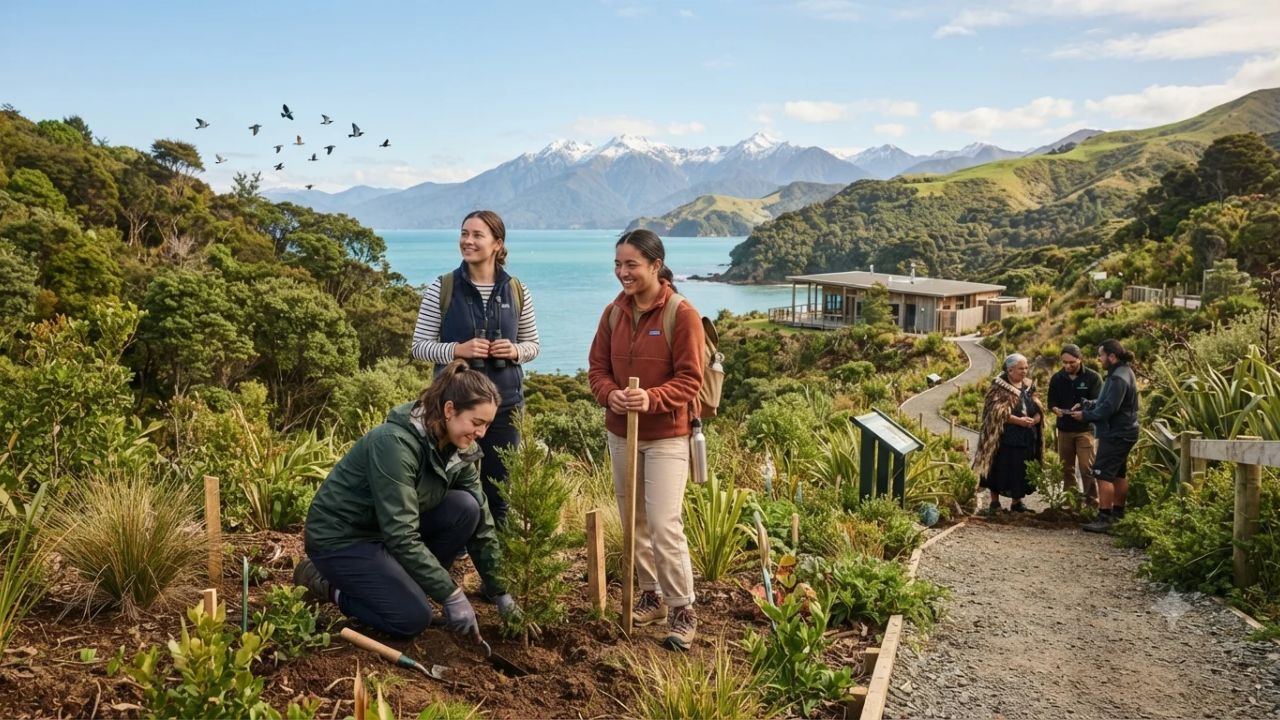
Image generated by AI
Targeting a doubling of tourism export earnings from 2023 levels by 2034 while committing to a zero-carbon visitor economy by 2030, New Zealand is fundamentally restructuring its travel economy around an enforceable regenerative framework. Moving decisively away from measuring destination performance through raw visitor arrival volumes, the policy framework developed by the national government pairs Environmental, Social, and Governance (ESG) principles with the indigenous Māori philosophy of Kaitiakitanga to ensure tourism leaves host ecosystems and regional communities demonstrably healthier than before.
From Mass Arrivals to Net Value: The Strategic Architecture of Kaitiakitanga
For decades, international destination marketing prioritized quantitative throughput. National tourism offices competed to set annual arrival records, leading to overcrowded trailheads, strained municipal sanitation, and rising local frustration across regional hotspots such as Queenstown, Rotorua, and the Coromandel Peninsula. This traditional volume-driven model treated natural environments and cultural communities as passive consumable assets rather than interconnected living systems.
Under policy directives led by the Ministry of Business, Innovation and Employment (MBIE) and executed internationally through Tourism New Zealand, the government has dismantled this extractive paradigm. Rather than welcoming unchecked mass arrivals, policymakers are pursuing high-value, low-impact travelers who contribute equitably to local workforces and natural conservation. The formal economic target—doubling export receipts from 2023 baselines by 2034—is deliberately linked to qualitative community benefits rather than doubling tourist numbers.
At the core of this transition is Kaitiakitanga, the sacred Māori duty of stewardship, guardianship, and protection over environmental and ancestral heritage. In operational practice, Kaitiakitanga functions as a binding ethical and administrative bridge between environmental protection and social responsibility. By institutionalizing indigenous stewardship into commercial licensing, operator permits, and regional destination management plans, New Zealand ensures that commercial tourism enterprises protect regional waterways, restore native biodiversity, and respect local iwi (tribal) governance.
The Tourism Sustainability Commitment: Operational Pillars and ESG Standards
To translate broad ecological principles into everyday commercial reality, the tourism sector has adopted structured performance benchmarks governed by the Tourism Sustainability Commitment under Tourism Industry Aotearoa (TIA).
The commitment guides commercial travel operations across four foundational pillars: economic growth, visitor experience, community enrichment, and environmental protection. Rather than treating ESG metrics as an administrative compliance checklist, commercial tour operators, hospitality providers, and transport carriers must integrate measurable carbon reduction targets, localized supply chain procurement, and habitat regeneration into their core business operations.
Practical implementation focuses on practical decarbonization without drowning small regional operators in bureaucratic friction. Enterprises are guided to adopt renewable energy systems, eliminate landfill waste, and finance active conservation projects—such as native bird corridor planting and pest eradication—directly through visitor booking surcharges. Through this model, travelers shift from passive observers into active contributors to environmental restoration.
| Operational Dimension | Historical Volume-Driven Tourism | Contemporary Regenerative ESG Framework | Practical Traveler Impact |
|---|---|---|---|
| Primary Metric of Success | Total visitor arrival headcount and bed-night volume | Tourism export value (doubling 2023 levels by 2034) and net ecosystem health | High-yield focus prioritizing longer stays and deeper regional engagement |
| Carbon & Climate Target | Unmonitored aviation and ground fleet emissions | Mandatory alignment toward a zero-carbon visitor economy by 2030 | Carbon-audited transport, low-emission fleets, and verified offsetting |
| Cultural & Community Role | Superficial cultural shows; commercial commodification | Integration of Kaitiakitanga (indigenous stewardship and social equity) | Authentic cultural engagement with direct financial returns to local communities |
| Industry Governance | Voluntary, fragmented green credentials | Unified Tourism Sustainability Commitment across four pillars | Enforceable operational standards required for national commercial licenses |
| Environmental Impact | Damage mitigation and superficial "leave no trace" ethics | Active regenerative ecological restoration (leaving habitats healthier) | Travelers participate directly in conservation and trail restoration projects |
| Visitor Pricing Architecture | Low-cost unbundled pricing encouraging high turnover | Premium value-based pricing internalizing environmental carrying costs | Increased visitor levies and conservation fees funding local infrastructure |
Expert Analysis: High-Yield Pricing, Visitor Levies, and Long-Haul Carbon Accountability
The transition to a regenerative tourism model introduces profound structural changes to travel economics, establishing clear dividing lines between low-cost mass holidays and premium sustainable travel.
For travelers booking this route, the direct consequence is an immediate increase in the baseline cost of visiting New Zealand, offset by a higher-quality, crowd-controlled destination experience. As regional councils enforce carrying capacity limits on fragile wilderness assets—such as the Milford Track, Tongariro Alpine Crossing, and Cathedral Cove—access is increasingly managed through advance booking systems, tiered pricing, and increased concession fees. By restricting daily foot traffic, park authorities preserve wilderness solitude while generating the capital required to maintain back-country tracks and biosecurity defenses.
The pricing pressure this creates means budget-conscious travelers must plan journeys with longer lead times and higher daily budgets. The national strategy deliberately discourages ultra-budget, high-turnover excursions in favor of extended stays where travelers spend money across regional family-owned lodges, indigenous cultural tours, and farm-to-table culinary providers. The financial mechanisms supporting this shift include adjustments to the International Visitor Conservation and Tourism Levy (IVL), which funnels foreign visitor capital directly into regional biodiversity and civic infrastructure.
Additionally, New Zealand’s geographic isolation at the southern tip of the Pacific presents an inherent long-haul aviation conundrum. Flying from North America, Europe, or Asia produces substantial carbon emissions, placing pressure on airlines to accelerate sustainable aviation fuel (SAF) integration and fleet efficiency. By setting an ambitious goal of a zero-carbon visitor economy by 2030, New Zealand forces its domestic transport networks, hotel infrastructure, and ground transit operators to eliminate emissions rapidly, compensating for the unavoidable carbon footprint of long-haul transoceanic flights.
Key Takeaways
- Ambitious 2034 Economic Target: New Zealand aims to double tourism export earnings from 2023 levels by 2034 while prioritizing community value over raw visitor numbers.
- 2030 Zero-Carbon Mandate: The national framework aligns commercial tourism operations toward achieving a zero-carbon visitor economy by the end of the decade.
- Indigenous Kaitiakitanga Principles: The Māori concept of environmental stewardship and guardianship serves as the foundational operating philosophy for sustainable tourism governance.
- Four Sustainability Pillars: The Tourism Sustainability Commitment binds operators to four measurable standards: economic growth, visitor experience, community enrichment, and environmental protection.
- Shift to Regenerative Operations: Tourism activities must actively restore and enhance ecosystems rather than merely minimizing damage, supported by higher visitor levies and carrying-capacity caps.
FAQ: New Zealand Regenerative Tourism and ESG 2026
What is regenerative tourism in New Zealand?
Regenerative tourism goes beyond basic sustainability by requiring that travel activities actively improve, restore, and enrich natural ecosystems and local host communities, ensuring that the destination is left healthier and more resilient for future generations.
What is Kaitiakitanga in the context of travel?
Kaitiakitanga is the indigenous Māori philosophy of guardianship, stewardship, and protection over the natural environment and cultural heritage. In tourism, it obligates operators and visitors to respect the land, support local communities, and practice responsible environmental governance.
How does New Zealand plan to double tourism earnings by 2034 without overtourism?
New Zealand targets high-value, regenerative travelers who take longer trips and spend more across regional communities. By enforcing carrying-capacity limits and prioritizing yield over arrival headcounts, the country increases export earnings without degrading infrastructure.
What is the zero-carbon visitor economy target for 2030?
By 2030, New Zealand aims for all domestic visitor operations—including accommodations, ground transport, and tourist attractions—to achieve net-zero carbon emissions through renewable energy adoption, waste elimination, and verified local carbon reduction projects.
[By proving that environmental guardianship and economic growth are complementary forces, New Zealand’s regenerative model establishes a global blueprint for the future of travel.]
Related Travel Guides
Disclaimer
This article is for informational and educational purposes only. It does not constitute legal, financial, or professional advice. While we strive to provide accurate and up-to-date information, travel policies, regulations, and conditions change rapidly. Always verify information with official sources before making travel decisions. Nomad Lawyer makes no representations about the accuracy, reliability, completeness, or suitability of the information provided. Readers should consult qualified professionals for advice specific to their circumstances. The views expressed in this article are those of the author and do not necessarily reflect the views of Nomad Lawyer.
Naina Thakur
Contributor & Travel Specialist
Travel enthusiast and legal writer covering visa regulations, responsible tourism, and cultural journeys across global destinations.
Learn more about our team →