
Myrtle Beach Aligns with Yuma, Panama City and Other US Destinations Empty with Canadian Tourists, Resulting Air Canada, WestJet, Air Transat Flight Cut
Myrtle Beach Aligns with Yuma, Panama City and Other US Destinations Empty with Canadian Tourists, Resulting Air Canada, WestJet, Air Transat Flight Cut

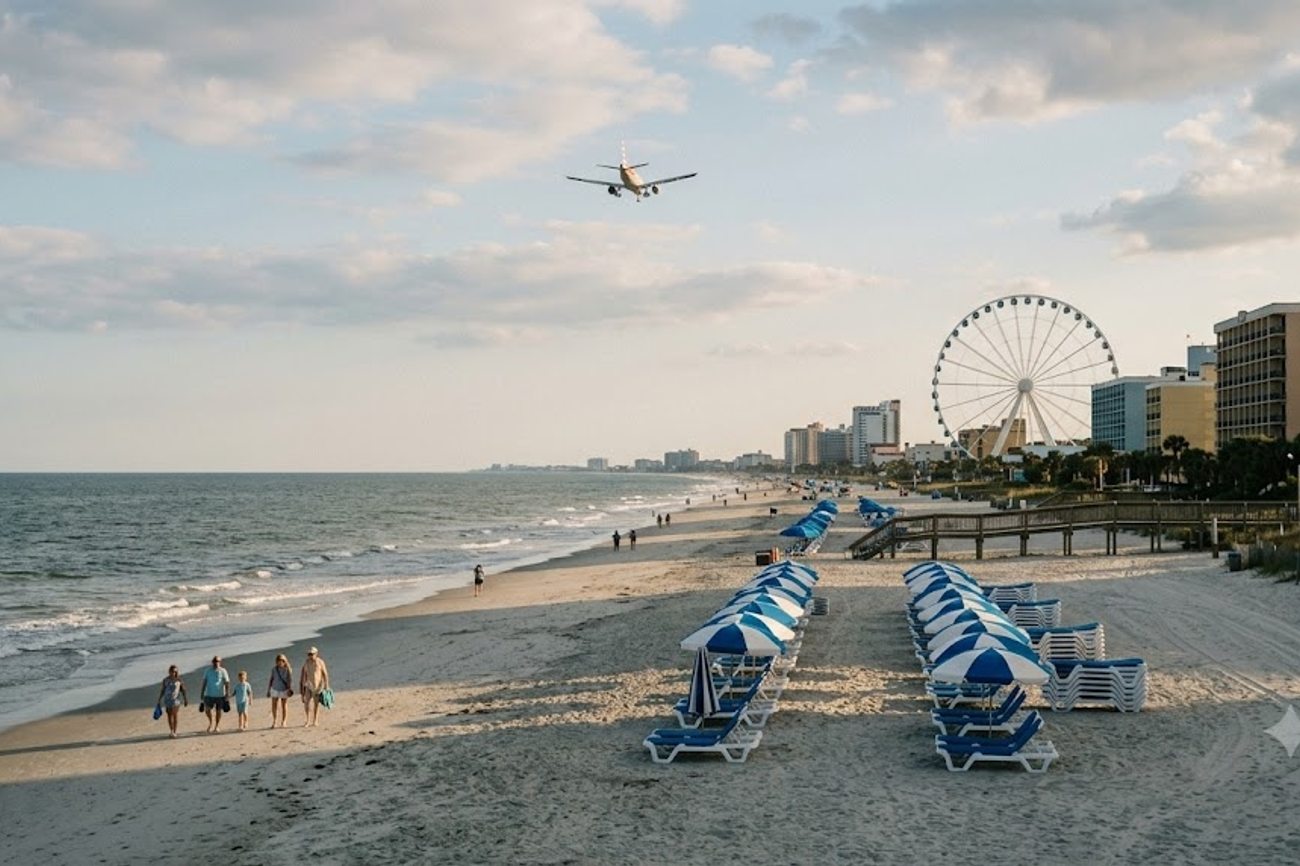
Image generated by AI
[Washington, May 2026] — Major U.S. tourism hubs are facing a precipitous collapse in Canadian visitor arrivals, forcing North America's largest carriers to slash flight capacity across several key American markets.
Air Canada, WestJet, and Air Transat are actively restructuring their networks, cutting routes or reallocating aircraft as demand from Canadian travelers plummets. The downturn is most severe in traditional "sun destinations" and major metropolitan gateways, where mobile-location data reveals declines in Canadian presence exceeding 60% in some regions.
The Catalyst for Capacity Cuts
The current aviation crisis is the result of a multi-year erosion of Canadian demand for U.S. travel that began in 2024. According to Statistics Canada, Canadian residents made 39 million return trips from the U.S. in 2024, but this figure crashed to 23.1 million trips in 2025—a sharp decline of 23.5%.
The trend has intensified into 2026. Data for the first quarter of 2026 shows that Canadian residents made 5.5 million trips to the U.S., representing a 10.6% drop compared to the same period in 2025. Crucially, this is not a sign that Canadians have stopped traveling; rather, they are diverting their spending toward domestic Canadian destinations and overseas markets, bypassing the U.S. entirely.
Markets Under Pressure
The impact is not evenly distributed. While some states report moderate declines in official visitation data, metropolitan-level mobile-location analysis suggests a much more aggressive exodus from specific cities.
The following destinations have seen the most dramatic drops in Canadian presence between April 2025 and March 2026 compared to the previous year:
| Destination | Decline in Canadian Visits | Data Methodology |
|---|---|---|
| Myrtle Beach, SC | 65.4% | Mobile-location analysis |
| Yuma, AZ | 62.3% | Mobile-location analysis |
| Panama City, FL | 60.3% | Mobile-location analysis |
| Orlando, FL | 58.2% | Mobile-location analysis |
| Cape Coral, FL | 58.2% | Mobile-location analysis |
| Miami, FL | 58.1% | Mobile-location analysis |
| Naples, FL | 57.4% | Mobile-location analysis |
| San Francisco, CA | 56.9% | Mobile-location analysis |
| New York City, NY | 55.5% | Mobile-location analysis |
| Las Vegas, NV | 55.5% | Mobile-location analysis |
Beyond these specific cities, state-level data confirms a broad regional weakness. Visit California reported a 20.1% decline in 2025 compared to 2024. Arizona estimates show a similar drop of approximately 22%, while Hawaii recorded an 11.6% decrease in official visitor data for the same period.
What This Means for Travelers
For the average traveler, this shift in aviation strategy translates to immediate changes in availability, pricing, and logistics.
Flight Availability and Scheduling Passengers booking travel between Canada and the U.S. will notice fewer direct flight options, particularly to secondary markets like Panama City or Myrtle Beach. As Air Canada and WestJet reduce capacity, remaining flights may fill up faster, and schedules may become more restrictive, with fewer daily frequencies.
Pricing Volatility While a drop in demand often leads to lower fares, the simultaneous reduction in seat capacity by major airlines can create a "bottleneck" effect. Travelers may find that while some routes are discounted to attract visitors, "prime" time slots on limited routes remain expensive.
Hotel and Service Impacts In regions like Southwest Florida (Cape Coral and Naples), the loss of "snowbirds"—long-stay Canadian visitors—is hitting local economies hard. Travelers visiting these areas may find some seasonal businesses, restaurants, or boutique hotels operating with reduced hours or closing entirely due to the lack of sustained winter demand.
Alternative Destination Incentives With Canadians pivoting toward overseas travel, travelers may find more competitive deals on transatlantic or transpacific flights as airlines shift their aircraft from U.S. routes to international long-haul corridors.
The Economic Fallout and Future Outlook
The collapse of the Canadian market is particularly damaging because of the "snowbird" phenomenon. Unlike short-term tourists who visit for a weekend, Canadian retirees often stay in Florida and Arizona for several months. The 57.4% drop in Naples and 58.2% drop in Cape Coral represent a massive loss of sustained revenue for golf courses, rental properties, and local retail.
In Orlando, the 58.2% decline in Canadian presence strikes at the heart of the theme park economy. Canadian families have historically been a cornerstone of the Orlando tourism model; their absence creates a vacuum in hotel occupancy and attraction ticket sales.
Similarly, Miami's 58.1% decline impacts more than just hotels. As a primary hub for cruises and onward travel to the Caribbean, the reduction in Canadian arrivals disrupts the entire cruise ecosystem operating out of South Florida.
Moving forward, the U.S. tourism industry must contend with a fundamental shift in Canadian consumer behavior. The data suggests that the "default" choice of the U.S. for winter sun and city breaks is being replaced. Unless airlines and tourism boards can implement aggressive recovery strategies, the capacity cuts seen in early 2026 may become permanent structural changes to North American aviation.
FAQ: Canadian-US Travel 2026
Why are there fewer flights from Canada to the US? Airlines are cutting capacity because Canadian demand has plummeted. Trips dropped 23.5% in 2025, and the trend continued into 2026, leading carriers to move planes to more profitable domestic or overseas routes.
Which US cities are seeing the biggest drop in Canadian tourists? Myrtle Beach (-65.4%), Yuma (-62.3%), and Panama City (-60.3%) are among the hardest hit. Major hubs like Orlando, Miami, and New York City have also seen declines exceeding 55%.
Are flights getting cheaper because of the low demand? Not necessarily. While demand is down, airlines are also reducing the number of flights. This reduction in "seats available" can keep prices high even if fewer people are flying.
Is this a temporary trend? The data shows a sustained decline starting in 2024 and accelerating through 2026. Canadians are increasingly choosing domestic travel or international destinations outside the U.S., suggesting a long-term shift in preference.
The North American flight map is being redrawn in real-time.
#AirCanada #WestJet #VisitFlorida #StatisticsCanada #USCanadaTravel2026 #AviationCapacity
Related Travel Guides
Disclaimer
This article is for informational and educational purposes only. It does not constitute legal, financial, or professional advice. While we strive to provide accurate and up-to-date information, travel policies, regulations, and conditions change rapidly. Always verify information with official sources before making travel decisions. Nomad Lawyer makes no representations about the accuracy, reliability, completeness, or suitability of the information provided. Readers should consult qualified professionals for advice specific to their circumstances. The views expressed in this article are those of the author and do not necessarily reflect the views of Nomad Lawyer.
Raushan Kumar
Founder & Lead Developer
Full-stack developer with 11+ years of experience and a passionate traveller. Raushan built Nomad Lawyer from the ground up with a vision to create the best travel and law experience on the web.
Learn more about our team →