
Mumbai Airport Traffic Shift: Flights Reroute to Navi Mumbai for Terminal 1 Overhaul
Mumbai transitions into a dual-airport system as flights shift to Navi Mumbai International and Terminal 2 ahead of the January 2027 Terminal 1B demolition.

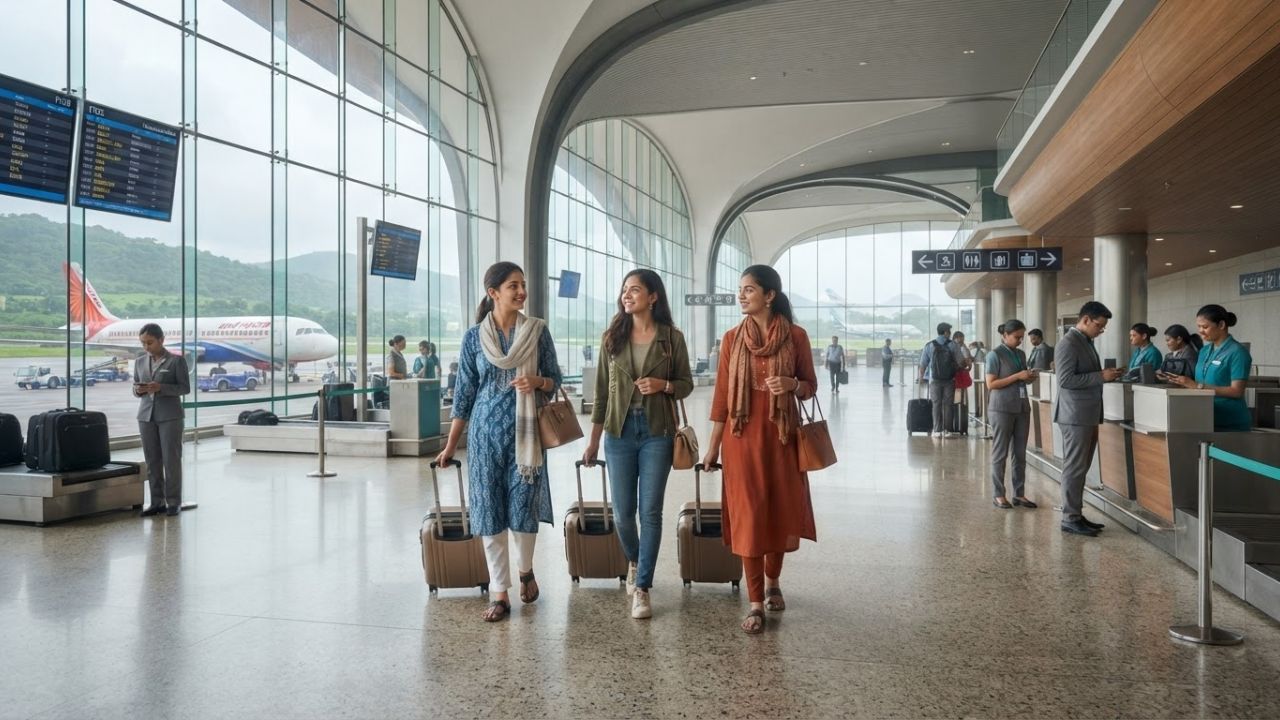
Image generated by AI
With Chhatrapati Shivaji Maharaj International Airport (CSMIA) handling over 55 million passengers on a constrained urban footprint, Mumbai is transitioning into a true two-airport metropolis as commercial flights begin shifting to Navi Mumbai International Airport (NMIA) ahead of the planned January 2027 demolition of Terminal 1B.
The Local Trend: The Emergence of Mumbai’s Dual-Airport Aviation System
The Mumbai Metropolitan Region (MMR) is undergoing the most significant aviation realignment in its modern history. Long constrained by a single crossing-runway facility in the heart of the western suburbs, Mumbai is transitioning into a multi-airport system comparable to London, Tokyo, and New York.
During FY2024-25, CSMIA handled 55.12 million passengers, operating under persistent airside and terminal capacity saturation. To facilitate a comprehensive structural overhaul of the aging domestic Terminal 1 (T1) in Santacruz, airport operators and civil aviation authorities are coordinating a phased redistribution of airline traffic toward the newly opened Navi Mumbai International Airport (NMIA) in Ulwe and the international Terminal 2 (T2) in Sahar.
Reported Key Transition Milestones and Operational Dates
| Target Transition Date | Reported Operational Milestone | Practical Passenger Impact |
|---|---|---|
| October 1, 2026 | Initial traffic reallocation toward NMIA | Select domestic departures shift from BOM to NMI |
| October 25, 2026 | One-third of T1 flights transfer to T2 | Domestic passengers reassigned to Sahar Terminal 2 |
| January 15, 2027 | Demolition of Terminal 1B northern section | Full reconstruction begins on 5-million-capacity concourse |
| Mid-2026 Onward | NMIA route expansion (IndiGo / Air India Express) | Navi Mumbai operates domestic & international flights |
Note: While a widely circulated notice highlighted an October 1 transition, airport operator MIAL has clarified that airline flight manifests and official carrier schedules remain the definitive authority for terminal and airport assignments.
Terminal 1 Redevelopment: Dismantling the 5-Million Passenger Concourse
The primary operational driver of the flight reshuffle is the complete physical reconstruction of Terminal 1. The northern section of Terminal 1B—which processes approximately five million travelers annually—is scheduled for demolition starting January 15, 2027.
Because the Santacruz terminal footprint cannot accommodate active heavy demolition alongside live passenger boarding, airlines such as IndiGo, SpiceJet, and Akasa Air are restructuring gate allocations. By shifting roughly one-third of domestic departures to the spacious Terminal 2 and transferring regional movements to Navi Mumbai, ground teams ensure passenger safety while clearing the physical zone for modern terminal foundations.
Comparative Infrastructure Profile: CSMIA vs. NMIA
| Aviation Parameter | CSMIA (Mumbai Santacruz / Sahar) | NMIA (Navi Mumbai Ulwe / Panvel) |
|---|---|---|
| IATA Airport Code | BOM | NMI |
| Operational Role | Established primary metropolitan hub | Brand-new secondary international gateway |
| FY2024-25 Passenger Traffic | 55.12 Million passengers handled | Operational launch phase (July 2026 onward) |
| Initial Phase Capacity | N/A (Operating at peak saturation) | 20 Million passengers annually |
| Ultimate Master Plan Scale | Site-constrained | Up to 90 Million passengers annually |
| International Operations | Mature worldwide network at Terminal 2 | Began July 2026 (Air India Express to Abu Dhabi) |
| Surface Transit Corridors | Western Express Highway & Metro Line 3 | Atal Setu (MTHL), Sion-Panvel & future Metro Line 8 |
Navigating the Two-Airport Reality: Surface Connectivity and Transit
For travelers, the rise of a dual-airport system introduces a critical logistical factor: avoiding airport confusion. BOM (CSMIA) and NMI (Navi Mumbai) are distinct facilities separated by more than 35 kilometers of metropolitan road networks:
- Travel Time Differentials: Travelers residing in South Mumbai, Colaba, and the Eastern Suburbs can access NMIA quickly via the Mumbai Trans Harbour Link (Atal Setu), often reaching Navi Mumbai faster than navigating Western Express Highway bottlenecks to Santacruz. Conversely, residents in Bandra, Andheri, and Borivali remain closest to CSMIA.
- Inter-Airport Transfers: Passengers booking connecting flights must verify whether their arrival and departure airports match. Transferring between BOM and NMI during peak hours can take between 75 and 120 minutes by road; travelers must allow at least 4.5 hours between connecting flight bookings.
- Future Transit Links: The Mumbai Metropolitan Region Development Authority (MMRDA) is progressing planning for Metro Line 8 (Gold Line), a dedicated high-speed mass transit link designed to provide direct airport-to-airport rail connectivity.
Destination Specialist Local Insider Tips
Travelers flying into or out of Mumbai during this structural transition can streamline their journeys with these essential guidelines:
- Scrutinize Your 3-Letter Airport Code Before Booking: Always verify whether your e-ticket lists BOM (CSMIA) or NMI (Navi Mumbai); never assume all flights to Mumbai land in Santacruz or Sahar.
- Use the Atal Setu (MTHL) for Quick NMIA Access from South Mumbai: If departing from Navi Mumbai and staying in Colaba, Fort, or Marine Drive, take the Mumbai Trans Harbour Link from Sewri to reach the NMIA terminal gates in under 45 minutes.
- Confirm Domestic Departures at Terminal 2: Beginning late October 2026, verify your terminal confirmation on airline apps 24 hours prior to departure; many domestic flights previously departing from Terminal 1 (Santacruz) will operate from Terminal 2 (Sahar).
- Sample Navi Mumbai's Agri-Koli Culinary Specialties: If you have an extended layover at NMIA, explore local eateries in Nerul or CBD Belapur to taste authentic coastal Maharashtrian cuisine, including spicy crab curry and bombil fry prepared with indigenous Agri-Koli spices.
- Coordinate Airport Transfers with Hotel Concierges: When booking airport pickups in Mumbai, explicitly state whether your flight arrives at BOM or NMI to avoid sending hotel cars to the wrong side of Mumbai Harbor.
Future Outlook
The activation of Navi Mumbai International Airport and the modernization of CSMIA Terminal 1 represent a transformative leap for Indian commercial aviation. As NMIA scales toward its ultimate capacity of 90 million passengers and Metro Line 8 connects both aviation poles, Maharashtra is establishing a modern, resilient gateway capable of powering regional tourism and global commerce for decades to come.
Related Travel Guides
Disclaimer
This article is for informational and educational purposes only. It does not constitute legal, financial, or professional advice. While we strive to provide accurate and up-to-date information, travel policies, regulations, and conditions change rapidly. Always verify information with official sources before making travel decisions. Nomad Lawyer makes no representations about the accuracy, reliability, completeness, or suitability of the information provided. Readers should consult qualified professionals for advice specific to their circumstances. The views expressed in this article are those of the author and do not necessarily reflect the views of Nomad Lawyer.
Raushan Kumar
Founder & Lead Developer
Full-stack developer with 11+ years of experience and a passionate traveller. Raushan built Nomad Lawyer from the ground up with a vision to create the best travel and law experience on the web.
Learn more about our team →