
Aviation Updates: Massive July 4th Midwest Travel Surge Triggers Terrifying Infrastructure Gridlock and Airport Disruptions Across Iowa
As millions of travelers suffocate the Midwest transit corridors ahead of Independence Day, massive infrastructure gridlock threatens severe airport disruptions and travel chaos.

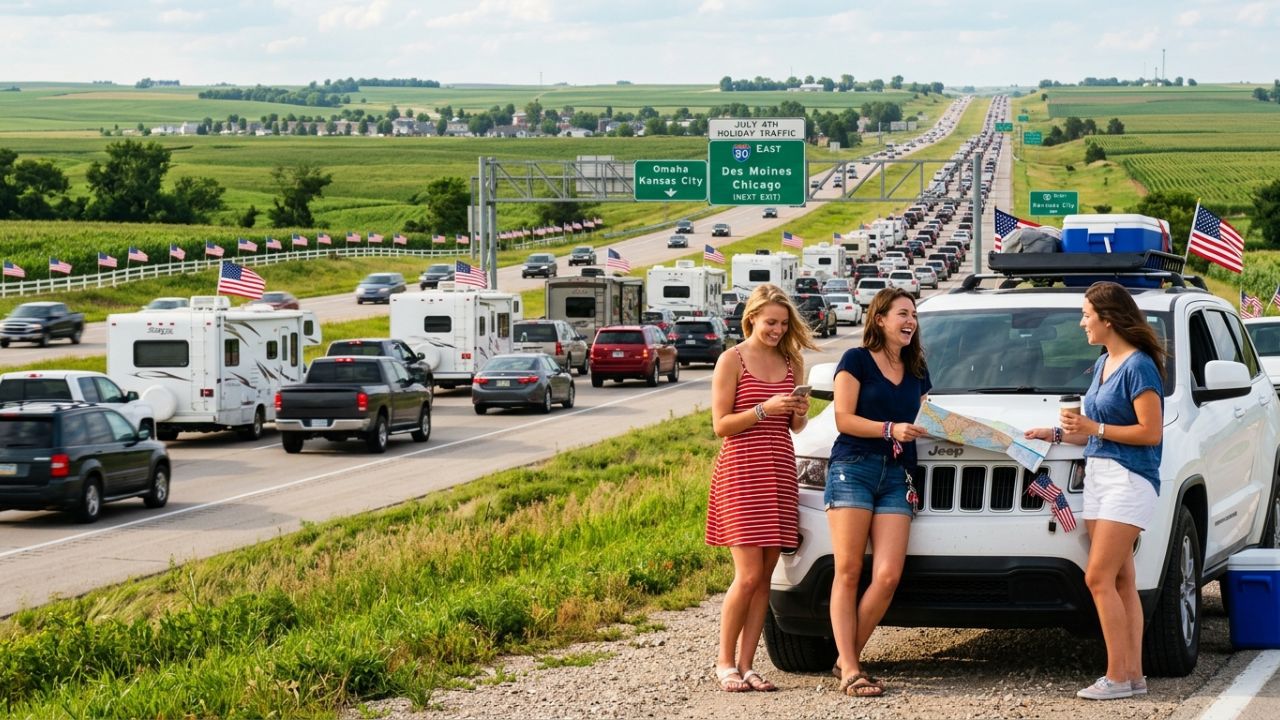
Image generated by AI
Aviation Updates: Massive July 4th Midwest Travel Surge Triggers Terrifying Infrastructure Gridlock and Airport Disruptions Across Iowa
As incredibly severe systemic congestion and massive passenger volumes completely suffocate the primary transit arteries of the Midwest, tens of thousands of global and domestic passengers are plunged into terrifying travel chaos as a massive 70-million-person Independence Day travel surge aggressively paralyzes operations across Iowa, Nebraska, Kansas, Missouri, Chicago, Des Moines, and Omaha.
While incredibly exhausted domestic passengers desperately navigate an incredibly brutal peak summer travel season defined by rolling flight cancellations and severe, localized airport disruptions, a massive, highly destructive infrastructure meltdown is actively shattering the absolute highest levels of the American mobility network. According to the absolute latest breaking airline news and travel tracking projections from the American Automobile Association (AAA), the United States is officially collapsing under the crushing weight of systemic holiday travel demand. Desperate to ensure that severe, localized regional gridlock does not completely destroy the entire continental network, authorities are violently battling a massive logistical backlog across the Midwest. Supported by the US Department of Transportation, AAA projections confirm an agonizing total of more than 70 million Americans mobilized for the July 4th period, completely stranding massive volumes of travelers in severe highway congestion and overwhelming regional aviation hubs indefinitely.
This highly critical operational collapse explicitly exposes the Midwest not just as a vital domestic transit point, but as a heavily congested, deeply fragile capacity zone prone to sudden, catastrophic failure. By violently overwhelming highway corridors, airport access roads, and short-haul regional flights, this systemic breakdown is directly driving massive travel chaos that routinely plagues travelers attempting to transit through under-resourced mega-hubs. Because traditional transit nodes frequently suffer from severe tarmac and ground congestion leading to massive, unannounced communication breakdowns, this current meltdown serves as an absolute warning. It completely bypasses the terrifying logistical nightmares of simple thunderstorms, representing a structural failure of the national transit system that forces major carriers and ground transport providers into a brutal, high-stakes battle of immediate risk assessment and agonizing holding patterns.
Aviation Updates: The Collapse of the Midwestern Corridor
This massive, highly structural shift in regional network stability perfectly illustrates the intense, incredibly fragile nature of modern domestic mobility.
According to highly detailed, official aviation updates and US National Travel and Tourism Office frameworks, this strategic capacity failure was explicitly triggered by strong cultural travel traditions overlapping with school vacations. The sheer density of the disruptions applies across the entire West North Central region, effectively capping outbound flow at the nation's most vital logistical arteries. Because primary connecting hubs are increasingly crippled by rolling travel chaos stemming from systemic aircraft shortages and massive highway gridlock, funneling massive passenger volumes through Iowa and Nebraska is currently a massive logistical gamble. This massive breakdown prevents a unified, highly reliable transit model, instead generating severe, cascading knock-on delays that ripple violently across the entire global air traffic system, directly breaking vital flight paths connecting the Midwest to massive transit hubs like Chicago.
Section-Wise Breakdown: Navigating the Paralyzed Network
The sudden, massive evolution of these critical transit failures actively impacts several incredibly distinct, highly sensitive operational dynamics spanning multiple state lines.
The West North Central Capacity Failure
At the absolute core of this massive operational pivot is the total logistical failure affecting the primary Midwest region. According to AAA projections, more than 5 million travelers are violently converging on the West North Central region alone, encompassing Iowa, Nebraska, Kansas, and Missouri. While a majority are utilizing private vehicles, a smaller, highly critical percentage is attempting to utilize regional air travel. Because the ground infrastructure is completely overloaded, accessing major airports becomes nearly impossible, leading to severe passenger delays and missed regional flight connections.
The Des Moines and Omaha Gridlock
The ultimate execution of this highly destructive failure heavily targets massive regional connecting hubs. Key congestion areas are completely exploding along interstate corridors connecting Des Moines, Omaha, and neighboring regional hubs. Transportation analysts strictly note that highway congestion will peak during early departure windows, creating massive bottlenecks. For travelers attempting to reach the airport, this severe localized gridlock means missed check-in windows, resulting in sudden, unannounced flight cancellations and agonizing terminal wait times as passengers scramble to rebook.
The Fuel and Safety Crisis
While airlines battle airspace capacity, ground travelers are absorbing massive operational costs. Fluctuating gas prices continue to strain household travel budgets. More critically, safety agencies are issuing desperate warnings regarding historically high accident rates. Driver fatigue, distracted driving, and heavy highway congestion are actively transforming routine holiday trips into terrifying safety hazards, severely stressing the region's emergency response and transportation authorities.
Flight Details and Verified Disruption Impact Matrix
To fully understand the exact structural parameters of this massive performance collapse and how authorities are desperately attempting to navigate complex regional congestion, the following matrix explicitly details the operational mobility failures directly recorded by tracking metrics.
Confirmed Independence Day Travel Mobility Matrix
| Mobility Data Metric | Confirmed Travel Forecast |
|---|---|
| Total US Travel Volume | >70 Million domestic travelers |
| Midwest Regional Volume | >5 Million travelers (West North Central) |
| Primary States Impacted | Iowa, Nebraska, Kansas, Missouri |
| Key Connecting Hubs | Des Moines, Omaha, Chicago |
| Travel Modalities | Predominantly private vehicles; strained regional air corridors |
| Supervising Authorities | AAA, US Department of Transportation (DOT) |
Data explicitly reflects the massive, highly structural operational disruption currently paralyzing the Midwestern gateway, directly forcing travelers to violently abandon their daily transit schedules.
Passenger Impact: The Financial and Emotional Toll
For the highly demanding passengers actively engaged in this massive domestic mobility crisis, traditional, highly anticipated peak travel is currently viewed as completely terrifying and incredibly unpredictable.
The immediate consequence of this massive baseline congestion is measured in the millions of passengers violently displaced across the Midwest. Passengers facing these massive airport disruptions and highway bottlenecks are forced to seek alternative arrangements, suffering intense anxiety as they endure prolonged traffic jams and massive communication blackouts. Families attempting to reach regional airports for July 4th vacations are explicitly warned that their carefully planned itineraries are currently in a state of rolling failure. The unexpected gridlock means missed rental car reservations, ruined hotel check-ins, and severe out-of-pocket expenses while travelers desperately attempt to navigate the clogged corridors connecting Iowa to the broader national network.
Industry Analysis: The Economics of Systemic Caution
Aviation and transportation structural analysts strictly point out that this massive, multi-national operational failure perfectly illustrates the extreme, highly vital importance of heavily optimized, continuous infrastructure management.
Data explicitly indicates that massive domestic mobility networks are absolutely desperate to secure rapid transit flow to actively combat the terrifying reality of capacity saturation. Across the Midwest, the reliance on short-distance road travel and constrained regional aviation hubs creates an incredibly fragile ecosystem. When 70 million Americans mobilize simultaneously, the entire system completely fractures. Until expanded airport infrastructure and high-speed rail stabilize the market, relying on deeply congested highway corridors completely destroys the reliance on scheduled leisure rotations, forcing passengers to absorb the massive delays associated with modern holiday travel culture.
Conclusion: A Highly Congested Midwestern Future
The massively evolving infrastructure dynamics directly defining the integration of massive passenger volume into the Iowa network violently reflect a much broader, highly critical structural transformation currently dominating how American transportation is physically managed in 2026.
Rather than violently forcing massive domestic traffic through deeply congested, highly restricted, delay-prone legacy networks that ignore potential capacity alerts, global travelers must actively reconsider routing without massive buffer times. As the Midwest aggressively struggles to clear the backlog and authorities attempt to manage highway accidents, travelers actively navigating the incredibly busy summer sector must absolutely remain highly vigilant. To actively survive potential travel chaos this evening, passengers must aggressively monitor all breaking aviation updates, actively utilize mobile applications for rapid alternative routing, and perfectly understand that escaping modern airport disruptions fundamentally requires accepting that routes through Iowa, Nebraska, and Kansas are currently in a state of rolling, highly sensitive failure.
Key Takeaways
- Massive National Gridlock: More than 70 million Americans are mobilizing for the Independence Day holiday, causing catastrophic systemic congestion.
- Midwest Capacity Failure: Over 5 million travelers are suffocating the West North Central region, severely impacting Iowa, Nebraska, Kansas, and Missouri.
- Hub Disruption: Severe traffic bottlenecks connecting Des Moines and Omaha threaten critical access to regional aviation hubs, driving missed flights.
- Safety Hazards: Authorities issue dire warnings regarding driver fatigue, distracted driving, and elevated accident rates on Midwest highways.
- Passenger Survival Strategy: Travelers are aggressively urged to avoid peak travel hours, depart early for airports to bypass ground congestion, and utilize digital apps to navigate the ongoing travel chaos.
Related Travel Guides
Massive UAE Visa Bombshell: Strict New 30-Day Escape Window Announced
Travel Chaos Cripples Spain as Iberia and Ryanair Suffer 1,079 Delays
Disclaimer
This article is for informational and educational purposes only. It does not constitute legal, financial, or professional advice. While we strive to provide accurate and up-to-date information, travel policies, regulations, and conditions change rapidly. Always verify information with official sources before making travel decisions. Nomad Lawyer makes no representations about the accuracy, reliability, completeness, or suitability of the information provided. Readers should consult qualified professionals for advice specific to their circumstances. The views expressed in this article are those of the author and do not necessarily reflect the views of Nomad Lawyer.
Preeti Gunjan
Contributor & Community Manager
A passionate traveller and community builder. Preeti helps grow the Nomad Lawyer community, fostering engagement and bringing the reader experience to life.
Learn more about our team →