
Middle East Aviation Gridlock 2026: Over 1,040 Cancellations and 1,630 Delays Paralyze Riyadh, Jeddah, and Istanbul

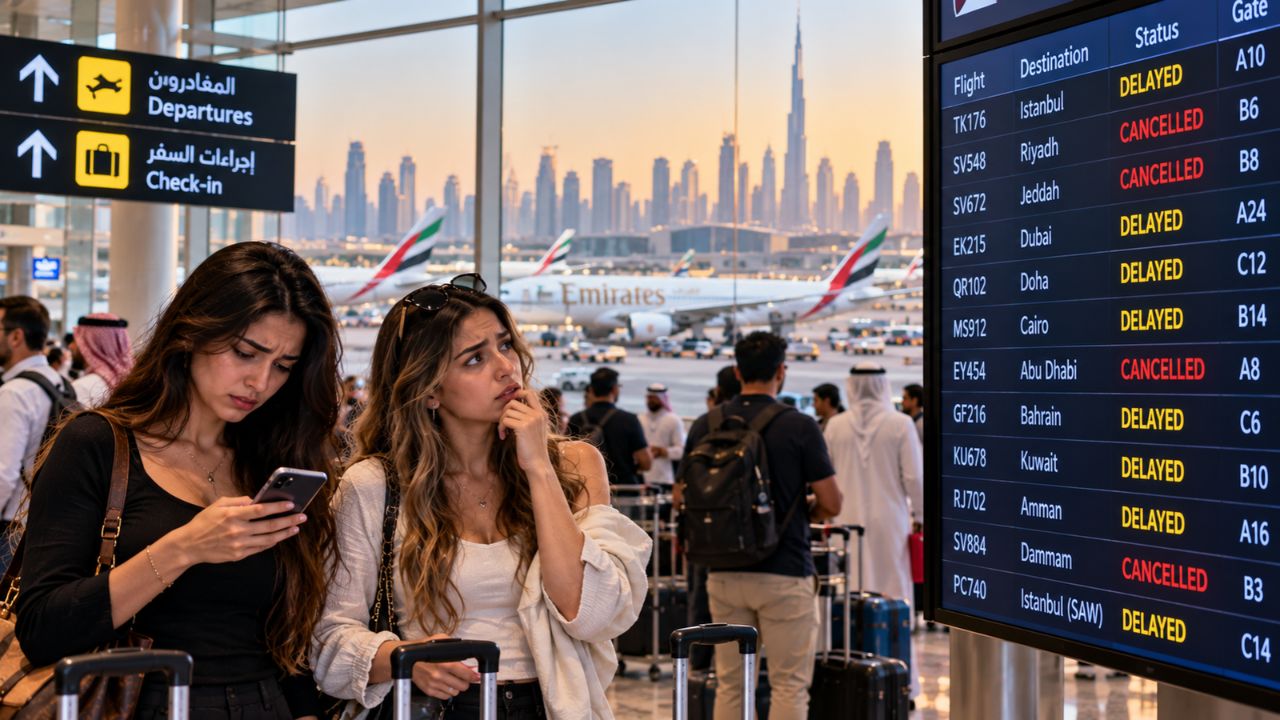
While security incidents in the Arabian Peninsula typically result in isolated air corridor detours, the weekend of October 11, 2026, ruptured the world's most critical East-West aviation bridge, grounding 1,041 flights and triggering 1,637 delays across the Middle East. At the center of the breakdown, King Khalid International Airport in Riyadh saw 538 flights canceled after a fatal projectile attack on Saturday claimed 13 lives and injured more than 300, followed by a Sunday strike on Terminal 4 that caused active fires, forced emergency diversions, and compelled carriers from Istanbul to Dubai into protective holding patterns.
Explosions, Airspace Closures, and EASA Warnings: Anatomy of a Regional Air Gridlock
The operational crisis reshaping Middle Eastern flight paths on 11 October stemmed from an escalating security emergency across Saudi Arabia. Following Saturday's deadly missile and drone strikes, Sunday brought another direct projectile hit against Terminal 4 at King Khalid International Airport in Riyadh, resulting in structural fire damage and additional injuries. Simultaneously, Saudi civil aviation officials confirmed an attack targeting King Fahd International Airport in Dammam, where emergency inspections and damage evaluations were launched immediately. The Houthi movement in Yemen claimed responsibility for the systematic strikes on Saudi energy and aviation facilities, while the Saudi-led coalition stated that air defense batteries intercepted several additional aerial targets over the central plateau.
The response from international aviation regulators was immediate. The European Union Aviation Safety Agency (EASA) issued official Conflict Zone Information Bulletins identifying severe, persistent security risks across the airspace of Saudi Arabia, Bahrain, Kuwait, Qatar, the United Arab Emirates, and parts of Oman. EASA warned international operators of airborne missile activity, low-altitude drone strikes, kinetic air-defense interceptions, and hazardous falling debris, advising airlines to conduct emergency safety assessments and bypass designated high-risk flight corridors. These airspace closures forced commercial airliners onto lengthy circular tracks over Egypt, the Red Sea, and the Levant, causing severe flight crew duty-time expirations and snarling downstream rotations across three continents.
Airlines reacted with sweeping route cancellations. Etihad Airways halted six Abu Dhabi–Riyadh round trips on Sunday, extending cancellations through Monday and Tuesday. Flag carriers and regional low-cost operators including Emirates, flydubai, and Air Arabia suspended multiple services linking the UAE to central and eastern Saudi Arabia. In total, 16 commercial airfields across the Kingdom reported flight cancellations, creating an immediate operational void across the Arabian Peninsula.
Beyond Saudi borders, the disruption produced immense congestion across Mediterranean and Gulf mega-hubs. Turkish airports absorbed the heaviest delay volume: Istanbul Airport reported 321 delays and 24 cancellations, while Istanbul Sabiha Gökçen International Airport registered 150 delays and two cancellations, combining for 471 delays across the Bosporus. In the UAE, Dubai International Airport recorded 61 cancellations and 248 delays, Abu Dhabi logged four cancellations and 106 delays, and Sharjah marked six cancellations and 85 delays. Cairo International absorbed 27 cancellations and 112 delays, while Doha’s Hamad International logged 18 cancellations and 117 delays.
Middle Eastern Airport Disruptions and Airline Impact Metrics
The operational statistics recorded on 11 October 2026 at 5:34 pm ET (12 October at 1:34 am GST) outline the scope of disruptions across regional hubs and air carriers:
| Airport Facility | Location / Hub | Flight Cancellations | Flight Delays | Regional Operational Status |
|---|---|---|---|---|
| King Khalid International | Riyadh, Saudi Arabia | 538 | 8 | Direct Terminal 4 strike, major ground halt |
| King Abdulaziz International | Jeddah, Saudi Arabia | 138 | 213 | Massive pilgrimage and international backlog |
| King Fahd International | Dammam, Saudi Arabia | 51 | 79 | Air defense interception and structural inspections |
| Istanbul Airport | Istanbul, Türkiye | 24 | 321 | Transcontinental holding stacks and re-routing |
| Sabiha Gökçen International | Istanbul, Türkiye | 2 | 150 | Regional carrier rotation delays across Anatolia |
| Dubai International | Dubai, UAE | 61 | 248 | Severe Gulf congestion and flight diversions |
| Cairo International | Cairo, Egypt | 27 | 112 | Red Sea bypass route airspace congestion |
| Prince Mohammad Bin Abdulaziz | Medina, Saudi Arabia | 31 | 34 | Precautionary ground holds and feeder cancellations |
| Abha Regional Airport | Abha, Saudi Arabia | 25 | 15 | Southern border defense security restrictions |
| Hamad International | Doha, Qatar | 18 | 117 | Rerouted Gulf corridor flight paths |
| Queen Alia International | Amman, Jordan | 14 | 40 | Levant airspace traffic management pacing |
| Ta’if & Tabuk Regional | Western Saudi Arabia | 28 (14 each) | 15 (4 & 11) | Mountain corridor domestic schedule cuts |
| Bahrain International | Manama, Bahrain | 10 | 29 | Gulf airspace transit restrictions |
| Seeb International | Muscat, Oman | 9 | 24 | Southern Arabian Sea corridor holding |
| Kuwait International | Kuwait City, Kuwait | 5 | 13 | Upper Gulf avoidance routing adjustments |
| Al Maktoum International | Dubai World Central, UAE | 2 | 15 | Secondary cargo and passenger diversions |
On the carrier ledger, national airlines within Saudi Arabia faced extraordinary losses according to figures monitored by the General Authority of Civil Aviation (GACA). National carrier Saudia canceled 260 flights (51% of its scheduled network) while delaying 93 (18%). Budget carrier flynas canceled 100 flights (39%) and delayed 53 (21%), flyadeal scrubbed 75 flights (41%) with 26 delays (14%), and start-up Riyadh Air recorded 18 cancellations (60%) with zero delays.
In Türkiye, Turkish Airlines absorbed 343 delays (20%) and 10 cancellations, while Pegasus Airlines registered 169 delays (23%) and four cancellations. In the Gulf, Emirates logged 136 delays (25%) and 22 cancellations, flydubai recorded 103 delays (37%) and six cancellations, Air Arabia managed 92 delays (39%) and six cancellations, and Qatar Airways absorbed 111 delays (17%) and 14 cancellations. Regional flag operators Oman Air (nine cancellations, 11 delays), EgyptAir (eight cancellations, 47 delays), and Royal Jordanian (seven cancellations, 17 delays) also faced heavy operational friction.
What Makes the Middle Eastern Aviation Crossroads Different
The Middle East is not simply another regional air market; it represents the central hinge connecting Africa, Europe, and Asia. Unlike North American domestic routes that can reroute across multiple parallel highways of sky, the Middle East features narrow civilian transit corridors bounded by geopolitical conflict zones and strictly regulated military air defense areas.
When central Saudi Arabian airspace shuts down, civil aviation authorities cannot easily push wide-body airliners into neighboring Iraqi, Syrian, or Iranian skies due to existing international risk restrictions. Aircraft flying between London and Singapore or Frankfurt and Mumbai are squeezed into a narrow maritime passage over the Red Sea or pushed thousands of miles south around the Arabian Sea.
Furthermore, these routes carry millions of religious travelers and expatriate workers whose lives are intimately tied to punctual transit. Flights into Jeddah and Medina carry pilgrims performing Umrah, while secondary stations like Dammam, Bisha, and Yanbu serve engineers, healthcare professionals, and laborers from across South and Southeast Asia. A shutdown in Riyadh does not merely strand vacationers; it separates families, stalls industrial projects, and disrupts holy rites.
Visitor Insider Tips: Navigating Unexpected Disruptions Across Regional Hubs
When severe regional disruption strikes the Middle East, standard travel routines must be adapted immediately. Use these tested field strategies:
- Handling Long Layovers at Istanbul Airport (IST): If you are stranded during connection delays at Istanbul Airport, be aware that walking from Concourse A to Concourse F can take over 25 minutes. Rather than waiting at gate benches, visit the iGA Sleepods located near Concourse D for quiet hourly rental cabins, or check into YOTEL airside for private shower and sleep suites. If your delay exceeds eight hours on a Turkish Airlines international ticket, visit the designated Hotel Desk outside customs near the main exit to request complimentary transit lodging.
- Alternative Ground Transit for Saudi Pilgrims: If your flight into Medina (Prince Mohammad Bin Abdulaziz) or Riyadh is canceled but you manage to reach King Abdulaziz International Airport in Jeddah, avoid waiting days for rescheduled domestic feeder flights. The Haramain High-Speed Railway operates direct, electric trains from the airport station directly to Mecca in 54 minutes and to Medina in approximately two hours, providing a reliable ground alternative to grounded aircraft.
- Bypassing Terminal Customer Service Lines in Dubai: At Dubai International (DXB) Terminal 3, transfer desk queues during regional airspace ground stops can stretch for several hours. Skip the physical lines: connect to the high-speed airport Wi-Fi, open your carrier’s mobile application or WhatsApp support line, and initiate self-service rebooking. Emirates frequently auto-rebooks disrupted passengers and generates digital boarding passes and meal vouchers directly inside the mobile app.
- Carry Critical Paperwork and Local Currency: If diverting into an unplanned third-country hub like Muscat, Amman, or Cairo, make sure your passport has at least six months of validity and keep printed copies of your original e-ticket and hotel bookings easily accessible. Carry a small reserve of US dollars or local currency, as digital payment terminals at emergency airport counters can experience network outages during mass rebooking waves.
Cultural and Environmental Context: Holy Journeys, Labor Corridors, and Airspace Fragility
The acute disruptions of 11 October showcase the deep cultural interdependence of the Middle East's aviation ecosystem. Each day, thousands of Muslims arrive in Jeddah dressed in the sacred white ihram garments, having spent lifetimes preparing for their pilgrimage to Mecca. When projectile attacks damage terminals and halt air corridors, the disruption tests the cultural fabric of hospitality that defines the region. Local charities, airport staff, and pilgrim guidance agencies across Jeddah and Medina mobilize to distribute dates, water, and emergency accommodations, transforming transit halls into spaces of communal solidarity.
Simultaneously, the crisis exposes the fragility of globalized labor corridors. The millions of Indian, Pakistani, Bangladeshi, and Filipino workers who power the Gulf economy rely on regional low-cost carriers like flynas, Air Arabia, and flydubai. When flights are suspended, workers face visa validity expiration deadlines, lost wages, and profound anxiety over family welfare.
From an environmental and operational standpoint, the necessary rerouting of hundreds of intercontinental airliners around restricted airspace generates immense secondary carbon emissions and fuel burn. Flying three hours out of the way around the Arabian Peninsula strains commercial airline fuel reserves and forces unplanned refueling stops in Athens, Cairo, or Muscat. As modern air travel confronts complex regional realities, understanding the geographic and cultural realities of these desert skyways remains essential for every global traveler.
FAQ: Navigating Middle East Airspace Disruptions 2026
What should I do if my flight through Riyadh or Jeddah is canceled?
Contact your airline immediately through its official mobile application or phone hotline to request a free rebooking or full refund. Do not proceed to the airport terminal until your new flight status and ticket confirmation are verified.
How do EASA conflict zone advisories affect commercial airline routes?
EASA directives recommend avoiding specific sovereign airspaces due to missile and drone risks. Airlines must plan longer diversionary routes, increasing overall flight duration by 60 to 180 minutes and causing secondary connection delays.
Can passengers traveling to Mecca use ground transport if flights to Medina are halted?
Yes. Passengers arriving at Jeddah’s King Abdulaziz International Airport can board the Haramain High-Speed Railway directly from the terminal station to reach both Mecca and Medina efficiently without relying on domestic flights.
Am I entitled to compensation if my flight is canceled due to missile strikes or airport damage?
Under international aviation conventions and European passenger rights rules (EU261), hostile military action and civil aviation ground stops are legally classified as extraordinary circumstances, exempting carriers from cash compensation, though airlines must still provide meals and hotel accommodations.
In skies shaped by ancient crossroads and modern currents, patience and agile preparation are every voyager's strongest guides.
Related Travel Guides
- Middle East Aviation Gridlock: 840 Flight Cancellations and 1,645 Delays Shake Riyadh, Doha, and Istanbul
- Riyadh Airport Crisis: 12 Dead, 309 Injured in Missile Strike as Flights Divert from King Khalid International
- Asia Aviation Gridlock 2026: Over 1,060 Cancellations Strike Riyadh, Dubai, and Mumbai Air Corridors
Disclaimer
This article is for informational and educational purposes only. It does not constitute legal, financial, or professional advice. While we strive to provide accurate and up-to-date information, travel policies, regulations, and conditions change rapidly. Always verify information with official sources before making travel decisions. Nomad Lawyer makes no representations about the accuracy, reliability, completeness, or suitability of the information provided. Readers should consult qualified professionals for advice specific to their circumstances. The views expressed in this article are those of the author and do not necessarily reflect the views of Nomad Lawyer.
Raushan Kumar
Founder & Lead Developer
Full-stack developer with 11+ years of experience and a passionate traveller. Raushan built Nomad Lawyer from the ground up with a vision to create the best travel and law experience on the web.
Learn more about our team →