
Asia Aviation Gridlock 2026: Over 1,060 Cancellations Strike Riyadh, Dubai, and Mumbai Air Corridors

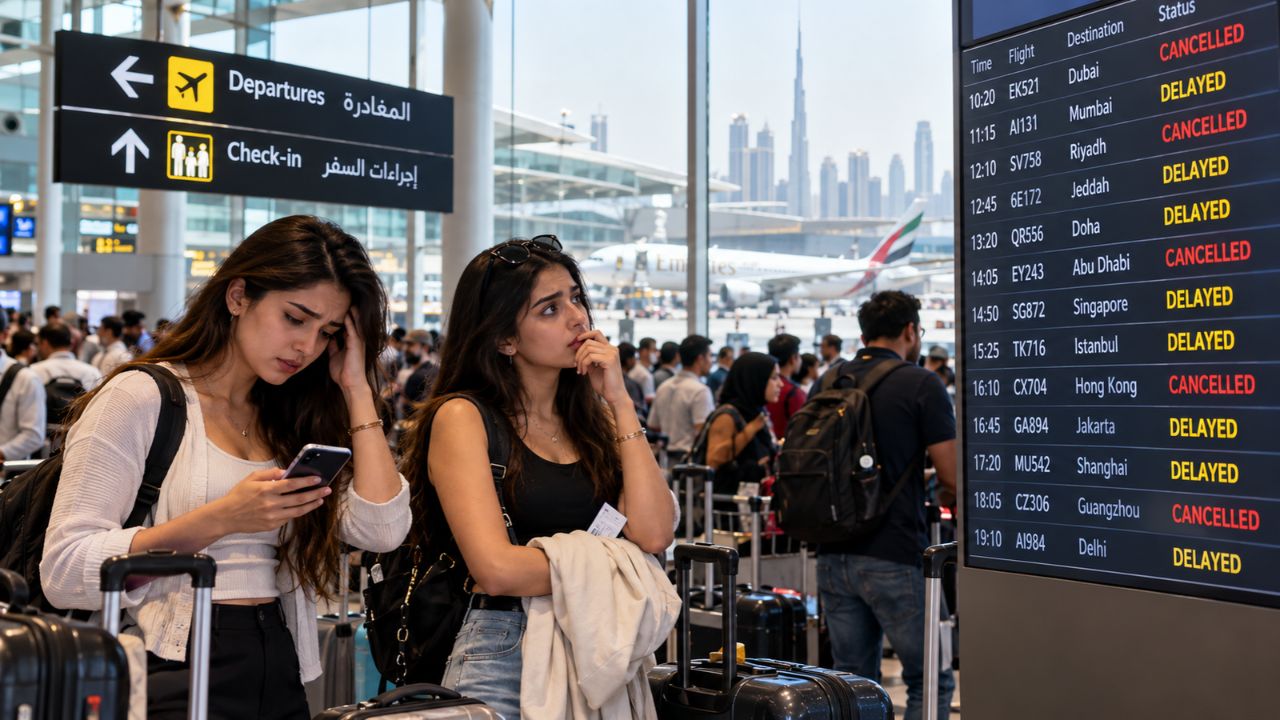
While regional flight disruptions frequently affect single hubs, October 11, 2026, triggered an unprecedented aviation chain reaction across Asia, stranding thousands as 1,062 flights were canceled and 3,880 delayed in a single operational window. At the eye of the storm, Riyadh's King Khalid International Airport saw 61% of inbound and 65% of outbound flights wiped out following projectile strikes claimed by Houthi militants, creating an immediate operational vacuum that cascaded eastward into Indian transit centers, Indonesian gateways, and Chinese commercial terminals.
Riyadh Security Crisis to Jakarta Haze: Anatomy of a Multi-Hub Aviation Shockwave
The operational shockwave that paralyzed Asian flight corridors on 11 October 2026 originated from an acute security emergency across Saudi Arabia. Following a fatal strike on Saturday, another projectile hit King Khalid International Airport on Sunday, compelling civil aviation authorities to suspend flight paths and close terminal operations. The fallout was instantaneous: Riyadh registered 454 cancellations against just 10 delays, leaving its tarmac empty while regional sister hubs scrambled. King Abdulaziz International Airport in Jeddah logged 114 cancellations alongside 176 delays, while King Fahd International Airport in Dammam recorded 39 cancellations and 71 delays. Further inland and south, Prince Mohammad Bin Abdulaziz Airport in Medina logged 27 cancellations and 29 delays, while Abha Regional Airport registered 21 cancellations and 17 delays, representing a 30% cut in scheduled arrivals. Smaller domestic stations bore even heavier proportional losses, with Bisha Domestic Airport losing 60% of both arrivals and departures, and Ta'if Regional shedding 50% of inbound and 45% of outbound services.
The sudden closure of central Arabian airspace sent shockwaves through the mega-connectors of the United Arab Emirates and Qatar. Dubai International Airport recorded 57 cancellations and 215 delays, managing roughly 5% cancellation rates on origins and destinations while its holding patterns stacked high over the Persian Gulf. Abu Dhabi reported four cancellations and 81 delays, Sharjah logged five cancellations and 78 delays, and Doha's Hamad International Airport absorbed 18 cancellations and 105 delays. Further west, Bahrain International marked nine cancellations and 23 delays, while Kuwait International logged five cancellations and 10 delays.
Simultaneously, travel through South Asia ran into severe logistical bottlenecks. Indian hubs absorbed secondary shocks from the Gulf airspace shutdown alongside intense localized weather. The India Meteorological Department (IMD) issued heavy rainfall and thunderstorm warnings for northern India, complicating domestic arrivals around the capital. Delhi’s Indira Gandhi International Airport suffered 242 flight delays and nine cancellations. Bengaluru’s Kempegowda recorded 107 delays and 11 cancellations, while Mumbai’s Chhatrapati Shivaji Maharaj International Airport reported 80 delays and 14 cancellations. In southern India, Kochi recorded 29 delays and four cancellations after carriers halted connections linking Kerala to Saudi Arabia, Doha, and Ras Al Khaimah. Akasa Air confirmed an extended suspension of all flights to Riyadh and Jeddah through 13 October, directly isolating labor and family transit channels.
Across Southeast and East Asia, independent environmental and scheduling hurdles magnified the strain. Indonesia’s Jakarta Soekarno-Hatta International Airport recorded 288 delays and 16 cancellations—the highest single delay count across all surveyed Asian airports—as seasonal peat forest fire smoke caused severe visibility degradation. At Borneo’s Iskandar Airport, wildfire smoke drove cancellations up to 30% of incoming and 40% of outgoing flights. In China, Shanghai Pudong logged 204 delays and five cancellations, Guangzhou Baiyun reported 150 delays and six cancellations, and Hong Kong International registered 123 delays and three cancellations. Singapore Changi logged 151 delays and three cancellations, while Istanbul Airport in Turkey absorbed 258 delays and 20 cancellations.
Asian and Middle Eastern Aviation Operational Disruption
The table below outlines confirmed cancellation and delay statistics recorded across major international gateways on 11 October 2026:
| Airport Name | IATA Code | Scheduled Cancellations | Reported Delays | Inbound Cancellation Rate | Outbound Cancellation Rate | Primary Root Factor |
|---|---|---|---|---|---|---|
| King Khalid International (Riyadh) | RUH | 454 | 10 | 61% | 65% | Missile strike and immediate airspace closure |
| King Abdulaziz International (Jeddah) | JED | 114 | 176 | 14% | 16% | Security alerts and diverted corridor holding |
| Dubai International | DXB | 57 | 215 | 5% | 5% | Knock-on Gulf corridor congestion |
| King Fahd International (Dammam) | DMM | 39 | 71 | 16% | 16% | Regional Saudi airspace re-routing |
| Soekarno-Hatta International (Jakarta) | CGK | 16 | 288 | 1% | 0% | Severe forest fire smoke and haze |
| Indira Gandhi International (Delhi) | DEL | 9 | 242 | 0% | 0% | Northern thunderstorms and Gulf flight gaps |
| Chhatrapati Shivaji Maharaj (Mumbai) | BOM | 14 | 80 | 1% | 1% | Gulf transit cuts and arrival slot delays |
| Shanghai Pudong International | PVG | 5 | 204 | 0% | 0% | Upstream regional scheduling delays |
| Hamad International (Doha) | DOH | 18 | 105 | 2% | 2% | Flight path rerouting over Gulf waters |
| Istanbul Airport | IST | 20 | 258 | 1% | 1% | Eastern airspace diversion holding patterns |
| Kempegowda International (Bengaluru) | BLR | 11 | 107 | 1% | 1% | Inbound aircraft rotation delays |
| Prince Mohammad Bin Abdulaziz (Medina) | MED | 27 | 29 | 16% | 15% | Regional precautionary ground stops |
| Abha Regional Airport | AHB | 21 | 17 | 30% | 19% | Southern border defense precautionary alerts |
| Bisha Domestic Airport | BHH | — | — | 60% | 60% | Complete domestic feeder suspension |
| Ta'if Regional Airport | TIF | — | — | 50% | 45% | Mountain corridor airspace restrictions |
On the carrier side, Saudi home carriers took the heaviest hit according to the General Authority of Civil Aviation (GACA). Saudia canceled 186 flights (36% of its daily roster) while delaying 87 (17%). Low-cost carrier flynas canceled 86 flights (34%) and delayed 44 (17%), flyadeal lost 74 flights (40%) with 21 delays (11%), and start-up Riyadh Air saw 18 cancellations, representing 60% of its scheduled operations without a single delay. In India, IndiGo logged 300 delays (13%) and nine cancellations, leading the continent in delayed services. Turkish Airlines followed with 295 delays (18%) and eight cancellations, China Eastern absorbed 251 delays (11%) and 54 cancellations, and Emirates managed 127 delays (23%) and 22 cancellations.
What Makes the Asia–Gulf Transit Corridor Different
To understand why a disruption in Riyadh or Dubai throws flight paths into disarray from London to Jakarta, travelers must recognize the unique nature of the Asia–Gulf transit bridge. Unlike European rail-backed corridors or North American domestic trunk lines, this route operates as the primary artery for millions of transiting diaspora workers, religious pilgrims, and long-haul intercontinental passengers.
The corridor links the labor capitals of South Asia—Kerala, Mumbai, Dhaka, and Colombo—with the construction, hospitality, and energy sectors of the Gulf Cooperation Council. When carriers like Akasa Air or Saudia halt departures between Kochi and Jeddah, it is not merely holiday plans that freeze; it disrupts family reunions, employment contracts, and vital overseas remittance schedules.
Simultaneously, the Gulf functions as the global pivot between East and West. Long-haul travelers connecting from Southeast Asia to Europe or Africa rely on tight two-hour transit windows in Dubai, Doha, and Abu Dhabi. When incoming aircraft from Riyadh or Dammam fail to arrive, gate allocations freeze, connecting baggage systems backup, and aircraft miss their strict departure slots into congested European airspace, multiplying delays across half the globe.
Visitor Insider Tips: Managing Sudden Layover and Flight Interruptions
When intercontinental travel hits widespread systemic turbulence, standard tourist habits will leave you waiting in four-hour lines. Use these tested strategies to protect your itinerary:
- Bypass Terminal Information Desks via App Rebooking: In massive hubs like Dubai (DXB) Terminal 3 or Mumbai (BOM) Terminal 2, line queues for transfer desks can stretch past 500 passengers within 30 minutes of a mass cancellation. Avoid waiting in physical lines. Connect immediately to airport Wi-Fi and use your airline’s mobile application or customer service chat to rebook alternative connections before seats vanish.
- Carry a 48-Hour Survival Kit in Your Daypack: Never place essential prescription medication, infant supplies, phone chargers, or basic hygiene items into checked luggage when transiting the Middle East or South Asia during volatile periods. If your baggage is checked through to Riyadh or Jeddah and your flight diverts to Dubai or Muscat, retrievement can take up to three days.
- Opt for Direct Indian Metropolitan Alternatives: If traveling between India and Europe or Southeast Asia during Gulf airspace restrictions, consider routing directly via Singapore (SIN) or non-stop carriers through Delhi rather than booking multi-stop itineraries through the Arabian Peninsula.
- Track Official Civil Aviation Advisories Directly: Third-party flight-tracking applications often lag behind real-time decisions during national security emergencies. Monitor direct announcements from airline social media teams, airport operational boards, and official civil aviation portals rather than relying solely on automated aggregation tools.
- Know Your Accommodation Rights During Unplanned Layovers: In hubs like Dubai and Doha, passengers stranded for over eight hours on international tickets through no fault of their own are often eligible for airline-provided hotel vouchers, meal allowances, or dedicated rest lounges inside the transit zone. Visit the designated transit assistance counter promptly, or request meal vouchers directly at boarding gates.
Cultural and Environmental Context: Regional Resilience and Dual Disruption Pressures
The widespread disruptions of 11 October illuminate the delicate balance between rapid infrastructure modernization and volatile regional realities across developing Asia. In Saudi Arabia, the aviation sector forms the backbone of the Vision 2030 economic transformation, designed to turn Riyadh into an international transit capital and welcome millions of annual visitors for leisure, business, and heritage exploration. When security shocks abruptly halt over 60% of King Khalid International Airport's operations, the impact reverberates far beyond balance sheets, testing national resilience and the security protocols guarding essential civilian corridors.
Simultaneously, the disruption intersects deeply with sacred travel. Tens of thousands of pilgrims travel through Jeddah and Medina each week to perform Umrah. Many have spent years saving wages for these spiritual journeys, originating in rural villages across Indonesia, Pakistan, and India. When flights through King Abdulaziz International are grounded, local community networks and pilgrim welfare organizations step in across airport holding areas, offering communal meals, prayer spaces, and lodging while flights are renegotiated.
At the other end of the continent, the haze grounding flights at Jakarta Soekarno-Hatta and Borneo's Iskandar Airport exposes the ongoing environmental vulnerability of Southeast Asia. Seasonal peatland clearing fires, combined with shifting atmospheric patterns, create hazardous smoke clouds that reduce runway visibility to near zero. Coupled with northern India's pre-winter thunderstorm systems, these natural forces demonstrate that today's global traveler faces dual pressures: navigating delicate geopolitical intersections in the desert West while managing climate-driven atmospheric volatility in the monsoon East.
FAQ: Navigating Asia and Gulf Travel Disruptions 2026
What steps should I take if my flight to Riyadh or Jeddah is canceled?
Contact your carrier immediately to request a free rebooking or full ticket refund. Avoid traveling to the airport until your revised itinerary and flight status are explicitly confirmed via official airline channels.
How long are airline suspensions to Saudi Arabia expected to last?
Suspension lengths vary by carrier. Akasa Air extended its halt through 13 October, while regional airlines evaluate flight permissions on a 24-hour rolling basis depending on security assessments and civil aviation directives.
Why did Jakarta record the highest flight delays in Asia on October 11?
Jakarta's Soekarno-Hatta Airport faced 288 delays primarily due to severe smoke and haze from regional peatland forest fires, which sharply reduced runway visibility and slowed arrival sequencing across western Indonesia.
Am I entitled to compensation for delays caused by regional airspace closures?
Security emergencies and air traffic control ground stops are legally classified as extraordinary circumstances. While airlines are generally exempt from statutory delay compensation, they remain obligated to provide duty of care, including meals and hotel accommodations for long layovers.
When regional skies turn unpredictable, calm preparation and agile rebooking are the most valuable tools in any traveler's pack.
Related Travel Guides
- Middle East Aviation Gridlock: 840 Flight Cancellations and 1,645 Delays Shake Riyadh, Doha, and Istanbul
- Riyadh Airport Crisis: 12 Dead, 309 Injured in Missile Strike as Flights Divert from King Khalid International
- SriLankan Airlines Suspends Riyadh Flights: Security Alert at King Khalid Airport and Regional Transit Advice
Disclaimer
This article is for informational and educational purposes only. It does not constitute legal, financial, or professional advice. While we strive to provide accurate and up-to-date information, travel policies, regulations, and conditions change rapidly. Always verify information with official sources before making travel decisions. Nomad Lawyer makes no representations about the accuracy, reliability, completeness, or suitability of the information provided. Readers should consult qualified professionals for advice specific to their circumstances. The views expressed in this article are those of the author and do not necessarily reflect the views of Nomad Lawyer.
Raushan Kumar
Founder & Lead Developer
Full-stack developer with 11+ years of experience and a passionate traveller. Raushan built Nomad Lawyer from the ground up with a vision to create the best travel and law experience on the web.
Learn more about our team →