
Middle East Aviation Crisis April 2026: Israel, UAE, Jordan Airspace Closures Trigger Mass Repatriation Chaos, Visa Overstay Fines Spike
Daily airspace restrictions across Middle East force airlines to slash capacity 30-35%, stranding thousands amid visa expirations. Israel, Jordan, Iran closures create unprecedented travel bottleneck.

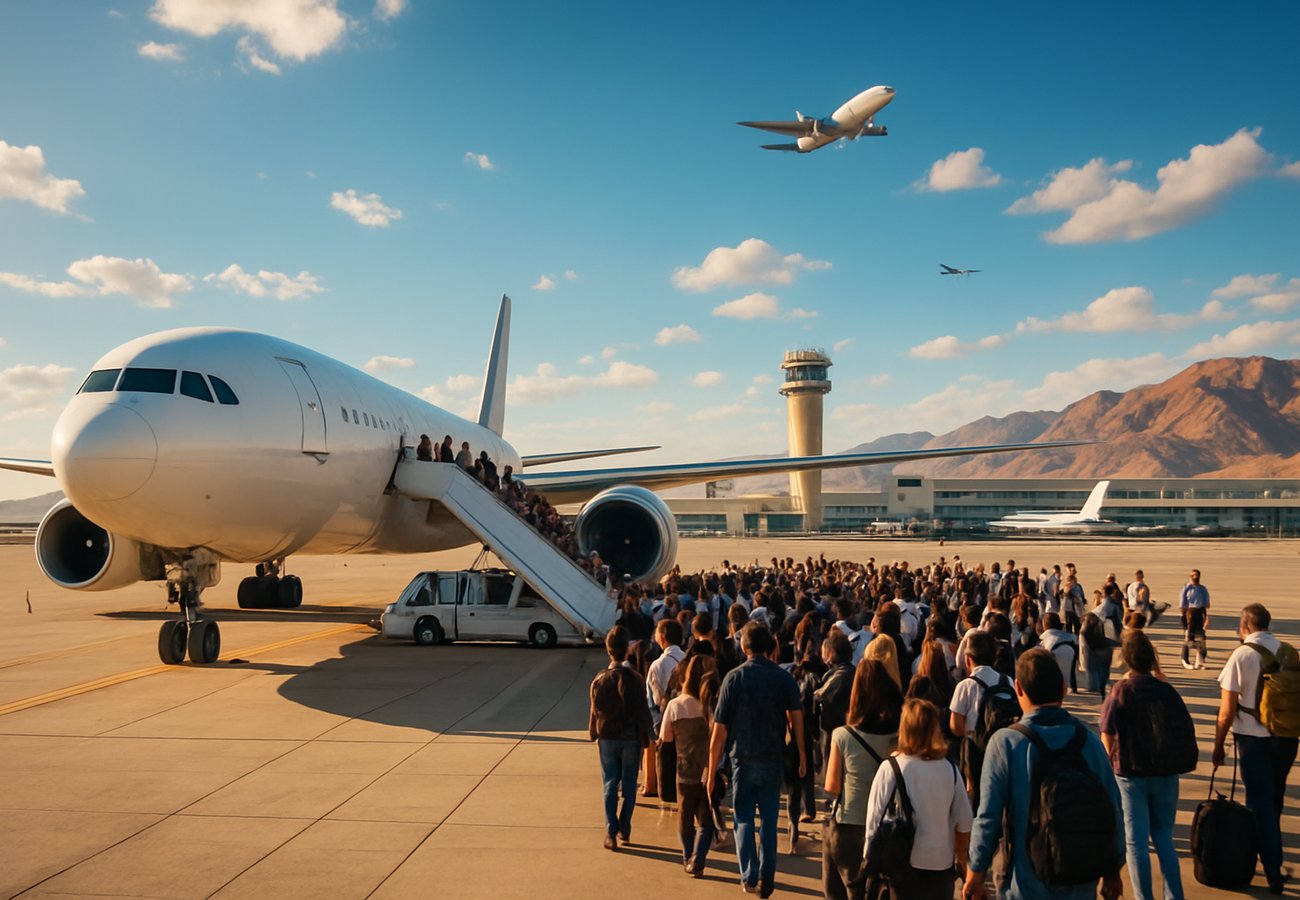
Image generated by AI
Middle East Aviation Enters Critical Phase as Fragmented Airspace Restrictions Trigger Mass Stranding Crisis
A cascading aviation emergency is unfolding across the Middle East as Israel, Jordan, Iran, Iraq, Syria, and Gulf states impose daily partial closures and severe airspace restrictions, forcing thousands of stranded travelers into a desperate race against mounting visa expirations and escalating overstay penalties. As of April 2026, the region's fractured flight operations have compressed Gulf carrier capacity to 65–70% of normal levels, while European airlines have suspended routes through late May, creating an unprecedented bottleneck that authorities and carriers struggle to manage amid ongoing conflict-driven disruptions.
The crisis represents the most severe aviation fragmentation in the Middle East since 2024, with each nation enforcing wildly different operational rules—from Jordan's nightly 6:00 PM to 9:00 AM airspace shutdowns to Iran's near-total commercial flight ban and Israel's pre-approved-flights-only regime. This patchwork of restrictions has shattered regional connectivity, forcing airlines to reroute flights across longer corridors, burning additional fuel and extending journey times by hours. According to industry monitoring via FlightAware, real-time flight tracking shows a 40% surge in flight diversions and cancellations across the region, with passengers reporting last-minute schedule changes and overnight layovers becoming routine.
The human cost is staggering. Thousands of expatriate workers, tourists, and business travelers face imminent visa expirations while trapped in countries with severely limited exit flights. UAE, Saudi Arabia, Qatar, Oman, and Bahrain—traditionally reliable transit hubs—are now operating under strict altitude limitations and managed-corridor protocols, forcing travelers to endure unpredictable delays and cancellations. Overstay fines are mounting rapidly; workers in the UAE face penalties exceeding $1,000 per day, while Saudi Arabia and Qatar impose similarly punitive fees. Airlines report a surge in desperate booking attempts, with passengers willing to pay premium prices for any available seat, yet capacity simply does not exist to accommodate demand.
Jordan's nightly airspace closures have decimated Amman's role as a regional connector, with transit traffic plummeting as travelers avoid the unpredictable time-bound restrictions. Baghdad International Airport has cautiously resumed limited operations, yet Iraqi aviation remains fragile, with airlines hesitant to restore full schedules due to lingering security concerns. Syria's reopened airspace offers minimal relief—flights are tightly controlled and largely restricted to humanitarian missions, leaving commercial passengers with virtually no options. Meanwhile, Iran's effective aviation isolation has eliminated a critical Europe–Asia corridor, forcing global carriers to burn additional fuel on longer reroutes and extending flight durations by 2–4 hours per journey.
The economic ripple effects extend far beyond the Middle East. IATA (International Air Transport Association) has flagged the disruption as a significant threat to global aviation connectivity, with fuel surcharges likely to increase as carriers burn more fuel on extended routes. Cargo operations—already strained by geopolitical tensions—face further delays, impacting supply chains dependent on Middle Eastern transit hubs. Tourism forecasts for the region have been slashed, with major hospitality operators reporting 50–60% booking cancellations through June 2026. Airlines operating in the region are absorbing massive losses; Emirates, Etihad, Qatar Airways, and Saudi Arabian Airlines are all operating at reduced profitability, while European carriers like Lufthansa, Air France, and British Airways have pulled back significantly, citing unpredictable operational costs and passenger safety concerns.
Security protocols have intensified dramatically. Israel now permits only pre-approved flights with enhanced security screening, adding 2–3 hours to airport processing times. Passengers report extreme security checks, limited airline options, and constant uncertainty about flight confirmations. The FAA and European aviation authorities have issued repeated advisories warning travelers of potential disruptions, though these warnings offer little practical relief for those already stranded or facing imminent visa expirations.
What This Means for Travelers
Passengers with bookings to or through the Middle East face severe uncertainty. Expect frequent cancellations, last-minute reroutes, and potential overnight layovers. If your visa is expiring, contact your airline and embassy immediately—many nations are granting temporary extensions for stranded travelers, but these must be requested proactively. Book refundable fares if possible, monitor FlightAware for real-time updates, and avoid connecting through Jordan, Iran, or Syria unless absolutely necessary. Consider alternative routes via Europe or Asia even if they add 6–8 hours to your journey. Travel insurance with cancellation coverage is now essential. If you are an expatriate worker facing overstay fines, explore emergency repatriation programs offered by your employer or government—many nations are coordinating charter flights for citizens stuck in the region.
Industry analysts warn that Middle East airspace fragmentation could persist through Q3 2026, making advance booking and flexibility critical for any regional travel.
The Middle East's aviation sector faces a long recovery ahead. While a fragile ceasefire has enabled limited reopenings, the region remains fundamentally unstable, with daily operational changes and unpredictable security conditions. Travelers should assume disruptions will continue, plan for extended journey times, and prioritize flexibility over cost savings. Airlines are adapting through selective route resumptions and dynamic scheduling, but the overall environment remains volatile. Those with non-urgent travel should postpone plans until late summer 2026, when airspace stability may improve. For essential travel, book early, choose direct flights where available, and maintain constant communication with your airline and embassy.
Related Travel Guides
Disclaimer
This article is for informational and educational purposes only. It does not constitute legal, financial, or professional advice. While we strive to provide accurate and up-to-date information, travel policies, regulations, and conditions change rapidly. Always verify information with official sources before making travel decisions. Nomad Lawyer makes no representations about the accuracy, reliability, completeness, or suitability of the information provided. Readers should consult qualified professionals for advice specific to their circumstances. The views expressed in this article are those of the author and do not necessarily reflect the views of Nomad Lawyer.
Kunal K Choudhary
Co-Founder & Contributor
A passionate traveller and tech enthusiast. Kunal contributes to the vision and growth of Nomad Lawyer, bringing fresh perspectives and driving the community forward.
Learn more about our team →