Mediterranean Autumn Cruise Reality: Celebrity Infinity's Six-Country Voyage Exposes Montenegro Visa Shifts, Schengen Re-Entry Traps, and Port Congestion


PIRAEUS, Greece — Operating across the transitional maritime corridor connecting the Aegean, Adriatic, and Western Mediterranean basins, Celebrity Cruises' 12-night voyage aboard Celebrity Infinity serves as an illuminating real-world case study in late-autumn multi-destination European cruising.
Departing from the Greek port of Piraeus on November 2 and scheduled to conclude in Barcelona on November 14, 2026, the itinerary promises travelers a continuous six-country voyage touching Greece, Croatia, Montenegro, Italy, France, and Spain.
However, beneath the promotional allure of visiting six sovereign nations on a single voyage lies an intricate regulatory and operational obstacle course. On November 1, 2026—just twenty-four hours before the ship set sail from Athens—the Government of Montenegro implemented sweeping changes to its national visa regime, revoking visa-free access for several major international nationalities and introducing immediate compliance checks for maritime arrivals.
Because Montenegro sits outside the European Union's Schengen Area, the detour out of Croatian waters into the Bay of Kotor transforms routine port-hopping into an international border crossing, exposing unprepared passengers to the "Schengen Re-entry Trap" and the digital screening protocols of the European Entry/Exit System (EES).
Compounding these border complexities are the operational realities of November sea travel: tender boat transfers in open-water anchorages, multi-hour overland transfers from industrial gateway berths to historic inland capitals, and shifting port infrastructure exemplified by Barcelona’s €104.5 million terminal consolidation.
An exhaustive operational audit of the voyage reveals the vital distinction between advertised destination counts and the authentic, usable sightseeing hours available to international travelers.
+----------------------------------------------------------------------------------------------------+ | CELEBRITY INFINITY 12-NIGHT MEDITERRANEAN VOYAGE SCORECARD | +----------------------------------------------------------------------------------------------------+ | Vessel & Operator | Celebrity Infinity | Celebrity Cruises (Royal Caribbean Group) | | Voyage Duration & Dates | 12 Nights | November 2 to November 14, 2026 | | Embarkation & Disembarkation | Piraeus (Athens), Greece to Barcelona, Spain | | Sovereign Nations Visited | 6 Countries (Greece, Croatia, Montenegro, Italy, France, Spain) | | Total Intermediate Ports | 8 Ports of Call (Dubrovnik, Split, Kotor, Messina, Naples, etc.) | | Total Scheduled Port Hours | 89 Scheduled Hours across 8 Intermediate Port Calls | | Country Port Time Allocation | Italy: 46 Hours (51.7%) | Croatia: 24 Hours | France: 11h | MNE: 8h | | Sea Day Distribution | 3 Full Days at Sea (November 3, November 7, November 13) | | Regulatory Flashpoint | Montenegro Visa Regime Changes Enacted November 1, 2026 | | Border Architecture Status | Schengen Exit/Re-entry & European Entry/Exit System (EES) Checks | | Tender Anchorage Ports | Kotor, Montenegro & Villefranche-sur-Mer (Nice), France | | Terminal Infrastructure News | Port of Barcelona €104.5M Terminal C Consolidation Plan | +----------------------------------------------------------------------------------------------------+
The Six-Country November Architecture: Nautical Geography and Port Schedule
The November repositioning of major cruise vessels across the Mediterranean represents an important seasonal transition for international maritime tourism. As summer passenger peaks recede, cruise lines reposition tonnage toward winter homeports, offering extended itineraries that aggregate distinct cultural and geographical regions into single consumer packages.
The scheduled routing of Celebrity Infinity links three distinct maritime bodies: the Aegean Sea, the enclosed waters of the Adriatic, and the open expanses of the Tyrrhenian and Balearic Seas in the Western Mediterranean.
                    CELEBRITY INFINITY 12-NIGHT MARITIME TRACK

  [PIRAEUS / ATHENS] (Nov 2 - Dep 17:00)
          |
          v [Day at Sea - Nov 3]
          |
  [DUBROVNIK, CROATIA] (Nov 4 - Docked 08:00 to 20:00)
          |
  [SPLIT, CROATIA] (Nov 5 - Docked 07:00 to 19:00)
          |
  [KOTOR, MONTENEGRO] (Nov 6 - TENDER 08:00 to 16:00) <=== NON-SCHENGEN BORDER DETOUR
          |
          v [Day at Sea - Nov 7]
          |
  [MESSINA, SICILY, ITALY] (Nov 8 - Docked 08:00 to 18:00)
          |
  [NAPLES, ITALY] (Nov 9 - Docked 07:00 to 18:00)
          |
  [CIVITAVECCHIA / ROME, ITALY] (Nov 10 - Docked 07:00 to 19:00)
          |
  [LA SPEZIA / FLORENCE, ITALY] (Nov 11 - Docked 07:00 to 20:00)
          |
  [VILLEFRANCHE / NICE, FRANCE] (Nov 12 - TENDER 07:00 to 18:00)
          |
          v [Day at Sea - Nov 13]
          |
  [BARCELONA, SPAIN] (Nov 14 - Arr 05:00 Disembarkation)
The published nautical schedule establishes eight intermediate ports of call bookended by embarkation in Greece and final debarkation in Spain. Three full days at sea (November 3, 7, and 13) provide necessary transit time to cover the roughly 2,200 nautical miles separating Piraeus from Barcelona.
+----------------------------------------------------------------------------------------------------+ | VERIFIED PORT SCHEDULE & DOCKING LOGISTICS (NOV 2–14, 2026) | +----------------------------------------------------------------------------------------------------+ | Country | Port of Call Destination | Scheduled Date | Operating Window | Berthing Logistics | +------------+--------------------------+----------------+------------------+------------------------+ | Greece | Athens (Piraeus) | 02 November | Depart 17:00 | Quayside Embarkation | | Croatia | Dubrovnik | 04 November | 08:00 – 20:00 | Gruž Port Pier Docked | | Croatia | Split | 05 November | 07:00 – 19:00 | City Pier Docked | | Montenegro | Kotor | 06 November | 08:00 – 16:00 | Offshore Ship Tenders | | Italy | Messina (Sicily) | 08 November | 08:00 – 18:00 | Commercial Quayside | | Italy | Naples | 09 November | 07:00 – 18:00 | Molo Angioino Docked | | Italy | Civitavecchia (Rome) | 10 November | 07:00 – 19:00 | Cruise Terminal Docked | | Italy | La Spezia (Florence) | 11 November | 07:00 – 20:00 | Garibaldi Pier Docked | | France | Villefranche-sur-Mer | 12 November | 07:00 – 18:00 | Offshore Ship Tenders | | Spain | Barcelona | 14 November | Arrive 05:00 | Adossat Wharf Pier | +----------------------------------------------------------------------------------------------------+
While marketing brochures present this voyage as a balanced tour of six European nations, an analysis of port duration reveals significant geographical concentration. Out of 89 total scheduled port hours, Italy receives 46 hours across four consecutive stops—accounting for 51.7 percent of all shore time.
Croatia receives 24 hours across two stops (27 percent), France receives 11 hours (12.3 percent), and Montenegro receives just 8 hours (9 percent). Greece and Spain function primarily as logistical transit terminals rather than immersive sightseeing destinations.
The Regulatory Flashpoint: Montenegro's Visa Mandates and the Schengen Re-Entry Trap
The most complex regulatory challenge confronting passengers aboard the Celebrity Infinity emerged just twenty-four hours before embarkation. On November 1, 2026, the Ministry of Foreign Affairs of Montenegro officially enacted revised visa regulations aligning the nation’s border controls with European Union accession standards.
Under the updated decree, passport holders from Belarus, China, the Russian Federation, Saudi Arabia, and Türkiye lost their previous temporary seasonal visa-free entry privileges. Citizens of these nations must now possess an official Montenegrin entry visa unless they qualify for specific statutory exemptions.
                  THE MONTENEGRO SHORE EXCURSION COMPLIANCE FILTER

  PASSENGER CITIZENSHIP STATUS
+------------------------------------+
| Tier 1: EU / EEA / USA / UK / CAN  | ===> VISA-FREE ENTRY (Standard Passport Control)
+------------------------------------+
| Tier 2: China / Russia / Türkiye / |
| Belarus / Saudi Arabia             |
+------------------------------------+
                  |
                  v
       STATUTORY EXEMPTION AUDIT
+------------------------------------------------------------------+
| Does the passenger hold a VALID MULTIPLE-ENTRY Schengen Visa,   |
| US Visa, UK Visa, or EU Residence Permit?                       |
+------------------------------------------------------------------+
         |                                           |
        YES                                          NO
         |                                           |
         v                                           v
  PERMITTED ASHORE                            DENIED SHORE BOARDING
  (Stay capped at 30 days                     (Confined to Ship in Kotor;
  or visa validity length)                    No Disembarkation Permitted)
Montenegro grants entry exemptions to foreign nationals holding valid multiple-entry Schengen visas, United States visas, United Kingdom visas, or residence permits issued by European Union member states. Eligible stays under these exemptions cannot exceed 30 days or the remaining validity of the underlying visa, whichever is shorter.
The Schengen Re-Entry Trap Explained
While Montenegrin regulations impact specific nationalities, the geographic position of Montenegro creates a legal trap for non-European cruise passengers of all nationalities who rely on Schengen visas.
Montenegro is an independent Balkan nation that is neither an EU member state nor a participant in the Schengen border-free zone. Conversely, Greece, Croatia, Italy, France, and Spain are full Schengen signatories.
                    THE SCHENGEN RE-ENTRY CHRONOLOGY

  1. EMBARKATION (Greece - Schengen Zone)       ===> FIRST SCHENGEN ENTRY RECORDED
  2. PORTS OF CALL (Croatia - Schengen Zone)    ===> INTERNAL SCHENGEN TRANSIT
  3. PORT OF CALL (Kotor - NON-SCHENGEN ZONE)   ===> FORMAL EXIT FROM SCHENGEN ZONE
  4. PORT OF CALL (Messina, Italy - Schengen)   ===> SECOND SCHENGEN ENTRY REQUIRED!
When Celebrity Infinity departs Split, Croatia, and sails south to enter the Bay of Kotor, the vessel physically exits the Schengen Area. When it subsequently arrives in Messina, Sicily, thirty-six hours later, the ship and every passenger aboard must legally re-enter Schengen territory.
This transit structure creates severe exposure for third-country nationals holding a single-entry Schengen visa:
- Upon passing Greek immigration control in Piraeus, the single entry permitted by the visa is officially redeemed and exhausted.
- When the ship departs Croatia for Montenegro, the passenger is processed as exiting the Schengen Zone.
- Upon arrival at the Italian border in Messina, Italian border authorities (Polizia di Frontiera) will refuse entry to any passenger holding an exhausted single-entry visa.
Consequently, cruise lines enforce strict documentation screening during embarkation. Passengers requiring a visa who cannot demonstrate possession of a multiple-entry Schengen visa (marked with "MULT" under the number of entries) are routinely denied boarding in Piraeus, forfeiting their cruise fare without recourse.
The European Entry/Exit System (EES): Digital Border Modernization at Sea Ports
Adding to the complexity of the November 2026 voyage is the ongoing deployment of the European Union’s automated Entry/Exit System (EES). Following its full operational launch at participating external border crossing points in April 2026, the EES replaces manual passport ink-stamping with biometric digital logging for non-EU travelers entering the Schengen Area for short stays.
At maritime border checkpoints—such as Piraeus, Gruž Port in Dubrovnik, and the Messina Cruise Terminal—the EES records:
- Traveler biometric profiles (four-finger scans and facial image capture).
- Exact dates, timestamps, and authorized border crossing points for every entry and exit.
- Automated tracking of the Schengen 90/180-day short-stay limitation, identifying overstayers instantly across centralized EU databases.
                    EES MARITIME BORDER CHECK WORKFLOW

   NON-EU CRUISE PASSENGER PASSES BORDER
   +-------------------------------------------------------------+
   | - Facial Image Comparison against Passport Biometric Chip   |
   | - Four-Finger Digital Biometric Scan                        |
   | - Centralized Database Verification (SIS, VIS, Europol)     |
   | - Electronic Entry/Exit Timestamp Replaces Ink Stamp        |
   +-------------------------------------------------------------+
                                 |
                                 v
   AUTOMATED SCHENGEN 90/180-DAY STAY MONITORING ACTIVE
For cruise operators, the biometric requirements of the EES introduce processing bottlenecks during vessel clearance. When a ship carrying over 2,000 international passengers arrives at an external Schengen border following a call in non-Schengen Montenegro, local immigration authorities must verify biometric records.
While crew and passengers with previously registered EES profiles clear electronic gates swiftly, first-time entrants must complete initial biometric enrollment at terminal kiosks, consuming shore excursion time.
Meanwhile, the European Travel Information and Authorisation System (ETIAS)—the EU's electronic travel authorization for visa-exempt travelers—remained in pre-launch status in late 2026, meaning visa-exempt travelers (including citizens of the US, Canada, Australia, and the UK) did not require prior electronic authorization for this voyage, relying on valid machine-readable passports.
Port Time Reality Check: 89 Scheduled Hours vs. Usable Shore Exploration
A primary attraction of multi-country cruises is the perceived efficiency of unpacking once while waking up in a new destination every morning. However, analyzing Celebrity Infinity's published schedule reveals that the headline figure of 89 scheduled port hours overstates the actual time travelers spend exploring cultural landmarks.
In modern maritime operations, the scheduled window represents the period between the ship securing its first mooring line and the final all-aboard call. The actual usable sightseeing time available to passengers is significantly shorter, eroded by mandatory operational procedures:
                  EROSION OF USABLE SHORE EXCURSION TIME

  SCHEDULED PORT WINDOW (e.g., 08:00 to 18:00 = 10 Hours Total)
  +-----------------------------------------------------------------------+
  | [Port Clearance] | [Tender / Ramp] | USABLE SHORE TIME | [All-Aboard] |
  |   0.5 to 1.0 h   |   0.5 to 1.0 h  |    5.0 to 6.5 h   |  0.5 to 1.0h |
  +-----------------------------------------------------------------------+
- Customs and Maritime Clearance: Before any passenger can step ashore, local port authorities, maritime health officials, and border police must clear the vessel. This administrative process routinely consumes 30 to 60 minutes after the ship docks.
- Gangway Staging and Queueing: On a ship carrying over 2,000 guests, disembarking through narrow security gangways creates passenger queues, taking up to 45 minutes for independent travelers who do not hold priority loyalty status or booked ship excursions.
- Mandatory All-Aboard Cutoffs: Standard maritime safety protocols mandate that all passengers return aboard 30 to 45 minutes prior to the scheduled departure time.
- Inland Transit Drag: As detailed below, several key ports are situated dozens of kilometers from the headline destinations they claim to serve.
+----------------------------------------------------------------------------------------------------+ | USABLE SHORE EXCURSION TIME AUDIT: CELEBRITY INFINITY | +----------------------------------------------------------------------------------------------------+ | Port of Call Destination | Scheduled Hours | Estimated Logistics Drag | True Usable Sightseeing| +------------------------------+-----------------+--------------------------+------------------------+ | Dubrovnik, Croatia | 12.0 Hours | 2.0 Hours (Shuttle/Walk) | 10.0 Hours (Direct) | | Split, Croatia | 12.0 Hours | 1.5 Hours (Clearance) | 10.5 Hours (Direct) | | Kotor, Montenegro | 8.0 Hours | 3.0 Hours (Tender Queue) | 5.0 Hours (Restricted) | | Messina, Sicily, Italy | 10.0 Hours | 2.0 Hours (Taormina Bus) | 8.0 Hours (Regional) | | Naples, Italy | 11.0 Hours | 2.0 Hours (Clearance) | 9.0 Hours (Direct) | | Civitavecchia (Rome access) | 12.0 Hours | 4.5 Hours (Rome Transit) | 7.5 Hours (Compressed) | | La Spezia (Florence access) | 13.0 Hours | 5.0 Hours (Train/Bus) | 8.0 Hours (Compressed) | | Villefranche-sur-Mer (Nice) | 11.0 Hours | 3.5 Hours (Tender/Train) | 7.5 Hours (Moderate) | +----------------------------------------------------------------------------------------------------+
When these logistical realities are quantified, the 89 scheduled port hours shrink to approximately 65.5 hours of genuine shore exploration across the entire 12-night voyage—averaging roughly eight hours per destination.
Tender Operations: Navigating Kotor and Villefranche Anchorages
Unlike standard commercial ports where a cruise ship ties up directly to a concrete pier, two key stops on the Celebrity Infinity itinerary—Kotor, Montenegro, and Villefranche-sur-Mer, France—rely on offshore tender operations.
In these locations, water depth constraints, narrow fjord channels, or historic waterfront preservation policies prevent large cruise ships from docking quayside. The vessel drops anchor in open deep-water roadsteads, deploying its motorized lifeboats and local harbor passenger ferries to shuttle guests between the ship and shore.
                      ANATOMY OF A TENDER OPERATION

      [ CRUISE SHIP ANCHORED OFFSHORE (1 to 2 km from Coast) ]
                                |
             +------------------+------------------+
             |                                     |
             v                                     v
     [ TENDER LIFEBOAT 1 ]                 [ TENDER LIFEBOAT 2 ]
     (100 - 150 Passengers)                (100 - 150 Passengers)
             |                                     |
             +------------------+------------------+
                                |
                   (15 - 25 Minute Water Crossing)
                                |
                                v
               [ SHORELINE LANDING PIER / JETTY ]
               - Port de la Santé (Villefranche)
               - Kotor Port Marina Wharf
Tender operations introduce specific travel considerations:
- Boarding Queue Delays: In Kotor and Villefranche, ferrying 2,000 guests ashore using tender vessels carrying 100 to 150 passengers each is a multi-hour undertaking. Priority tender boarding is typically reserved for guests booking official ship-sponsored shore excursions or holding elite loyalty tiers. Independent travelers must collect paper tender tickets and wait for their group numbers to be called, often delaying shore arrival by up to 90 minutes.
- Maritime Swell Sensitivity: November in the Mediterranean is characterized by volatile atmospheric conditions, shifting wind currents, and maritime swells. While the Bay of Kotor provides natural mountainous shelter from open Adriatic waves, Villefranche-sur-Mer lies exposed to southern Mediterranean swells. If wave heights exceed 1.5 meters, tender operations become unsafe, forcing captains to cancel shore excursions or bypass the port entirely for safety reasons.
For the eight-hour stop in Kotor on November 6, the tender requirement is particularly impactful. Accounting for morning clearance, tender transit, and the mandatory 15:15 final tender return cutoff, passengers have barely five hours of actual time within the historic Venetian walls of Kotor.
Gateway Ports vs. Inland Destinations: Civitavecchia to Rome and La Spezia to Florence
A recurring operational dilemma in European cruise travel is the gap between advertised marketing destinations and physical port geography. On the Italian segment of the voyage, two marquee calls—Civitavecchia and La Spezia—function as industrial gateway ports situated far from the historic cultural centers they claim to serve.
               GATEWAY PORT OVERLAND DISTANCE & TRANSIT DRAG

  ADVERTISED ATTRACTION           ACTUAL PORT BERTH        ONE-WAY TRANSIT TIME
+-------------------------------+------------------------+----------------------+
| Rome (Colosseum / Vatican)    | Civitavecchia Quayside | 75 to 90 Minutes     |
| Florence (Uffizi / Duomo)     | La Spezia Garibaldi    | 110 to 130 Minutes   |
| Pisa (Leaning Tower)          | La Spezia Garibaldi    | 60 to 75 Minutes     |
+-------------------------------+------------------------+----------------------+
Civitavecchia to Rome: The 80-Kilometer Transit
Civitavecchia is a commercial seaport located approximately 80 kilometers northwest of central Rome. For passengers docking at 07:00 on November 10, reaching the Vatican or the Colosseum requires substantial ground transit:
- Regional Rail (Trenitalia FL5 Line): Passengers must walk or take a port shuttle from the cruise berth to the port gates, transfer via local bus or walk 20 minutes to Civitavecchia Railway Station, and board a regional commuter train to Roma Termini or Roma San Pietro. Total travel time is 75 to 90 minutes each way.
- Motorcoach Excursions: Tour buses navigating the A12 motorway toward Rome face severe morning rush-hour traffic along the Grande Raccordo Anulare (GRA), extending highway transit times past 90 minutes.
- Net Sightseeing Impact: Out of a 12-hour port window, travelers surrender three to four hours strictly to round-trip overland transit, leaving approximately seven hours to navigate crowded Roman sites and return to the ship before the 18:30 all-aboard call.
La Spezia to Florence and Pisa: The Tuscan Transit
The operational challenge intensifies in La Spezia on November 11. While advertised as the gateway to Tuscany, La Spezia is separated from Florence by more than 145 kilometers of rugged terrain:
- Reaching central Florence via train or highway motorcoach requires nearly two hours of transit each way under optimal traffic conditions.
- Visiting the Leaning Tower of Pisa requires an 80-kilometer journey taking roughly 60 to 75 minutes.
- Travelers attempting to visit both Florence and Pisa on the same port call spend four hours seated in transit vehicles, converting an expansive 13-hour port window into a hurried excursion.
These realities require disciplined travel planning. Independent travelers visiting gateway ports should pre-book skip-the-line museum tickets, utilize dedicated express train connections (such as the Civitavecchia Express), or choose local coastal exploration (such as Cinque Terre from La Spezia or Tarquinia from Civitavecchia) to avoid transit fatigue.
Shoulder-Season Economics: Beating Overtourism in Greece, Croatia, and Italy
Despite logistical and regulatory hurdles, operating a Mediterranean cruise in November delivers a major economic and experiential advantage: the complete absence of extreme summer crowds.
According to data published by Eurostat, tourism across southern Europe is characterized by extreme seasonality. In 2025, July and August accounted for 31.1 percent of all annual tourist accommodation nights across the European Union. In Mediterranean coastal nations, this concentration is even more pronounced:
- Croatia: 54.5 percent of all annual tourist overnight stays occur within the sixty-day July–August peak.
- Greece: 41.6 percent of annual tourist stays are concentrated in July and August.
- Italy: Peak summer months generate extreme congestion across coastal historic centers, with Venice, Dubrovnik, and the Amalfi Coast implementing tourist caps, day-tripper fees, and cruise ship restrictions.
                  MEDITERRANEAN SUMMER PEAK CONCENTRATION

   CROATIA (54.5% of Nights in July/Aug)         GREECE (41.6% of Nights in July/Aug)
+------------------------------------------+    +------------------------------------+
| [JULY & AUGUST]                          |    | [JULY & AUGUST]                    |
| Extreme Overtourism, Heatwaves (38°C+)   |    | Extreme Heatwaves, Saturated Ports |
| Saturated Medieval Alleys & High Prices  |    | High Flight & Hotel Pricing Surges |
+------------------------------------------+    +------------------------------------+
                     |                                           |
                     v                                           v
       [ THE NOVEMBER SHOULDER-SEASON ALTERNATIVE: CELEBRITY INFINITY ]
       - Moderate Autumn Temperatures (16°C to 20°C / 61°F to 68°F)
       - Minimal Walking Crowds in Dubrovnik's Stradun & Rome's Vatican
       - Cruise Fares Discounted up to 45% Compared to Mid-Summer Peaks
For travelers aboard Celebrity Infinity in November, the seasonal shift transforms the visitor experience:
- Unimpeded Cultural Access: In Dubrovnik, walking the medieval city walls or strolling along the polished limestone of the Stradun is relaxed and uncrowded. In mid-summer, the city processes over 10,000 cruise passengers simultaneously, creating pedestrian gridlock. In November, visitors explore historic architecture at their own pace without long queues.
- Comfortable Walking Climates: Summer temperatures across southern Italy and Greece frequently exceed 38°C (100°F), inducing heat exhaustion during outdoor archaeological tours. November daytime temperatures range between a comfortable 16°C and 20°C (61°F to 68°F), ideal for walking tours through Pompeii, the Colosseum, or Diocletian’s Palace in Split.
- Compelling Price-to-Value Metrics: According to the Cruise Lines International Association (CLIA), late-season Mediterranean cruises operate at significant discounts compared to peak summer departures. A 12-night balcony stateroom aboard Celebrity Infinity in November is priced up to 45 percent lower than comparable mid-summer sailings, providing high-value access to six European nations.
However, shoulder-season travel involves trade-offs. Daylight hours are significantly shorter, with the sun setting around 17:00 local time. Additionally, seasonal restaurants, beach clubs, and water ferries across the French Riviera and coastal Sicily close for the winter by late October, limiting certain tourist amenities.
Port Infrastructure Overhauls: Barcelona's €104.5M Terminal Modernization
The conclusion of the voyage in Barcelona on November 14 connects directly with a major infrastructure transformation reshaping cruise operations across the Western Mediterranean. On October 30, 2026, the Port Authority of Barcelona detailed a comprehensive plan to reorganize its international cruise terminal facilities along the Adossat Wharf.
Under the binding institutional agreement executed with municipal authorities, the Port of Barcelona is systematically reducing the total number of cruise terminals from seven down to five, consolidating all commercial cruise activity onto the Adossat Wharf while closing aging urban terminals located adjacent to the World Trade Center and downtown city center.
                 PORT OF BARCELONA CRUISE TERMINAL OVERHAUL

   EXISTING OPERATIONAL ARCHITECTURE             FUTURE CONSOLIDATED GREEN WHARF
+---------------------------------------+    +---------------------------------------+
| - 7 Dispersed Terminal Facilities     |    | - 5 Consolidated Modern Terminals     |
| - Urban Terminals near City Center    |    | - All Cruise Traffic on Adossat Wharf |
| - High City Emission Concerns         | => | - €104.5M Replacement of Terminal C   |
| - Heavy Vessel Engine Auxiliary Power |    | - Rooftop Solar PV & Shore Power (OPS)|
| - Fragmented Ground Shuttle Transport |    | - Eliminates Emissions at Berth       |
+---------------------------------------+    +---------------------------------------+
The centerpiece of this modernization program is a proposed €104.5 million capital investment to construct a state-of-the-art replacement for Cruise Terminal C.
Key architectural and environmental elements of the new terminal include:
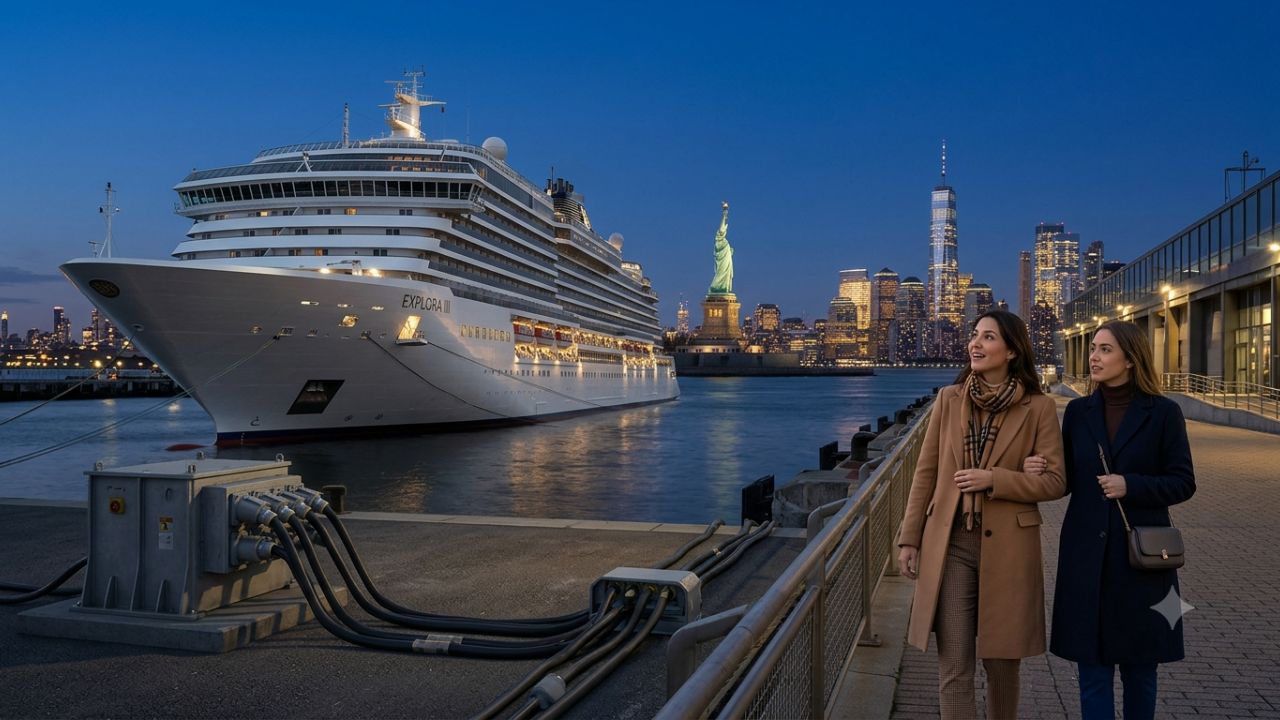
- Onshore Power Supply (OPS) Cold-Ironing: The new terminal will be equipped with high-voltage shoreside electrical connection infrastructure. This allows berthed cruise ships to shut down their onboard diesel auxiliary engines and plug directly into the clean terrestrial electrical grid, eliminating local sulfur dioxide, particulate matter, and greenhouse gas emissions while docked.
- Integrated Photovoltaic Generation: The terminal roof will incorporate extensive solar photovoltaic arrays, generating renewable electricity to power terminal lighting, baggage handling carousels, and passenger passenger boarding bridges.
- Automated Luggage and Passenger Logistics: Advanced biometric border verification lanes and high-throughput automated baggage sorting systems will streamline disembarkation, allowing passengers arriving on early morning voyages (such as Celebrity Infinity's 05:00 arrival) to transition to Barcelona-El Prat Airport (BCN) or Sants Railway Station quickly.
While these infrastructure upgrades are multi-year capital projects that will not alter passenger handling for the current November 2026 voyage, they demonstrate how Mediterranean cruise hubs are addressing environmental sustainability and local community impacts.
Strategic Guide for Cruise Travelers and Travel Advisors
For international travelers planning multi-country European cruises or travel advisors structuring complex itineraries, following a detailed operational checklist ensures travel compliance and minimizes disruption.
                      PASSENGER COMPLIANCE & EXCURSION MATRIX

  CRITICAL AREA            OPERATIONAL ACTION REQUIRED           KEY FAILURE RISK
+------------------------+-------------------------------------+-----------------------------------+
| Schengen Documentation | Verify MULTIPLE-ENTRY visa validity | Boarding denied at Piraeus;       |
|                        | Ensure "MULT" is marked on visa     | forfeiture of cruise fare         |
+------------------------+-------------------------------------+-----------------------------------+
| Montenegro Entry Check | Confirm nationality visa status;    | Confined to stateroom in Kotor;   |
|                        | Check qualifying exemption rules    | denied shore disembarkation       |
+------------------------+-------------------------------------+-----------------------------------+
| Tender Shore Timing    | Collect tender tickets early;       | Missed excursion departures;      |
|                        | Monitor port weather conditions     | extended dockside delays          |
+------------------------+-------------------------------------+-----------------------------------+
| Inland Transit Planning| Utilize express trains or ship tours| Traffic jams on A12/A1 motorway;  |
|                        | Allow 2.5-hour buffer for return    | missed ship all-aboard call       |
+------------------------+-------------------------------------+-----------------------------------+
Essential Visa and Documentation Checklist
- Verify Multiple-Entry Schengen Status: If you hold a passport from a country requiring a visa to enter the Schengen Area (such as India, China, South Africa, or the Philippines), inspect your Schengen visa vignette carefully. The "Number of Entries" field must state "MULT". If it states "01" (single entry), you will be prohibited from boarding the cruise in Piraeus because the itinerary exits the Schengen Zone into Montenegro before re-entering Italy.
- Review Montenegro Exemption Guidelines: If you are a citizen of Belarus, China, Russia, Saudi Arabia, or Türkiye, you cannot enter Montenegro visa-free under the November 1, 2026 rules unless you hold an eligible multiple-entry Schengen, US, UK, or Irish visa with remaining validity exceeding your intended stay.
- Carry Physical Visas: Do not rely on digital copies, smartphone screenshots, or expired residence permits. Ship pursers and local border police require original physical passports with valid affixed visa foils.
Shore Excursion and Port Buffer Strategies
- Gateway Port Buffer Margins: When visiting Rome from Civitavecchia or Florence from La Spezia, book an official ship-sponsored excursion if you are uncomfortable managing independent rail schedules. When booking cruise line excursions, the ship is contractually obligated to wait if your tour bus is delayed in highway traffic; if an independent train is delayed, the ship will depart on schedule, leaving you responsible for catching up with the vessel at the next port at your own expense.
- Tender Port Flexibility: In Kotor and Villefranche-sur-Mer, plan flexible walking itineraries near the tender landing dock rather than booking complicated independent long-distance tours. If strong afternoon winds cause tender operations to be suspended early, you must be in position to board the final shuttle immediately.
- Pre-Cruise and Post-Cruise Land Extensions: To turn this six-country cruise into a truly comprehensive holiday, book two nights in Athens prior to embarkation and two nights in Barcelona after disembarkation. This provides ample time to explore the Acropolis, Plaka, Sagrada Família, and Park Güell without the stress of sailing departure deadlines.
Related Travel Guides
- Schengen Visa Multi-Entry Rules: Avoiding Re-Entry Denials on European Cruises
- Athens Piraeus Port Transfer and Long-Haul Cruise Embarkation Guide
- Civitavecchia to Rome: Train Navigation, Express Shuttles, and Time Management
- Top Mediterranean Shoulder-Season Cruises: Beating Summer Crowds and Heatwaves
This article is for informational purposes. Flight routes, passenger regulations, visa rules, and transit advisories are subject to change by airlines and aviation authorities. Readers are advised to verify schedules and travel documentation with relevant carriers and border agencies before departure.