Uncovering Lopinot: The Urgent Truth Behind Trinidad’s Most Haunted Heritage Valley

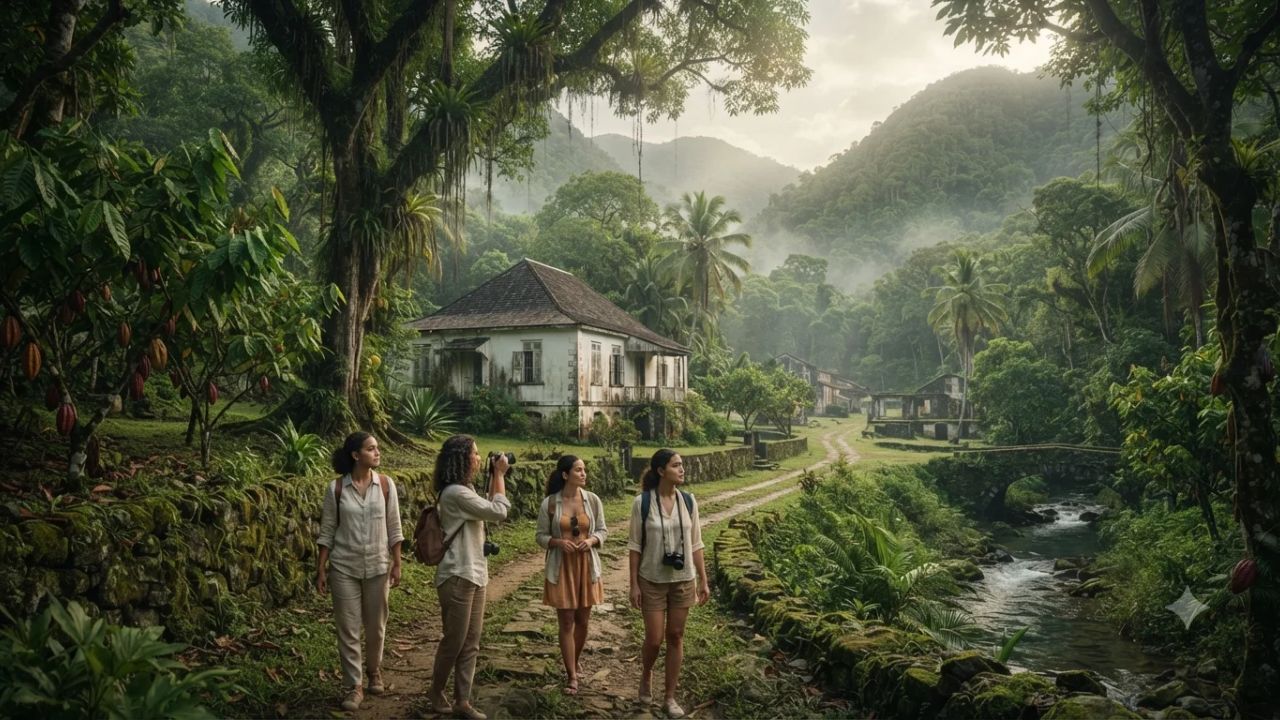
Image generated by AI
Carved from a 478-acre royal land grant awarded by the British Crown in 1806, the secluded mountain valley of Lopinot in Trinidad’s Northern Range stands as one of the Caribbean’s most structurally complex dark tourism sites, where lucrative colonial cocoa agriculture, forced human bondage, and enduring paranormal folklore converge. Located a brief 20-minute drive north of the high-density Eastern Main Road, the settlement flanks the freshwater course of the Arouca River under the canopy of towering immortelle trees planted centuries ago to shade fragile cacao crops. For international travelers navigating the West Indies, Lopinot represents an authentic counter-narrative to sun-and-sand resort tourism, compelling visitors to confront the architectural brutality of the transatlantic slave trade while experiencing an autonomous, community-managed ecotourism ecosystem.
The Colonial Genesis: From Saint-Domingue Upheaval to La Reconnaissance
The modern geopolitical identity of Lopinot originated in the violent collapse of France’s wealthiest colonial sugar possession during the Haitian Revolution. Charles Joseph de Loppinot de la Fresilliere, a French aristocrat and veteran military officer, evacuated Saint-Domingue amid the enslaved uprising, eventually securing refuge in Trinidad following the island’s capitulation to British imperial rule. In 1806, the British colonial administration awarded the Count a 478-acre land concession deep in the uncharted interior of the Northern Range.
Naming the remote territory the La Reconnaissance estate, Count de Loppinot transformed the mountain basin into one of the Southern Caribbean’s most agriculturally productive cocoa enterprises. However, documented records preserved by the National Trust of Trinidad and Tobago affirm that this economic success rested entirely upon the systematic exploitation and forced labor of enslaved African men, women, and children who cleared virgin montane rainforest, graded terrace tracks, and harvested cacao pods under severe coercion.
The physical remains of the estate function as an unvarnished museum of colonial subjugation. Among the surviving structures, the plantation jailhouse provides a chilling demonstration of deliberate spatial cruelty. Historic surveys reveal that estate managers constructed a two-story cocoa-drying and processing facility directly over the subterranean confinement cells. This architectural design ensured that even as punishment was administered in dark, unventilated subterranean pits, the labor of processing luxury export commodities continued uninterrupted directly overhead.
Pre-Colonial Antiquity and Indigenous Heritage
While popular historical accounts frequently treat the arrival of European planters in 1806 as the inception of human settlement in the valley, archaeological scholarship reveals a far deeper temporal timeline. Continuous field excavations conducted across the estate grounds have yielded pre-Columbian ceramic fragments and sacred ceremonial stones known as zemis.
These artifacts, sculpted by Trinidad’s First Peoples, confirm that indigenous Amerindian communities inhabited the fertile riverbanks of the Arouca River centuries before European naval incursions. The discovery of zemis—spiritual vessels embodying protective ancestral deities—demonstrates that the valley possessed deep ceremonial significance long before colonial sugar and cocoa monocultures reshaped the Caribbean basin. Modern heritage preservation initiatives led by regional researchers ensure that Lopinot's museum interpretation integrates indigenous survival alongside the plantation narrative.
Site Specifications, Folklore, and Heritage Assets
Lopinot's identity is defined by a unique convergence of material archaeology, structural preservation, living musical traditions, and persistent paranormal reports.
| Cultural & Heritage Dimension | Historic Parameter | Contemporary Tourism Function |
|---|---|---|
| Land Concession Grant | 478 Acres established in 1806 | Protected historic complex & ecological sanctuary |
| Foundational Proprietor | Count Charles Joseph de Loppinot | Historical figure anchoring estate colonial documentation |
| Primary Economic Crop | Trinitario Cacao / High-Yield Cocoa | Artisanal chocolate micro-manufacturing & agritourism |
| Key Architectural Ruins | Plantation great house, cocoa houses, jailhouse | Open-air historical interpretation & museum education |
| Indigenous Material Records | Pre-Columbian zemis & stone tools | Documented human presence predating European contact |
| Folklore Pedagogical Figures | Soucouyant, Douens, La Diablesse | Oral heritage deterring children from wilderness hazards |
| Living Performing Arts | Venezuelan-rooted Parang music | Annual heritage festivals & acoustic string traditions |
| Media & Paranormal Profile | Investigated by Discovery’s Expedition X | High-profile international dark tourism magnet |
Beyond physical brick and timber, Lopinot functions as the primary cultural repository of Trinidadian folklore. For generations, isolated valley elders utilized vivid oral storytelling to instill environmental discipline and safety in village youth. Mythical figures such as the Soucouyant (a blood-seeking shapeshifting elder), Douens (the lost, barefoot spirits of unbaptized children wearing oversized straw hats with feet turned backward), and La Diablesse (a demonic temptress concealing a cloven hoof beneath voluminous petticoats) were deployed as protective pedagogical tools. These cautionary narratives warned young children against wandering into the disorienting, snake-inhabited rainforests of the Northern Range, successfully preventing youth disappearances.
In modern times, these folkloric traditions have merged with active paranormal lore. Residents and ghost-tourism travelers document recurring sightings of a faceless spectral figure haunting the stone estate bridge, alongside auditory reports of phantom hooves galloping through the estate grounds during midnight tropical rainstorms. The valley's supernatural aura gained international media attention when field investigation crews from the Discovery television series Expedition X conducted high-tech sensor sweeps across the jailhouse and great house, cementing Lopinot's reputation as a premier destination for dark tourism.
Living Culture: Venezuelan Parang and Artisan Chocolate
Lopinot’s modern cultural fabric is equally shaped by 19th-century migration. Following the abolition of slavery, cocoa planters hired Venezuelan agricultural laborers—known locally as cocoa panyols—whose Spanish-Amerindian heritage permanently altered the valley's cultural acoustic.
These migrant laborers introduced Parang, a vibrant Venezuelan folk music tradition driven by the rhythmic strumming of the cuatro, the rattle of chac-chacs (maracas), and Spanish narrative vocals. Today, promoted actively through official regional cultural campaigns supported by Tourism Trinidad, Lopinot serves as the national capital of Parang, hosting lively holiday competitions and open-air jam sessions that draw musicologists from around the world.
Simultaneously, the village has reclaimed its agricultural heritage through sustainable cooperative enterprise. Instead of exporting raw, unrefined cocoa beans to multinational conglomerates, the Lopinot Tourism Association and village families produce single-origin, artisanal chocolates. Visitors participate in traditional "cocoa dancing"—the historical method of polishing fermenting cacao beans with bare feet on open wooden drying trays—transforming a legacy of exploited labor into an instrument of community economic self-determination.
Expert Analysis: The Ethics of Dark Tourism and Community-Led Heritage Stewardship
The commercialization of dark heritage sites presents profound ethical challenges throughout the post-colonial world. Too often, international tour operators commodify human suffering, transforming historic sites of enslavement into shallow ghost-hunting attractions that divorce supernatural thrills from historical accountability.
For travelers booking this route, the direct consequence is an immersive educational encounter that demands intellectual and emotional maturity. Lopinot rejects the passive escapism of all-inclusive beach resorts. Visitors walking across the estate grounds are directly confronted with the architectural machinery of forced confinement: the cramped jailhouse cells located directly beneath the cocoa drying floors force travelers to reckon with the human cost of 19th-century luxury trade commodities.
The pricing pressure this creates means that regional tourism bodies must guard against over-commercialization. In high-density tourism hubs across the Caribbean, unmanaged mass cruise arrivals frequently erode historic infrastructure and dilute local community agency. In contrast, Lopinot has deliberately resisted high-impact hotel developments. By operating under a decentralized model managed by the local community, tourist expenditures directly support local cocoa farmers, independent parang luthiers, and heritage docents rather than offshore corporate conglomerates.
Furthermore, international dark tourism researchers emphasize that sustainable heritage preservation requires transparent historical synthesis. By actively curating pre-Columbian indigenous zemis alongside colonial plantation registers, Lopinot provides a multi-layered historical perspective that aligns with international conservation standards championed by the UNESCO World Heritage Centre. The ghosts that haunt Lopinot are not merely folklore for international television crews; they embody the unresolved memories of colonial exploitation, preserved by a resilient community that has turned historical trauma into living cultural pride.
Key Takeaways
- Historical Foundation: Lopinot was established in 1806 as the La Reconnaissance estate following a 478-acre royal land grant awarded to French Count Charles Joseph de Loppinot.
- Agricultural Brutality: The estate's cocoa prosperity was constructed entirely through the forced labor of enslaved Africans, evidenced by the preserved jailhouse cells located beneath the cocoa-drying house.
- Deep Indigenous Antiquity: Archaeological excavations continually recover pre-Columbian ceramic shards and ceremonial zemis left behind by Trinidad’s First Peoples long before European colonization.
- Living Folklore and Parang: The valley serves as the epicentre of Trinidadian oral legends—including Douens and La Diablesse—as well as the historic home of Venezuelan-rooted Parang folk music.
- Sustainable Community Stewardship: The Lopinot Tourism Association operates a community-first ecotourism model centered on artisanal single-origin chocolate making, cultural education, and historical preservation.
FAQ: Visiting Lopinot Historical Complex 2026
Where is Lopinot located and how do travelers get there?
Lopinot is situated in Trinidad’s Northern Range along the Arouca River, roughly a 20-minute drive north of the Eastern Main Road from Arouca village.
Who was the historical founder of Lopinot?
The settlement is named after Charles Joseph de Loppinot de la Fresilliere, a French military officer who fled the Haitian Revolution and established the La Reconnaissance cocoa estate in 1806.
What are the main cultural and historical attractions in Lopinot?
Key sites include the restored Lopinot Historical Complex, the plantation jailhouse, the great house museum, traditional cocoa-drying facilities, and live Parang musical performances.
Why is Lopinot famous for folklore and ghost stories?
Lopinot is renowned for sightings of Count de Loppinot's ghost, spectral figures near the estate bridge, and oral traditions featuring mythical entities like Douens, Soucouyants, and La Diablesse.
Beneath the shadow of the immortelle trees and the mountain mist of the Northern Range, Lopinot proves that confronting the painful truths of history is the only way a community can truly write its own future.
Related Travel Guides
- Portugal and Other European Countries Are Now Offering Better Cultural Tourism at Vibrant Markets
- Civil Aviation Authority of Thailand and Regional Airlines Increase Air Seat Capacity to Support Target Five Million Chinese Inbound Arrivals
- India's Rising Outbound Travel Demand Fuels Historic Tourism Growth in Oman
This article is for informational purposes. Flight routes, passenger regulations, visa rules, and transit advisories are subject to change by airlines and aviation authorities. Readers are advised to verify schedules and travel documentation with relevant carriers and border agencies before departure.
Related Stories

Samarkand Marathon 2026: Uzbekistan Attracts 1,500 Athletes from 63 Nations for Sports Tourism
Indonesia Boosts Wellness Tourism as Yogyakarta Hosts 2026 Cultural Wellness Festival