
LaGuardia Airport Plane Crash Investigation Exposes Critical Runway Collision Risks: NTSB Reveals Chain of System Failures, Control Tower Pressure, and Emergency Response Coordination Breakdown
NTSB investigation reveals LaGuardia Airport plane crash resulted from cascading system failures: delayed flights, surveillance limitations, fire truck coordination chaos, and split-second control tower decisions converged in perfect-storm scenario.

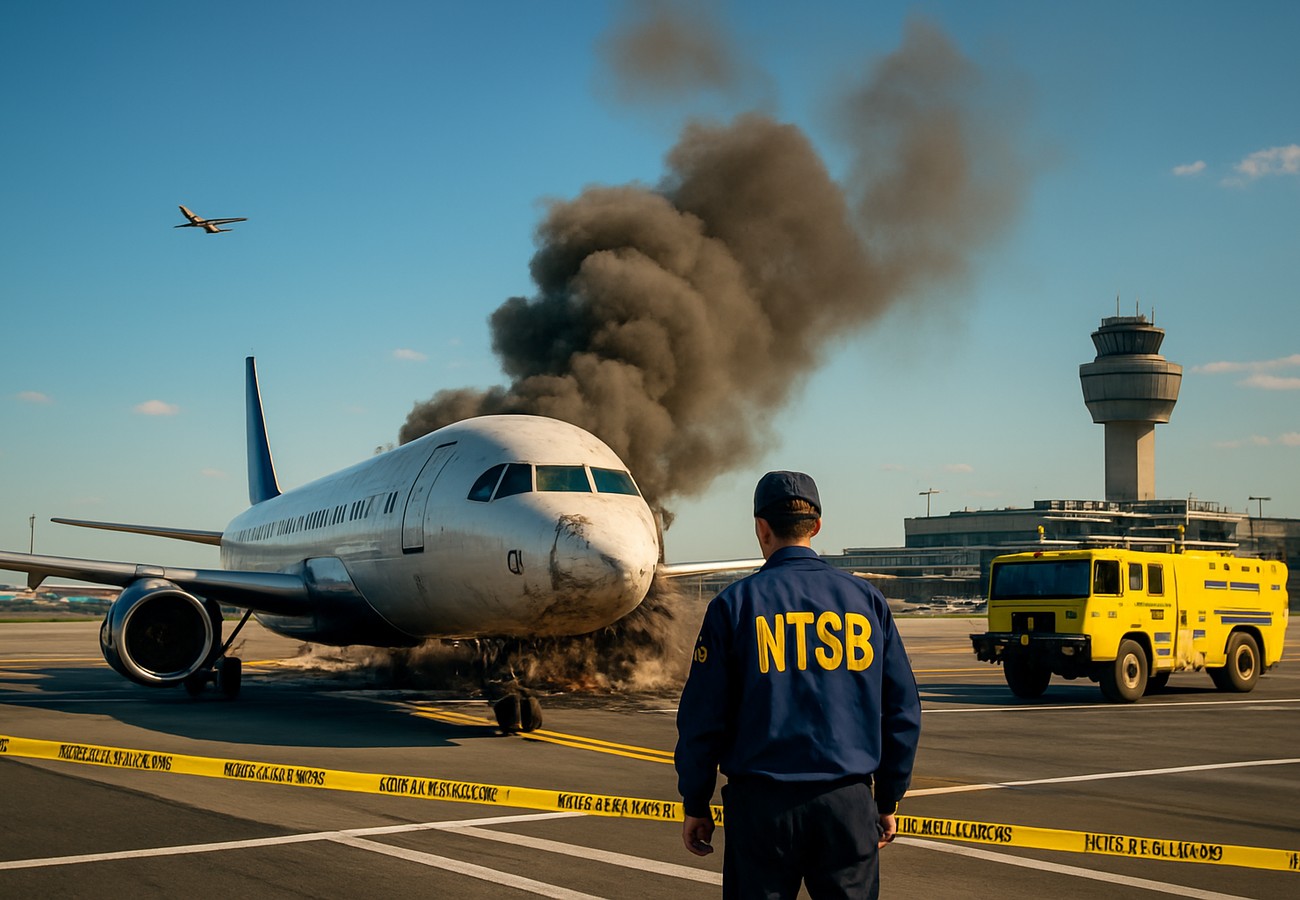
Image generated by AI
Quick Summary
- NTSB investigation identifies cascade of system failures, not single error
- Delayed flight volume created unprecedented control tower pressure
- Fire truck convoy coordination failed during active runway operations
- ASDE-X surveillance system could not track non-transponder-equipped emergency vehicles
- Nine-second warning interval proved insufficient for collision reversal
LaGuardia Airport Plane Crash Investigation Reveals Systemic Coordination Crisis
NEW YORK — The National Transportation Safety Board's preliminary findings into the LaGuardia Airport plane crash paint a picture of cascading operational pressures converging into a catastrophic runway collision scenario. What initially appeared as a single-point failure has instead emerged as a sequence of split-second decisions, surveillance system limitations, and emergency response coordination breakdowns that aligned in the worst possible configuration, underscoring fundamental vulnerabilities in modern airport safety infrastructure.
The investigation fundamentally challenges assumptions about accident causation in complex air transportation systems. Rather than identifying one critical mistake, NTSB examiners have documented how multiple safety layers—each functioning individually as designed—created compounding hazards when activated simultaneously during peak operational stress.
The Perfect Storm: How Routine Operations Escalated Into Crisis
That evening at LaGuardia Airport began unremarkably. Air traffic controllers managed standard flight sequences with scheduled staffing levels and anticipated traffic volumes. Within minutes, however, conditions deteriorated dramatically.
The initial pressure point: delayed flights throughout the day pushed arrival schedules far beyond historical late-evening norms. Aircraft were landing every few minutes, leaving minimal separation intervals. Simultaneously, a separate emergency involving a departing aircraft demanded immediate controller attention. This split-focus scenario—where controllers had to divide cognitive resources between airborne emergencies and ground traffic—represents precisely the operating condition where human error rates accelerate most sharply.
Emergency response crews were simultaneously active on airport surface areas, adding a fourth competing priority layer to controller workload. The investigation describes this convergence as creating "an unusually compressed decision-making environment where attention switching became unavoidable and situational clarity fragmented."
Emergency Vehicle Coordination Chaos During Active Runway Conditions
The most critical coordination failure involved a fire truck convoy responding to an aircraft-related incident on the airport surface. This emergency response team was authorized to cross controlled runway areas while both landing and departing operations continued—a scenario requiring precise timing and clear communication.
In practice, however, the ground emergency was progressing at emergency response speed while air traffic operations were executing at standard separation intervals. Controllers were managing multiple active landing sequences while simultaneously coordinating ground vehicle movement across those same runways.
According to NTSB communication records, clearance was issued for the fire truck convoy to cross the runway. Critically, this authorization was issued while an arriving aircraft was already in its final descent phase—approximately 100 feet above ground level and committed to landing. Red runway warning lights remained active throughout this window, yet did not prevent the crossing attempt.
NTSB investigators noted that the fire truck operator reported hearing warning instructions but did not immediately recognize that the directive applied to his vehicle during the high-stress emergency response phase.
ASDE-X Surveillance System Failure: Why Technology Did Not Prevent Collision
One of the investigation's most significant findings centers on the Automated Surface Detection Equipment (ASDE-X) system, which is specifically designed to prevent runway collisions through real-time aircraft and ground vehicle tracking.
On this particular evening, ASDE-X did not function as a collision prevention mechanism, primarily because:
- The fire truck convoy was not equipped with compatible transponders, rendering vehicles invisible to transponder-based tracking
- Radar returns from multiple ground targets blended together, eliminating precise position discrimination
- The system could not generate automated collision warnings for non-equipped emergency vehicles
- Controllers received no technical alert about the developing conflict path
This limitation is now identified as a central failure point. FAA Air Traffic Operations standards assume ASDE-X will provide collision prevention alerts. When those alerts failed to materialize, controllers lacked critical situational awareness during the precise moments when intervention was still possible.
The Nine-Second Window: When Warning Came Too Late
The final phase of the LaGuardia Airport plane crash unfolded across nine seconds—an interval that proved fatally inadequate for collision reversal.
Official communication records document this sequence:
- Aircraft received final landing clearance while at approximately 100 feet altitude
- Fire truck crew requested runway crossing authorization seconds later
- Clearance was issued despite active aircraft landing in progress
- Runway warning lights remained illuminated
- Controllers detected the developing conflict and issued urgent stop commands
The instruction was transmitted with appropriate urgency. However, nine seconds proved insufficient for a fire truck operating at emergency response speed to decelerate, stop, and reverse course. The aircraft, already committed to landing configuration at low altitude, could not abort its descent or divert to alternate runway positioning.
IATA accident analysis experts reviewing the sequence noted that the reaction window was "measured in single-digit seconds rather than the ten-to-fifteen-second intervals typically required for emergency reversal in mixed-mode runway operations."
Control Tower Pressure: When Workload Exceeds Cognitive Capacity
Another critical layer in the investigation involves documentation of control tower stress levels during the incident period.
Controllers were not understaffed—all required positions were occupied by certified personnel. However, the operational workload was characterized as "substantially exceeding historical norms for the facility during late-evening operations." Specific pressure factors included:
- Delayed flight schedules compressed into 90-minute windows
- Aircraft landing and departing in rapid succession with minimal separation
- A separate aircraft emergency requiring immediate diversion of controller attention
- Ground emergency response requiring real-time runway crossing coordination
- Communication load from multiple simultaneous priority situations
NTSB human factors specialists noted that even well-trained, experienced teams face documented performance degradation when multiple competing emergencies overlap. The investigation references peer-reviewed human factors research showing that cognitive load beyond 85-90% capacity creates significant error rate acceleration, even among expert operators.
Controllers managing the LaGuardia Airport operations that evening were almost certainly operating in this cognitive saturation zone during the critical nine-second window.
How Multiple System Layers Converged Into Catastrophe
When viewed as an integrated system rather than individual components, the LaGuardia Airport plane crash appears as the product of several intersecting failures:
- Arrival pressure: Delayed flight volume created unprecedented late-evening traffic density
- Surveillance limitation: Non-equipped emergency vehicles were invisible to ASDE-X surveillance
- Coordination timing: Runway crossing clearance overlapped with active aircraft landing
- Warning interval: The nine-second warning period was insufficient for ground vehicle deceleration
- Cognitive saturation: Controllers were managing four competing priorities simultaneously
- Communication ambiguity: Stop instructions came during high-load communication environment
Each component, examined individually, appeared manageable. Collectively, they created a scenario where reaction time collapsed entirely.
NTSB Recommendations and Future Safety Implications
The investigation has generated preliminary recommendations focusing on three core areas:
Airport Emergency Response Coordination: Revised procedures for authorizing emergency vehicle movement during active runway operations, potentially including mandatory transponder equipment for all ground vehicles operating during flight movements.
ASDE-X System Enhancement: Upgrade surveillance systems to track non-transponder-equipped vehicles through alternative technologies such as enhanced radar discrimination or GPS-based ground tracking.
Runway Collision Analysis Tools: Develop enhanced early-warning systems capable of identifying developing conflicts between aircraft and ground vehicles earlier in the conflict development sequence.
The Broader Safety Conversation
The LaGuardia Airport plane crash investigation is generating significant discussion within the aviation safety community about fundamental assumptions regarding runway safety systems. The incident challenges the belief that multiple independent safety layers will always prevent catastrophic outcomes, revealing instead that under sufficient combined stress, coordinated system failures can overwhelm traditional prevention mechanisms.
FlightRadar24 and other aviation monitoring platforms are now analyzing historical traffic patterns at major US airports to identify facilities that regularly operate with similar pressure profiles to LaGuardia during delayed-flight scenarios.
Frequently Asked Questions
What caused the plane crash at LaGuardia Airport? The NTSB investigation identified a cascade of system failures rather than a single cause: delayed flight volume created control tower pressure, emergency vehicle coordination failed during active runway operations, ASDE-X surveillance could not track non-equipped vehicles, and the final warning interval was insufficient for collision reversal.
Could ASDE-X have prevented the collision? If the fire truck had been equipped with a compatible transponder and ASDE-X had been fully functional, the system would likely have generated automated collision warnings, giving controllers additional situational awareness during the critical seconds before impact.
Why was emergency vehicle clearance issued during active landing operations? Controllers were managing multiple competing priorities simultaneously and may have underestimated the conflict interval between the aircraft landing sequence and the ground vehicle crossing. The investigation attributes this partly to cognitive saturation during peak operational load.
What changes will result from this investigation? The NTSB has recommended mandatory transponder equipment for airport emergency vehicles, enhanced ASDE-X capabilities, revised emergency response authorization procedures, and improved early-warning systems for runway conflict detection.
Could this happen at other major airports? Yes. Many major US airports operate with similar pressure profiles during delayed-flight scenarios. The investigation has prompted the FAA to conduct system-wide assessments of runway safety procedures at facilities with comparable traffic volumes and emergency response patterns.
How long does the investigation timeline typically extend? NTSB investigations can span 12-24 months for complex accidents involving multiple system failures. The preliminary findings from the LaGuardia incident are expected to evolve as additional technical data is analyzed and expert review is completed.
Disclaimer
This article is for informational and educational purposes only. It does not constitute legal, financial, or professional advice. While we strive to provide accurate and up-to-date information, travel policies, regulations, and conditions change rapidly. Always verify information with official sources before making travel decisions. Nomad Lawyer makes no representations about the accuracy, reliability, completeness, or suitability of the information provided. Readers should consult qualified professionals for advice specific to their circumstances. The views expressed in this article are those of the author and do not necessarily reflect the views of Nomad Lawyer.
Kunal K Choudhary
Co-Founder & Contributor
A passionate traveller and tech enthusiast. Kunal contributes to the vision and growth of Nomad Lawyer, bringing fresh perspectives and driving the community forward.
Learn more about our team →