
Kazakhstan Gains UNESCO World Heritage Status for Five Mangystau Rock Mosques Boosting Central Asian Travel
UNESCO inscribes five ancient rock-hewn mosques in Mangystau, Kazakhstan on the World Heritage List, driving heritage tourism from Central Asia and Russia.

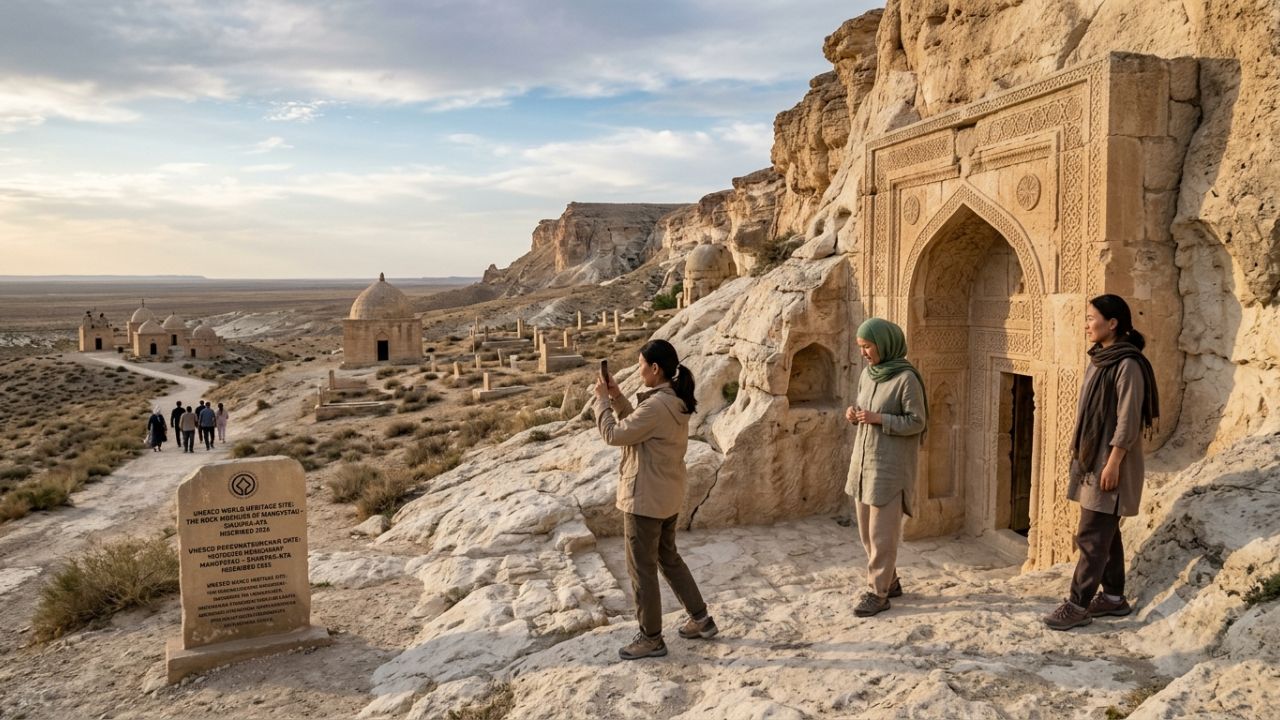
Image generated by AI
UNESCO has officially inscribed the Rock Mosques and Associated Sacred Sites of Mangystau in western Kazakhstan onto the World Heritage List, unlocking fresh opportunities for religious and cultural tourism across Central Asia.
The decision, adopted during the World Heritage Committee’s 48th session in Busan, South Korea, recognizes five historic religious complexes: Beket-Ata, Shopan-Ata, Karaman-Ata, Shakpak-Ata, and Sultan-Epe. The inscription coincides with record inbound tourism performance, as Kazakhstan welcomed 7 million foreign visitors in the first half of 2026 according to official travel statistics published by Kazakh Tourism and designation records from the UNESCO World Heritage Centre.
Five Sacred Rock-Hewn Complexes Awarded World Heritage Status
Inscribed under cultural criteria (ii) and (iii), the serial property represents a unique architectural tradition developed in the semi-desert landscape of the Mangystau Peninsula. The rock-cut sanctuaries showcase centuries of historical interaction between Islamic Sufi traditions and Central Asian Turkic nomadic culture.
UNESCO World Heritage Inscription Details
├── Property Name   : Rock Mosques and Associated Sacred Sites of Mangystau
├── Date & Session  : 25 July 2026 | 48th World Heritage Committee Session (Busan, South Korea)
├── Cultural Criteria: Criteria (ii) & (iii) — Sufi & Turkic Nomadic Integration
└── Components      : 5 Distinct Sacred Sites (Beket-Ata, Shopan-Ata, Karaman-Ata, Shakpak-Ata, Sultan-Epe)
The five components consist of natural caves, excavated limestone chambers, and ancient necropolises that continue to function as active places of pilgrimage and religious worship.
The Five Component Sites of the Mangystau Serial Property
| Sacred Site | Geographical Setting | Key Architectural & Spiritual Significance | Primary Visitor Appeal |
|---|---|---|---|
| Beket-Ata | Inland semi-desert canyon | Underground religious chambers carved into chalk cliffs; central Sufi pilgrimage site | Sufi heritage, rock-cut architecture, pilgrimage traditions |
| Shopan-Ata | Inland sandstone valley | Ancient cave mosque linked to the Khoja Ahmed Yasawi spiritual lineage | Yasawi Sufi history, carved prayer rooms, ancient graves |
| Karaman-Ata | Inland desert steppe | Historic underground mosque surrounded by an extensive medieval necropolis | Stone burial monuments, Kazakh clan memorials, sacred legends |
| Shakpak-Ata | Northern coastal plateau | Cross-shaped limestone cave mosque featuring intricate interior engravings | Unique cruciform cavern design, ancient inscriptions |
| Sultan-Epe | Northern coastal canyon | Multi-chambered underground sanctuary and historical pilgrimage well | Coastal desert geology, sacred water spring, Sufi traditions |
Inbound Tourism Performance: 7 Million Arrivals Led by Regional Neighbors
Kazakhstan's inbound travel sector experienced substantial growth during the first half of 2026, recording 7.0 million foreign arrivals between January and June. Travelers from neighboring Central Asian states and Russia accounted for nearly 80 percent (5.6 million) of total inbound footfall.
H1 2026 Kazakhstan Foreign Visitor Breakdown (7.0 Million Total)
├── Uzbekistan : 2.5 Million Arrivals (35.7% Total Share)
├── Kyrgyzstan : 1.6 Million Arrivals (22.9% Total Share)
├── Russia     : 1.5 Million Arrivals (21.4% Total Share)
└── Other      : 1.4 Million Arrivals (20.0% Total Share)
Uzbekistan led as Kazakhstan's largest source market with 2.5 million visitors, followed by Kyrgyzstan with 1.6 million and Russia with 1.5 million. The high volume of regional cross-border travel provides a sturdy base for expanding heritage itineraries across western Kazakhstan.
Regional Source Market Breakdown & Cultural Connections
The newly inscribed UNESCO sites align closely with historical and religious travel interests across neighboring nations:
- Uzbekistan (2.5M Arrivals): Shared links to the Khoja Ahmed Yasawi Sufi tradition connect Uzbek travelers to Shopan-Ata and Karaman-Ata, fostering educational and spiritual travel itineraries.
- Kyrgyzstan (1.6M Arrivals): Shared Turkic nomadic heritage and visa-free travel frameworks facilitate road trip itineraries connecting Kyrgyzstan to the rock-cut architecture of Shakpak-Ata.
- Russia (1.5M Arrivals): Longstanding cross-border transport links via Caspian transit routes allow Russian culture seekers to explore the remote geological landforms and stone necropolises surrounding Beket-Ata.
Travel Logistics and Gateway Access via Aktau
For international travelers planning visits to the UNESCO rock mosques, the port city of Aktau on the Caspian Sea serves as the primary urban gateway. Aktau offers commercial airport connections, hotel accommodation, and regional tour operators.
Mangystau Travel & Transport Logistics
├── Urban Gateway   : Aktau (Caspian Sea Port & International Airport)
├── Northern Circuit: Shakpak-Ata & Sultan-Epe (Accessible via northern coastal roads)
├── Inland Circuit  : Beket-Ata, Shopan-Ata & Karaman-Ata (Located inland across desert plateaus)
└── Transport Advice: Pre-arranged 4x4 vehicles & local guides recommended for desert tracks
Because the five sites are geographically dispersed across rugged desert terrain, visitors should organize itineraries into two separate circuits: a northern coastal loop covering Shakpak-Ata and Sultan-Epe, and an inland desert loop covering Shopan-Ata, Karaman-Ata, and Beket-Ata.
2027–2032 UNESCO Management Plan and Sustainable Conservation
To balance increased visitor access with heritage protection, Kazakh authorities are establishing an Integrated Management Plan covering 2027–2032.
The six-year framework addresses structural conservation, natural landscape protection, disaster risk monitoring, and tourist facility upgrades. Because the monuments remain active places of worship, visitor guidelines emphasize modest dress, quiet conduct, and adherence to local pilgrimage protocols.
Why This Matters
The inscription of Mangystau’s rock-hewn mosques elevates Kazakhstan’s position within global heritage tourism, offering an authentic alternative to conventional urban or nature-based itineraries in Central Asia. For international travelers, the sites combine extraordinary geological landforms with centuries of intact Sufi architectural tradition.
For the regional travel economy, World Heritage status encourages infrastructure investment in the Mangystau region, driving demand for local guides, transport providers, and hospitality services in Aktau. By implementing a multi-year conservation management plan, Kazakhstan is ensuring that increased tourist footfall preserves the spiritual and physical integrity of its most sacred landmarks.
FAQ: Kazakhstan UNESCO Rock Mosques 2026
Which mosques were inscribed on the UNESCO World Heritage list in 2026?
UNESCO inscribed five rock-hewn mosques in western Kazakhstan: Beket-Ata, Shopan-Ata, Karaman-Ata, Shakpak-Ata, and Sultan-Epe.
Where are the UNESCO rock mosques located and how can travelers visit them?
The mosques are located in the Mangystau region of western Kazakhstan. The Caspian port city of Aktau serves as the main travel gateway, with sites accessible via organized 4x4 overland tours.
Which countries drive the highest number of visitors to Kazakhstan?
In the first half of 2026, Kazakhstan welcomed 7 million foreign visitors, led by Uzbekistan (2.5 million), Kyrgyzstan (1.6 million), and Russia (1.5 million).
What is the 2027–2032 UNESCO Management Plan?
It is a multi-year conservation framework focused on protecting the sacred monuments, preserving the surrounding semi-desert landscape, and improving visitor facilities while respecting active pilgrimage traditions.
Related Travel Guides
Disclaimer
This article is for informational and educational purposes only. It does not constitute legal, financial, or professional advice. While we strive to provide accurate and up-to-date information, travel policies, regulations, and conditions change rapidly. Always verify information with official sources before making travel decisions. Nomad Lawyer makes no representations about the accuracy, reliability, completeness, or suitability of the information provided. Readers should consult qualified professionals for advice specific to their circumstances. The views expressed in this article are those of the author and do not necessarily reflect the views of Nomad Lawyer.
Kunal K Choudhary
Co-Founder & Contributor
A passionate traveller and tech enthusiast. Kunal contributes to the vision and growth of Nomad Lawyer, bringing fresh perspectives and driving the community forward.
Learn more about our team →