
Bypassing Travel Chaos: JFK Officially Named America’s Most Stressful Airport as Corporate Commuters Flee Massive Flight Cancellations and Terminal Gridlock: Airline News
As massive travel chaos and a 30% flight disruption rate paralyze New York airspace, business travelers aggressively abandon JFK and Newark for regional alternatives.

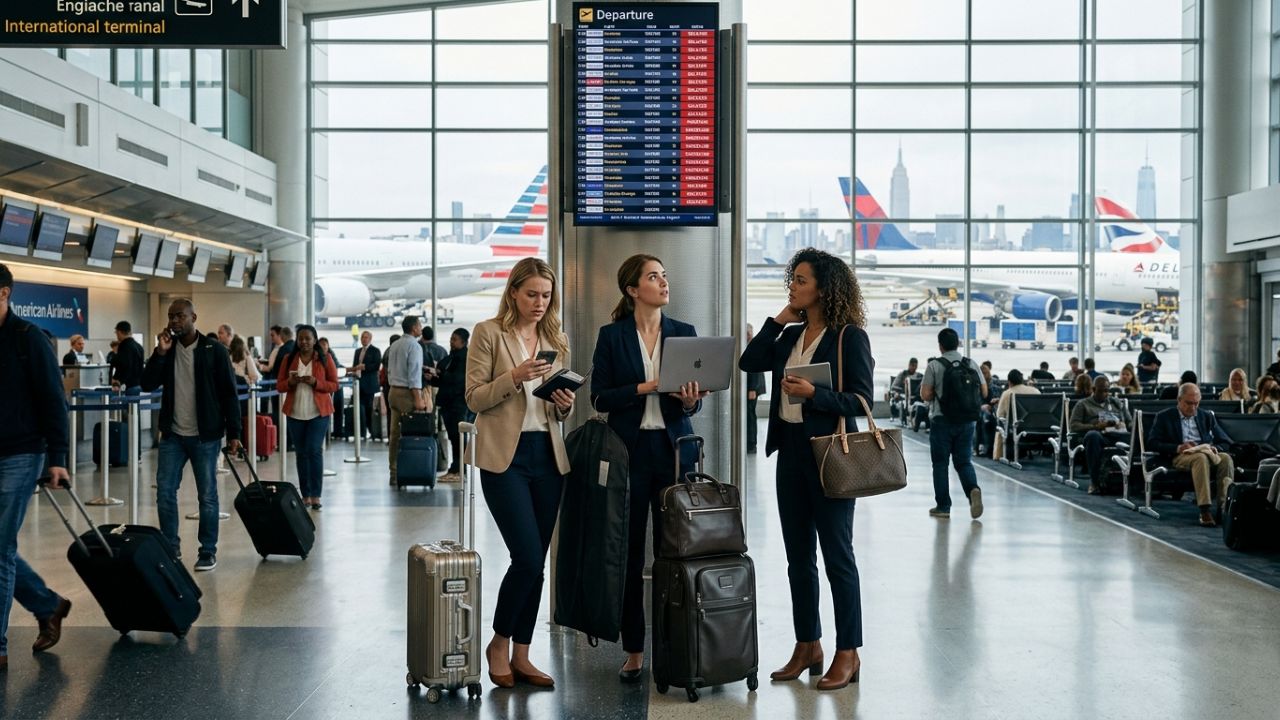
Image generated by AI
In a massive statistical indictment that proves major Northeastern transit hubs are currently generating catastrophic levels of travel chaos, New York’s John F. Kennedy International Airport (JFK) has officially been named the absolute most stressful aviation facility in the United States. Reported on June 20, 2026, as exhausted corporate executives frantically monitor the latest airline news for an escape from rolling flight cancellations and agonizing terminal gridlock, a comprehensive study by Booking.com for Business confirms the collapse of operational efficiency in New York airspace. By factoring in exhausting runway delays, agonizing customs queues, and paralyzing highway congestion into Manhattan, analysts awarded JFK a staggering stress score of 8.06 out of 10. With Newark Liberty International ranking a close second due to massive airport disruptions, desperate corporate travel managers are aggressively abandoning these paralyzed legacy corridors in favor of highly optimized regional bypasses, cementing this data as today's most crucial headline in breaking aviation updates.
By introducing direct passenger coordination and dynamic scheduling backups, the regional aviation hubs target growing passenger demand across vital commerce sectors. The choice to coordinate flight departures in phases helps to manage gate capacity, supporting the country's broader regional transportation network.
Context: The Collapse of the Corporate Transit Hub
For modern business professionals operating on razor-thin corporate schedules, navigating the massive New York aviation complex has become the absolute ultimate exposure to structural transit failure.
Historically, JFK was the undisputed gateway for high-stakes international commerce. However, the definitive Booking.com for Business study reveals that the hub now introduces a terrifying array of unpredictable variables that routinely shatter time-sensitive itineraries. The data is damning: arriving executives face an exhausting average customs wait time of 24 minutes and 48 seconds, completely eliminating any buffer time between the tarmac and vital boardroom negotiations. Furthermore, the sheer physical scale of the disjointed JFK terminal complex forces commuters into agonizing pedestrian bottlenecks. When this terminal gridlock is compounded by systemic flight cancellations, JFK transforms from an international gateway into an absolute pressure cooker, completely draining corporate productivity and costing multi-national enterprises millions of dollars in lost billable hours.
To view live flight schedules, verify the active severity of the JFK tarmac gridlock, or to track potential route restorations prior to heading to the airport, travelers must consult official aviation directories. For direct updates regarding how this massive operational crisis might trigger flight cancellations for your specific airline out of New York, travelers should aggressively utilize the official digital portals of their respective carriers. To explore live flight tracking and monitor the exact severity of the cascading bottlenecks paralyzing alternative regional airspace, passengers can consult the official FlightAware tracking service.
Section-Wise Breakdown: The Northeast Gridlock Nightmare
JFK and the Van Wyck Expressway: The Ultimate Bottleneck
The misery of flying into JFK does not conclude at baggage claim; the ground transit to Manhattan is a legendary corporate nightmare. Traveling from the passenger terminals into the central business district takes an astonishing average of 65 minutes under standard conditions. Arriving executives must battle the infamous Van Wyck Expressway, where heavy highway congestion routinely adds more than half an hour of pure, unavoidable delay to their commutes. This agonizing transfer time is officially the longest urban transit window recorded among all major airports evaluated, forcing executives to abandon car services for complex rail connections just to survive the gridlock.
Newark Liberty International: The Cancellation Crisis
Securing a notoriously frustrating second-place finish, Newark Liberty International Airport scored an incredibly high 7.99 out of 10 on the definitive stress metric. Newark's specific failure point is highly operational: the facility suffers a staggering 30 per cent flight disruption rate. For a corporate traveler, a 30% chance of experiencing a delay or flight cancellation is an absolutely unacceptable risk profile, making Newark a highly volatile gamble for anyone attempting to execute precise commercial scheduling.
The National Contagion: Regional Hubs Buckling
The travel chaos is not isolated to New York. California’s Ontario International Airport and Florida’s Fort Lauderdale-Hollywood International Airport tied for a highly frustrating third place, suffering immensely from localized airspace crowding and severe commuter traffic congestion. Even legendary transit bastions like Chicago O’Hare and Los Angeles International landed firmly within the top ten most stressful environments, proving that legacy airfields are systematically buckling under the weight of historic passenger volumes and hyper-congested regional flight paths.
Technical Roster: Official Corporate Airport Stress Matrix
To ensure absolute factual accuracy regarding the exact stress indices, specific disruption rates, and critical transit times defining this massive infrastructure analysis, the following matrix details the strictly verified aviation data:
Official Corporate Airport Stress Matrix (Booking.com for Business)
| American Aviation Hub / Evaluation Metric | Verified Statistical Data |
|---|---|
| John F. Kennedy International (JFK) | Ranked #1 Most Stressful (Score: 8.06 / 10) |
| JFK Customs Processing | Average wait time: 24 minutes and 48 seconds |
| JFK Ground Transit to Manhattan | Average 65 minutes (often adding 30+ mins delay) |
| Newark Liberty International | Ranked #2 Most Stressful (Score: 7.99 / 10) |
| Newark Operational Volatility | Suffers a staggering 30% flight disruption rate |
| Ontario Int'l (CA) & Fort Lauderdale (FL) | Tied for 3rd most stressful airports nationally |
| Phoenix Sky Harbor International | Ranked Least Stressful (Disruption Rate: 20.5%) |
| Highly Optimized Transit Alternatives | Norman Y. Mineta San Jose & Hartsfield-Jackson Atlanta |
Data accurately reflects the verified stress indices, operational disruption rates, and specific customs/transit times compiled by Booking.com for Business as of June 2026.
Industry Analysis: The Value of Tactical Avoidance
Aviation analysts monitoring the intensely volatile US domestic market note that this data-driven ranking is triggering a massive behavioral shift among corporate travel coordinators.
Analysts emphasize that airfields originally designed decades ago cannot handle modern passenger density. When a major hub like Newark operates with a 30% flight disruption rate, it ceases to be a functional transit point and becomes a severe liability. In stark contrast, highly optimized facilities like Phoenix Sky Harbor International Airport—officially ranked the least stressful major hub with a significantly lower disruption rate of 20.5%—are aggressively stealing corporate market share. Facilities like Norman Y. Mineta San Jose International and Hartsfield-Jackson Atlanta prioritize automated customs, rapid baggage retrieval, and efficient layouts. Travel managers are now explicitly writing policies that legally require personnel to route their journeys through these specific low-stress alternatives, completely starving the paralyzed Northeast corridors of highly lucrative business-class revenue.
Actionable Advice for Corporate Travelers
Because these massive operational failures fundamentally alter the reliability of corporate travel into the Northeast, business commuters must execute this strategic survival checklist immediately:
- Abandon the JFK/Newark Corridor: If your final destination allows for regional flexibility, absolutely refuse to book flights directly into JFK or Newark. The 30% disruption rate and massive ground gridlock guarantee a high probability of missed meetings. Actively reroute your itineraries into secondary, highly efficient regional airports whenever geographically possible.
- Exploit Low-Stress Bypasses: When planning national travel, deliberately route your connections through officially recognized low-stress sanctuaries like Phoenix Sky Harbor, Mineta San Jose, or Atlanta. These airports feature near-perfect baggage handling and minimal flight cancellations, ensuring you maintain an uninterrupted corporate workflow.
- Mandate Buffer Zones and Transit Alternatives: If you are forced to fly into JFK, never rely on highway transfers via the Van Wyck Expressway. You must aggressively pre-book express rail connections to Manhattan, and corporate managers must integrate massive 2-3 hour time buffers into all itineraries to absorb the inevitable 24-minute customs delays and terminal gridlock.
FAQ: US Corporate Airport Stress Rankings
Which US airport is currently the most stressful for business travelers?
According to the latest Booking.com for Business study, New York's JFK International Airport ranks as the most stressful, scoring a staggering 8.06 out of 10.
Why did Newark Liberty rank second in the national stress index?
Newark Liberty secured its highly frustrating ranking largely due to massive operational volatility, suffering an unacceptable 30 per cent flight disruption rate.
Which US airports provide the least stressful corporate experience?
Phoenix Sky Harbor International officially ranks as the least stressful hub, alongside highly optimized facilities like Mineta San Jose and Hartsfield-Jackson Atlanta.
The Reality of Airport Selection
The catastrophic stress ratings assigned to JFK and Newark prove definitively that relying on traditional Northeast legacy hubs is the ultimate risk in modern corporate aviation. By funneling high-value executives into severely constrained airspace, corporations have successfully guaranteed that systemic travel chaos will destroy their productivity. Yet, as business leaders frantically rewrite their corporate travel policies to avoid the Van Wyck Expressway, they must accept a critical new reality: surviving the massive disruptions of modern commerce demands extreme logistical discipline. Navigating the hostile 2026 American airspace requires a complete refusal to book vulnerable itineraries through paralyzed hubs, and the tactical awareness to fly exclusively through highly optimized airports that prioritize executive efficiency over legacy dominance.
Key Takeaways
- JFK Claims Worst Ranking: JFK Airport officially secured the title of the most stressful US airport with a score of 8.06/10, driven by severe terminal and transit gridlock.
- Massive Ground Delays: Traveling from JFK to Manhattan averages an agonizing 65 minutes, with highway congestion routinely adding 30+ minutes of delay.
- Newark's Disruption Crisis: Ranked second (7.99/10), Newark suffers a staggering 30% flight disruption rate, making it a severe liability for corporate travel.
- Regional Hubs Buckling: Ontario International and Fort Lauderdale tied for third most stressful, while Chicago O'Hare and LAX remained firmly in the top ten.
- Phoenix Provides Sanctuary: Phoenix Sky Harbor ranked as the absolute least stressful hub (20.5% disruption rate), alongside Mineta San Jose and Atlanta.
Related Travel Guides
Massive Travel Chaos Paralyzes Chicago O'Hare with 1,425 Disruptions
Delta Air Lines Triggers US Domestic Flight Cancellations
JFK Corporate Airport Stress Rankings Live Updates on Reddit
Disclaimer
This article is for informational and educational purposes only. It does not constitute legal, financial, or professional advice. While we strive to provide accurate and up-to-date information, travel policies, regulations, and conditions change rapidly. Always verify information with official sources before making travel decisions. Nomad Lawyer makes no representations about the accuracy, reliability, completeness, or suitability of the information provided. Readers should consult qualified professionals for advice specific to their circumstances. The views expressed in this article are those of the author and do not necessarily reflect the views of Nomad Lawyer.
Kunal K Choudhary
Co-Founder & Contributor
A passionate traveller and tech enthusiast. Kunal contributes to the vision and growth of Nomad Lawyer, bringing fresh perspectives and driving the community forward.
Learn more about our team →