
Italy Confirms Devastating June 26 Nationwide Ground Strike, Triggering Ultimate Travel Chaos and Massive Flight Cancellations Across Rome, Milan, Verona, and Cagliari: Latest Airline News
A confirmed 24-hour nationwide ground handling strike on June 26 will paralyze Italian aviation, unleashing catastrophic travel chaos and flight cancellations across Rome, Milan, and Cagliari.

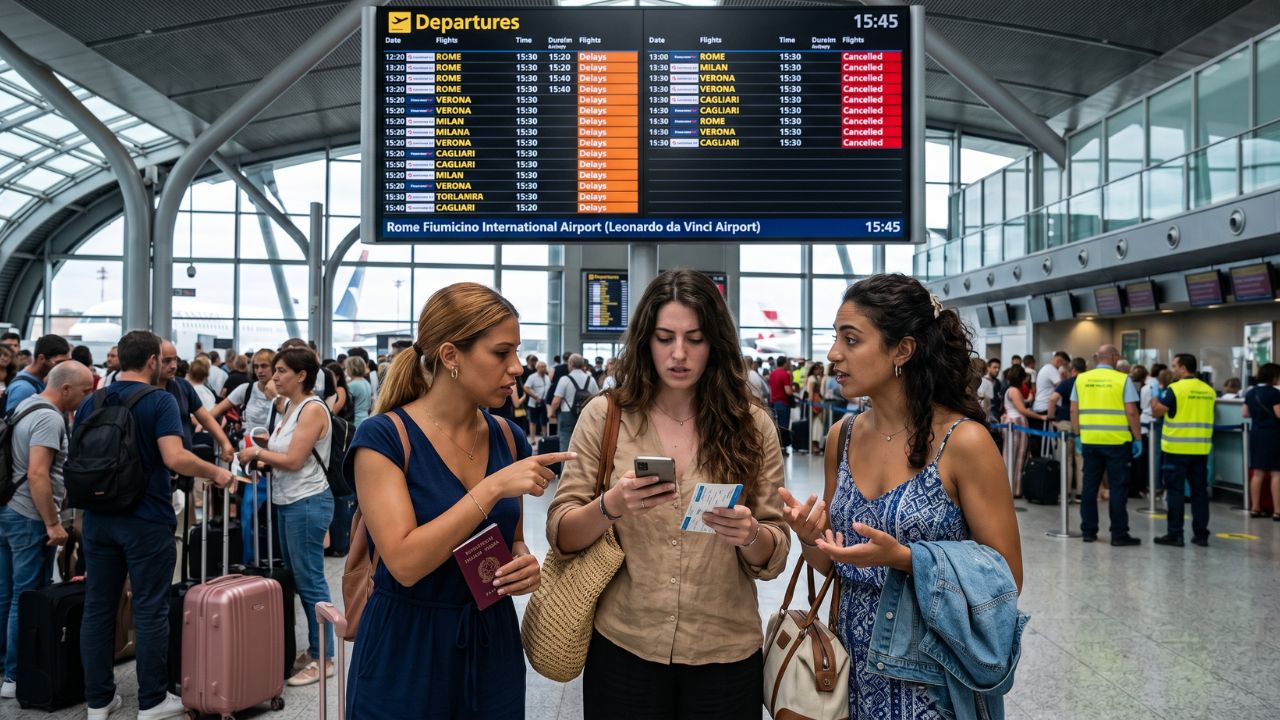
Image generated by AI
In a devastating industrial mandate guaranteed to unleash the ultimate travel chaos and an unrelenting wave of massive flight cancellations across one of Europe’s most critical tourism markets, Italy has officially confirmed a catastrophic 24-hour nationwide ground handling strike scheduled for June 26. Announced on June 18, 2026, this coordinated labor withdrawal will instantly paralyze major aviation hubs, with Rome, Milan, Verona, and Cagliari bracing for total operational breakdown. Because ground handlers control the absolute physical movement of aircraft—including baggage logistics, aircraft marshaling, and ramp coordination—their 24-hour suspension will trigger severe airport disruptions that airlines cannot bypass. As millions of summer tourists and business travelers face extended terminal gridlock, lost luggage, and sudden itinerary destruction, this impending nationwide aviation meltdown is driving today's most urgent headline in breaking airline news and essential global aviation updates.
By introducing direct passenger coordination and dynamic scheduling backups, the regional aviation hubs target growing passenger demand across vital commerce sectors. The choice to coordinate flight departures in phases helps to manage gate capacity, supporting the country's broader regional transportation network.
Context: The Total Paralysis of the Italian Peninsula
For the millions of international tourists preparing to navigate the Mediterranean peak summer season, the June 26 ground handling strike represents the absolute worst-case scenario for localized travel chaos.
Historically, when air traffic controllers strike, airlines can sometimes reroute flights around the affected airspace. However, a nationwide ground handling strike creates inescapable physical bottlenecks. The moment ground staff withdraws their services, the entire operational chain collapses. Check-in systems stall, baggage cannot be loaded into the cargo holds, and arriving aircraft are forced into dangerous stacking patterns because there is no one available to marshal them into their allocated gates. Without ground coordination, flight sequencing breaks down within minutes. Rome, managing immense long-haul international traffic, and Milan, handling dense European corporate and transit flow, will suffer immediate systemic failures. Furthermore, secondary hubs like Verona and Cagliari lack the operational redundancy to absorb this shock, meaning their schedules will simply disintegrate. Airlines have no choice but to execute pre-emptive flight cancellations to prevent their fleets from being permanently trapped on Italian tarmacs. Passengers holding tickets for June 26 are mathematically guaranteed to face extreme delays, terminal overcrowding, and the total collapse of their Italian transit itineraries.
To view live flight schedules, verify the active delay status of your specific itinerary, or to track active regional airspace restrictions, travelers must consult official aviation directories. For direct updates regarding how this massive industrial action guarantees sudden route abandonments affecting your specific Italian connections, travelers should aggressively utilize the official portals of their operating carriers. To explore live flight tracking and monitor the exact severity of the cascading bottlenecks causing the flight cancellations at competitor hubs, passengers can consult the official FlightAware tracking service.
Section-Wise Breakdown of the Nationwide Breakdown
Rome: The International Long-Haul Collapse
As Italy's primary gateway, airports in Rome are expected to experience the most severe congestion levels. Passenger processing systems will slow to a crawl, and international long-haul flights—which require massive, synchronized ground operations to turn around widebody aircraft—will face critical delays. As terminal congestion escalates, airport command centers will be forced to implement emergency flight consolidation, triggering massive flight cancellations and leaving thousands of international tourists stranded in exterior departure zones.
Milan: The Commercial Transit Gridlock
Milan’s aviation infrastructure will suffer immense pressure as high-yield commercial traffic and leisure tourism collide. The suspension of ground handling will instantly interrupt inbound and outbound flight cycles, while cargo movement logistics will grind to a halt. Airlines operating in Milan will execute aggressive pre-emptive cancellations to avoid trapping their aircraft in the hub, ensuring that European hub connectivity cascading out of Milan is severely fractured.
Verona: The Regional Feeder Failure
In Verona, the lack of operational redundancy means the strike will cause disproportionate disruption. Passenger assistance and baggage handling units will effectively cease to exist during peak strike hours. Regional feeder flights connecting northern Italy to broader European hubs will face total route suspensions, entirely cutting off the tourist flow through one of Italy’s most vital regional economic corridors.
Cagliari: The Island Connectivity Breakdown
For Cagliari, the strike threatens a critical breakdown of island connectivity. Sardinia relies almost exclusively on limited air corridors and ferry-air coordination to move tourists from the mainland. The strike will force major flight cancellations, reducing flight frequency to near-zero. Because island destinations lack alternative overland transport routes, passengers attempting to travel to or from Cagliari will face absolute itinerary paralysis.
Technical Roster: Italy June 26 Strike Impact Matrix
To ensure absolute factual accuracy regarding the exact parameters of this massive industrial action and the specific operational failures driving the threat of nationwide flight cancellations, the following matrix details the verified strike data:
Italy Nationwide Strike Impact Assessment
| Category | Impact Level | Affected Areas | Expected Outcome |
|---|---|---|---|
| Passenger Check-in | Severe | Rome, Milan, Verona, Cagliari | Long queues, delays |
| Baggage Handling | Critical | All major airports | Lost or delayed baggage |
| Aircraft Turnaround | Severe | National network | Flight delays and cancellations |
| Cargo Logistics | High | Milan, Rome | Supply chain slowdown |
| Regional Flights | Critical | Verona, Cagliari | Route suspensions |
| International Flights | Severe | Rome, Milan | Schedule disruptions |
Passenger Impact: Stranded During Peak Season
For the hundreds of thousands of holidaymakers preparing to explore Italy during the peak of summer, this 24-hour strike guarantees extreme psychological stress and total financial itinerary failure.
The immediate passenger impact of this nationwide ground strike is the complete loss of travel autonomy. Passengers arriving at Rome or Milan on June 26 will find themselves trapped inside paralyzed terminals. Without baggage handlers, any checked luggage will either be abandoned on the tarmac or left un-loaded at the departure origin, ensuring thousands of tourists arrive for their Italian vacations without their belongings. Furthermore, because rebooking systems will face massive, simultaneous overload conditions as airlines dynamically cancel flights, securing an alternative seat will be nearly impossible. Passengers will be forced to endure 24 hours of excruciating airport disruptions, sleeping on terminal floors while their expensive hotel reservations and non-refundable tour bookings evaporate. The operational backlog will be so massive that even passengers flying on June 27 and June 28 will suffer from severe residual delays as airlines desperately attempt to clear the stranded traffic.
Industry Analysis: The Power of the Ramp Worker
Aviation industry analysts view this confirmed nationwide strike as a stark reminder that despite billions of dollars invested in digital aviation technology, the entire global transit network remains entirely subservient to the physical labor of ground handling staff.
Analysts note that by organizing a coordinated 24-hour strike across all major and regional hubs simultaneously, Italian ground handlers have weaponized the peak summer travel season to maximize their negotiating leverage. Industry experts warn that the economic ripple effects will be catastrophic for Italy's tourism sector. Beyond the immediate loss of airline revenue from mass flight cancellations, the strike will disrupt ferry logistics, hotel supply chains, and corporate event attendance in Milan. Airlines across Europe that rely on Italian hubs for Mediterranean connectivity will be forced to aggressively reconfigure their own slot allocations to manage the downstream delays, proving that a localized strike in Italy is fully capable of triggering continental travel chaos.
Actionable Advice for Surviving the Italian Strike
While passengers cannot force Italian ground crews back to work, you can execute this strategic planning checklist to fully insulate your summer itinerary from this guaranteed travel chaos:
- Never Check a Bag on June 26: The baggage handling impact is classified as "Critical." If you absolutely must fly into or out of Italy on or around the strike date, travel exclusively with a carry-on. Any bag checked into the cargo hold during a ground handler strike is mathematically guaranteed to be delayed, lost, or trapped on a grounded aircraft.
- Aggressively Rebook for June 24 or June 28: Do not attempt to "ride out" the strike on June 26, and avoid flying on June 27 (which will be consumed by the massive recovery backlog). Immediately contact your airline and use their strike waivers to shift your arrival to several days before or after the industrial action to completely bypass the airport disruptions.
- Reroute Overland from Switzerland or France: If you must reach northern Italy during the strike window, fly into neighboring hubs like Zurich (ZRH) or Nice (NCE) and utilize the European rail network to cross the border into Milan or Verona. Bypassing Italian airspace entirely is your strongest defense against flight cancellations.
- Secure Cancelation Insurance Immediately: If you are holding non-refundable hotel or tour bookings in Rome, Milan, or Cagliari, explicitly verify your travel insurance policy today. Ensure it covers "industrial action" or "carrier grounding" so you can recover the massive financial losses triggered by your canceled flight.
FAQ: Italy June 26 Nationwide Strike
When is the Italian airport strike taking place?
Italy has confirmed a massive 24-hour nationwide ground handling strike scheduled for June 26, which will heavily impact operations during the peak summer travel season.
Which Italian airports will be affected by the travel chaos?
The strike will cause severe airport disruptions across the entire national network, with Rome, Milan, Verona, and Cagliari expected to suffer the most critical operational paralysis and flight cancellations.
What airport services will be shut down?
Ground handling staff control essential physical operations; their strike will cause severe disruptions to passenger check-in, baggage handling, aircraft turnaround, and cargo logistics, effectively grounding aircraft.
The Reality of Summer Transit Vulnerability
The confirmation of the devastating June 26 nationwide ground handling strike across Italy proves definitively that the European summer travel network is highly fragile and entirely vulnerable to coordinated industrial action. By completely paralyzing essential ramp and baggage operations at massive hubs like Rome and Milan, ground staff have mathematically guaranteed a devastating wave of physical travel chaos that airlines are powerless to stop. As domestic and international carriers desperately struggle to consolidate schedules and manage the furious crowds—frequently triggering massive terminal queues, rolling flight cancellations, and excruciating airport disruptions—travelers must accept a critical new reality: avoiding brutal travel anxiety requires actively abandoning strike-affected dates, refusing to check luggage, and aggressively executing overland rerouting strategies to bypass the collapsed Italian aviation grid.
Key Takeaways
- Nationwide 24-Hour Paralysis: A confirmed ground handling strike on June 26 will trigger massive travel chaos across Italy's entire aviation network.
- Major Hubs Crippled: Rome and Milan will face severe international and commercial flight cancellations, while Verona and Cagliari will suffer critical regional route suspensions.
- Baggage Logistics Destroyed: With a "Critical" impact level on baggage handling, any luggage checked during the strike window is highly likely to be lost or severely delayed.
- Aircraft Turnaround Failure: The lack of ramp coordination will prevent planes from docking or pushing back, causing immediate aircraft stacking and schedule disintegration.
- Passenger Survival: Travelers must absolutely refuse to check bags, aggressively rebook their flights to avoid the June 26-27 window, or utilize overland rail from neighboring countries to bypass the airport disruptions.
Related Travel Guides
Massive Travel Chaos Paralyzes Chicago O'Hare with 1,425 Disruptions
Disclaimer
This article is for informational and educational purposes only. It does not constitute legal, financial, or professional advice. While we strive to provide accurate and up-to-date information, travel policies, regulations, and conditions change rapidly. Always verify information with official sources before making travel decisions. Nomad Lawyer makes no representations about the accuracy, reliability, completeness, or suitability of the information provided. Readers should consult qualified professionals for advice specific to their circumstances. The views expressed in this article are those of the author and do not necessarily reflect the views of Nomad Lawyer.
Kunal K Choudhary
Co-Founder & Contributor
A passionate traveller and tech enthusiast. Kunal contributes to the vision and growth of Nomad Lawyer, bringing fresh perspectives and driving the community forward.
Learn more about our team →