
Italy Aligns With Renaissance Heritage As Sgraffito Art Reveals Hidden Architectural Treasures
Italy Aligns With Renaissance Heritage As Sgraffito Art Reveals Hidden Architectural Treasures

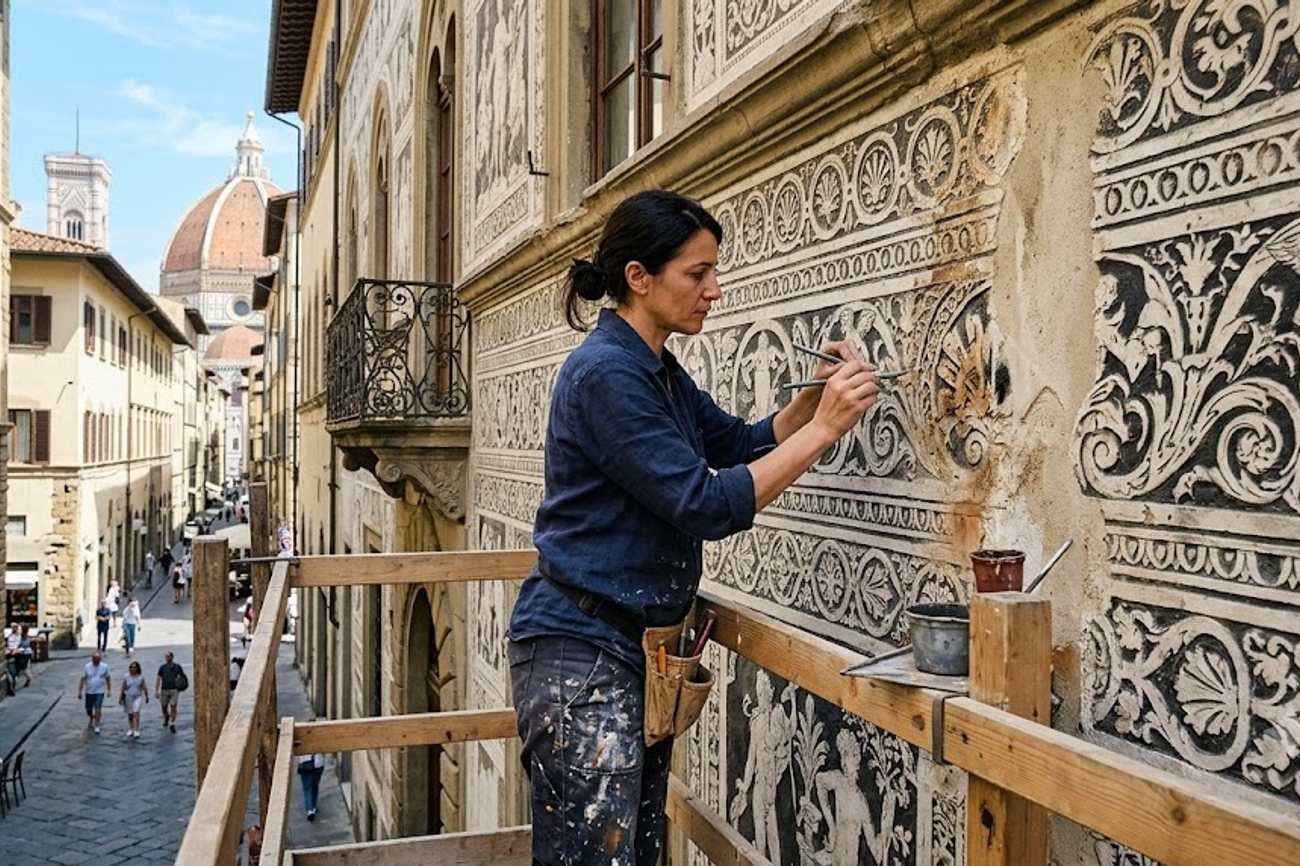
Image generated by AI
International tourist arrivals to Italy have surged by over 10% year-over-year in key urban centers, yet the concentration of foot traffic remains heavily skewed toward "top-tier" monuments. While the Uffizi Gallery and the Colosseum continue to dominate visitor statistics, there is a measurable shift toward "diffuse tourism"—the movement of travelers away from centralized hubs toward street-level architectural heritage. This transition is evidenced by the rising demand for specialized cultural itineraries that prioritize the urban fabric over the museum gallery, signaling a market move toward experiential, open-air art consumption.
The Sgraffito Market: Art Beyond the Gallery
Sgraffito—the technique of scratching through tinted plaster to reveal contrasting base colors—represents a significant but underutilized asset in Italy's cultural tourism portfolio. Unlike traditional frescoes, which are often sequestered within climate-controlled environments, sgraffito is an external architectural medium. This creates a "living museum" effect that aligns with current global trends in urban exploration.
The data suggests that sgraffito's prominence peaked during the 15th and 16th centuries, specifically within the Renaissance and Mannerist traditions. The technique's value proposition during this era was twofold: it provided a faster execution time than traditional fresco work and offered superior durability against the elements. Today, this durability allows travelers to encounter high-art motifs on public streets in Florence, Rome, Pisa, and Orvieto.
In Florence, the architectural data points to a bridge between the Renaissance and the late 19th century. The Palazzo degli Angeli, completed in 1892 by Giuseppe Boccini at the intersection of Via Calimala and Via de’ Lamberti, demonstrates how sgraffito was utilized as a revivalist tool to maintain the city's historical aesthetic into the modern era. Conversely, the Palazzo Bianca Cappello on Via Maggio 26 provides a direct link to the Medici court, featuring grotesque motifs attributed to Bernardino Poccetti.
Comparative Architectural Distribution
The distribution of surviving sgraffito works varies significantly by city, reflecting different urban development patterns and restoration histories. While Florence focuses on palatial residences, Rome offers a more fragmented, domestic distribution of the art form.
| Destination | Primary Site Example | Architectural Era/Focus | Key Artistic Driver |
|---|---|---|---|
| Florence | Palazzo Bianca Cappello | Renaissance / Grotesque | Bernardino Poccetti |
| Florence | Palazzo degli Angeli | 19th Century / Revivalist | Giuseppe Boccini |
| Pisa | Palazzo della Carovana | Late Renaissance | Giorgio Vasari |
| Rome | Via Francesco Crispi 87 | 1890s / Eclectic | Unknown / Mannerist influence |
| Rome | Via del Pellegrino 64-67 | Renaissance / Domestic | Daniele da Volterra |
| Orvieto | Palazzo Netti | 16th Century / Allegorical | Symbolic Humanism |
When analyzing the Pisa market, the data centers on the Palazzo della Carovana in Piazza dei Cavalieri. Work began here in the autumn of 1564, utilizing designs by Giorgio Vasari. Vasari's role is critical not only as a designer but as a documentarian; his writings provide the primary historical data for the technique. However, the site also highlights the volatility of architectural preservation. A major restoration in the early 20th century resulted in the loss of numerous original figures, which had to be recreated—a common pattern in the maintenance of outdoor plaster works.
What This Means for Travelers
For the modern traveler, the shift toward sgraffito-focused exploration is a strategic move to avoid the "overtourism" bottlenecks reported by the World Tourism Organization (UNWTO). By pivoting from internal galleries to external façades, travelers can access high-value art without the queue times associated with major museums.
Booking and Itinerary Advice:
- Route Optimization: If visiting Rome, prioritize the Ludovisi area (specifically Via Francesco Crispi 87) and the streets near Campo de’ Fiori and Piazza Navona. The presence of sgraffito at Via del Pellegrino 64/65 (which once served as an inn advertisement) and 66/67 (attributed to Daniele da Volterra) suggests that these neighborhoods offer a higher density of "street-level" art than the central monumental core.
- Timing: Because these sites are outdoors and subject to lighting conditions, morning or late afternoon visits are essential to capture the chiaroscuro effect—the contrast between light and dark—that defines the sgraffito technique.
- Diversification: Travelers should expand their itinerary to include Orvieto. The Palazzo Netti offers a distinct intellectual experience, where the data is encoded in allegorical inscriptions regarding science, knowledge, and energy, providing a slower-paced alternative to the crowded centers of Florence and Rome.
Projection: The Rise of the "Open-Air Archive"
The current trajectory of Italian tourism indicates a move toward the "Open-Air Archive" model. As cities implement stricter crowd-control measures in museums, the value of accessible, street-side heritage increases. We expect to see a rise in augmented reality (AR) integration for sites like the Palazzo della Carovana, where lost figures from the early 20th century could be digitally restored for visitors.
Data from IATA regarding passenger flows to regional airports suggests that secondary cities like Orvieto are becoming more attractive to high-net-worth "slow travelers" who prioritize niche architectural studies over checklist tourism. The ability of sgraffito to transform a standard city walk into a curated cultural experience makes it a prime candidate for the next wave of specialized tourism products.
FAQ: Italian Sgraffito Trends 2025
Will these sites become as crowded as the Uffizi? Unlikely. Because sgraffito is integrated into the urban environment and lacks a single "ticket gate," it naturally distributes crowds across the city. It remains a niche interest for architectural enthusiasts rather than a mass-market attraction.
Is it a good time to visit these sites? Yes. Current urban planning in Florence and Rome is increasingly focusing on "diffuse" itineraries to alleviate pressure on city centers, making these street-level sites more accessible and better signposted than in previous decades.
Which city has the best concentration of sgraffito? Florence offers the most cohesive experience, blending 16th-century Medici-era works with 19th-century revivalist façades, providing a comprehensive timeline of the technique's evolution.
How does sgraffito differ from a fresco? While a fresco is painted into wet plaster, sgraffito is a subtractive process. It involves scratching through a top layer of plaster to reveal a contrasting color underneath, creating depth and durability.
The shift from the gallery to the street is not just a change in location, but a change in how we quantify cultural value.
#SgraffitoArchitecture #ItalyCulturalTourism2025 #RenaissanceUrbanism #FlorenceArchitecturalTrends #DiffuseTourismItaly #UrbanArtPreservation
Related Travel Guides
- Armenia Tourism Surges Beyond Yerevan as Tatev, Vayots Dzor and Dilijan Draw New Travellers
- Haiti Tourism Turns to Clairin Heritage as Northern Communities Revive Artisanal Cane Traditions
- Thiruvananthapuram to Tambaram Special Train Extended Through October 2026: Kerala-Tamil Nadu Festive Rail Connectivity
Disclaimer
This article is for informational and educational purposes only. It does not constitute legal, financial, or professional advice. While we strive to provide accurate and up-to-date information, travel policies, regulations, and conditions change rapidly. Always verify information with official sources before making travel decisions. Nomad Lawyer makes no representations about the accuracy, reliability, completeness, or suitability of the information provided. Readers should consult qualified professionals for advice specific to their circumstances. The views expressed in this article are those of the author and do not necessarily reflect the views of Nomad Lawyer.
Naina Thakur
Contributor & Travel Specialist
Travel enthusiast and legal writer covering visa regulations, responsible tourism, and cultural journeys across global destinations.
Learn more about our team →