
India’s BRICS Chairship Delivers New Delhi Declaration and More Than 50 Practical Outcomes
India’s BRICS Chairship Delivers New Delhi Declaration and More Than 50 Practical Outcomes

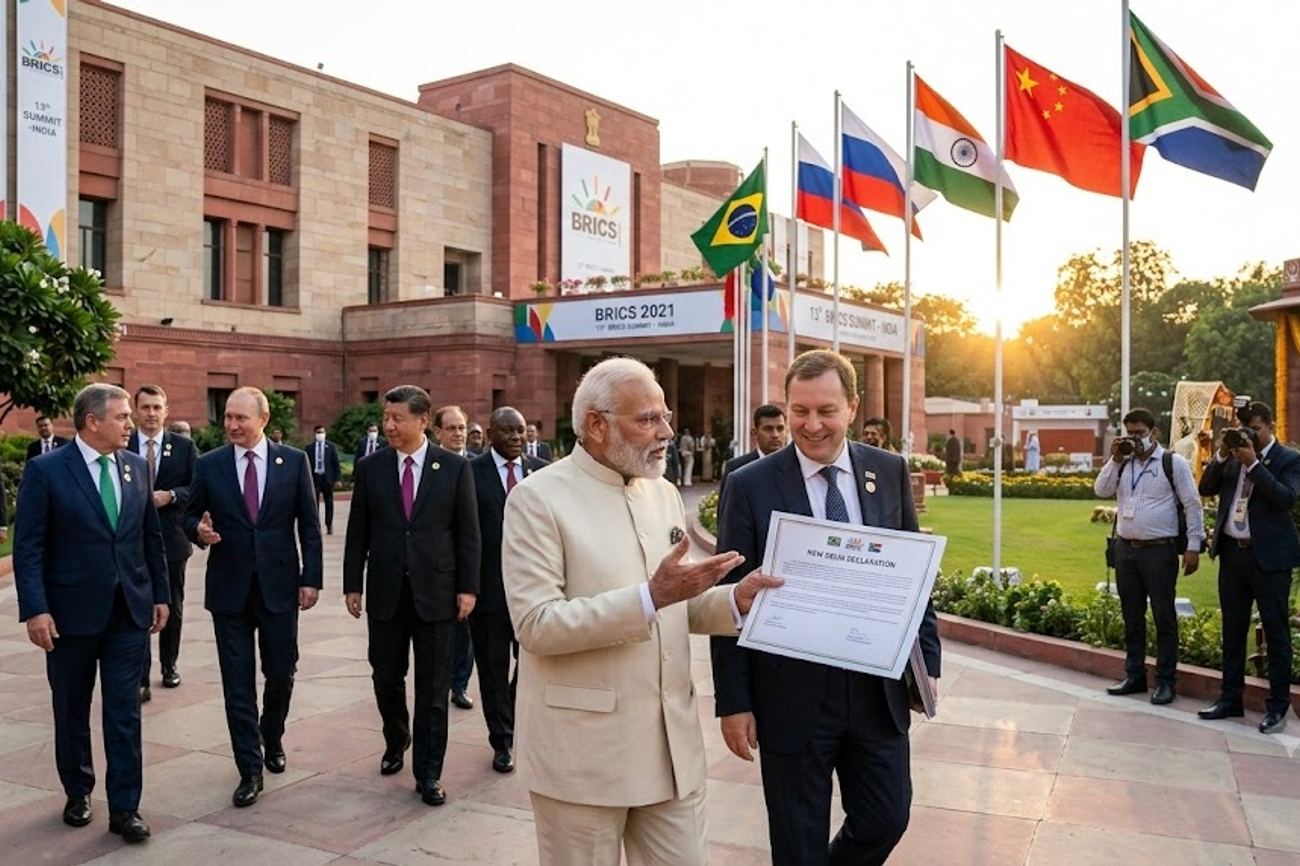
Image generated by AI
350 separate meetings conducted over an eight-month period culminated in the adoption of the New Delhi BRICS Leaders’ Declaration, marking the conclusion of India's 18th BRICS Summit chairship. This administrative marathon was designed to shift the bloc's trajectory from abstract political discourse toward a framework of "practical outcomes," resulting in more than 50 specific initiatives aimed at systemic resilience and economic integration.
The Architecture of the New Delhi Declaration
The 18th BRICS Summit focused on the core theme of "Inclusive Global Governance and Strengthening Multilateralism." This was not merely a diplomatic slogan but a strategic push by India to recalibrate the power dynamics of global oversight. The resulting New Delhi Declaration serves as a formal mandate to overhaul international financial architectures and the United Nations, specifically targeting the UN Security Council to ensure the Global South possesses a proportional voice in global decision-making.
India's approach to the chairship was characterized by a "whole-of-India" strategy. The preparation involved engagements across more than 30 Indian cities, integrating academia, industry, and civil society. This decentralized approach was intended to move the BRICS identity beyond a closed-door meeting of heads of state, utilizing public-facing events such as the BRICS Artisan Bazaar, the BRICS Film Festival, and the BRICS Youth Summit to build cultural capital.
Quantifying the 50+ Practical Outcomes
The summit's output is categorized into four strategic pillars. Rather than vague promises, the Indian Ministry of External Affairs detailed specific mechanisms for implementation.
| Pillar | Key Initiatives & Frameworks | Primary Objective |
|---|---|---|
| Resilience | BRICS Centres of Excellence on Agro-ecology; Network on Digital Agriculture; Mission for Healthy Lifestyle | Food/Health Security & Disaster Management |
| Innovation | Digital Public Infrastructure (DPI); Science and Research Repository; Startup Innovation Fund and Incubator Network | Technological Sovereignty & Research |
| Cooperation | MSME Cooperation Portal; Logistics Supply Chain Cooperation Framework; Global Value Chain integration | Economic Engagement & SME Growth |
| Sustainability | Smart Grids; Energy Storage; Climate-resilient Urban Infrastructure; Sustainable Urban Mobility | Green Infrastructure & Urban Planning |
Beyond these pillars, Prime Minister Narendra Modi introduced four distinct structural initiatives: the BRICS Troika mechanism for continuity, a roadmap for global governance reform, a specialized network for seafarer emergency support, and a negotiation support system to train Global South professionals in technology and rule-making.
Expert Analysis: The Shift Toward Logistical Sovereignty
For the global traveler and the international business operator, the most critical data point is not the political rhetoric regarding the UN, but the "BRICS Logistics Supply Chain Cooperation Framework" and the "BRICS MSME Cooperation Portal."
When a bloc of this size—representing a massive portion of the world's population and GDP—formalizes a logistics framework, it signals a move toward "logistical sovereignty." For years, trade and travel infrastructure in the Global South have relied on Western-centric standards and hubs. The creation of a dedicated BRICS logistics framework suggests a long-term goal of reducing dependence on traditional Western transit corridors and financial clearinghouses.
The direct consequence for business travelers and exporters is a potential shift in how goods and people move between these member states. If the "Sustainable Urban Mobility" and "Smart Grids" initiatives are implemented uniformly, we can expect a standardization of digital transit payments and infrastructure that bypasses traditional intermediaries. Furthermore, the focus on Digital Public Infrastructure (DPI) suggests that India is attempting to export its "India Stack" model—the digital identity and payment systems that have revolutionized its domestic economy—to other BRICS nations.
The inclusion of a "seafarer emergency support initiative network" is a subtle but vital nod to the maritime vulnerabilities exposed during recent global supply chain crises. By creating a dedicated support network, BRICS is effectively building a parallel safety net for the personnel who power global trade, further insulating their economic arteries from external geopolitical shocks.
Key Takeaways
- Structural Reform: The New Delhi Declaration formally demands a more representative UN Security Council and a restructured international financial system to empower developing nations.
- Logistical Integration: The establishment of a Logistics Supply Chain Cooperation Framework aims to optimize trade routes and reduce friction in the movement of goods across member states.
- Digital Export: India is leveraging the summit to promote Digital Public Infrastructure (DPI), aiming to standardize technology and research via a new Science and Research Repository.
- Security Alignment: The bloc has issued an unequivocal condemnation of terrorism, specifically citing attacks in Jammu and Kashmir as a point of collective concern.
- Human Capital Investment: A new negotiation support system will be launched to train young professionals from the Global South in global rule-making and emerging technologies.
FAQ: BRICS New Delhi Summit 2026
What is the BRICS Troika mechanism proposed by India? The Troika is a leadership structure designed to ensure continuity between the outgoing, current, and incoming chairs of the BRICS summit, preventing the "reset" effect that often happens when the chairship changes annually.
How does the BRICS Logistics Supply Chain Cooperation Framework affect trade? It aims to streamline the movement of goods between member nations by coordinating customs, infrastructure, and transport protocols, potentially reducing shipping times and costs for businesses operating within the bloc.
What is the goal of the BRICS Startup Innovation Fund? This fund is designed to provide capital and incubator support for entrepreneurs within BRICS nations, focusing on technological independence and the development of home-grown innovation.
Why is the "Global South negotiation support" significant? It provides technical training to officials from developing nations, allowing them to better navigate and influence the creation of international laws and technology standards, which are currently dominated by G7 nations.
The transition from diplomatic dialogue to logistical infrastructure marks the beginning of a new, more pragmatic era for the BRICS bloc.
Tags: BRICS 2026, New Delhi Declaration, Global South Logistics, India Ministry of External Affairs, UN Security Council Reform, BRICS Digital Public Infrastructure
Related Travel Guides
Disclaimer
This article is for informational and educational purposes only. It does not constitute legal, financial, or professional advice. While we strive to provide accurate and up-to-date information, travel policies, regulations, and conditions change rapidly. Always verify information with official sources before making travel decisions. Nomad Lawyer makes no representations about the accuracy, reliability, completeness, or suitability of the information provided. Readers should consult qualified professionals for advice specific to their circumstances. The views expressed in this article are those of the author and do not necessarily reflect the views of Nomad Lawyer.
Preeti Gunjan
Contributor & Community Manager
A passionate traveller and community builder. Preeti helps grow the Nomad Lawyer community, fostering engagement and bringing the reader experience to life.
Learn more about our team →