
Travel Chaos Devastates Indianapolis International: Republic, Southwest, and Delta Trigger 55 Delays and 3 Flight Cancellations Amid Severe Northeast Airport Disruptions: Latest Airline News
Indianapolis International is currently engulfed in massive travel chaos, reporting 55 delays and 3 flight cancellations as severe congestion from New York and Philadelphia cripples the grid.

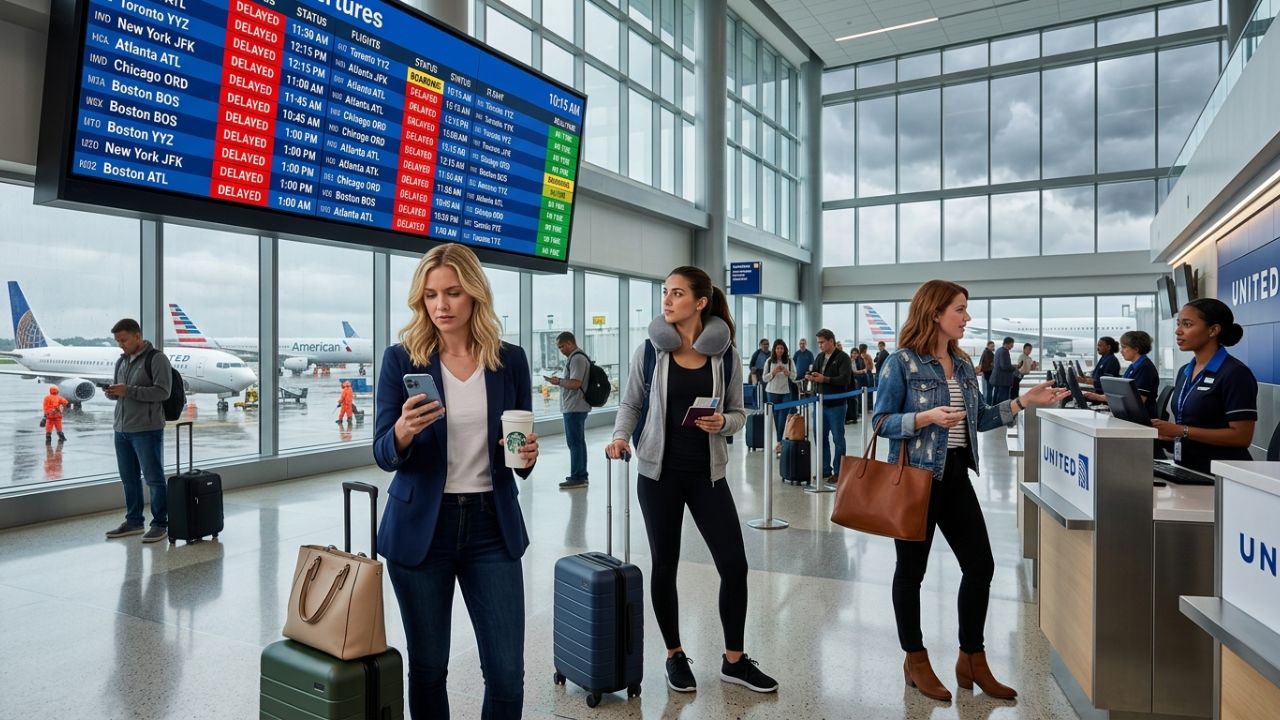
Image generated by AI
Unexpected operational bottlenecks and sudden technical outages have triggered an intense wave of travel chaos at Indianapolis International Airport today, completely paralyzing the midwestern transit grid. Reported on June 19, 2026, severe airport disruptions originating from the congested Northeast corridor have slammed into Indianapolis, trapping dozens of aircraft on crowded runways. Consequently, prominent carriers including Southwest, Republic, Delta Air Lines, and Jazz (Air Canada) are currently suffering the hardest hits. As a direct result of these compounding operational factors—including severe downstream weather completely blocking critical cross-border Canadian routes to Toronto—terminal departure boards now display an aggressive total of 55 delays and 3 sudden flight cancellations. As desperate airlines actively shuffle displaced flight crews in a frantic bid to resolve this frustrating logistical crisis, the resulting ripple effects are driving today's most crucial headline in breaking airline news and essential global aviation updates.
By introducing direct passenger coordination and dynamic scheduling backups, the regional aviation hubs target growing passenger demand across vital commerce sectors. The choice to coordinate flight departures in phases helps to manage gate capacity, supporting the country's broader regional transportation network.
Context: The Collapse of the Midwestern Bridge
For the North American aviation industry, the sudden travel chaos crippling Indianapolis International serves as a brutal reminder of the extreme fragility within the domestic transit network.
Historically, Indianapolis acts as a vital, highly efficient bridge connecting the congested Northeast corridor to the western and southern United States. However, when systemic scheduling disruptions strike massive East Coast hubs like New York and Philadelphia, that efficiency collapses instantly. Today, ground delay programs and severe downstream congestion have forced Indianapolis to absorb the shockwaves of an overburdened national grid. While the 55 delays and 3 cancellations represent only a fraction of the airport’s overall daily capacity, the disruptions are heavily and surgically concentrated on highly specific regional feeders and critical cross-border Canadian routes. This targeted congestion causes significant, intense localized frustration for thousands of affected passengers. Travelers moving through the Midwest today are feeling the acute sting of these regional bottlenecks as airline crews time out and aircraft simply run out of tarmac space.
To view live flight schedules, verify the active delay status of your specific midwestern itinerary, or to track active regional airspace restrictions, travelers must consult official aviation directories. For direct updates regarding how this massive travel chaos affects specific route abandonments and current flight cancellations, travelers should aggressively utilize the official portals of Southwest, Republic, and Delta. To explore live flight tracking and monitor the exact severity of the cascading bottlenecks at major East Coast competitor hubs, passengers can consult the official FlightAware tracking service.
Section-Wise Breakdown: The Geography of the Gridlock
The Northeast Corridor Collapse: JFK and PHL
The absolute epicenter of the inbound bottleneck is heavily concentrated in the Northeast United States. New York’s John F. Kennedy International (JFK) is punishing the Indianapolis schedule, generating 5 delayed inbound flights (a massive 71% delay rate for that origin) and forcing 3 outbound delays (42%). Philadelphia International (PHL) is acting as a brutal secondary chokepoint, forcing 3 inbound delays (42%) and severely restricting departures with 4 outbound delays (50%). Baltimore/Washington (BWI) shows 2 inbound delays (40%), while LaGuardia (LGA) adds 2 inbound delays (22%) and 1 outbound delay (11%), effectively sealing off the East Coast from Indianapolis.
The Southern and Midwest Hubs: Atlanta, Orlando, and Chicago
Atlanta’s Hartsfield-Jackson (ATL) is notable for claiming the majority of today’s outright schedule destruction, generating 1 canceled inbound flight (9%) and 2 inbound delays (18%), alongside 1 canceled outbound flight (9%). Orlando (MCO) is generating symmetrical travel chaos with 2 inbound delays (28%) and 2 outbound delays (28%). For travelers heading to Chicago, airport selection is currently critical: Midway (MDW) is suffering 1 outbound delay (representing a massive 50% disruption rate for its specific schedule), while O’Hare (ORD) remains surprisingly efficient with only 1 outbound delay (5%).
The Cross-Border Canadian Disruption: Toronto Pearson
In terms of international travel, the cross-border Canadian route is uniquely devastated. Flights to and from Toronto Pearson International (YYZ) are uniquely disrupted by compounding severe weather. The route shows 1 inbound delay (25%), alongside 1 brutal outbound cancellation (33%) and 1 outbound delay (33%), proving that international traffic is facing identical headwinds to the US domestic network.
Technical Roster: Indianapolis Disruption Data Matrix
To ensure absolute factual accuracy regarding the exact parameters of this massive systemic collapse and the specific metrics driving the regional flight cancellations, the following matrix details the verified airline operational data currently impacting Indianapolis:
Indianapolis Carrier Disruption Matrix
| Airline / Regional Carrier | Verified Delays | Verified Cancellations | Disruption Rate (%) |
|---|---|---|---|
| Southwest Airlines | 16 | 0 | 21% |
| Republic Airways | 13 | 0 | 14% |
| Endeavor Air | 9 | 0 | 50% |
| PSA Airlines | 6 | 0 | 75% |
| Delta Air Lines | 2 | 2 | 7% (Delays) / 7% (Cancellations) |
| Jazz (Air Canada) | 2 | 1 | 50% (Delays) / 25% (Cancellations) |
| American Airlines | 4 | 0 | 9% |
| Alaska Airlines | 2 | 0 | 50% |
| Frontier Airlines | 1 | 0 | 25% |
Additional specific route disruptions currently contributing to the 55-delay total include: Boston (BOS) 1 inbound (14%) and 3 outbound (37%); Charlotte (CLT) 1 inbound (14%) and 2 outbound (25%); Southwest Florida (RSW) 1 inbound (100%); Raleigh-Durham (RDU) 1 inbound (50%) and 1 outbound (50%); Seattle-Tacoma (SEA) 1 inbound (50%) and 1 outbound (33%); Houston (HOU) 1 inbound (33%); Washington Dulles (IAD) 1 inbound (20%); Las Vegas (LAS) 1 inbound (20%) and 1 outbound (20%); Austin (AUS) 1 inbound (16%) and 1 outbound (16%); Detroit (DTW) 1 inbound (11%); Newark (EWR) 1 inbound (11%); Kansas City (MCI) 1 outbound (50%); Nashville (BNA) 1 outbound (33%); Minneapolis (MSP) 1 outbound (16%); Dallas-Fort Worth (DFW) 1 outbound (12%); and Denver (DEN) 1 outbound (11%).
Passenger Impact: The Regional Feeder Nightmare
For the thousands of travelers attempting to utilize Indianapolis as a connecting hub, the concentration of delays on regional carriers guarantees a highly stressful, heavily compromised transit experience.
The immediate passenger impact of this structural travel chaos is the collapse of the regional feeder network. While major mainline aircraft are managing the crisis somewhat effectively, regional partners are suffering devastating hits. PSA Airlines is operating with a staggering 75% delay rate, and Endeavor Air is sitting at a brutal 50% delay rate. This means passengers flying into Indianapolis from smaller regional markets to connect to major international flights out of JFK or Atlanta are mathematically guaranteed to miss their connections. The financial fallout is immediate: passengers are forced to absorb the massive cost of last-minute airport hotels as airline crews "time out" of their legal operating hours, leaving aircraft fully boarded but unable to legally depart the tarmac.
Industry Analysis: The Vulnerability of Connected Grids
Aviation analysts view the systemic breakdown at Indianapolis International as definitive proof that ground delay programs in the Northeast can instantly paralyze perfectly functional airports thousands of miles away.
Analysts note that while the sheer volume of delayed flights is carried by Southwest (16 delays) and Republic (13 delays), the actual operational cause is downstream congestion. New York's JFK and Philadelphia are forcing the Federal Aviation Administration (FAA) to throttle departures out of Indianapolis to prevent East Coast airspace from becoming completely saturated. Industry experts emphasize that the intense disruption of Jazz (Air Canada) highlights how quickly severe weather events in Toronto can sever vital North American commerce links. Analysts predict that until the massive ATC staffing shortages in the Northeast corridor are resolved, highly efficient regional hubs like Indianapolis will continue to serve as unwilling holding pens, absorbing the travel chaos generated by coastal mega-hubs.
Actionable Advice for Navigating the Indianapolis Gridlock
While standard passengers cannot control downstream ground delay programs or severe Canadian weather, you can execute this strategic survival checklist to actively bypass the travel chaos currently suffocating Indianapolis:
- Leverage American Airlines Immediately: If you are desperately trying to escape Indianapolis and your original flight is canceled, immediately look at booking a walk-up fare with American Airlines. They remain a rare bright spot today, successfully operating with a highly efficient 9% delay rate (4 delays) and zero cancellations.
- Audit Your Regional Carrier Risk: Do not just check your booking code; check the actual operator. If your ticket says Delta Connection but is operated by Endeavor Air (50% delay rate), or American Eagle operated by PSA Airlines (75% delay rate), you are in extreme danger. Attempt to rebook onto a mainline aircraft immediately before heading to the airport.
- Exploit Alternate Chicago Routings: If you are heading to the Chicago area, aggressively monitor the disparity in delays. Midway (MDW) is currently suffering a 50% disruption rate. Immediately contact your airline to see if you can be re-routed into O'Hare (ORD), which is currently operating with a highly efficient 5% delay rate.
- Demand Rebooking Rights for Canceled Routes: For the specific flights that have been outright canceled to Atlanta and Toronto, federal regulations require airline agents at the Indianapolis terminal to rebook you on the next available flight. Do not accept a flight tomorrow if a competitor airline has an open seat today.
FAQ: Indianapolis Travel Disruptions
Why is Indianapolis International experiencing massive travel chaos?
The midwestern hub is suffering from severe travel chaos driven by downstream congestion from the Northeast corridor, severe cross-border weather in Canada, and sudden technical outages, resulting in 55 delays and 3 flight cancellations.
Which airlines are suffering the highest number of flight cancellations and delays?
Southwest holds the highest sheer volume with 16 delays, while regional feeders like PSA Airlines (75% delay rate) and Endeavor Air (50% delay rate) are crippled. Delta and Jazz (Air Canada) are reporting the primary flight cancellations.
Which destination airports are causing the most gridlock out of Indianapolis?
New York (JFK), Philadelphia (PHL), and Atlanta (ATL) are the primary domestic chokepoints causing the travel chaos, while Toronto (YYZ) is generating the primary international flight cancellations.
The Reality of Midwestern Transit Fragility
The severe operational gridlock currently paralyzing Indianapolis International proves definitively that no domestic airport is immune to the cascading effects of global travel chaos. By absorbing 55 delays and 3 flight cancellations driven almost entirely by external East Coast and Canadian congestion, Indianapolis demonstrates the extreme interconnectivity of the modern aviation network. As Southwest, Republic, and Delta desperately attempt to shuffle crews to recover their schedules—frequently stranding passengers on regional feeder flights—travelers must accept a critical new reality: surviving the modern skies requires aggressive carrier auditing, a constant awareness of downstream ATC bottlenecks, and a ruthless willingness to rebook on competitor airlines the moment the departure board flashes red.
Key Takeaways
- Massive Regional Gridlock: Indianapolis International is currently absorbing 55 delays and 3 flight cancellations due to severe downstream travel chaos.
- Southwest and Republic Hit Hardest: Southwest Airlines is carrying the highest sheer volume with 16 delayed flights, while Republic accounts for 13 delays.
- Regional Feeder Collapse: PSA Airlines is suffering a catastrophic 75% delay rate, and Endeavor Air is crippled at 50%, devastating connecting passenger itineraries.
- The Northeast Chokepoint: Severe congestion at JFK and Philadelphia is actively throttling departures and arrivals, paralyzing the midwestern grid.
- Atlanta and Toronto Cancellations: Delta and Jazz (Air Canada) are responsible for the outright flight cancellations affecting the ATL and YYZ routes.
Related Travel Guides
Massive Travel Chaos Paralyzes Chicago O'Hare with 1,425 Disruptions
Disclaimer
This article is for informational and educational purposes only. It does not constitute legal, financial, or professional advice. While we strive to provide accurate and up-to-date information, travel policies, regulations, and conditions change rapidly. Always verify information with official sources before making travel decisions. Nomad Lawyer makes no representations about the accuracy, reliability, completeness, or suitability of the information provided. Readers should consult qualified professionals for advice specific to their circumstances. The views expressed in this article are those of the author and do not necessarily reflect the views of Nomad Lawyer.
Kunal K Choudhary
Co-Founder & Contributor
A passionate traveller and tech enthusiast. Kunal contributes to the vision and growth of Nomad Lawyer, bringing fresh perspectives and driving the community forward.
Learn more about our team →