
India Travel Transforms As Delhi Unveils Barapullah Phase 3 Corridor Cutting Commute Time With Smart Connectivity
India Travel Transforms As Delhi Unveils Barapullah Phase 3 Corridor Cutting Commute Time With Smart Connectivity

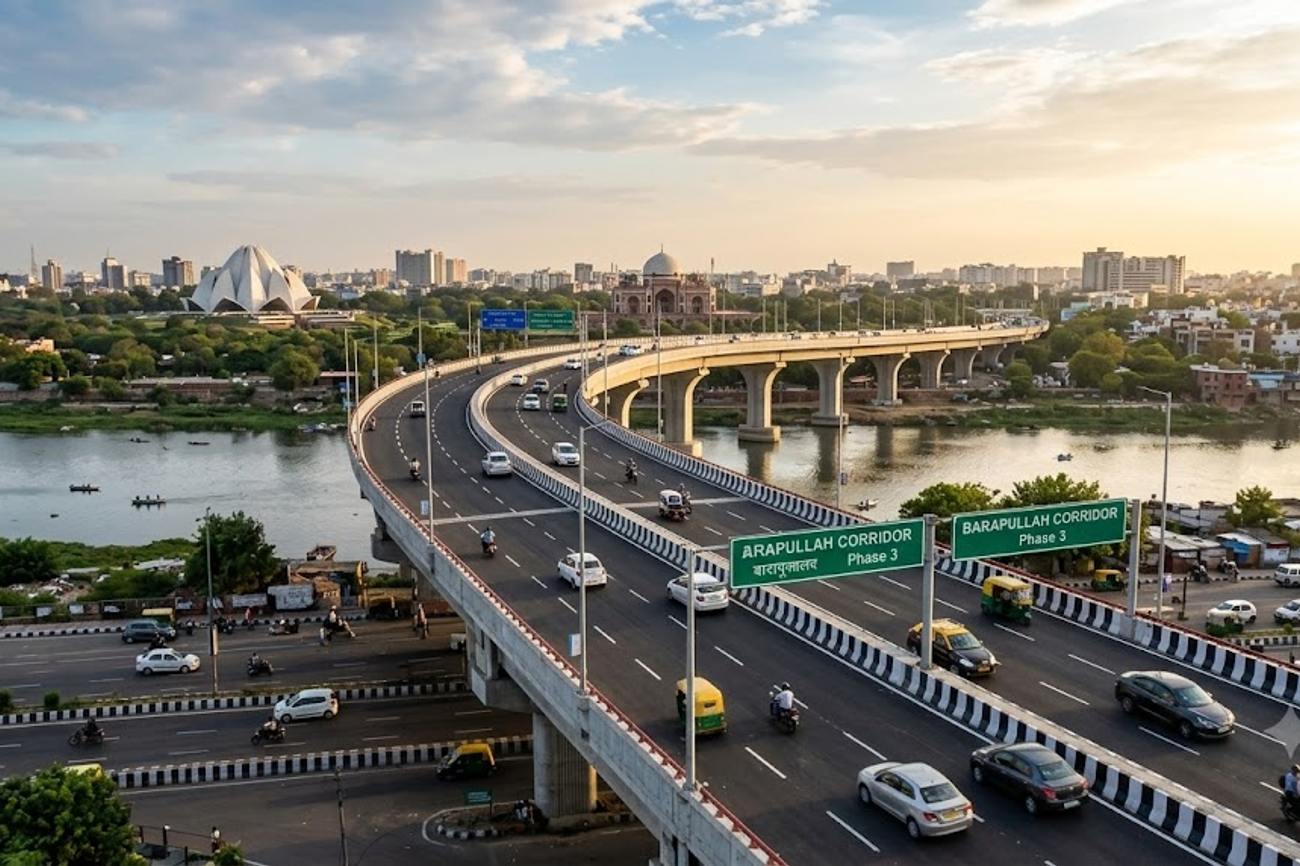
Image generated by AI
A 60% reduction in commute times—from 40 minutes down to 15—is the primary promise of the Barapullah Phase 3 Corridor, a massive infrastructure pivot designed to decouple East Delhi and Noida from the gridlock of the National Capital Region (NCR). Scheduled for inauguration on September 29, 2026, this project represents more than just a road expansion; it is a strategic attempt to bypass the systemic failures of surface-level urban transit in one of the world's most densely populated metropolitan areas.
The Geometry of Delhi-NCR Connectivity
The Barapullah Phase 3 Corridor is not a standalone road but a critical integration into an existing network. This specific phase consists of a 3.5-kilometre, four-lane elevated roadway that bridges the gap between Mayur Vihar Phase I and Sarai Kale Khan. By linking these two hubs, the project creates a seamless, signal-free artery that extends the total continuous elevated route to nearly 9 kilometres.
For the thousands of professionals and residents moving between the satellite city of Noida and the administrative and medical hubs of South Delhi, this removes the reliance on surface intersections that have historically crippled productivity and fuel efficiency. The corridor is specifically engineered to streamline access to high-priority zones, most notably the All India Institute of Medical Sciences (AIIMS), ensuring that emergency vehicles and patients can bypass the traditional bottlenecks of the city center.
Engineering Specifications and Fiscal Escalation
The technical execution of Phase 3 involves a sophisticated approach to traffic distribution and river crossing. Rather than utilizing a simple linear path, the corridor employs nine interconnected loops. These loops serve as strategic valves, allowing vehicles to enter and exit the elevated system at multiple points, thereby preventing the "bottleneck effect" common at the ends of traditional flyovers.
A centerpiece of this phase is the introduction of Delhi’s 10th road bridge over the Yamuna River. This structure utilizes an extra-dosed design—a hybrid between a girder bridge and a cable-stayed bridge—featuring spans of approximately 125 metres. This engineering choice allows for greater stability and longer spans, reducing the number of piers required in the riverbed.
However, the path to completion was marked by significant financial and temporal slippage. The project's final revised cost reached Rs 1,635 crore. This represents a cost overrun of approximately Rs 375 crore over the initial budget, a surge attributed to prolonged construction delays and mid-project design modifications.
| Feature | Specification |
|---|---|
| Total Length (Phase 3) | 3.5 Kilometres |
| Configuration | 4-Lane Elevated Roadway |
| Total Integrated Network | ~9 Kilometres |
| Bridge Type | Extra-dosed (Yamuna River) |
| Bridge Span | ~125 Metres |
| Access Points | 9 Interconnected Loops |
| Final Revised Cost | Rs 1,635 Crore |
| Cost Increase | Rs 375 Crore |
| Inauguration Date | September 29, 2026 |
| Estimated Time Saving | 35-40 mins $\rightarrow$ 15 mins |
Expert Analysis: The Macro-Impact of Elevated Transit
From a logistical standpoint, the Barapullah Phase 3 Corridor is a response to the "induced demand" paradox. While adding road capacity often attracts more cars, the signal-free nature of this elevated route targets a specific failure point: the intersection. In Delhi, the primary cause of delay is not the lack of asphalt, but the inefficiency of signalized junctions. By lifting the primary flow of traffic above these junctions, the city is effectively creating a "high-speed bypass" for the NCR.
For travelers and business operators booking logistics or commutes across this route, the direct consequence is a shift in the geography of the city. When a 40-minute journey drops to 15 minutes, the "economic distance" between Noida and South Delhi shrinks. This likely increases the attractiveness of Noida as a residential hub for those working in the South Delhi institutional corridor, potentially driving up real estate values in East Delhi and Noida.
Furthermore, the inclusion of dedicated cycling tracks and pedestrian pathways marks a departure from the vehicle-centric planning of previous decades. While a four-lane highway is hardly a sanctuary for cyclists, integrating non-motorized transport (NMT) into the design suggests a regulatory shift toward the guidelines promoted by the Ministry of Road Transport and Highways (MoRTH). The pricing pressure this creates is subtle: by reducing vehicle idling, the city lowers the hidden cost of fuel waste and carbon emissions, though the long-term impact will depend on whether the corridor simply encourages more private car ownership.
Key Takeaways
- Commute Compression: Travel times between Noida/East Delhi and South Delhi (AIIMS) are projected to drop from 35-40 minutes to roughly 15 minutes.
- Infrastructure Scale: The project adds a 3.5-km, 4-lane elevated stretch, bringing the total integrated Barapullah system to nearly 9 km.
- Technical Innovation: The project features Delhi's 10th Yamuna bridge, utilizing an extra-dosed design with 125-metre spans and nine exit/entry loops.
- Fiscal Impact: The project concluded with a revised budget of Rs 1,635 crore, reflecting a Rs 375 crore increase over original estimates.
- Multimodal Integration: Unlike previous phases, Phase 3 includes dedicated infrastructure for pedestrians and cyclists to support sustainable urban mobility.
FAQ: Delhi-Noida Transit 2026
When does the Barapullah Phase 3 Corridor open to the public? The corridor is scheduled for official inauguration on September 29, 2026.
Which specific areas will benefit most from this new route? Commuters traveling between Mayur Vihar Phase I, Noida, and South Delhi destinations—specifically those heading toward AIIMS and Sarai Kale Khan—will see the most significant time savings.
How does the new Yamuna bridge differ from older bridges? It uses an extra-dosed design with spans of approximately 125 metres, which improves structural efficiency and traffic flow across the river compared to traditional girder bridges.
Will there be options for non-car travelers on the corridor? Yes, the design incorporates dedicated facilities for cyclists and pedestrians, promoting non-motorized transport alongside the four-lane vehicle roadway.
A city that moves faster is a city that grows faster, provided the asphalt doesn't outpace the planning.
Tags: Barapullah Phase 3, Delhi-Noida Corridor, NCR Urban Mobility 2026, Yamuna Bridge Infrastructure, Mayur Vihar Transit, Sarai Kale Khan Connectivity
Related Travel Guides
- Delta Air Lines Travel Expands LAX Network With New Monterey Philadelphia Routes and Bigger US Connectivity
- Orlando Converges with Tokyo and Global Tourism Capitals as Mega-Attractions Redefine Visitor Economies
- Portugal Aligns With Spain and France as Europe’s Dark Sky Destinations Redefine Night Tourism Experiences: All You Need to Know
Disclaimer
This article is for informational and educational purposes only. It does not constitute legal, financial, or professional advice. While we strive to provide accurate and up-to-date information, travel policies, regulations, and conditions change rapidly. Always verify information with official sources before making travel decisions. Nomad Lawyer makes no representations about the accuracy, reliability, completeness, or suitability of the information provided. Readers should consult qualified professionals for advice specific to their circumstances. The views expressed in this article are those of the author and do not necessarily reflect the views of Nomad Lawyer.
Raushan Kumar
Founder & Lead Developer
Full-stack developer with 11+ years of experience and a passionate traveller. Raushan built Nomad Lawyer from the ground up with a vision to create the best travel and law experience on the web.
Learn more about our team →