
Iceland Resonates With Hawaii and Sicily in Attracting Adventure Seekers in Fiery Landscapes Booming Volcano Travel Across America
Volcano tourism surges across Iceland's Reykjanes Peninsula, Hawaii Volcanoes National Park, and Sicily's Mount Etna as millions of adventure travelers seek active geological frontiers.

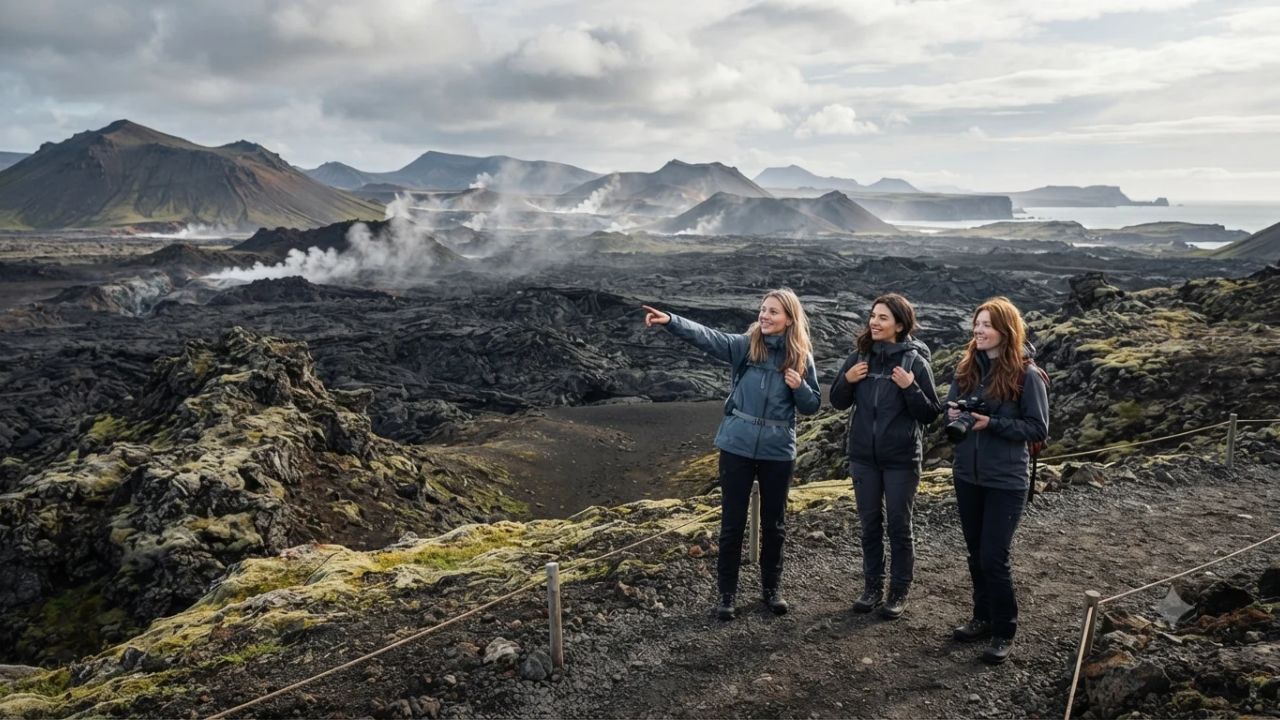
Image generated by AI
[Reykjavik, October 2024] — A global surge in "volcano tourism" is transforming the travel economies of Iceland, Hawaii, and Sicily as adventurers increasingly prioritize geological anomalies over traditional city-based sightseeing. This shift toward high-intensity nature travel is driving significant visitor traffic to the Reykjanes Peninsula, Hawaii Volcanoes National Park, and Mount Etna, where travelers are seeking direct encounters with Earth's most volatile forces.
Tectonic Convergence and the Global Rise of Active Geotourism
The transformation of volcanic regions into premier travel hubs stems from a structural shift in what adventure tourists prioritize during their journeys. For decades, remote wilderness travel centered primarily on alpine trekking, maritime expeditions, or wildlife viewing. However, modern travel demographics have gravitated toward educational adventure and real-time geological phenomena. Active volcanic zones offer a tangible connection to planetary creation, where visitors can witness newly hardened basalt crusts, active sulfur vents, and glowing magma fountains under the stewardship of scientific monitoring agencies.
Government authorities and regional tourism boards have responded by formalizing volcanic geotourism corridors. In southwestern Iceland, the Icelandic Meteorological Office coordinates continuous seismic tracking and gas sensor arrays alongside local search-and-rescue teams, allowing authorities to open safe observation perimeters around newly formed volcanic craters whenever seismic conditions permit. Similarly, the United States Department of the Interior has expanded interpretive facilities and trail monitoring to safely process millions of international guests entering the remote reaches of Hawaii Island. In southern Italy, regional administrators have integrated volcanic crater excursions with centuries-old agricultural traditions, showing that extreme geological environments can support multifaceted regional economies without sacrificing visitor safety.
This global phenomenon is underpinned by four distinct visitor motivations:
- Geothermal wellness integration, connecting mineral-rich thermal reservoirs directly to restorative luxury spa complexes.
- Scientific engagement, where amateur geologists, environmental researchers, and aerial photographers contribute observational data and media documentation.
- High-contrast visual photography, driven by the rare juxtaposition of glacial fields, black volcanic sand beaches, and molten vents.
- Endemic biodiversity discovery, drawing naturalists keen to explore rare botanical and microbial species that pioneer newly cooled volcanic crusts.
Tri-Regional Geotourism Metrics: Iceland, Hawaii, and Sicily Compared
To understand how volcanic travel operates at scale, commercial operators analyze three distinct destinations that represent separate geological structures and operational models: the North Atlantic fissure fields of Iceland, the Pacific shield volcanoes of Hawaii, and the Mediterranean stratovolcano of Sicily.
| Destination Region | Primary Volcanic Structure | Key Visitor Sites & Infrastructure | Primary Management Body | Primary Gateway Hub |
|---|---|---|---|---|
| Reykjanes Peninsula, Iceland | Divergent Tectonic Rift & Fissure Basalt Swarms | Blue Lagoon, Bridge Between Continents, Gunnuhver, Grindavík | Icelandic Meteorological Office & Suðurnes Police | Keflavík International Airport (KEF) |
| Hawaii Volcanoes National Park, USA | Massive Hotspot Shield Volcanoes (Kīlauea & Mauna Loa) | Crater Rim Drive, Kīlauea Iki Trail, Thurston Lava Tube, Chain of Craters Road | National Park Service | Hilo (ITO) & Kona (KOA) Airports |
| Mount Etna, Sicily, Italy | Active Composite Stratovolcano | Summit Craters, Silvestri Craters, High-Altitude Vineyards, Valle del Bove | UNESCO World Heritage Centre & Parco dell'Etna | Catania-Fontanarossa Airport (CTA) |
Iceland: Fissure Dynamics on the Reykjanes Peninsula
Southwestern Iceland's Reykjanes Peninsula has emerged as one of the most closely observed geological corridors on Earth due to intense episodic fissure eruptions that commenced in recent years. Located directly above the Mid-Atlantic Ridge, where the North American and Eurasian tectonic plates slowly pull apart, the peninsula gives travelers rare access to exposed continental rift topography. At the Bridge Between Continents, visitors can physically walk across a pedestrian footbridge spanning a deep sandy chasm that marks the boundary between two major tectonic plates.
Beyond the raw volcanic fissures, Reykjanes serves as a cornerstone of Icelandic hospitality and maritime commerce. The world-renowned Blue Lagoon geothermal retreat harnesses mineral-rich brine heated thousands of feet beneath the surface, attracting international wellness travelers seeking silica-rich bathing pools set amid jagged basalt beds. Nearby, the Gunnuhver geothermal field showcases high-pressure steam vents, bubbling mud pools, and powerful sulfuric exhalations. The coastal town of Grindavík provides cultural context on historic fishing heritage, while the surrounding maritime bluffs support massive seabird nesting colonies and seasonal whale watching passages. Because the entire peninsula sits within minutes of Keflavík International Airport and just forty-five minutes from Reykjavík, international travelers can integrate world-class volcanic observation into short layovers or extended touring routes.
Hawaii: Shield Volcano Exploration on Hawaii Island
In the central Pacific, Hawaii Volcanoes National Park protects two of the planet's most formidable volcanic giants: Kīlauea, celebrated for its frequent summit and rift eruptions, and Mauna Loa, recognized as the largest active volcano on Earth by volume. Managed by the National Park Service, this 335,000-acre protected wilderness allows travelers to safely traverse living volcanic environments that slope from sea level up to Mauna Loa's 13,678-foot alpine summit.
The park's visitor infrastructure provides structured access to dynamic geological formations. Along Crater Rim Drive, scenic overlooks present panoramic views of the Halemaʻumaʻu crater floor, where volcanic degassing and intermittent lava activity are monitored around the clock. The Kīlauea Iki Trail descends four hundred feet through native rainforest before directing hikers across the steaming, cracked floor of a solidified 1959 lava lake. At the Thurston Lava Tube, officially known as Nāhuku, travelers walk through a five-hundred-year-old subterranean tunnel carved by an ancient river of molten basalt. Beyond its geology, the park preserves a profound cultural legacy for Native Hawaiians, who revere the volcanic peaks as the sacred home of Pelehonuamea, demanding strict cultural respect, quiet contemplation, and zero disturbance of sacred mineral formations from every visiting party.
Sicily: Alpine Stratovolcano Encounters on Mount Etna
Dominating the skyline of eastern Sicily, Mount Etna rises roughly 3,357 meters above the Mediterranean Sea as Europe's most active and prominent stratovolcano. Inscribed as a prestigious UNESCO World Heritage site, Etna represents thousands of years of recorded volcanic eruptions intertwined with Mediterranean cultural history, Roman mythology, and classical agriculture. Its slopes feature layered volcanic ash, historic cinder cones, and cavernous lava caves formed over millennia.
The travel economy surrounding Mount Etna thrives on combining high-elevation adventure with refined regional culture. Visitors routinely ascend the mountain's lower slopes via cable cars and specialized off-road four-wheel-drive vehicles to reach authorized observation perimeters near the active summit craters. Surrounding Etna, fertile volcanic soils enriched by minerals support thriving viticulture, where boutique wineries produce distinct, highly sought-after wines from indigenous Nerello Mascalese grapes. Travelers frequently base themselves in Catania, an architectural treasure filled with Baroque monuments built from dark volcanic basalt, or in Taormina, known for its cliffside vistas, ancient Greek amphitheater, and luxury coastal hospitality. This synergy between rugged mountain exploration and Sicilian gastronomic tradition makes Mount Etna an exemplary model of diversified regional tourism.
Expert Analysis: The Operational Risk and Pricing Realities of Volcano Travel
For travelers booking trips into active volcanic zones, the direct consequence of rising geotourism demand is an operational reality defined by heightened price volatility, strict access controls, and complex insurance hurdles. Unlike conventional resort vacations, volcanic travel itineraries must remain fluid because public safety cordons change dynamically according to real-time seismic and atmospheric data. When magma shifts toward the surface or toxic sulfur dioxide concentrations exceed safe thresholds, civil protection authorities will close highway corridors, suspend rail links, and cancel backcountry permits without advance notice.
The pricing pressure this creates means that gateway accommodations situated near park entrances or major geothermal attractions command aggressive market premiums. Properties flanking the entrance to Hawaii Volcanoes National Park in Volcano Village, luxury boutique hotels around the Blue Lagoon in Iceland, and historic wine estates on the eastern slopes of Mount Etna now routinely book out six to nine months in advance during peak seasons. In addition, the specialized nature of high-hazard terrain requires visitors to contract licensed alpine or volcanic guides, which significantly elevates baseline trip costs compared to self-guided national park excursions elsewhere in the world.
From a contractual and insurance perspective, travelers must scrutinize booking fine print. Standard travel insurance policies frequently exclude interruptions caused by known or ongoing volcanic activity once an alert level has been issued by government volcanologists. If an international flight into Keflavík International Airport or Catania-Fontanarossa Airport is delayed by high-altitude volcanic ash plumes, travelers whose policies lack comprehensive natural catastrophe clauses risk total forfeiture of their non-refundable lodging reservations and expedition fees.
Simultaneously, environmental sustainability has emerged as a pressing operational challenge. Fragile volcanic mosses, porous basalt crusts, and rare endemic plant communities take decades to regenerate once trampled by off-trail hikers. Both the National Park Service in Hawaii and environmental agencies in Iceland have instituted zero-tolerance enforcement for off-trail trespassing, levying steep criminal fines and deportation orders against tourists who violate safety cordons to record social media clips near active vents. As tourist volume expands across all three regions, park authorities are actively drafting reservation caps and timed-entry systems to prevent catastrophic wear on fragile access roads and delicate native habitats.
Key Takeaways
- Active volcanic destinations across Iceland, Hawaii, and Sicily are experiencing record visitor interest as travelers substitute passive beach vacations for dynamic, experiential Earth science adventures.
- Access logistics differ substantially across regions, requiring travelers to transit specialized gateways such as Keflavík for Reykjanes, Hilo or Kona for Hawaii Island, and Catania for Mount Etna.
- Real-time safety management enforced by scientific bodies like the National Park Service and the Icelandic Meteorological Office can trigger sudden trail closures, road diversions, and restricted zones.
- Premium lodging near active volcanic hubs requires booking several months in advance due to strict supply limits in environmentally protected zones.
- Standard travel insurance policies often exclude predictable volcanic disruptions, requiring travelers to procure dedicated natural catastrophe coverage before embarking.
FAQ: Volcano Travel 2026
Is it safe to travel near an active volcano? Yes, provided visitors adhere strictly to official cordons and instructions from managing agencies like the National Park Service or local civil protection authorities. Safety depends entirely on respecting trail closures, monitoring real-time gas emissions, and hiring certified local guides when entering high-altitude or backcountry zones.
What essential gear is required for hiking volcanic terrain? Travelers must pack sturdy, thick-soled hiking boots to resist sharp basalt rock, windproof and thermal outerwear for abrupt weather changes, ample drinking water, and eye protection. In areas with elevated volcanic gas concentrations, carrying certified particulate masks and personal gas monitors may be advised by guides.
Does standard travel insurance cover volcanic eruptions and delays? Standard travel insurance frequently excludes disruptions from ongoing volcanic events once unrest is publicly declared. Travelers must verify that their policies include comprehensive trip cancellation and interruption coverage for natural disasters, atmospheric ash airspace shutdowns, and mandatory regional evacuations before booking non-refundable itineraries.
Which international airports provide the fastest access to these volcanic hubs? Keflavík International Airport sits directly on Iceland's Reykjanes Peninsula, offering the most immediate volcanic access. For Hawaii Volcanoes National Park, Hilo International Airport is the closest gateway, followed by Kona. For Mount Etna, Catania-Fontanarossa Airport offers direct highway connections up the volcano's southern and eastern slopes.
When the Earth moves beneath your feet, meticulous preparation turns volatile nature into an unforgettable journey.
Related Travel Guides
- Philippines DOT Trains for Tourism Sector Growth to Integrate the Filipino Culture Into an Authentic Visitor Experiences
- Japan Tourism Faces Major Challenge as China Visitor Decline Weighs on August International Arrivals
- Fiji Tourism Reaches Historic Milestone as Visitor Arrivals Cross 100,000 in a Single Month
Disclaimer
This article is for informational and educational purposes only. It does not constitute legal, financial, or professional advice. While we strive to provide accurate and up-to-date information, travel policies, regulations, and conditions change rapidly. Always verify information with official sources before making travel decisions. Nomad Lawyer makes no representations about the accuracy, reliability, completeness, or suitability of the information provided. Readers should consult qualified professionals for advice specific to their circumstances. The views expressed in this article are those of the author and do not necessarily reflect the views of Nomad Lawyer.
Preeti Gunjan
Contributor & Community Manager
A passionate traveller and community builder. Preeti helps grow the Nomad Lawyer community, fostering engagement and bringing the reader experience to life.
Learn more about our team →