The Ultimate Guide to Five Magical Harry Potter Rail Journeys Across the United Kingdom as the Film Franchise Turns 25

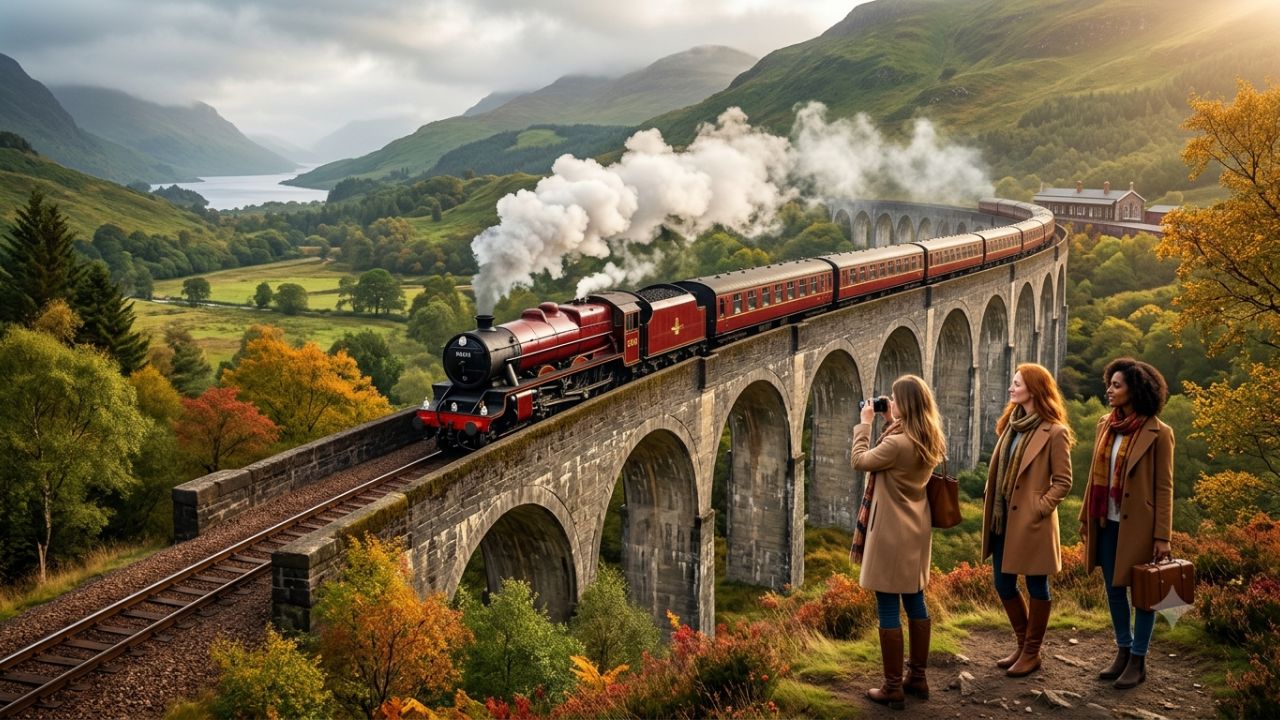
LONDON, November 4, 2026 — Marking a quarter-century since Harry Potter and the Philosopher’s Stone made its cinematic debut in November 2001, the United Kingdom is celebrating twenty-five years of screen magic by inviting global travelers to explore the real railway lines, ancient cathedrals, and dramatic landscapes that brought J.K. Rowling’s wizarding world to life. While the stories inhabit the realm of fantasy, the physical settings that anchored the cinematic adaptations are celebrated treasures of British architectural and industrial heritage. From the grand brick train sheds of London King’s Cross to the medieval libraries of Oxford, the Norman arches of Durham Cathedral, the steam-hauled moorland tracks of North Yorkshire, and the sweeping concrete viaducts of the Scottish Highlands, Britain’s railways serve as the living connective tissue linking fictional storytelling with tangible historic travel.
For millions of international visitors and domestic holidaymakers, embarking on a Harry Potter rail journey is an immersive encounter with British cultural geography. Rather than isolated film sets built inside artificial amusement compounds, Britain's filming locations remain operational components of the national landscape: active railway junctions, working cathedral cloisters, scholarly reading rooms, and preserved steam corridors maintained by dedicated heritage volunteers. As Warner Bros. Studio Tour London prepares to launch its celebrated winter feature, "Hogwarts in the Snow," on November 14, 2026, travelers can construct an unforgettable multi-destination itinerary that combines cinematic nostalgia with scenic rail exploration across England and Scotland.
========================================================================================
THE FIVE ICONIC HARRY POTTER RAIL CIRCUITS ACROSS BRITAIN (25TH ANNIVERSARY)
========================================================================================
  [CIRCUIT 1: LONDON HUB]      --> King's Cross Station (Platform 9¾ Concourse Installation)
  [CIRCUIT 2: STUDIO ARCHIVE]  --> Leavesden Studios (Watford Junction | Hogwarts in the Snow)
  [CIRCUIT 3: MEDIEVAL INTELLECT]--> Oxford University (Divinity School & Christ Church Stairs)
  [CIRCUIT 4: NORMAN MAJESTY]  --> Durham Cathedral (Romanesque Cloisters & Chapter House)
  [CIRCUIT 5: STEAM HERITAGE]  --> Goathland Station (North York Moors | Original Hogsmeade)
  [CIRCUIT 6: HIGHLAND VISTA]  --> Glenfinnan Viaduct (West Highland Line | Loch Shiel)
========================================================================================
Strategic Key Indicators for Harry Potter Rail Tourism in the UK
- Screen Tourism Multiplier: National tourism research published by VisitBritain indicates that over half of international leisure visitors engage in film- and television-related travel activities, generating hundreds of millions of pounds in regional visitor expenditure outside London.
- The Locomotive as Narrative Bridge: Passenger trains operate as the central transitional motif of the franchise, serving as the magical threshold that transports characters from the mundane realities of suburban life into the enchanted Scottish Highlands.
- Diverse Operational Frameworks: The five major destinations span three distinct railway environments: working mainline commuter networks (Network Rail), preserved community-run steam corridors (North Yorkshire Moors Railway), and isolated wilderness lines (ScotRail's West Highland Line).
- Winter Exhibition Integration: Warner Bros. Studio Tour London at Leavesden introduces an expanded 2026 winter installation featuring live Foley sound-effects demonstrations on the Backlot Stage alongside decorated Great Hall feast tables.
- Independent Planning Necessity: The locations do not form a single continuous tourist train service; successful exploration requires booking separate mainline rail tickets, guided university tours, and timed studio admissions across a multi-day itinerary.
The Locomotive as Cultural Threshold: Why Trains Define the Wizarding World
In the landscape of modern popular culture, few transport vehicles are as deeply loved as the Hogwarts Express. Drawn by a gleaming 4-6-0 Hall Class steam locomotive in vivid crimson livery, the school train is more than a convenient mode of conveyance; it functions as a psychological bridge between worlds. In both the literature and the films, passing through the barrier at Platform 9¾ and stepping aboard the vintage compartment carriage marks the absolute boundary between ordinary suburban existence and extraordinary magical discovery.
This literary focus on passenger trains is deeply rooted in British social history. Britain is the birthplace of commercial railway transport, where pioneering engineers like George Stephenson and Isambard Kingdom Brunel transformed Victorian society by laying thousands of miles of iron track through ancient hills and urban centers. By centering the journey to school on a vintage steam train departing from a central London railway terminus, the filmmakers grounded their magical universe in genuine British industrial romance.
Today, that connection provides travelers with a unique lens through which to experience Britain. Riding trains to visit Harry Potter filming locations allows visitors to appreciate the contrasts of the British landscape: transitioning from the rapid pulse of London's brick terminals through the rolling agricultural pastures of the Midlands, the heather-covered hills of North Yorkshire, and into the mist-covered mountains of the Scottish Highlands. The journey itself becomes an essential part of the travel experience, mirroring the contemplative journey taken by students each September.
THE ANATOMY OF CINEMATIC RAIL TRANSIT: BRIDGING FICTION AND BRITISH HERITAGE
| Entity / Route | Metrics | Operational Status |
|---|---|---|
| Fictional Dimension | Real-World Railway Location | Cultural & Historic Identity |
| Platform 9¾ Barrier | London King's Cross Station | Lewis Cubitt's 1852 arched |
| Departure Point | Western Departures Concourse | yellow-brick rail terminus |
| Hogsmeade Station | Goathland Railway Station | Preserved 1865 North York |
| School Terminus | North Yorkshire Moors Railway | Moors heritage steam depot |
| Hogwarts Express | Glenfinnan Viaduct | Robert McAlpine's 1901 mass |
| Mountain Crossing | West Highland Line (Mallaig line) | concrete 21-arch viaduct |
| Hogwarts Cloisters | Durham Cathedral | 11th-century Norman Romanesque |
| & Classroom Spaces | Cloister Walk & Chapter House | UNESCO World Heritage Site |
| Hogwarts Infirmary | Oxford Bodleian Library | 15th-century Perpendicular |
| & Grand Entrance | Divinity School & Christ Church | Gothic stone vaulted halls |
Circuit 1: London King’s Cross and the Magic of Platform 9¾
For any traveler embarking on a film-inspired railway tour of Britain, the journey begins at London King’s Cross Station. Designed by architect Lewis Cubitt and opened to passenger traffic in 1852, King’s Cross is celebrated for its unadorned, functional elegance, characterized by two massive arched yellow-brick train sheds that span the operational platforms.
In the films, students reach the Hogwarts Express by walking boldly through the solid brick dividing barrier between Platforms 9 and 10. While the actual filming took place between operational Platforms 4 and 5—where the arched brick pillars offered greater visual depth for camera crews—Network Rail has established an official homage on the station’s western departures concourse. Here, beneath the soaring, white semi-lattice canopy designed by John McAslan + Partners, visitors encounter the famous Platform 9¾ installation: a vintage wrought-iron luggage trolley embedded half-way into a brick wall, complete with brass-bound trunks and an owl cage.
The photo installation is accessible to all station visitors without purchasing a train ticket. On any given afternoon, a cheerful international queue forms as visitors drape Gryffindor, Ravenclaw, Hufflepuff, or Slytherin scarves around their shoulders to capture a souvenir photograph mid-stride into the wall. Adjacent to the installation sits the Harry Potter Shop at Platform 9¾, designed to resemble Ollivanders wand shop with dark wooden shelving, brass chandeliers, and collectible wands.
King’s Cross serves as far more than a photo backdrop; it is an active transportation hub. Situated adjacent to St Pancras International—which provided the ornate Victorian Gothic red-brick facade used for exterior shots of the station in Harry Potter and the Chamber of Secrets—King's Cross serves as the departure terminal for high-speed London North Eastern Railway (LNER) Azuma trains racing north along the East Coast Main Line toward Yorkshire, Durham, and Scotland.
Circuit 2: Leavesden Studios and the Artistry of "Hogwarts in the Snow"
While location shooting across Britain provided exterior scale, the physical sets that defined the interior life of Hogwarts were constructed twenty miles northwest of central London at Leavesden, Hertfordshire. Located on the site of a former Second World War aircraft factory and airfield where de Havilland Mosquito fighter-bombers were once assembled, Warner Bros. Studio Tour London – The Making of Harry Potter preserves the authentic soundstages where all eight films were produced.
Reaching Leavesden by public transport is straightforward. From London Euston Station, travelers board frequent West Coast Main Line commuter trains operated by London Northwestern Railway, reaching Watford Junction in just twenty minutes. Outside Watford Junction, passengers board dedicated electric double-decker shuttle buses—wrapped in film imagery—that transport visitors directly to the studio tour entrance in fifteen minutes.
========================================================================================
LEAVESDEN STUDIO TOUR: HIGHLIGHTS OF THE WINTER INSTALLATION
========================================================================================
  [SEASONAL FEATURE]     --> "Hogwarts in the Snow" (Runs Nov 14, 2026 – Jan 17, 2027)
  [THE GREAT HALL SET]   --> Dressed for festive feast with Christmas trees & roast hams
  [SCALE CASTLE MODEL]   --> 1:24 Scale Hogwarts Castle coated in hand-applied snow
  [NEW FOR 2026 SEASON]  --> Live Foley Sound Effects demonstration on the Backlot Stage
  [ORIGINAL LOCOMOTIVE]  --> GWR 4900 Class 5972 "Olton Hall" resting at Platform 9¾ set
========================================================================================
The winter holiday window is the most celebrated time to visit Leavesden. Opening on November 14, 2026, and running through January 17, 2027, the annual "Hogwarts in the Snow" transformation re-dresses key sets using authentic cinematic winter techniques. In the Great Hall, long banquet tables are laid with festive feasts, while towering Christmas trees decorated with shimmering baubles and topped with miniature flying witches flank the stone walls. Roaring fires—created using specialized water-vapor and lighting effects—glow in the gothic fireplaces.
New for the 2026 anniversary season, Warner Bros. has introduced an educational feature on the Backlot Stage dedicated to the art of Foley sound production. Visitors can observe sound artists demonstrating how ordinary objects were used to create the rich acoustic atmosphere of winter scenes—from walking on cornstarch to simulate crisp crunching snow to flapping leather gloves to replicate the sound of owls taking flight through winter squalls.
Inside the soundstages, visitors also stand face-to-face with the real locomotive used in the films: the GWR 4900 Class 5972 Olton Hall, built in 1937 at Swindon Railway Works. Positioned along a recreated Platform 9¾ brick platform, the locomotive billows steam as visitors walk down the carriage corridor, peering into compartments dressed with props from specific school years, complete with confectionery wrappers and chocolate frog boxes.
Circuit 3: Oxford’s Academic Splendor: Christ Church and the Bodleian
A short train journey west from London Paddington brings travelers into the city of Oxford. Accessible in fifty-two minutes aboard Great Western Railway (GWR) high-speed services, Oxford offers an exceptional concentration of authentic university architecture that directly inspired the filmmakers.
OXFORD UNIVERSITY FILMING SITES & ARCHITECTURAL HIGHLIGHTS
| Entity / Route | Metrics | Operational Status |
|---|---|---|
| Architectural Venue | Specific Cinematic Appearance | Historical Background |
| Christ Church | Grand entrance staircase where | 16th-century stone staircase |
| Grand Staircase | McGonagall welcomes first-years | beneath fan-vaulted ceiling |
| Christ Church | Direct architectural inspiration | Tudor dining hall built by |
| Great Hall | for the Leavesden Great Hall set | Cardinal Wolsey in the 1520s |
| Bodleian Library: | Hogwarts Infirmary and the Yule | Completed in 1488; masterpiece |
| Divinity School | Ball dance rehearsal room | of English Perpendicular Gothic |
| Bodleian Library: | Hogwarts Library Restricted | 15th-century chained library; |
| Duke Humfrey's Room | Section explored by Harry at night | Oldest reading room in Oxford |
| New College | Courtyard cloister where Malfoy | 14th-century cloister framed |
| Cloisters & Quad | is turned into a white ferret | by a giant weeping oak tree |
The centerpiece of any Oxford tour is Christ Church. Entering through the Tom Quad, visitors climb the grand sixteenth-century stone staircase beneath an intricate stone fan vault designed by master mason William Townsend. It was upon these steps that Professor McGonagall first greeted the first-year students in The Philosopher’s Stone, delivering her memorable speech regarding house points and school conduct. At the top of the stairs, travelers enter Christ Church’s Great Hall. While actual filming took place on a soundstage replication, the Tudor dining hall—founded by Cardinal Thomas Wolsey in 1525—served as the direct architectural blueprint for the Hogwarts Great Hall, featuring long communal wooden benches, portrait-lined paneled walls, and a hammerbeam timber ceiling.
Walking north through the cobblestone lanes of Radcliffe Square leads visitors to the Bodleian Library. Completed in 1488, the Divinity School is widely regarded as one of the finest surviving examples of English Perpendicular Gothic architecture, distinguished by an elaborate stone ceiling adorned with 455 carved stone bosses representing university benefactors and biblical motifs. In the films, this soaring hall served as the Hogwarts infirmary, where Madam Pomfrey mended broken bones and cured petrified students. In Harry Potter and the Goblet of Fire, the same hall was cleared of beds to become the room where Professor McGonagall instructed Ron Weasley and his classmates in the art of the waltz.
Above the Divinity School lies Duke Humfrey’s Library, the oldest reading room in the Bodleian complex. Dating to the fifteenth century, this timber-lined scholarly sanctuary—filled with original chained volumes and heraldic painted ceiling panels—portrayed the Hogwarts library’s Restricted Section. Because Duke Humfrey’s remains an active research library, access is granted strictly through ticketed guided tours operated by the Bodleian, which require advance reservations and enforce a minimum visitor age of eleven years.
Circuit 4: Durham Cathedral: Norman Arches and the Transfiguration Classroom
Traveling north along the East Coast Main Line aboard an LNER Azuma train, travelers reach the historic city of Durham in under three hours from London King’s Cross. Perched high upon a rocky promontory enclosed by a loop of the River Wear, Durham Cathedral—a UNESCO World Heritage Site founded in 1093 to enshrine the relics of St. Cuthbert—represents the pinnacle of Norman Romanesque architecture in Europe.
========================================================================================
DURHAM CATHEDRAL FILMING LOCATIONS & OPERATIONAL VISITOR PROTOCOLS
========================================================================================
  [THE CLOISTER WALK]    --> Snow-covered Hogwarts quadrangle where Harry released Hedwig
  [THE CHAPTER HOUSE]    --> Authentic setting for Professor McGonagall's classroom
  [ARCHITECTURAL STYLE]  --> 11th-century Norman Romanesque with massive fluted stone columns
  [PUBLIC ACCESS TIMES]  --> Chapter House open 10:00 AM – 4:00 PM, Monday through Saturday
  [RAIL ACCESSIBILITY]   --> Direct high-speed LNER services from London King's Cross (3h)
========================================================================================
Durham Cathedral provided the film directors with the physical weight, age, and spiritual gravity needed to depict a thousand-year-old magical institution. The cathedral’s covered cloister walk—an enclosed quadrangle where medieval monks once studied and transcribed illuminated manuscripts—served as the snow-dusted Hogwarts courtyard in the first two films. It was beneath these heavy stone arches that Harry walked with his snowy owl, Hedwig, releasing her into the winter sky over a digital rendition of the castle turrets. In Harry Potter and the Chamber of Secrets, the same cloister walk provided the setting for the memorable confrontation where Ron Weasley’s damaged wand caused his "slug-vomiting" curse to backfire.
Directly off the cloister walk lies the cathedral’s historic Chapter House. Featuring ribbed stone vaults, carved stone corbels, and an ancient stone bishop’s bench, this room served as Professor McGonagall’s Transfiguration classroom. Here, students practiced transforming teacups into gerbils and listened to explanations regarding the legendary Chamber of Secrets.
Today, the Chapter House is open to public visitors Monday through Saturday from 10:00 AM to 4:00 PM, free of admission charges, though donations to support cathedral conservation are encouraged. Visitors stepping into the room immediately recognize the semicircular stone seating and Norman windows. Beyond the Harry Potter connections, the cathedral offers extraordinary historical treasures, including the shrine of St. Cuthbert, the tomb of the Venerable Bede, and some of the earliest ribbed vault ceilings ever constructed in the Western world.
Circuit 5: Goathland Station: Living Steam Heritage in the North York Moors
Nestled within a steep, heather-fringed valley in the North York Moors National Park, Goathland Railway Station is celebrated as one of the most charming heritage railway stops in Britain. With its wrought-iron pedestrian footbridge, hand-cranked level-crossing gates, water tower, and traditional enamel station signage, Goathland retains the intact atmosphere of a country station from the late Victorian era.
In Harry Potter and the Philosopher’s Stone, Goathland was chosen to portray Hogsmeade Station—the railway terminus where the Hogwarts Express arrived at the edge of the school grounds. It was along Goathland’s wooden platforms that Hagrid stood with his glowing lantern, directing first-year students down to the rowboats on the black lake.
GOATHLAND STATION (HOGSMEADE) HERITAGE RAIL & HIKING BLUEPRINT
| Entity / Route | Metrics | Operational Status |
|---|---|---|
| System Component | Operational Specification | Practical Traveler Value |
| Operating Railway | North Yorkshire Moors Railway | Preserved 18-mile heritage |
| (NYMR) Steam Corridor | line running across wild moors | |
| Mainline Gateway | York Railway Station | High-speed LNER hub connected |
| (Trans-Pennine & East Coast Hub) | to scenic regional bus links | |
| Bus Connection | Yorkshire Coastliner (Route 840) | Direct scenic bus service from |
| Voted Britain's most scenic route | York, Malton, and Pickering | |
| Walking Itinerary | The Rail Trail (Goathland to | Easy 3.5-mile downhill walking |
| Grosmont Station) | route along 1836 railbed | |
| Natural Landmark | Mallyan Spout Waterfall | 70-foot natural waterfall |
| (Located behind village inn) | reached via wooded ravine |
The station is owned and preserved by the North Yorkshire Moors Railway (NYMR), an eighteen-mile preserved steam line operating between Pickering and Grosmont. Because the NYMR is a heritage charity operating historic equipment, services follow a seasonal calendar. Regular daily scheduled steam services conclude in early November, transitioning to specialized winter dining excursions and festive Santa Specials in late November and December.
For independent travelers visiting outside the scheduled steam timetable, Goathland remains accessible. The station grounds, station shop, and tea room are open on weekends, and the pedestrian platform can be visited on foot at any time of year. Travelers departing from York can board the award-winning Yorkshire Coastliner (Route 840) bus, which winds across the moorland plateau before descending into Goathland village.
While in Goathland, visitors can embark on the popular Rail Trail, a scenic three-and-a-half-mile walking route following the original 1836 horse-worked railway alignment down through the valley to Grosmont Station. Along the route, hikers pass historic stone bridges, rushing streams, and the nearby Mallyan Spout waterfall, which cascades seventy feet down a fern-covered limestone gorge.
Circuit 6: Glenfinnan Viaduct and the Wild West Highland Line
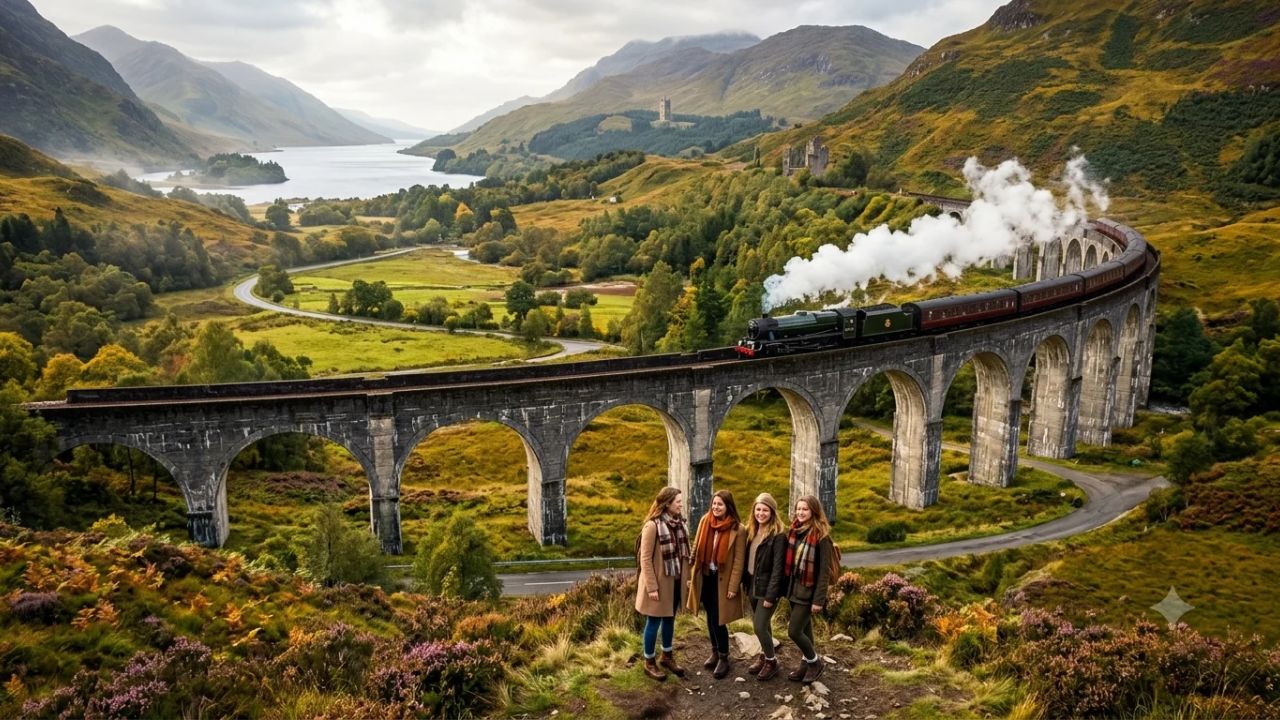
No location captures the visual romance of the Harry Potter films quite like the Glenfinnan Viaduct in the western Scottish Highlands. Situated along the West Highland Line in Inverness-shire, this soaring twenty-one-arch concrete structure carries the railway in a graceful sweeping curve high above the valley floor, framed by the peaks of the Highlands and the waters of Loch Shiel.
========================================================================================
GLENFINNAN VIADUCT & WEST HIGHLAND LINE OPERATIONAL HIGHLIGHTS
========================================================================================
  [CONSTRUCTION HISTORY] --> Built in 1897–1901 by Robert McAlpine; pioneer mass concrete
  [STRUCTURAL SCALE]     --> 21 Curved arches spanning 416 yards, rising 100 feet high
  [PASSENGER RAIL]       --> Regular ScotRail passenger services operating year-round
  [HERITAGE STEAM EXCURSION]--> The Jacobite (West Coast Railways; operates April–October)
  [HISTORIC LANDMARK]    --> Glenfinnan Monument commemorating the 1745 Jacobite rising
========================================================================================
Completed in 1901 by visionary civil engineer Robert McAlpine—famously nicknamed "Concrete Bob" for his pioneering use of mass unreinforced concrete—the viaduct spans 416 yards and rises one hundred feet into the Highland air. In the films, the viaduct appeared in iconic sequences across multiple installments, most famously in Harry Potter and the Chamber of Secrets, where Ron and Harry pilot their enchanted flying Ford Anglia around the steam locomotive as it crosses the curving bridge.
Travelers can experience the viaduct in two distinct ways: from the passenger seat of a train crossing the bridge, or from designated mountain walking viewpoints on the valley floor below. ScotRail operates scheduled passenger trains along the West Highland Line between Fort William and Mallaig, providing travelers with a year-round transit option that crosses the viaduct as part of the public transport network. Aboard these trains, passengers enjoy sweeping views from the large carriage windows as the train slows across the curved viaduct, offering panoramic vistas down the length of Loch Shiel.
During the spring, summer, and early autumn months (typically April through October), West Coast Railways operates The Jacobite, a world-renowned heritage steam excursion featuring vintage carriages hauled by classic steam locomotives. While the Jacobite offers an authentic steam experience, tickets sell out months in advance, and operations are subject to seasonal schedules.
Beyond its cinematic fame, Glenfinnan holds a place in Scottish history. At the head of Loch Shiel stands the Glenfinnan Monument, erected in 1815 to mark the spot where Prince Charles Edward Stuart (Bonnie Prince Charlie) raised his royal standard on August 19, 1745, launching the final Jacobite uprising. Visitors disembarking at Glenfinnan Station can tour the small railway museum housed in the restored station building, follow a well-maintained walking trail down to the monument, and climb to the top of the tower for views of the surrounding hills.
Comparative Journey Planning Matrix: Timetables, Transit, and Booking Windows
To assist holidaymakers in assembling a seamless multi-day journey across the United Kingdom, the following comprehensive planning matrix synthesizes transit durations, primary operators, ticketing lead times, and scheduling considerations:
THE GRAND HARRY POTTER UK RAILWAY ITINERARY: TRANSIT & BOOKING MATRIX (2026)
| Column 1 | Column 2 | Column 3 | Column 4 | Column 5 |
|---|---|---|---|---|
| Destination Hub | London Departure | Primary Transport | Optimal Booking | Suggested Visit |
| & Filming Scene | Terminal Gateway | Operating Carrier | Window Advance | Time Duration |
| King's Cross | London King's Cross | Network Rail | No booking needed; | 45m – 1 hour |
| Platform 9¾ | (Concourse Hall) | Public Concourse | open daily access | (Photo + shop) |
| Leavesden Studio | London Euston | London Northwest. | 3 to 5 Months | 4 – 5 Hours |
| Original Sets | (Fast to Watford) | & Studio Shuttle | for winter slots | (Full exhibition) |
| Oxford Colleges | London Paddington | Great Western Rail | 4 to 8 Weeks | Full Day Trip |
| & Historic Bodleian | (High-Speed Line) | (GWR) Express Line | for advance fares | (6 – 8 Hours) |
| Durham Cathedral | London King's Cross | London North | 8 to 12 Weeks | Full Day or |
| Cloister & Chapter | (East Coast Trunk) | Eastern Rail (LNER) | for Azuma tickets | Overnight Stay |
| Goathland Depot | London King's Cross | LNER to York + | 4 to 6 Weeks | Full Day Excursion |
| Hogsmeade Depot | to York Central | Coastliner 840 bus | (Moors connection) | from York Hub |
| Glenfinnan Line | London Euston | ScotRail / | 8 to 12 Weeks | 2 to 3 Days |
| Loch Shiel Curve | (Caledonian Sleeper | Caledonian Sleeper | (Highland cabins) | (Highland Circuit) |
This planning matrix underscores that while London, Hertfordshire, and Oxford can be combined across a single weekend, destinations in northern England and the Scottish Highlands require dedicated travel days. Rather than attempting to see all five sites in a rushed four-day trip, travelers should design a circular itinerary: spending two days exploring London, Leavesden, and Oxford, boarding a high-speed LNER train north to York and Durham, and continuing to Edinburgh before catching the West Highland Line into Fort William.
Strategic Passenger Field Guide: Packing, Etiquette, and Rail Passes
For international travelers navigating the British railway network, thoughtful preparation can turn a complex itinerary into a smooth, relaxing holiday. The following field protocols outline essential travel strategies:
PRACTICAL FIELD PROTOCOL: HARRY POTTER RAIL ITINERARY PLANNING
| Category / Entity | Details / Impact |
|---|---|
| Planning Factor | Operational Guidance |
| Rail Passes | Overseas visitors should purchase a BritRail GB Pass, which |
| offers flexible hop-on travel across all national train operators | |
| Seat Reservations | Make free advance seat reservations on LNER and GWR trains to |
| ensure window seating on scenic stretches along the coast. | |
| Weather Apparel | Pack durable waterproof boots, thermal base layers, and windproof |
| outerwear for walking around Glenfinnan and the North York Moors. | |
| Sacred Etiquette | Durham Cathedral is an active place of worship; maintain quiet |
| during church services and avoid taking flash photography inside. | |
| Photography Rules | Respect filming restrictions inside the Bodleian Library; use of |
| tripods and flash photography in historic rooms is prohibited. |
When traveling by rail in Britain, travelers should consider the benefits of a BritRail Pass. Available exclusively to international visitors, the pass allows unlimited train travel across the entire National Rail network for a set number of days. This provides the flexibility to adjust travel schedules without paying dynamic ticket change fees.
Travelers visiting Durham Cathedral and Oxford’s historic colleges should remember that these sites are not commercial amusement parks, but working religious and educational institutions. At Durham Cathedral, public access to the Chapter House and cloisters may be restricted during Sunday services, choral evensong, or diocesan ceremonies. Checking the cathedral’s official daily service calendar ensures that your visit does not conflict with liturgical events.
In the Scottish Highlands, proper outdoor gear is essential. Weather conditions around Glenfinnan and Fort William can change rapidly, with autumn bringing rain, mist, and chilly mountain winds. Sturdy waterproof hiking boots are recommended for walking the trails leading to the viaduct viewpoints, and carrying a lightweight flashlight or headlamp is advisable when taking late-afternoon trains, as daylight fades quickly in northern latitudes during November.
The Strategic Roadmap: Preserving Cinematic Heritage for the Next Quarter-Century
As the United Kingdom commemorates twenty-five years since Harry Potter and the Philosopher’s Stone first captivated moviegoers, the real-world locations that brought the story to life stand as enduring testaments to the power of storytelling to enrich the travel experience.
The longevity of this screen tourism phenomenon illustrates the value of protecting historic architecture and scenic natural landscapes. The reason these locations continue to resonate with travelers is that they were not built as temporary movie props; they are authentic, centuries-old places that possess genuine historical character. The Romanesque arches of Durham, the Tudor halls of Christ Church, the preserved steam depots of North Yorkshire, and the viaducts of the Scottish Highlands existed long before the films were made, and with thoughtful conservation, they will continue to inspire visitors for generations to come.
By pairing modern public transport with respectful cultural exploration, travelers can experience the timeless magic of the British landscape—a country where an ordinary railway ticket can still lead to extraordinary destinations, proving that the real world possesses plenty of magic of its own.
Related Travel Guides and Analysis
- UK Rail Trips and Harry Potter Filming Locations Disrupted by Engineering Works
- Amtrak Expands Thanksgiving 2026 Train Services Across the United States
- Southern France Railway Disruption and Flood Damage Recovery
- Brussels Travel Price Storm and European Energy Volatility
- Spain, France, Austria, and Thailand Top Global Winter Tourist Rankings
- Bolivia Emerges as a Global Corporate Incentive Powerhouse
- Indonesia Pioneers the Global Regenerative Tourism Revolution
This article is for informational purposes. Flight routes, passenger regulations, visa rules, and transit advisories are subject to change by airlines and aviation authorities. Readers are advised to verify schedules and travel documentation with relevant carriers and border agencies before departure.
Related Stories
UK Rail Trips Beyond London: Five Harry Potter Film Sites Face Major November Disruptions for 25th Anniversary

Vietnam and Laos Strengthen Cross-Border Tourism Ties as Laos Targets 6 Million Visitors by 2030