
Gulf Air Corridors Severed: 291 Cancellations and 1,801 Delays Paralyze Riyadh, Dubai, and Regional Hubs
A cascading aviation crisis grips the Middle East as 291 cancellations and 1,801 delays snarl 15 hubs across Riyadh, Dubai, Sharjah, and Istanbul on 18 October 2026.

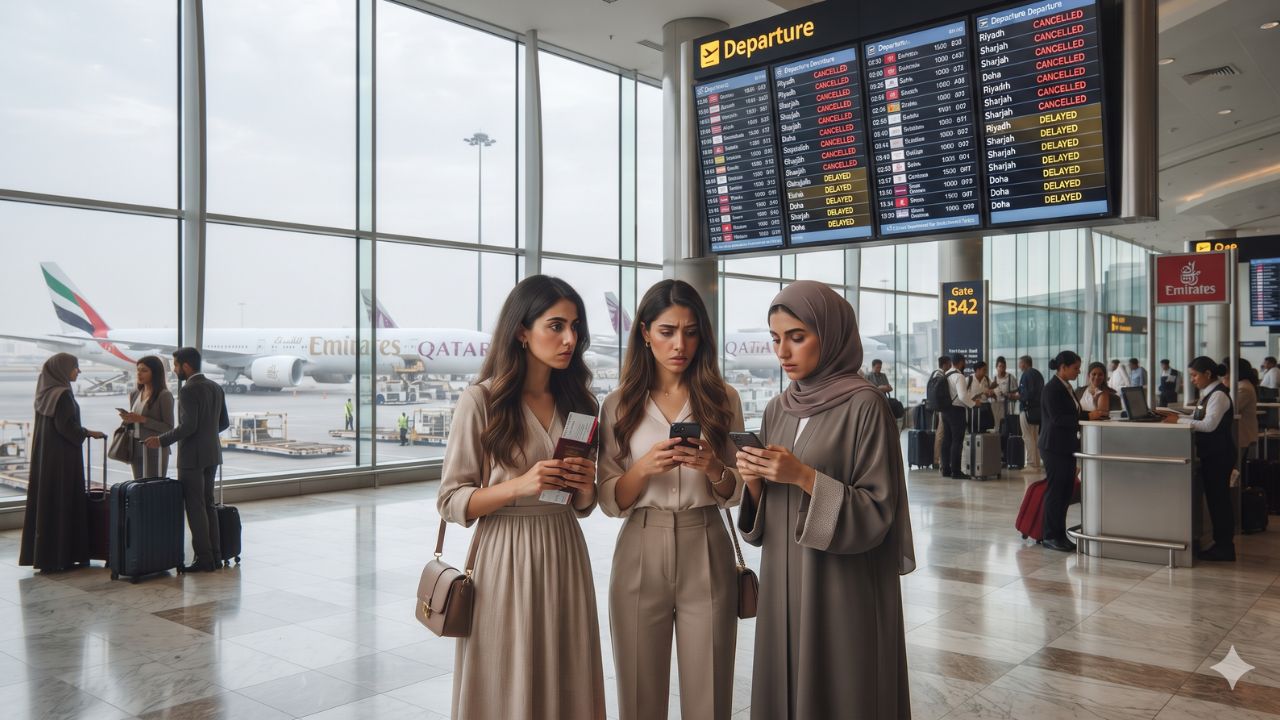
A wave of 291 flight cancellations and 1,801 delays rippled across 15 premier aviation hubs throughout the Gulf and the Eastern Mediterranean on 18 October 2026, as military drone strikes against Saudi civil infrastructure paralyzed connecting skies. Grounding operations from Riyadh and Jeddah to Dubai, Sharjah, Doha, and Istanbul, real-time tracking logs compiled by FlightAware as of 7:21 pm ET on 17 October (3:21 am GST on 18 October) revealed that national flag carrier Saudia saw nearly one in four flights cancelled. Compounded by severe low-visibility haze across the United Arab Emirates and catastrophic flash flooding in western Türkiye, the synchronized disruption disconnected high-volume transit corridors linking Europe, South Asia, and the Arabian Peninsula.
The sweeping schedule collapse demonstrates how quickly asymmetric regional conflicts can dismantle the operational rhythm of global superconnector hubs. Rather than absorbing localized terminal delays, international carriers were forced to execute emergency network truncations, severing multi-daily business shuttles between Gulf Cooperation Council (GCC) commercial capitals. For hundreds of thousands of corporate executives, religious pilgrims, and transit passengers connecting onto long-haul flights, the sudden freeze converted the world’s most active transfer nodes into crowded transit bottlenecks.
Airfield Security Alerts and Regional Weather Choke Points: Root Causes of the Gulf Gridlock
The primary catalyst for this intercontinental disruption stems from targeted strikes against civilian aviation installations across Saudi Arabia that began in early October. Confirmed reports from international news agencies documented that aerial barrages directed at King Khalid International Airport (RUH) in Riyadh on 10 and 11 October inflicted structural damage, casualties, and serious operational impairment. In response, the General Authority of Civil Aviation (GACA) enacted emergency security closures, suspending airport operations to conduct comprehensive infrastructure safety audits and runway remediation.
While civil aviation regulators initially extended the official operational suspension at Riyadh until 21:00 GMT on 17 October (00:00 Saudi local time on 18 October), active airfield reopening remained unconfirmed as safety evaluations continued. The operational paralysis immediately propagated through regional route networks:
- Emirates: Suspended all scheduled Dubai flights serving Riyadh, Jeddah, and Dammam across 17 and 18 October.
- Etihad Airways: Extended complete route cancellations between Abu Dhabi and Riyadh through 19 October.
- Air India and Air India Express: Imposed blanket operational suspensions across their extensive Saudi flight portfolios through 24 October.
- Qatar Airways: Indefinitely halted commercial rotations serving Riyadh and Dammam, citing active airspace security risks.
Simultaneously, environmental phenomena introduced secondary delays across the wider region. In the United Arab Emirates, the General Civil Aviation Authority (GCAA UAE) issued operational alerts as seasonal morning fog and particulate haze severely degraded horizontal runway visual ranges at Dubai International and Sharjah. Further north, severe meteorological fronts caused widespread flash flooding and municipal disruption across Istanbul and Antalya, inundating highway access routes and forcing air traffic controllers to implement prolonged holding patterns for aircraft approaching Turkish hubs.
Fifteen-Hub Operational Ledger: Flight Cancellations, Gate Holds, and Carrier Metrics
An examination of the FlightAware disruption dataset reveals stark divergence between hubs absorbing direct combat-zone closures versus those managing feeder-induced schedule delays.
The following data table breaks down operational delays, cancellations, and carrier performance across the 15 monitored Middle Eastern and Eastern Mediterranean gateways:
| Hub Airport / Operating Carrier | Regional Geography | Recorded Cancellations | Recorded Flight Delays | Carrier Cancellation Rate (%) | Dominant Operational Delay Catalyst |
|---|---|---|---|---|---|
| King Khalid International (RUH) | Riyadh, Saudi Arabia | 116 cancellations | 0 delays | Complete facility halt | Direct drone strikes & emergency GACA safety closures |
| King Abdulaziz International (JED) | Jeddah, Saudi Arabia | 56 cancellations | 173 delays | Significant schedule cut | Security diversions & long-haul arrival sequencing |
| King Fahd International (DMM) | Dammam, Saudi Arabia | 23 cancellations | 33 delays | Moderate schedule cut | Gulf route cancellations & airspace avoidance |
| Prince Mohammad Bin Abdulaziz (MED) | Medina, Saudi Arabia | 8 cancellations | 36 delays | Pilgrimage sector impact | Religious charter cancellations & rerouting |
| Prince Abdulmohsin Bin Abdulaziz (YNB) | Yanbu, Saudi Arabia | 2 cancellations | 0 delays | Regional feeder halt | Feeder suspensions to national capital |
| Dubai International (DXB) | Dubai, UAE | 19 cancellations | 298 delays | Heaviest delay volume | Saudi shuttle cancellations & seasonal low visibility |
| Sharjah International (SHJ) | Sharjah, UAE | 6 cancellations | 82 delays | Regional LCC impact | Low-cost carrier network holds & weather minimums |
| Hamad International (DOH) | Doha, Qatar | 5 cancellations | 105 delays | Transit bank pacing | Airspace avoidance & Saudi sector suspensions |
| Bahrain International (BAH) | Manama, Bahrain | 5 cancellations | 27 delays | Shuttle route impact | Causeway feeder cuts & Gulf transit holds |
| Antalya Airport (AYT) | Mediterranean Türkiye | 1 cancellation | 341 delays | Heaviest Turkish delay | Severe convective storms & Mediterranean flow control |
| Istanbul Airport (IST) | Istanbul, Türkiye | 10 cancellations | 311 delays | European megahub delay | Severe flash flooding & surface transport access cuts |
| Istanbul Sabiha Gökçen (SAW) | Istanbul, Türkiye | 19 cancellations | 202 delays | LCC Turkish hub delay | Convective squalls & regional turnaround cascades |
| Cairo International (CAI) | Cairo, Egypt | 9 cancellations | 132 delays | North African gateway | Trans-Red Sea traffic holds & Saudi delays |
| Queen Alia International (AMM) | Amman, Jordan | 7 cancellations | 12 delays | Levant regional transit | Cross-border regional suspensions |
| Ben Gurion Airport (TLV) | Tel Aviv, Israel | 2 cancellations | 49 delays | Eastern Mediterranean | Airspace corridor security restrictions |
| Saudia | Saudi Flag Carrier | 87 cancellations (24%) | 81 delays (22%) | 24% cancellation rate | Riyadh terminal closure & domestic route halts |
| Emirates | UAE Flag Carrier | 3 cancellations (0%) | 182 delays (34%) | 34% delay rate | Network-wide turnaround delays from Saudi cuts |
| Qatar Airways | Qatari Flag Carrier | 5 cancellations (0%) | 83 delays (13%) | 13% delay rate | Airspace metering & Saudi route suspensions |
| Air Arabia | UAE Low-Cost Carrier | 5 cancellations (2%) | 70 delays (29%) | 29% delay rate | Sharjah base weather & secondary Saudi groundings |
| Pegasus Airlines | Turkish Low-Cost Carrier | 19 cancellations (2%) | 215 delays (29%) | 29% delay rate | Sabiha Gökçen rainstorms & aircraft rotation rot |
| Turkish Airlines | Turkish Flag Carrier | 7 cancellations (0%) | 294 delays (18%) | 18% delay rate | Istanbul hub flow control & approach holding |
| Riyadh Air | Saudi Startup Carrier | 3 cancellations (10%) | 0 delays (0%) | 10% cancellation rate | Test and operational route suspensions |
The figures confirm that Saudi airports bore the brunt of physical groundings, led by Riyadh’s 116 cancellations. In contrast, superconnector hubs like Dubai (298 delays) and Doha (105 delays) absorbed structural scheduling rot, as aircraft arriving late from disrupted regional sectors pushed subsequent intercontinental departure banks into rolling delays.
Expert Analysis: Superconnector Bank Decoupling, Insurance Liabilities, and Re-Routing Complexities
The synchronized failure of Gulf flight corridors exposes the acute operational vulnerability of the "hub-and-spoke" wave system perfected by Middle Eastern mega-carriers.
For travelers booking this route, the direct consequence is the complete collapse of tightly timed connection windows. Megahub operators like Emirates at Dubai and Qatar Airways at Doha organize their daily flight operations around coordinated 90-to-120-minute transfer banks, where dozens of flights from Europe arrive simultaneously to exchange passengers onto outbound banks heading toward South Asia, Southeast Asia, and Australasia. When 34 percent of Emirates’ flights and 29 percent of Air Arabia’s departures suffer multi-hour delays, inbound passengers miss their onward long-haul connections. With subsequent flights booked to capacity, stranded travelers face forced 24-to-48-hour terminal stopovers.
The pricing pressure this creates means that unaffected trans-Eurasian corridors are commanding exorbitant last-minute premiums. As corporate travel departments and independent travelers seek alternative routes bypassing Gulf airspace entirely, seat inventories on non-stop flights operated by European and Asian carriers—such as Singapore Airlines, Cathay Pacific, and British Airways routing through Central Asian corridors—have seen walk-up business-class and flexible economy tariffs triple in price.
From a regulatory and airline corporate liability standpoint, the prolonged closure of King Khalid International Airport triggers severe contractual complications. Under international hull and liability insurance policies governed by Lloyd's of London, commercial airliners operating into zones subject to active missile bombardment forfeit standard war-risk indemnification unless exorbitant additional daily premiums are paid. For international operators like Emirates, Etihad, and Air India, suspending flights into Saudi Arabia is not merely an operational choice; it is an unavoidable legal necessity mandated by aircraft leasing covenants and aviation underwriters. Until sovereign defense authorities establish guaranteed airspace interception corridors and recertify civilian airport perimeters, regular commercial timetables connecting the Gulf will remain deeply fractured.
Key Takeaways
- 291 Cancellations and 1,801 Delays: Widespread aviation disruption struck 15 major Gulf and Eastern Mediterranean airports on 18 October 2026.
- Riyadh Terminal Shutdown: King Khalid International Airport recorded 116 cancellations, remaining non-operational following drone strikes as GACA safety audits continue.
- Mass Airline Suspensions into Saudi Arabia: Emirates, Etihad, Qatar Airways, and Air India extended flight cancellations serving Riyadh, Jeddah, and Dammam through late October.
- Dubai and Antalya Delay Surges: Dubai International logged 298 flight delays, while Antalya recorded 341 delays due to Mediterranean storm fronts and weather pacing.
- Saudia Erases 24% of Operations: Saudi Arabia's flag carrier cancelled 87 flights (a 24 percent cancellation rate) and delayed 81 more, destabilizing domestic and regional connectivity.
FAQ: Gulf Flight Cancellations and Middle East Airspace Disruptions October 2026
Why are so many flights cancelled across Saudi Arabian airports?
Flights are grounded due to military drone attacks targeting King Khalid International Airport in Riyadh, prompting civil aviation authorities to suspend airfield operations for safety evaluations.
How long are airline flight suspensions into Saudi Arabia expected to last?
Emirates and Etihad have suspended flights through 18 and 19 October, while Air India and Air India Express have extended service suspensions until 24 October 2026.
Why is Dubai International Airport experiencing hundreds of flight delays?
Dubai International recorded 298 delays due to cascading disruptions from cancelled Saudi feeder flights combined with seasonal low visibility and morning fog in the UAE.
What should connecting passengers in the Gulf do if their flight is cancelled?
Passengers should monitor airline mobile apps, secure written confirmation of cancellations, retain all receipts for hotel accommodation and meals, and request re-routing on unaffected partner carriers.
As regional security threats and volatile weather fronts shutter critical air bridges, the Arabian Peninsula’s vital transit crossroads faces its most demanding operational test.
Related Travel Guides
Disclaimer
This article is for informational and educational purposes only. It does not constitute legal, financial, or professional advice. While we strive to provide accurate and up-to-date information, travel policies, regulations, and conditions change rapidly. Always verify information with official sources before making travel decisions. Nomad Lawyer makes no representations about the accuracy, reliability, completeness, or suitability of the information provided. Readers should consult qualified professionals for advice specific to their circumstances. The views expressed in this article are those of the author and do not necessarily reflect the views of Nomad Lawyer.
Preeti Gunjan
Contributor & Community Manager
A passionate traveller and community builder. Preeti helps grow the Nomad Lawyer community, fostering engagement and bringing the reader experience to life.
Learn more about our team →