
Asia Aviation Gridlock: 5,216 Delays and 515 Cancellations Hit Megahubs Across Jakarta, Mumbai, and Riyadh
A staggering 5,216 flight delays and 515 cancellations ground passengers across Asian and Middle Eastern hubs, driven by monsoons, wildfire haze, and Gulf airspace closures.

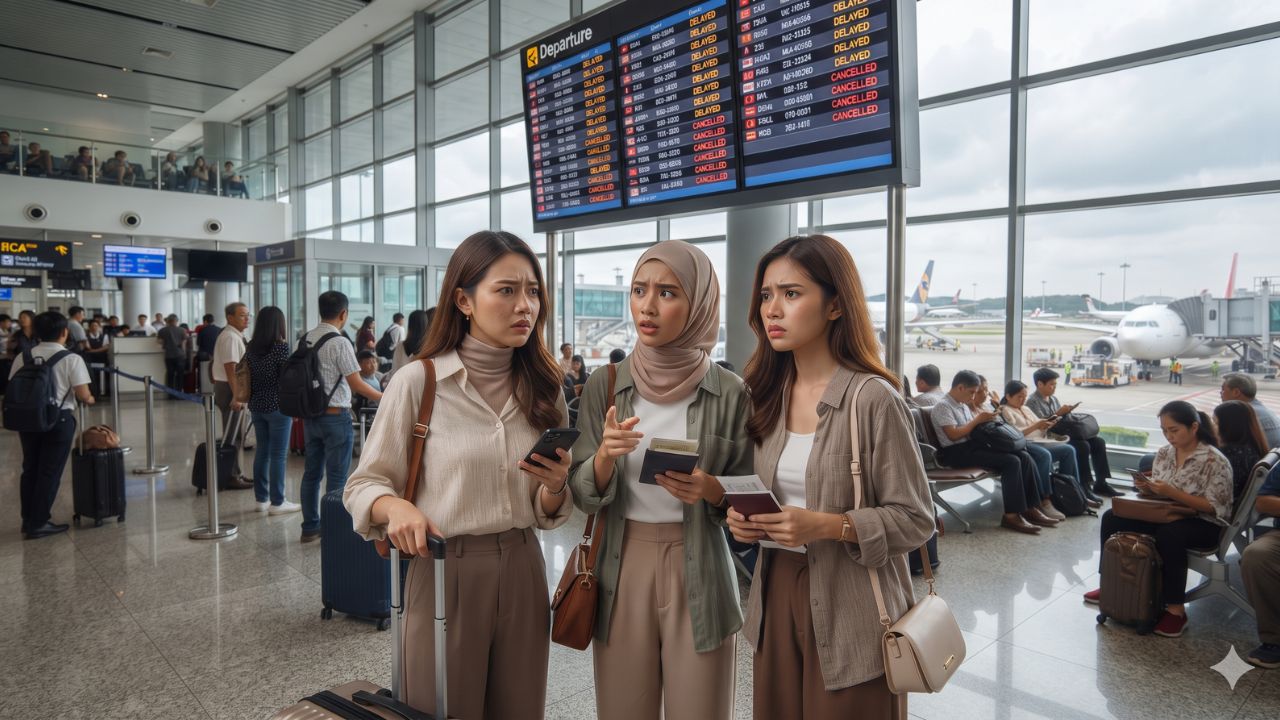
A staggering 5,216 flight delays and 515 outright cancellations crippled commercial air corridors across Asia and the Middle East in a single operational window on 17 October 2026, leaving hundreds of thousands of international transit passengers stranded. Verified by real-time tracking statistics compiled by FlightAware as of 3:53 pm ET (1:24 am IST on 18 October), the cascading breakdown impacted major connecting gateways from Kuala Lumpur, Shanghai, and Singapore to Mumbai, Dubai, and Riyadh. Combining tropical convective storms in Southeast Asia, hazardous peat fire haze in Indonesia, air traffic management choke points in China, and military security closures in the Persian Gulf, the synchronized disruption exposed structural limits in global airline schedule recovery.
The multi-regional gridlock reveals how fragile intercontinental flight banks become when regional weather phenomena coincide with severe geopolitical airspace restrictions. With narrowbody and widebody jets stranded out of position across hundreds of city pairs, turnaround operations disintegrated across primary transit points. For long-haul travelers navigating multi-leg journeys between Europe, Australasia, and North America, missed flight connections triggered mandatory reroutings, extended terminal layovers, and severe baggage backlog challenges across three continents.
Compound Disruptors: Monsoon Fronts, Wildfire Haze, and Middle East Airspace Closures
The operational crisis was driven by several overlapping regional catalysts rather than an isolated incident:
Across Southeast Asia and southern China, intense seasonal monsoon rainfall and reduced cloud ceilings triggered severe Flow Management ground stops. Kuala Lumpur International Airport (KUL) emerged as the single most delay-impacted hub in the region with 317 delayed flights, closely followed by Shanghai Pudong (PVG) with 298 delays, Singapore Changi (SIN) with 256 delays, and Bangkok Suvarnabhumi (BKK) recording 253 delays. In parallel, secondary regional airports in Indonesia suffered catastrophic operational paralysis due to dense agricultural and forest-fire smoke. Visibility minimums dropped below legal operating thresholds at Central Kalimantan gateways, causing Tjilik Riwut Airport (PKY) to cancel 50 percent of originating flights and 37 percent of arrivals, while Iskandar Airport (PKN) recorded a 37 percent origin cancellation rate alongside a 44 percent inbound failure rate.
In South Asia, Indian aviation hubs absorbed compounding delays as heavy precipitation across western and southern peninsular sectors intersected with airspace congestion. Mumbai’s Chhatrapati Shivaji Maharaj International Airport (BOM) recorded 213 delays alongside 11 cancellations, while Delhi’s Indira Gandhi International Airport (DEL) logged 206 delays. Further south, Bengaluru Kempegowda (BLR) logged 99 delays and 8 cancellations, while newly inaugurated Navi Mumbai International Airport (NMI) recorded 18 delays and 10 cancellations, representing a 9 percent destination cancellation rate.
Simultaneously, the civil aviation sector in the Arabian Peninsula absorbed severe security-driven capacity withdrawals. Following elevated missile and drone threats against airport perimeters in Saudi Arabia, King Khalid International Airport (RUH) in Riyadh logged 114 outright flight cancellations with a 24 percent origin cancellation rate, while Jeddah’s King Abdulaziz International Airport (JED) absorbed 52 cancellations and 137 delays. In the United Arab Emirates, Dubai International Airport (DXB) recorded 261 delays and 16 cancellations, forcing long-haul carriers to hold arriving flights in offshore holding stacks.
Operational Breakdown: Airport Disruption Totals and Carrier Cancellation Rates
The operational breakdown across key international airports and affected airlines reveals clear divergence between hubs absorbing schedule friction (delays) versus those suffering terminal shutdowns (cancellations).
The following comparative data table summarizes the disruption metrics across primary airport nodes and operating carriers:
| Airport / Carrier Entity | Regional Classification | Recorded Delays | Recorded Cancellations | Peak Cancellation Rate (%) | Primary Operational Disruption Factor |
|---|---|---|---|---|---|
| Kuala Lumpur (KUL) | Southeast Asia Hub | 317 delays | 3 cancellations | Negligible (<1%) | Convective tropical thunderstorms & slot holding |
| Shanghai Pudong (PVG) | East Asia Megahub | 298 delays | 3 cancellations | Negligible (<1%) | Air traffic flow management & runway sequencing |
| Dubai International (DXB) | Middle East Superconnector | 261 delays | 16 cancellations | 1% origin / destination | Regional airspace rerouting & holding stacks |
| Singapore Changi (SIN) | Southeast Asia Hub | 256 delays | 3 cancellations | Negligible (<1%) | Weather-related approach pacing |
| Bangkok Suvarnabhumi (BKK) | Southeast Asia Gateway | 253 delays | 3 cancellations | Negligible (<1%) | Heavy seasonal rainfall & ground equipment holds |
| Istanbul Airport (IST) | Intercontinental Hub | 264 delays | 9 cancellations | Negligible (<1%) | Cross-continental connecting bank delays |
| Beijing Capital (PEK) | Northern China Hub | 243 delays | 4 cancellations | Negligible (<1%) | Airspace flow restrictions & weather pacing |
| Mumbai (BOM) | South Asia Gateway | 213 delays | 11 cancellations | 1% origin / destination | Weather minimums & domestic turnaround delays |
| Jakarta Soekarno-Hatta (CGK) | Indonesian Gateway | 206 delays | 22 cancellations | 2% origin / 1% destination | Peat-fire haze & regional feeder cancellations |
| Riyadh (RUH) | Arabian Peninsula Hub | 0 delays | 114 cancellations | 24% origin / 20% destination | Targeted military threat & terminal NOTAM closures |
| Tjilik Riwut (PKY) | Indonesian Regional | High delays | High cancellations | 50% origin / 37% destination | Severe peat forest-fire smoke below visual limits |
| China Eastern Airlines | Chinese Legacy Carrier | 335 delays (14%) | 24 cancellations (1%) | 1% cancellation rate | Flow restrictions across Shanghai and eastern bases |
| Saudia | Saudi Flag Carrier | 68 delays (19%) | 87 cancellations (24%) | 24% cancellation rate | Network-wide cancellations from Riyadh security |
| Emirates | UAE Flag Carrier | 172 delays (32%) | 3 cancellations (0%) | Negligible (<1%) | Extended holding patterns & long-haul feeder delays |
| Malindo Air | Southeast Asian Carrier | 84 delays (52%) | 1 cancellation (0%) | Negligible (<1%) | Fleet turnaround cascades (52% total delay rate) |
| Akasa Air | Indian Domestic Carrier | 20 delays (8%) | 27 cancellations (11%) | 11% cancellation rate | Crew duty-time timeouts & schedule restructuring |
Airline schedule integrity suffered sharp declines. Malindo Air recorded a staggering 52 percent delay rate across its active fleet, while Emirates saw 32 percent of its flights delayed (172 operations). In India, budget operator Akasa Air absorbed an 11 percent cancellation rate (27 flights grounded), while SpiceJet recorded an identical 11 percent cancellation rate alongside a 34 percent delay rate. In China, China Eastern Airlines absorbed 335 flight delays, representing 14 percent of its scheduled operations.
Expert Analysis: Aircraft Rotation Rot, Misconnected Itineraries, and Regulatory Duty-of-Care Rights
The convergence of over 5,000 delayed flights demonstrates the vulnerability of modern ultra-high-utilization airline schedules. Today's commercial carriers operate narrowbody fleets on tight 30-to-45-minute turnarounds, assigning single aircraft to operate five to seven sequential segments each day.
For travelers booking this route, the direct consequence is severe aircraft rotation rot. When an early morning flight from Bangkok to Kuala Lumpur or Mumbai to Bengaluru is held on the tarmac for 90 minutes due to flow control, that delay cannot be absorbed. The aircraft arrives late for its second sector, causing cockpit and cabin crews to exceed statutory flight duty time limitations (FDTL) established by regulators like the Directorate General of Civil Aviation (DGCA India) and the International Air Transport Association (IATA). By mid-afternoon, airlines face severe crew shortages, forcing operations control centers to cancel downstream evening flights outright.
The pricing pressure this creates means that last-minute hotel accommodation, inter-terminal meals, and alternative rebooking fares across secondary carriers escalate rapidly. Because major carriers like Saudia, China Eastern, and Akasa Air grounded significant portions of their daily rotations, available seat inventory on surviving flights evaporated within hours. Stranded passengers attempting to purchase walk-up tickets on rival airlines faced surge pricing across business and unrestricted economy fare classes.
From a regulatory consumer protection standpoint, passengers must recognize the legal distinction between weather-related disruptions and operational airline failures. Delays caused by dense haze in Kalimantan or tropical monsoons in Bangkok are universally classified under international aviation law as extraordinary circumstances (force majeure), relieving carriers from paying statutory delay compensation cash penalties. However, carriers remain strictly obligated under international standards to provide duty-of-care assistance—including meal vouchers, functional hotel accommodation, and rebooking onto the next available flight. Conversely, where delays stem from crew duty expirations or maintenance delays downstream, travelers can file statutory claims under domestic passenger charters.
Key Takeaways
- Mass Disruption Snapshot: FlightAware recorded 5,216 flight delays and 515 cancellations across Asian and Middle Eastern airports on 17 October 2026.
- Kuala Lumpur and Shanghai Top Delay Boards: Kuala Lumpur International led the region with 317 delays, followed by Shanghai Pudong with 298 delays and Dubai International with 261 delays.
- Severe Middle East Flight Freezes: Riyadh’s King Khalid International Airport suffered 114 cancellations with a 24 percent origin cancellation rate amid regional security concerns.
- Environmental Haze Halts Regional Flights: Indonesian peat-fire smoke forced Tjilik Riwut Airport (PKY) to cancel 50 percent of its departures and 37 percent of inbound flights.
- High Airline Delay Percentages: Malindo Air experienced a 52 percent fleet delay rate, Emirates saw 32 percent of flights delayed, and Saudia cancelled 24 percent of its schedule.
FAQ: Asia Aviation Flight Delays and Cancellations October 2026
What caused the widespread flight disruptions across Asia on 17 October 2026?
Disruptions were caused by a combination of severe monsoon weather in Southeast Asia, Indonesian forest-fire smoke, air traffic flow congestion in China and India, and airspace security closures in Saudi Arabia.
Which Asian airport recorded the highest number of flight delays?
Kuala Lumpur International Airport (KUL) recorded the highest number of delays in the region, logging 317 delayed flights alongside three cancellations.
Are passengers entitled to cash compensation for weather-related flight delays?
Under international aviation law, weather and environmental haze are classified as extraordinary circumstances, exempting airlines from paying cash compensation, though airlines must still provide meals, hotel stays, and rebooking.
What should travelers do if their connecting flight through Asia is cancelled?
Passengers should immediately contact their ticketing carrier to secure protected rebooking, obtain written confirmation of delay causes, and retain all receipts for hotel, transport, and meal expenses.
When tropical storms, environmental haze, and closed skies collide, Asia’s vast aviation network proves that modern travel remains bound by the laws of nature and geography.
Related Travel Guides
Disclaimer
This article is for informational and educational purposes only. It does not constitute legal, financial, or professional advice. While we strive to provide accurate and up-to-date information, travel policies, regulations, and conditions change rapidly. Always verify information with official sources before making travel decisions. Nomad Lawyer makes no representations about the accuracy, reliability, completeness, or suitability of the information provided. Readers should consult qualified professionals for advice specific to their circumstances. The views expressed in this article are those of the author and do not necessarily reflect the views of Nomad Lawyer.
Kunal K Choudhary
Co-Founder & Contributor
A passionate traveller and tech enthusiast. Kunal contributes to the vision and growth of Nomad Lawyer, bringing fresh perspectives and driving the community forward.
Learn more about our team →