
Gulf Airspace Crisis Triggers 1,150 Flight Cancellations and 1,280 Delays Across Doha, Dammam, and Dubai
A cascading regional aviation crisis grounds 1,150 flights and delays 1,280 across the Gulf, with Saudi Arabia logging over 390 cancellations and mega-hubs in Dubai and Doha absorbing heavy delay backlogs.

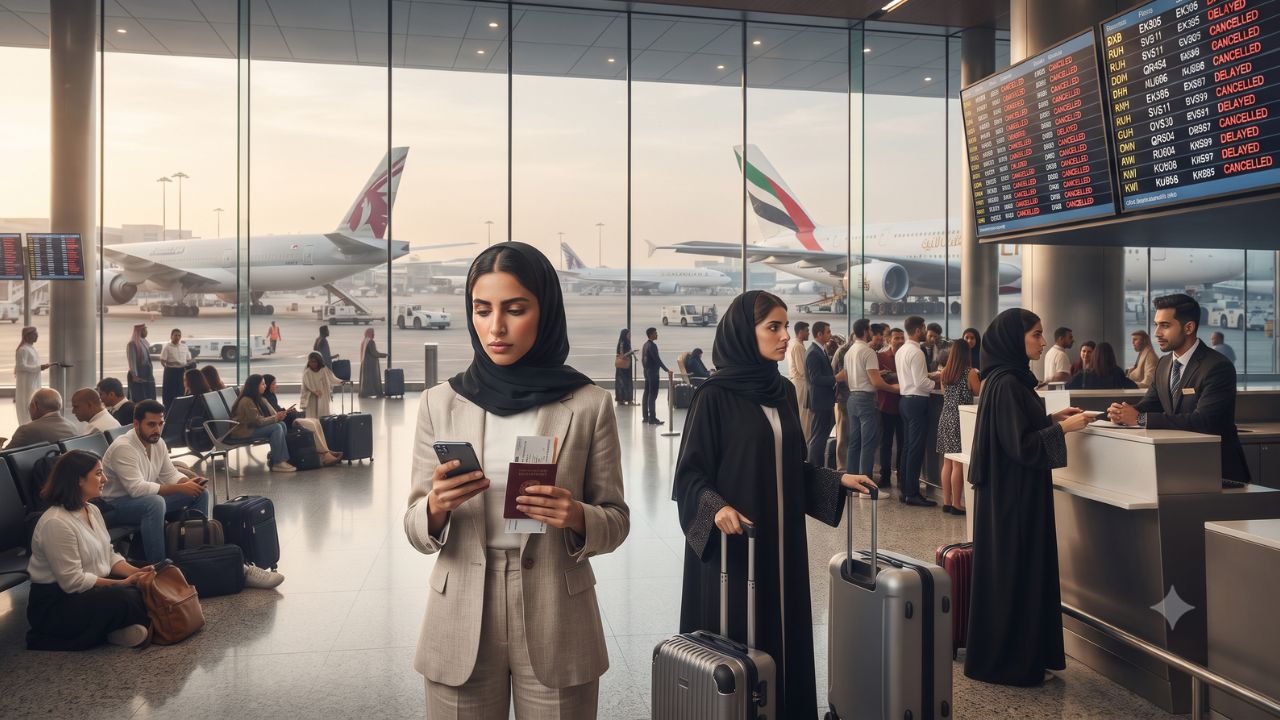
A wave of 1,150 flight cancellations and 1,280 delays rippled across the Persian Gulf, Levant, and neighboring aviation corridors on 13 October 2026, as Saudi Arabian airports logged over 390 grounded flights and major super-connectors in Dubai, Doha, and Istanbul buckled under severe airspace rerouting. Verified by real-time tracking data from FlightAware recorded at 6:02 pm (14 October at 2:02 am GST), the operational gridlock reveals a compounding systemic failure across the Middle East. With Saudi airspace constrained by emergency security directives, international flight paths linking Europe, Africa, and Asia have compressed into narrow sovereign funnels, creating cascading delays across the world’s most critical long-haul transit hubs.
The crisis has severely degraded flight connectivity across the Gulf Cooperation Council (GCC). As flight paths skirt restricted zones, aircraft are burning excess fuel, exhausting legally mandated crew duty cycles, and missing scheduled departure windows. For international travelers transiting through Dubai International (DXB) or Doha’s Hamad International (DOH), the disruption has converted routine three-hour layovers into protracted terminal stranding, demonstrating the extreme vulnerability of global hub-and-spoke networks when regional airspace is suddenly compromised.
The Epicenter in Saudi Arabia: Jeddah, Dammam, and Regional Airfield Paralysis
The geographic core of the shutdown remains firmly rooted within the Kingdom of Saudi Arabia, where flight groundings have crippled both trunk commercial operations and domestic provincial connections. At Jeddah’s King Abdulaziz International Airport (JED)—the primary arrival terminal for religious pilgrims and international transfers—authorities registered 172 cancellations alongside 235 delays, overwhelming gate allocations and baggage handling infrastructure.
Along the eastern oil corridor, King Fahd International Airport (DMM) in Dammam reported 83 cancellations and 55 delays. In the western province, Prince Mohammad Bin Abdulaziz International Airport (MED) in Madinah logged 31 cancellations and 38 delays.
The operational paralysis extended deep into the Kingdom’s regional airfield network:
- Abha International (AHB): 29 cancellations and 13 delays.
- Prince Sultan Bin Abdulaziz Regional (Tabuk): 17 cancellations and 11 delays.
- Taif International (TIF): 14 cancellations and three delays.
- Hail (HAS) & Al Jouf (AJF): 12 cancellations each, with three and two delays respectively.
- Bisha (BHH): Seven cancellations and two delays.
- Guriat (URY): Six cancellations and one delay.
- King Abdullah Bin Abdulaziz Regional (Jizan): Six cancellations and zero delays.
- Al Qaisumah International (AQI): Five cancellations and zero delays.
At the airline level, Saudi flag carrier Saudia bore the brunt of the shutdown, grounding 266 flights—representing 49% of its entire scheduled operation—while recording 108 delays (20%). Low-cost giant Flynas cancelled 116 flights (44%) and delayed 43 (16%), while budget peer flyadeal cancelled 65 flights (35%) and logged 24 delays (13%). Commercial startup Riyadh Air recorded 24 cancellations, representing a 72% grounding rate of its operating proving flights, with zero delays.
Gulf Super-Connectors and Peripheral Airfield Contagion
The operational friction in Saudi airspace radiated instantly into neighboring aviation gateways. In the United Arab Emirates, Dubai International Airport (DXB) reported 198 delays and 66 cancellations, as widebody aircraft held on taxiways awaiting clearance into alternative northern and southern corridors. Zayed International Airport (AUH) in Abu Dhabi posted 119 delays and 10 cancellations, while Sharjah International Airport (SHJ) recorded 78 delays and 10 cancellations.
Across the Persian Gulf, Qatar’s Hamad International Airport (DOH) registered 119 delays and 32 cancellations, while Bahrain International Airport (BAH) logged 27 delays and 10 cancellations.
The perimeter of disruption stretched well beyond the Arabian Peninsula:
- Cairo International Airport (CAI): 137 delays and 43 cancellations as North African feeder traffic severed connections with the Gulf.
- Istanbul Airport (IST), Türkiye: 204 delays and 22 cancellations, functioning as a bottleneck for flights avoiding Middle Eastern airspace.
- Amman Queen Alia International (AMM): 25 delays and 16 cancellations.
- Damascus International (DAM): Eight delays and nine cancellations.
Flag carriers across the region struggled to preserve schedule integrity under mandatory airway diversions. Qatar Airways recorded 26 cancellations (4%) and 108 delays (17%). In the UAE, Emirates logged five cancellations (0% rounded) alongside 103 delays (20%), while Etihad Airways registered eight cancellations (2%) and 98 delays (28%). Regional low-cost operator flydubai recorded 26 cancellations (8%) and 75 delays (25%), while Air Arabia posted 10 cancellations (4%) and 68 delays (29%).
Secondary regional airlines absorbed acute operational shocks: EgyptAir logged 15 cancellations (5%) and 32 delays (11%); Royal Jordanian posted 10 cancellations (6%) and seven delays (4%); Gulf Air recorded eight cancellations (5%) and 19 delays (13%); and Oman Air registered four cancellations (4%) and nine delays (9%). Highly localized operators were devastated: Syrian Arab Airlines cancelled five flights (33%) with two delays (13%); Yemenia Airways cancelled four flights (26%) with three delays (20%); and Iraq’s Fly Baghdad suffered a 100% cancellation rate, grounding both of its scheduled flights (two cancellations). Across Türkiye, Turkish Airlines logged seven cancellations (0% rounded) and 183 delays (12%), while budget carrier Pegasus Airlines posted one cancellation (0%) and 120 delays (17%).
Middle East Aviation Disruption Audit: Hub and Carrier Data Matrix
To evaluate the operational landscape confronting travelers, the tables below delineate the verified distribution of cancellations and delays across major airfields and regional airlines.
| Hub Airport & Code | Flight Cancellations | Flight Delays Logged | Dominant Operational Failure Mode |
|---|---|---|---|
| Jeddah (JED), Saudi Arabia | 172 cancellations | 235 delays | Severe pilgrim transit backlog; ramp holding limits |
| Dammam (DMM), Saudi Arabia | 83 cancellations | 55 delays | Regional Gulf shuttle groundings; schedule collapse |
| Dubai International (DXB), UAE | 66 cancellations | 198 delays | Flow management rerouting; long-haul transfer friction |
| Cairo International (CAI), Egypt | 43 cancellations | 137 delays | Red Sea corridor avoidance; regional feeder delays |
| Hamad International (DOH), Qatar | 32 cancellations | 119 delays | Airspace funnel congestion; arrival bank delays |
| Madinah (MED), Saudi Arabia | 31 cancellations | 38 delays | Airway congestion; schedule compression |
| Istanbul (IST), Türkiye | 22 cancellations | 204 delays | Eurasian transit bottleneck; airspace avoidance detours |
| Amman (AMM), Jordan | 16 cancellations | 25 delays | Regional Levant border holding; corridor closures |
| Abu Dhabi (AUH), UAE | 10 cancellations | 119 delays | Long-haul scheduling adjustments and holding patterns |
| Sharjah (SHJ), UAE | 10 cancellations | 78 delays | Low-cost network schedule pruning |
The airline operational audit establishes severe schedule dilution across GCC carriers:
| Operating Airline | Cancellations (Rate %) | Delays (Rate %) | Network & Fleet Impact |
|---|---|---|---|
| Saudia | 266 (49%) | 108 (20%) | Domestic network paralyzed; international widebody staging halts |
| Flynas | 116 (44%) | 43 (16%) | Low-cost domestic point-to-point trunk routes severed |
| flyadeal | 65 (35%) | 24 (13%) | Secondary city connectivity collapses across Saudi provinces |
| Riyadh Air | 24 (72%) | 0 (0%) | Proving and introductory network flight sectors cancelled |
| flydubai | 26 (8%) | 75 (25%) | Narrowbody cross-border Gulf operations disrupted |
| Qatar Airways | 26 (4%) | 108 (17%) | Rerouting around Saudi airspace causes flight time extensions |
| EgyptAir | 15 (5%) | 32 (11%) | Cairo–Gulf trunk routes scrubbed or delayed |
| Air Arabia | 10 (4%) | 68 (29%) | High-density regional low-cost rotations compromised |
| Royal Jordanian | 10 (6%) | 7 (4%) | Regional cross-border Levant schedules reduced |
| Etihad Airways | 8 (2%) | 98 (28%) | Arrival bank desynchronization at Abu Dhabi hub |
| Gulf Air | 8 (5%) | 19 (13%) | Bahrain regional shuttle connections dropped |
| Turkish Airlines | 7 (0% rounded) | 183 (12%) | Major delay backlog on Southeast Asian and African sectors |
| Emirates | 5 (0% rounded) | 103 (20%) | Flight times extended; interline connections held |
| Syrian Arab Airlines | 5 (33%) | 2 (13%) | Severe regional flight cancellation rate |
| Oman Air | 4 (4%) | 9 (9%) | Minor regional schedule adjustments via Muscat |
| Yemenia Airways | 4 (26%) | 3 (20%) | Critical humanitarian and regional connectivity severed |
| Fly Baghdad | 2 (100%) | 0 (0%) | Complete suspension of scheduled operations |
| Pegasus Airlines | 1 (0% rounded) | 120 (17%) | Turkish point-to-point European-Middle East delays |
Expert Analysis: Airspace Congestion Cascades, Chokepoint Physics, and the Trans-Eurasian Transit Crunch
The current Middle Eastern crisis illustrates the unforgiving physics of modern commercial airspace. When a sovereign airspace block the size of Saudi Arabia restricts commercial traffic, the surrounding flight corridors do not expand to compensate. Aircraft must funnel into narrow, highly constrained navigational gates over the Persian Gulf, Iran, and the Red Sea corridor.
For travelers booking this route, the direct consequence is severe misconnection rates across transfer hubs in Dubai, Doha, and Abu Dhabi. A standard 90-minute layover in Doha or Dubai was engineered under the assumption of unhindered great-circle routing. Adding 45 to 90 minutes of evasive flying time to circumnavigate restricted airspace means that aircraft arrive at the gate after their onward connecting flights have departed. Because subsequent flights are already operating at peak seasonal load factors, missed connections cannot be resolved via next-flight protection, forcing travelers into multi-day hotel stays.
The pricing pressure this creates means that short-notice travel through the Middle East will command prohibitive emergency fares. As Saudia, Flynas, and regional carriers cancel over 1,150 flights, remaining open inventory on operating international flights is instantly claimed by automated yield management systems. Seats on unhindered carriers operating alternate routes—such as via Central Asia or the Mediterranean—are being re-priced into full-fare economy and premium categories.
Furthermore, consumer protection frameworks offer minimal financial relief. Under Saudi General Authority of Civil Aviation (GACA) rules, cancellations resulting from sovereign security emergencies or military airspace closures fall under statutory force majeure exemptions, shielding airlines from mandatory monetary compensation. While carriers remain obligated to provide basic duty-of-care provisions—including meals, drinks, and hotel accommodation where available—the systemic shortage of airport hotel rooms in Jeddah and Dammam leaves thousands of passengers absorbing unexpected out-of-pocket expenses.
Key Takeaways
- Massive Regional Disruption: On 13 October 2026, 1,150 flight cancellations and 1,280 delays paralyzed Middle Eastern aviation, centered on severe airspace restrictions in Saudi Arabia.
- Severe Saudi Airfield Impacts: Jeddah’s King Abdulaziz Airport recorded 172 cancellations and 235 delays, while Dammam logged 83 cancellations and 55 delays.
- Domestic Carrier Groundings: Saudia grounded 49% of its flights (266 cancellations), Flynas cancelled 44% (116 flights), and Riyadh Air cancelled 72% (24 flights).
- Super-Connector Delay Shock: Dubai International absorbed 198 delays and 66 cancellations, while Hamad International in Doha logged 119 delays and 32 cancellations.
- Force Majeure Legal Limits: Because disruptions stem from regional security directives, airlines are legally exempt from statutory cash compensation under GACA and regional consumer rules.
FAQ: Gulf Airspace Flight Disruptions October 2026
What caused the massive flight cancellations across the Gulf on 13 October 2026?
Cancellations and delays were triggered by regional security concerns and military airspace closures across Saudi Arabia, forcing civil aviation authorities to restrict commercial operations and divert international flight paths.
Are passengers entitled to cash compensation for canceled Gulf flights?
No. Under Saudi GACA regulations and international aviation conventions, disruptions caused by military action or airspace closures are classified as force majeure, exempting airlines from paying statutory cash compensation.
How are flight delays in Dubai and Doha connected to Saudi airspace restrictions?
Dubai and Doha rely on neighboring airspace corridors for long-haul routes. Circumnavigating closed Saudi airspace forces flights into narrow alternate corridors, adding flight time, burning extra fuel, and causing missed transfer connections.
What should travelers transiting through Jeddah or Dammam do immediately?
Passengers should verify their flight status directly through airline mobile applications before departing for the airport, confirm all connecting flight segments, and retain all receipts for meals and accommodation if stranded.
When regional skies close, the seamless architecture of global aviation dissolves into a stark reminder that geography always commands the flight path.
Related Travel Guides
- Over 1,590 Flight Cancellations and 4,424 Delays Paralyze Asian and Middle Eastern Aviation Corridors
- Breeze Airways Connects Fort Lauderdale to Burlington, Charleston, and Stewart in May 2027 Expansion
- United Airlines Eliminates Flight Segment Path for 2027 MileagePlus Status, Raising 1K Spend to 32,000 PQP
Disclaimer
This article is for informational and educational purposes only. It does not constitute legal, financial, or professional advice. While we strive to provide accurate and up-to-date information, travel policies, regulations, and conditions change rapidly. Always verify information with official sources before making travel decisions. Nomad Lawyer makes no representations about the accuracy, reliability, completeness, or suitability of the information provided. Readers should consult qualified professionals for advice specific to their circumstances. The views expressed in this article are those of the author and do not necessarily reflect the views of Nomad Lawyer.
Naina Thakur
Contributor & Travel Specialist
Travel enthusiast and legal writer covering visa regulations, responsible tourism, and cultural journeys across global destinations.
Learn more about our team →