
Over 1,590 Flight Cancellations and 4,424 Delays Paralyze Asian and Middle Eastern Aviation Corridors
A dual crisis of Saudi airport closures and Southeast Asian weather delays grounds 1,590 flights and delays 4,424 across Riyadh, Mumbai, Guangzhou, and Jakarta.

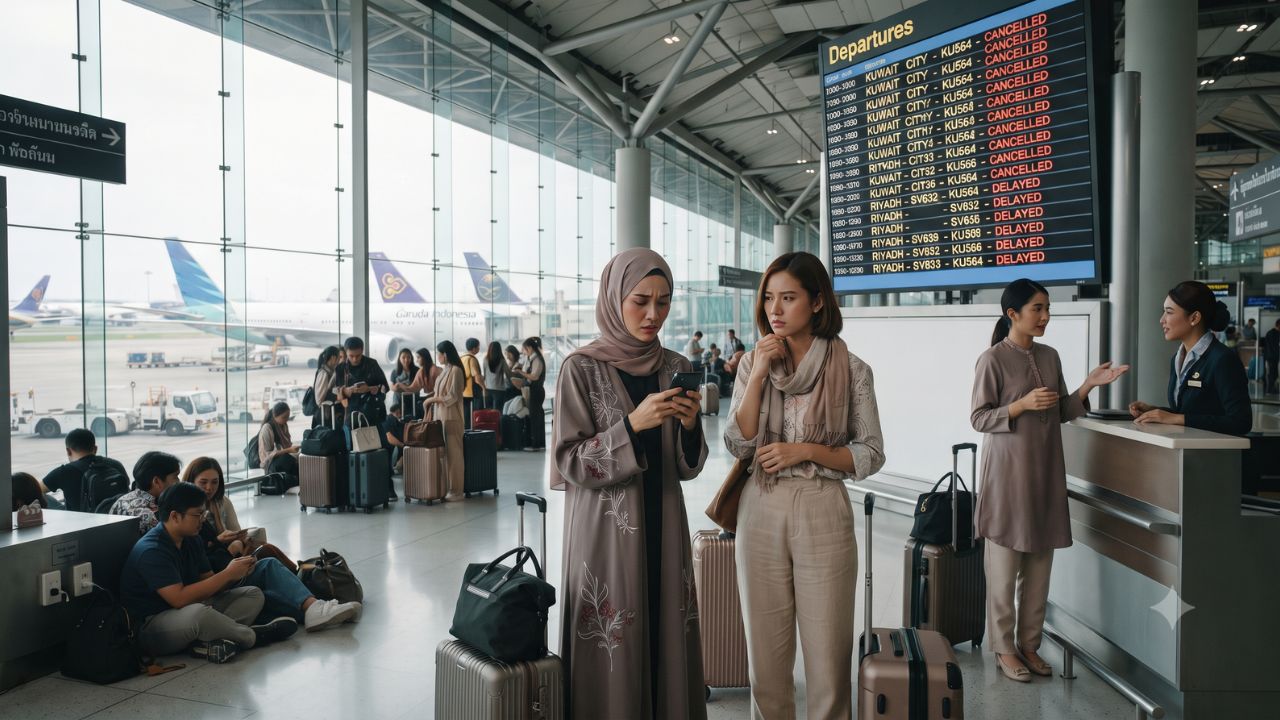
A total of 1,590 flight cancellations and 4,424 delays paralyzed air transport networks across Asia and the Middle East on 13 October 2026, led by a 50% operational wipeout at Saudia and 532 scrubbed flights at Riyadh’s King Khalid International Airport alone. Verified through real-time telemetry from FlightAware recorded at 2:40 pm ET (10:40 pm GST), the regional gridlock illustrates an acute operational divergence across the eastern hemisphere: while the Arabian Peninsula suffered an unprecedented structural shutdown triggered by armed perimeter strikes and airspace closures, East, South, and Southeast Asian hubs were inundated by severe delay cascades driven by monsoon storms, Indonesian wildfire haze, and terminal slot congestion.
The compound disruption has severed transit corridors linking Europe with the Asia-Pacific basin. While Western carriers have rerouted long-haul flights around sovereign Gulf exclusion zones, regional passengers across India, China, Vietnam, Thailand, and Indonesia are absorbing widespread schedule breakdowns. When mega-hubs experience simultaneous shock events, the commercial aviation system loses its capacity to absorb aircraft rotation delays, converting localized airport holds into a multi-day international displacement crisis.
Gulf Airspace Shockwave: Saudi Airport Shutdowns and Carrier Paralyzation
The primary epicenter of cancellations remains concentrated in Saudi Arabia, where civil aviation regulators enacted emergency flight freezes following hostiles strikes on King Khalid International Airport (RUH) in Riyadh. The capital gateway emerged as the single most disrupted aviation facility in the world on 13 October, reporting 532 flight cancellations against just one recorded delay—reflecting a total operational freeze rather than routine air traffic spacing.
The shutdown instantly overwhelmed secondary Saudi airports handling diverted and stranded passenger traffic:
- Jeddah (King Abdulaziz International Airport - JED): Recorded 168 cancellations and 173 delays, paralyzing Umrah pilgrim transit flows.
- Dammam (King Fahd International Airport - DMM): Reported 79 cancellations and 42 delays along the eastern Gulf corridor.
- Madinah (Prince Mohammad bin Abdulaziz International Airport - MED): Registered 31 cancellations and 26 delays.
- Regional Airfields: Abha logged 29 cancellations and 13 delays; Taif posted 14 cancellations and three delays; Hail recorded 12 cancellations and three delays.
The carrier-level toll within the Kingdom reached unprecedented levels. National flag carrier Saudia grounded 265 flights—representing exactly 50% of its total scheduled operation—while logging 101 delays (19%). Low-cost operator Flynas cancelled 115 flights, or 43% of its schedule, alongside 33 delays (12%), while budget subsidiary flyadeal scrubbed 65 flights (36%) and delayed 18 (10%). Startup carrier Riyadh Air suffered a 71% schedule cancellation rate, grounding 23 departures with zero delays recorded.
Pan-Asian Schedule Fractures: Monsoon Weather, Wildfire Smoke, and Congestion Cascades
While cancellations dominated the Middle East, widespread delay cascades crippled high-volume commercial gateways across China, India, and Southeast Asia. Severe monsoon squalls in the Philippines and Thailand converged with reduced atmospheric visibility in Indonesia, where seasonal agricultural wildfire smoke blanketed major western departure corridors.
In China, industrial mega-hubs struggled under strict airspace flow control:
- Guangzhou Baiyun (CAN): 207 delays and six cancellations.
- Shanghai Pudong (PVG): 198 delays and seven cancellations.
- Shanghai Hongqiao (SHA): 145 delays and three cancellations.
- Shenzhen Bao'an (SZX): 121 delays and 11 cancellations.
- Beijing Capital (PEK): 111 delays and 22 cancellations.
- Hohhot Baita (HET): 13 delays and 12 cancellations.
In India, Chhatrapati Shivaji Maharaj International Airport (BOM) in Mumbai logged 209 delays and 31 cancellations, aggravated by airspace detours around the Middle East and heavy domestic ground congestion. Kempegowda International Airport (BLR) in Bengaluru recorded 69 delays and 12 cancellations, while Hyderabad’s Rajiv Gandhi International Airport (HYD) logged 56 delays and 13 cancellations. Regional gateways saw proportional friction, with Ahmedabad recording 27 delays and seven cancellations, and Navi Mumbai posting 21 delays and 10 cancellations.
Southeast Asian gateways absorbed severe schedule friction. Bangkok’s Suvarnabhumi Airport (BKK) recorded 214 delays against two cancellations. In Vietnam, Ho Chi Minh City’s Tan Son Nhat (SGN) logged 233 delays and 10 cancellations, Hanoi’s Noi Bai (HAN) posted 122 delays and seven cancellations, and Da Nang registered 62 delays and 12 cancellations. In Indonesia, wildfire smoke at Jakarta’s Soekarno-Hatta (CGK) drove 233 delays and 39 cancellations, while Bali’s Ngurah Rai (DPS) logged 84 delays and five cancellations, and Sultan Hasanuddin in Makassar registered 88 delays and nine cancellations.
Airfield Disruption Audit: Hub Groundings, Delays, and Operating Rates
To demonstrate the structural divergence between cancellation-heavy Middle Eastern war zones and delay-heavy Asian transit hubs, the table below consolidates official telemetry for affected airports and operating carriers.
| Aviation Node / Airport | Flight Cancellations | Flight Delays Recorded | Operational Failure Characteristic |
|---|---|---|---|
| Riyadh (RUH), Saudi Arabia | 532 cancelled | 1 delayed | Complete airfield paralysis; military security exclusion |
| Jeddah (JED), Saudi Arabia | 168 cancelled | 173 delayed | Massive pilgrim transit backlog; widebody staging freeze |
| Jakarta (CGK), Indonesia | 39 cancelled | 233 delayed | Severe wildfire smoke visibility reduction and runway holds |
| Ho Chi Minh City (SGN), Vietnam | 10 cancelled | 233 delayed | Tropical storm convective cells and apron saturation |
| Bangkok (BKK), Thailand | 2 cancelled | 214 delayed | Regional feeder delay accumulation and slot compression |
| Mumbai (BOM), India | 31 cancelled | 209 delayed | Middle East corridor rerouting and runway maintenance |
| Guangzhou (CAN), China | 6 cancelled | 207 delayed | Military airway restrictions and domestic flow management |
| Shanghai Pudong (PVG), China | 7 cancelled | 198 delayed | Transpacific departures held for air traffic slots |
| Dammam (DMM), Saudi Arabia | 79 cancelled | 42 delayed | Regional Gulf feeder grounding and schedule abandonment |
| Beijing Capital (PEK), China | 22 cancelled | 111 delayed | Northern hub rotation deficits and schedule pruning |
The carrier breakdown reveals acute exposure among regional flag operators:
| Airline Operator | Cancellations (Rate %) | Delays (Rate %) | Strategic Operational Impact |
|---|---|---|---|
| Saudia | 265 (50%) | 101 (19%) | Half of national fleet grounded; regional hub isolation |
| Flynas | 115 (43%) | 33 (12%) | Domestic point-to-point network severely severed |
| flyadeal | 65 (36%) | 18 (10%) | Budget domestic schedules collapsed across key trunk routes |
| Riyadh Air | 23 (71%) | 0 (0%) | Near-total suspension of commercial proving sectors |
| IndiGo (India) | 39 (1%) | 370 (17%) | Massive domestic delay cascade across Airbus A320 fleet |
| China Eastern | 32 (1%) | 282 (12%) | High-volume eastern China trunk delays |
| Air China | 53 (3%) | 94 (5%) | Capital network cancellations and transcontinental holds |
| Shenzhen Airlines | 37 (5%) | 84 (11%) | Southern China business commuter delays |
| Akasa Air (India) | 27 (11%) | 26 (10%) | Regional capacity hit on western Indian routes |
| Vietnam Airlines | 17 (4%) | 80 (21%) | Indochina regional schedule compression |
| Batik Air (Indonesia) | 24 (8%) | 78 (26%) | Wildfire smoke diversions across Indonesian archipelago |
| Qatar Airways | 25 (4%) | 80 (12%) | Airspace bottlenecks around closed Saudi flight corridors |
| flydubai | 22 (7%) | 51 (18%) | Gulf cross-border feeder cancellations |
| Emirates | 4 (0% rounded) | 69 (13%) | Widebody schedule absorption with minor delay padding |
| Turkish Airlines | 5 (0% rounded) | 121 (8%) | European-Asian transit holdovers at Istanbul Airport |
Expert Analysis: Air Corridor Fragility, Asymmetrical Disruptions, and Passenger Rights Arbitrage
The 13 October crisis exposes the vulnerability of hub-and-spoke international transit. Airlines do not operate in geographical vacuums. When Saudia loses 50% of its operating schedule and Riyadh cancels 532 flights, the aircraft that fail to depart are the exact widebodies scheduled to pick up passengers in Manila, Dhaka, London, and Mumbai.
For travelers booking this route, the direct consequence is severe misconnection risks and unrecoverable itinerary abandonments. An Indian or Southeast Asian migrant worker or tourist holding a connecting ticket via Riyadh or Jeddah faces stranding in intermediate hubs without hotel accommodations or immediate rebooking alternatives. Because Gulf airspace diversions add up to two hours of flight time to avoid restricted conflict zones, arrival banks in Doha, Dubai, and Mumbai are missing downstream connection windows, forcing airlines to hold planes or offload connecting luggage.
The pricing pressure this creates means that replacement one-way airfares on operating third-country carriers will spike exponentially. When 1,590 flights vanish from regional supply within 24 hours, remaining seat capacity on resilient carriers like Emirates, Turkish Airlines, or Singapore Airlines is instantly repriced by automated revenue management algorithms into highest-tier fare buckets. Travelers stranded by cancellations who attempt to purchase walk-up emergency tickets will face fares four to five times standard advance-purchase levels.
Furthermore, passengers face a fragmented legal patchwork of consumer protection. Under Saudi General Authority of Civil Aviation (GACA) regulations, cancellations driven by force majeure or military action exempt carriers from statutory cash compensation, leaving travelers entitled only to ticket refunds or delayed rebooking. In contrast, passengers delayed in India under Directorate General of Civil Aviation (DGCA India) mandates or traveling on European-regulated legs face vastly different standards for airline-funded meals and overnight hotel vouchers. Navigating these regulatory boundaries requires travelers to retain electronic records, boarding stubs, and written airline delay notices.
Key Takeaways
- Unprecedented Disruption Scale: On 13 October 2026, 1,590 flight cancellations and 4,424 delays battered Asian and Middle Eastern aviation corridors, led by a structural shutdown in Saudi Arabia.
- Saudi Airfield Freezes: Riyadh’s King Khalid International logged 532 cancellations and one delay, while Jeddah recorded 168 cancellations and 173 delays.
- Carrier Capacity Losses: Saudia suffered a 50% cancellation rate (265 flights), Flynas cancelled 43% (115 flights), and Riyadh Air cancelled 71% (23 flights).
- Widespread Asian Delays: Weather and airspace congestion triggered 370 delays at IndiGo, 282 at China Eastern, 233 in Jakarta due to wildfire smoke, and 209 in Mumbai.
- Severe Ancillary Pricing Surges: The sudden loss of regional seat capacity has driven emergency rebooking airfares to peak pricing tiers across unaffected transit hubs.
FAQ: Asia and Middle East Flight Disruptions October 2026
What caused the massive flight cancellations across Saudi Arabia on 13 October 2026?
Widespread cancellations resulted from security incidents and airfield damage at Riyadh’s King Khalid International Airport, leading Saudi authorities to implement safety closures and airspace restrictions across the Kingdom.
Why are airports in China, India, and Southeast Asia experiencing severe delays?
Delays in Asia stem from a combination of tropical storms in Thailand and Vietnam, agricultural wildfire smoke impairing visibility in Jakarta, and airspace congestion caused by rerouting around Middle Eastern conflict zones.
Are passengers entitled to cash compensation for cancellations in Riyadh or Jeddah?
Under Saudi GACA rules, cancellations classified as security emergencies or force majeure exempt airlines from paying statutory cash compensation, though carriers remain legally obligated to offer ticket refunds or alternative rebooking.
How does wildfire smoke in Indonesia affect flights across Southeast Asia?
Thick wildfire haze in Jakarta and surrounding islands reduces runway visibility below minimum safety thresholds, triggering ground hold programs, extended approach spacing, and cascading departure delays across regional airline networks.
When sovereign skies close and storms gather, the aviation network reveals its true nature: a fragile chain where a single severed link strands thousands across continents.
Related Travel Guides
- Ryanair, easyJet, and Jet2 Unleash Summer 2027 Expansions as Regional Airports Capture Point-to-Point Growth
- Air New Zealand Hits 87.3% Punctuality to Rank Third in Asia-Pacific Following Boarding Process Overhaul
- Finnair AirLounge Business Class Redefines Long-Haul Comfort with Motorless Shells and Nordic Design
Disclaimer
This article is for informational and educational purposes only. It does not constitute legal, financial, or professional advice. While we strive to provide accurate and up-to-date information, travel policies, regulations, and conditions change rapidly. Always verify information with official sources before making travel decisions. Nomad Lawyer makes no representations about the accuracy, reliability, completeness, or suitability of the information provided. Readers should consult qualified professionals for advice specific to their circumstances. The views expressed in this article are those of the author and do not necessarily reflect the views of Nomad Lawyer.
Naina Thakur
Contributor & Travel Specialist
Travel enthusiast and legal writer covering visa regulations, responsible tourism, and cultural journeys across global destinations.
Learn more about our team →