
Guatemala Accelerates Mundo Maya Airport Recertification: Flores Gateway Expands National Aviation Resilience

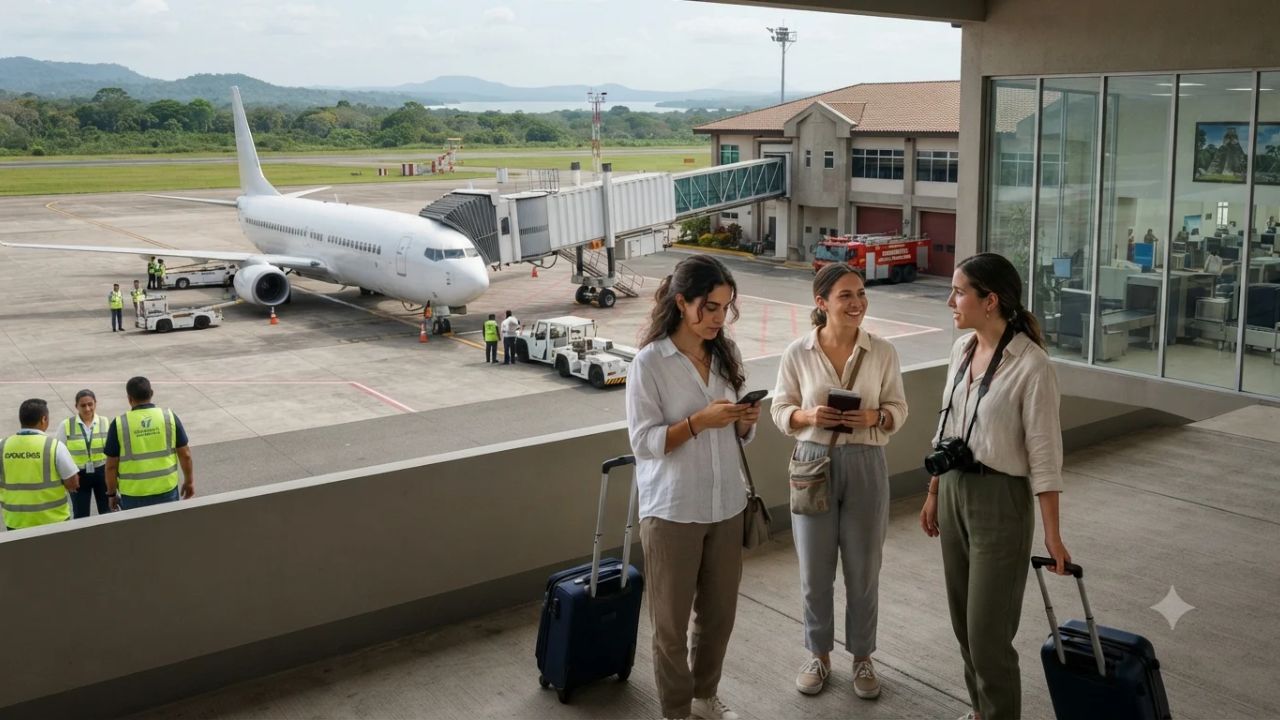
Image generated by AI
A 37 percent surge in passenger throughput between 2023 and 2025 against a mere 1 percent increase in aircraft movements has triggered an intensive 40-action recertification programme at Mundo Maya International Airport (FRS) in Flores, Petén. Spearheaded by the Dirección General de Aeronáutica Civil (DGAC) and the Ministry of Communications, Infrastructure and Housing (CIV), the comprehensive operational overhaul is upgrading runway infrastructure, advanced air navigation systems, emergency response protocols, and security screening architectures. Beyond serving as the primary tourist gateway to the ancient Mayan citadels of Tikal and Yaxhá, completion of the recertification is intended to elevate the airfield into a fully certified alternate diversion hub for La Aurora International Airport (GUA) in Guatemala City.
The technical pivot addresses an urgent operational bottleneck within Central American air transport. While regional tourism marketing continues to celebrate expanding flight connections into Petén, airport ground systems have been absorbing intense passenger density. As scheduled commercial carriers transition from smaller turboprops to high-capacity narrowbody aircraft, terminal processing facilities, waiting areas, and baggage systems have experienced peak-period strain. By aligning physical infrastructure and emergency readiness with international standards overseen by the International Civil Aviation Organization (ICAO), civil aviation authorities are establishing the structural foundation required to absorb heavier airliners and support nationwide network resilience.
Deconstructing Passenger Intensity: The Mechanics Behind the Operational Overhaul
The statistical impetus behind the modernization push becomes clear when examining the diverging trajectories of passenger volume and aircraft movements. Official traffic audits recorded passenger flows climbing from 284,365 travelers in 2023 to approximately 390,584 in 2025. Over that identical two-year window, recorded flight operations inched up from 7,471 to 7,563 movements—a marginal uptick of roughly 1 percent.
This data divergence reveals that passenger density per flight operation expanded by 35.7 percent, rising from 38.1 passengers per movement in 2023 to 51.6 in 2025. Rather than experiencing an uncontrolled proliferation of flight operations, Mundo Maya is handling significantly larger passenger loads concentrated within existing runway slots. This density amplifies pressure on terminal waiting rooms, security screening queues, customs facilitation, and ramp ground handling equipment.
| Operational Indicator | Baseline Year (2023) | Benchmark Year (2025) | Operational Change | Strategic Aviation Significance |
|---|---|---|---|---|
| Annual Passenger Throughput | 284,365 passengers | 390,584 passengers | +37.3% Growth | Heavy demand surge driven by cultural tourism and regional business |
| Recorded Flight Operations | 7,471 movements | 7,563 movements | +1.2% Growth | Airfield movement totals remained nearly static across the period |
| Average Passengers Per Movement | 38.1 passengers | 51.6 passengers | +35.7% Increase | Reflects fleet up-gauging and higher seat load factors on trunk routes |
| Runway Dimensions | 3,000 m × 45 m | 3,000 m × 45 m | Verified Baseline | Capable of supporting commercial narrowbody and widebody diversions |
| Terminal Gate Waiting Area | — | 270-passenger capacity | Modernized Facility | Critical choke point during simultaneous commercial departures |
| Air Navigation Architecture | Legacy ground aids | DVOR/DME & ILS Glide Slope | Upgraded 9 Jan 2026 | Inaugurated via COCESNA for precision all-weather approaches |
| Security Screening Technology | Standard inspection | 2 X-ray units + AI detection | Upgraded System | Automated baggage recognition accelerating passenger throughput |
| Emergency Response Readiness | Baseline SEI station | SAR ATS Subcentre established | Implemented Sept 2026 | Integration of INCERFA, ALERFA, and DETRESFA emergency protocols |
Recognizing these operational realities, the government’s 40-point programme is structured across five focal pillars: passenger safety and service experience, institutional and organizational governance, air traffic management modernization, the airport rescue and firefighting service (SEI), and runway physical integrity.
Technical Architecture: Precision Navigation and Airfield Modernization
Mundo Maya’s physical airfield assets already provide an exceptional engineering baseline. Located in Santa Elena, the facility features an asphalt runway measuring 3,000 meters in length and 45 meters in width, flanked by landside vehicle parking for 65 vehicles. However, operating safely in variable tropical weather conditions requires advanced instrumentation.
On 9 January 2026, the Central American Corporation for Air Navigation Services (COCESNA) inaugurated a new Doppler VHF Omnidirectional Range and Distance Measuring Equipment (DVOR/DME) installation at the airfield. Supported by a 50-antenna navigation array and an Instrument Landing System (ILS) equipped with Glide Slope guidance, the facility now provides flight crews with continuous, high-precision distance and azimuth telemetry, enabling stabilized approaches during low-visibility cloud cover and heavy seasonal rainfall.
On the ground, passenger processing has been bolstered with two advanced baggage X-ray screening systems equipped with artificial intelligence software programmed to automatically identify prohibited items. To support emergency preparedness, civil aviation leadership coordinated with the Ministry of Communications, Infrastructure and Housing on 1 September 2026 to integrate the airfield into the regional Search and Rescue (SAR ATS) framework. The plan formalizes progressive alerting stages—INCERFA (uncertainty phase), ALERFA (alert phase), and DETRESFA (distress phase)—supported by an operational SAR ATS Subcentre. This follows intensive safety drills conducted in July 2026, where 70 personnel from the airport authority, immigration, customs, the Instituto Guatemalteco de Turismo (INGUAT), and commercial airlines completed live-fire suppression training and rigorous foreign-object-debris (FOD) runway sweeping protocols.
The Dual-Gateway Strategy: Connecting Flores to La Aurora
The strategic relevance of the Flores airfield is inextricably tied to Guatemala’s national transport architecture. Currently, international long-haul operations into Guatemala remain almost entirely concentrated at La Aurora International Airport in Guatemala City. Nestled in a dense urban basin surrounded by mountainous terrain and active volcanic topography, La Aurora is historically susceptible to weather closures, volcanic ash advisories, and runway maintenance interruptions.
Developing Mundo Maya into a certified, operationally resilient secondary hub provides the national airspace with vital redundancy. While Mundo Maya cannot substitute for La Aurora’s passenger volumes, its 3,000-meter runway can safely accommodate diverted commercial airliners without requiring them to divert across international borders into El Salvador, Honduras, or Mexico.
The commercial link between the two gateways is expanding rapidly. On 29 March 2026, Latin American carrier Avianca increased its scheduled service between Guatemala City and Flores to three daily flights. This high-frequency shuttle provides international passengers landing at La Aurora with synchronized connections to Petén, transforming what was once an arduous multi-day overland journey into a rapid 45-minute domestic hop.
Expert Analysis: Airline Up-Gauging, Slot Allocation, and Regional Yields
From an airline fleet planning perspective, Mundo Maya's transformation illustrates the broader industry shift toward capacity up-gauging in secondary leisure markets. When regional airports experience passenger demand spikes without corresponding runway slot expansion, airlines substitute 50-seat turboprops with 150- to 180-seat Airbus A320 or Boeing 737 aircraft.
For travelers booking this route, the direct consequence is that while seat availability on peak-season flights to Tikal has improved due to three-daily airline schedules, terminal processing times before departure can become constrained if multiple flights board concurrently within the 270-passenger waiting lounge. Tour operators and independent travelers must build realistic departure buffers of at least 90 minutes, even for domestic hops to the capital.
The pricing pressure this creates means airlines operating between Guatemala City and Flores can sustain high yields without slashing base ticket prices. Because passenger volume expanded by 37 percent while flight movements grew by barely 1 percent, carriers have achieved exceptionally high seat load factors. Until additional competing carriers introduce service or the DGAC authorizes direct international scheduled routes from North American hubs, airfares on the Flores trunk route will remain resilient.
Beyond immediate yield considerations, airport certification is an indispensable prerequisite for future international expansion. While tour operators routinely lobby for direct scheduled flights connecting Petén with Miami, Houston, or Cancun, international network planners will not commit multimillion-dollar aircraft assets to uncertified airfields lacking ICAO-compliant rescue firefighting categories and all-weather precision navigation aids. The current 40-action upgrade is removing these regulatory barriers step by step.
Key Takeaways
- Divergent Growth Pattern: Passenger volume at Mundo Maya Airport expanded 37.3 percent between 2023 and 2025 to 390,584 travelers, while flight operations rose only 1.2 percent to 7,563 movements.
- Rising Passenger Density: Average travelers per recorded flight operation increased by 35.7 percent, climbing from 38.1 to 51.6 passengers, placing elevated demands on terminal infrastructure.
- 40-Action Recertification: Guatemala's DGAC and CIV are executing a structural recertification plan across five strategic pillars, targeting safety, navigation, runway integrity, and organizational capacity.
- Precision Navigation Upgrade: COCESNA inaugurated a new DVOR/DME system on 9 January 2026, paired with a 50-antenna array and ILS Glide Slope guidance for all-weather approaches.
- National Hub Redundancy: Recertification aims to establish Mundo Maya as a viable domestic alternate diversion airport to relieve operational disruptions at Guatemala City's La Aurora.
FAQ: Mundo Maya International Airport Recertification 2026
Has Mundo Maya Airport completed its official recertification?
No. The airport is actively advancing through a verified 40-action recertification programme overseen by the DGAC and CIV. Completion remains an active operational objective to meet full international standards.
How many flights operate daily between Guatemala City and Flores?
Avianca operates three daily scheduled flights between Guatemala City (GUA) and Flores (FRS), having expanded frequencies on 29 March 2026 to support business and tourism travel.
Why is Mundo Maya considered an alternate to La Aurora Airport?
With a 3,000-meter runway, upgraded ILS navigation, and enhanced emergency response, Mundo Maya can serve as a domestic diversion hub when volcanic ash or weather disrupts operations at La Aurora.
What terminal facilities are available for travelers at Mundo Maya?
The airport features a 270-passenger departure lounge, 65 vehicle parking spots, AI-assisted dual baggage X-ray scanners, and an on-site INGUAT tourism information office assisting visitors to Tikal and Yaxhá.
[In the logistics of cultural tourism, ancient wonders draw the world to a nation’s doorstep, but modern aviation standards determine whether they arrive in safety and comfort.]
Related Travel Guides
Disclaimer
This article is for informational and educational purposes only. It does not constitute legal, financial, or professional advice. While we strive to provide accurate and up-to-date information, travel policies, regulations, and conditions change rapidly. Always verify information with official sources before making travel decisions. Nomad Lawyer makes no representations about the accuracy, reliability, completeness, or suitability of the information provided. Readers should consult qualified professionals for advice specific to their circumstances. The views expressed in this article are those of the author and do not necessarily reflect the views of Nomad Lawyer.
Kunal K Choudhary
Co-Founder & Contributor
A passionate traveller and tech enthusiast. Kunal contributes to the vision and growth of Nomad Lawyer, bringing fresh perspectives and driving the community forward.
Learn more about our team →