
Singapore Airlines Leads Global Long-Haul Rankings as Passenger Experience Outweighs Punctuality

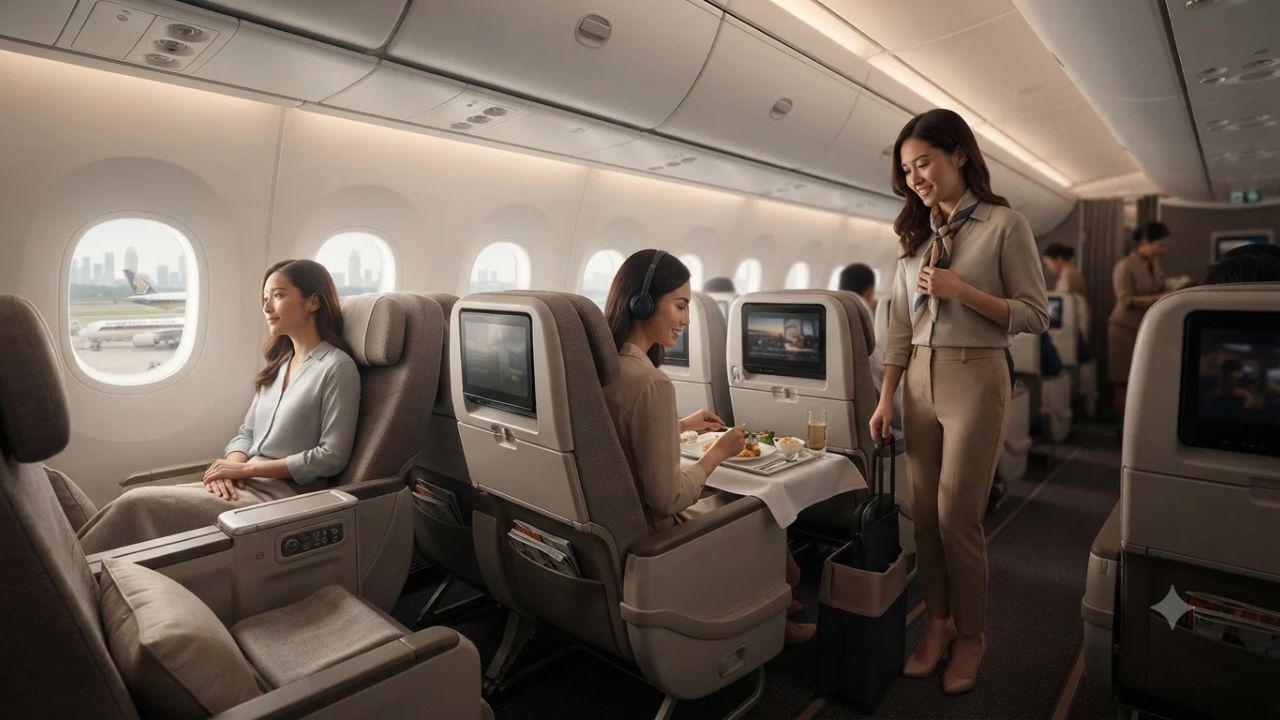
Image generated by AI
On intercontinental flight sectors exceeding 10 hours where passenger willingness to pay premium fares is directly tied to seat ergonomics and service consistency, Singapore Airlines has captured the number one spot in the 2026 Global Long-Haul Travel Experience Ranking. Surpassing Middle Eastern powerhouse Qatar Airways in second place and Hong Kong's Cathay Pacific in third, the comprehensive aviation benchmark underscores an accelerating paradigm shift in international airline economics: travelers no longer select carriers purely based on flight timetables or on-time operational reliability.
Instead, as long-distance journeys subject passengers to extended cabin confinement, consumer decision-making has decoupled from basic schedule convenience. The multi-category assessment reveals that international travelers actively reward airlines that invest in holistic cabin atmospheres, tailored culinary programmes, functional seating geometry, and empathetic service delivery. By outperforming global competitors across seat comfort, food quality, and holistic passenger satisfaction, Singapore Airlines demonstrates that sustained capital expenditure in cabin hard product and crew training generates substantial pricing power in long-haul international corridors.
The Evolution of Long-Haul Benchmarks: Beyond the Tyranny of On-Time Performance
For decades, airline commercial departments and civil aviation authorities treated on-time performance (OTP) as the ultimate benchmark of carrier excellence. While punctual departures and arrivals remain operational necessities, they function merely as baseline hygiene factors on sectors spanning 10 to 18 hours. A flight landing strictly on schedule offers little consolation to a passenger who endured cramped seat pitch, mediocre catering, unresponsive flight attendants, or defective inflight entertainment.
The 2026 evaluation evaluated intercontinental carriers across an integrated matrix of passenger-facing criteria. Long-duration journeys magnify minor discomforts into severe friction points: an unsupportive lumbar cushion, dry cabin airflow, limited hydration options, or rigid meal service windows become acutely noticeable after six hours aloft. Consequently, modern international passengers are factoring total comfort, rest potential, and physical wellbeing into their purchasing calculations.
The ranking highlights the economic reality of value versus absolute price. While ultra-low-cost carriers have revolutionized short-haul regional transport through unbundled, bare-bones pricing, unbundling faces structural limitations on long-haul routes. When faced with extended transit times between Australasia, East Asia, Europe, and North America, leisure and corporate passengers alike demonstrate clear willingness to pay higher base fares for carriers that guarantee consistent, full-service hospitality.
Global Airline Standings: Deconstructing the 2026 Long-Haul Hierarchy
The top ten carriers in the 2026 ranking illustrate how distinct network models and regional hubs compete for long-distance international travelers. While Asian and Gulf carriers dominate the top tiers through meticulous service culture and cutting-edge widebody fleets, Western operators secure competitive placements through operational resilience and network reach.
| Global Rank | Airline Carrier | Primary Operational Hub | Core Category Strengths | Strategic Passenger Distinction |
|---|---|---|---|---|
| 1 | Singapore Airlines | Singapore Changi Airport (SIN) | Seat comfort, culinary quality, overall cabin service | Flawless service execution and ergonomic cabin design |
| 2 | Qatar Airways | Doha Hamad International (DOH) | Qsuite privacy, network consistency, premium lounges | High-frequency connectivity across six continents |
| 3 | Cathay Pacific | Hong Kong International (HKG) | Seating comfort, operational reliability, crew care | Balanced premium comfort and transpacific schedule depth |
| 4 | TUI Airways | UK Regional Gateways | Value-for-money, leisure comfort, holiday service | Competitive long-haul charter and scheduled holiday delivery |
| 5 | Emirates | Dubai International (DXB) | Inflight entertainment (ice), network scale, amenities | Massive widebody capacity with high-engagement media systems |
| 6 | Qantas | Sydney Kingsford Smith (SYD) | Operational endurance, long-range comfort, safety | Pioneer in ultra-long-haul endurance and physical wellbeing |
| 7 | Malaysia Airlines | Kuala Lumpur International (KUL) | Hospitality culture, cabin catering, attentive service | Competitive Malaysian hospitality on long-distance routes |
| 8 | Virgin Atlantic | London Heathrow (LHR) | Cabin design, premium economy, social spaces | Innovative clubhouse atmosphere and lifestyle branding |
| 9 | Delta Air Lines | Atlanta Hartsfield-Jackson (ATL) | Operational consistency, cabin Wi-Fi, punctuality | Strongest US network performer in transcontinental operations |
| 10 | Air France | Paris Charles de Gaulle (CDG) | Gastronomic refinement, cabin aesthetics, French styling | Distinctive dining and polished European long-haul identity |
Qatar Airways secured the runner-up position through exceptional service consistency across its intercontinental transit banks at Hamad International Airport, where modern Boeing 787 and Airbus A350 fleets deliver uniform cabin standards. Cathay Pacific captured third place, reflecting its post-pandemic recovery and heavy investment in passenger comfort across Asian and North American trunks.
Notably, fourth-placed TUI Airways outperformed several full-service legacy carriers by optimizing the long-haul leisure experience, offering dependable comfort tailored to family and holiday traveler budgets. Emirates ranked fifth, powered by its market-leading inflight entertainment architecture and widebody fleet reach, while Australian flag carrier Qantas placed sixth, leveraging its operational expertise in non-stop transcontinental endurance routes.
Expert Analysis: Fleet Economics, Cabin Densification, and Yield Elasticity
From an airline revenue management and fleet strategy perspective, the 2026 rankings expose the commercial trade-off between cabin seat density and passenger yield. Over the past decade, several legacy airlines attempted to extract higher revenues by densifying economy cabins—narrowing seat widths from 18 inches to 17 inches and tightening seat pitch to 30 or 31 inches on long-range Boeing 777 and 787 airframes.
For travelers booking this route, the direct consequence is that choosing an airline based strictly on the cheapest aggregator search result frequently results in acute physical fatigue, degraded sleep quality, and significant productivity loss upon arrival, leading frequent flyers to actively avoid densified budget operators. Passengers have learned through uncomfortable experience that a US$100 saving on a 14-hour flight evaporates when balanced against discomfort and hidden ancillary fees.
The pricing pressure this creates means top-ranked carriers like Singapore Airlines and Qatar Airways can command sustainable fare premiums of 15 to 25 percent above commoditized market competitors. Because their reputation for premium seating geometry, high-end catering, and attentive crew responsiveness is firmly established, these airlines maintain robust forward bookings even during broader macroeconomic belt-tightening.
Airlines trapped in the middle tiers face an existential commercial dilemma. Carriers that dilute onboard service to cut short-term operating costs find themselves unable to compete with premium market leaders for lucrative business and premium economy travelers, while simultaneously lacking the hyper-low cost structures required to underprice low-cost leisure specialists. Long-term profitability in long-haul aviation belongs to operators that either invest uncompromisingly in passenger experience or ruthlessly optimize low-cost point-to-point volume; half-measures produce passenger dissatisfaction and eroding yields.
Key Takeaways
- Singapore Airlines Ranks First: Singapore Airlines topped the 2026 Global Long-Haul Travel Experience Ranking, leading across seat comfort, dining quality, and overall cabin satisfaction.
- Experience Over Punctuality: On flights exceeding 10 hours, travelers prioritize seat ergonomics, catering quality, and service attentiveness over mere on-time arrival statistics.
- Top Tier Dominance: Qatar Airways and Cathay Pacific secured second and third positions, reinforcing the competitive dominance of Asian and Gulf carriers in long-distance travel.
- Leisure Performance: TUI Airways achieved fourth place, proving that targeted leisure carriers can outperform legacy network airlines by delivering balanced long-haul value.
- Pricing Power and Yields: Airlines delivering verified, high-comfort onboard environments successfully command premium ticket pricing, insulating themselves from commoditized fare wars.
FAQ: Global Long-Haul Airline Rankings 2026
Why did Singapore Airlines achieve the top ranking for long-haul travel?
Singapore Airlines secured first place due to superior performance across core passenger metrics, including cabin seat comfort, gourmet dining standards, crew attentiveness, and holistic journey value on flights over 10 hours.
Which airlines rounded out the top five positions in the ranking?
Following Singapore Airlines in first place, Qatar Airways ranked second, Cathay Pacific third, TUI Airways fourth, and Emirates fifth.
Does on-time performance still matter on long-haul flights?
Punctuality remains an operational baseline, but passenger research indicates travelers on 10-plus hour journeys place greater emphasis on seat ergonomics, sleep quality, food standards, and service consistency.
How does cabin comfort influence airline ticket prices?
Airlines offering superior seating space, attentive service, and quality catering command fare premiums of 15 to 25 percent, as international travelers actively pay more to avoid physical fatigue on extended journeys.
[In the unforgiving expanse of intercontinental flight, true airline luxury is not defined by excess, but by the quiet art of making fifteen hours in the sky feel entirely effortless.]
Related Travel Guides
Disclaimer
This article is for informational and educational purposes only. It does not constitute legal, financial, or professional advice. While we strive to provide accurate and up-to-date information, travel policies, regulations, and conditions change rapidly. Always verify information with official sources before making travel decisions. Nomad Lawyer makes no representations about the accuracy, reliability, completeness, or suitability of the information provided. Readers should consult qualified professionals for advice specific to their circumstances. The views expressed in this article are those of the author and do not necessarily reflect the views of Nomad Lawyer.
Raushan Kumar
Founder & Lead Developer
Full-stack developer with 11+ years of experience and a passionate traveller. Raushan built Nomad Lawyer from the ground up with a vision to create the best travel and law experience on the web.
Learn more about our team →