Greece Elevates Patmos Tourism Visibility in France Through UNESCO Heritage, Slow Food, and Luxury Hospitality

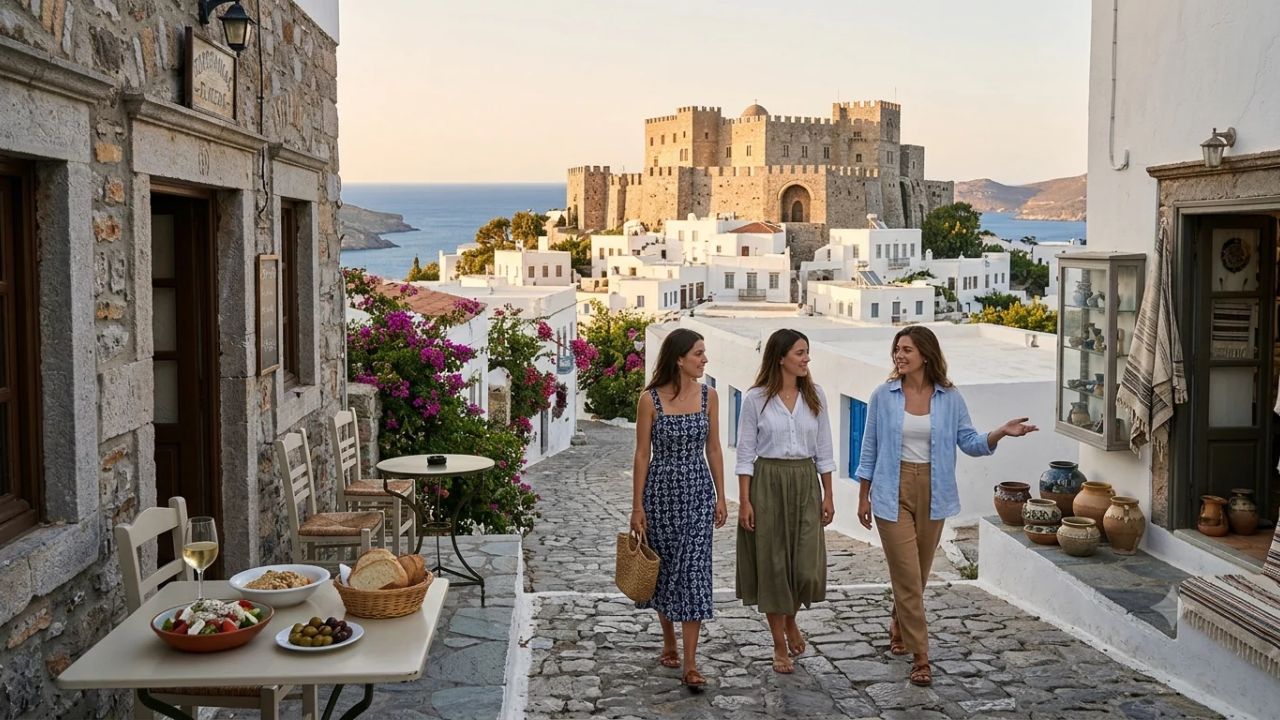
The Greek National Tourism Organisation's targeted promotion in France highlights Patmos as a sanctuary of spiritual heritage, authentic cuisine, and sustainable hospitality.
ATHENS, Oct 31 (Nomad Lawyer) — The Greek National Tourism Organisation (GNTO) has launched an intensive destination marketing initiative across France, positioning the historic Dodecanese island of Patmos as a premier sanctuary for cultural heritage, Slow Food gastronomy, and understated luxury hospitality. Coordinated through the GNTO French Office in collaboration with the prominent French digital publication Food & Sens, the Municipality of Patmos, and Patmos Aktis, the campaign seeks to revitalize outbound French travel to Greece by steering discerning European travelers toward authentic, culturally immersive Aegean experiences.
[!NOTE] Campaign Overview: Formalized in an official ministerial announcement on October 29, 2026, the campaign follows an eight-day press familiarization visit conducted from September 5 to September 12, 2026. The promotional sequence includes four targeted editorial features designed to counter a 5.4% dip in French arrivals to Greece recorded during the first eight months of 2026 by emphasizing high-yield, low-impact cultural and culinary tourism.
GNTO GREECE-FRANCE TARGETED DESTINATION MARKETING FRAMEWORK
| Column 1 |
|---|
| [Institutional Drivers] --------> GNTO French Office & Municipality of Patmos |
| v |
| [Target Demographics] ----------> High-Yield French Cultural & Epicurean Travelers |
| v |
| [Media Execution Partner] ------> Digital Gastronomy Platform: Food & Sens |
| v |
| [Familiarization Mission] ------> 8-Day Field Inspection (September 5-12, 2026) |
| +---------+-----------------------+-------------------------+ |
| v v v |
| [Pillar 1: Heritage] [Pillar 2: Slow Food] [Pillar 3: Luxury] |
| UNESCO World Heritage Skala Market Traditions Patmos Aktis Resort & Spa |
| 1088 St. John Monastery Local Cheeses & Pastries Landscape-Sensitive Design |
| Cave of the Apocalypse Indigenous Aegean Wines Mediterranean Fine Dining |
| v |
| [Strategic Macroeconomic Target] |
| Offset -5.4% French Inbound Volume with +16.2% Expenditure |
| Shift Aegean Travel from Mass Coastal Sun to Year-Round Heritage |
Strategic Imperative: Rebalancing French Outbound Tourism in Greece's 2026 Season
The targeted marketing drive for Patmos unfolds against a multifaceted macroeconomic landscape within the Greek tourism economy. According to provisional financial and operational figures released by the Bank of Greece on October 22, 2026, Greece's national tourism sector achieved extraordinary aggregate records during the primary eight-month window from January through August 2026. Total inbound traveler arrivals across all international gateways reached 28.51 million visitors, marking a robust 10.0% year-on-year expansion. Concurrently, national tourism receipts climbed 9.4% to reach approximately €18.20 billion, confirming Greece's position as one of Southern Europe's dominant holiday economies.
A granular inspection of the source market data, however, exposes notable regional divergences. While arrivals from Germany rose 8.1% to 4.21 million, travelers from Italy surged 22.1% to 1.92 million, and United Kingdom volume advanced 3.9% to 3.40 million, the French market demonstrated contrasting dynamics. Total tourist arrivals originating from France contracted by 5.4% during the January–August period, settling at 1.35 million visitors. In parallel, overall French visitor expenditure across Greece fell 8.1% to €931.9 million.
| Source Market / Economic Metric | January–August 2026 Volume | Annual Change (%) | Total Spending (€) | Spending Trend (%) |
|---|---|---|---|---|
| Total International Inbound | 28.51 million | +10.0% | €18.20 billion | +9.4% |
| Germany | 4.21 million | +8.1% | €2.84 billion | +7.2% |
| United Kingdom | 3.40 million | +3.9% | €2.61 billion | +5.8% |
| Italy | 1.92 million | +22.1% | €1.38 billion | +18.4% |
| France | 1.35 million | -5.4% | €931.9 million | -8.1% |
| France (August Specific) | Peak Summer Window | -6.1% | High-Season Peak | +16.2% |
Despite the contraction in total arrivals over the eight-month aggregate, August 2026 generated a notable financial anomaly: French visitor spending in Greece surged by 16.2% year-on-year, even as French visitor volume declined by 6.1% during the same month. This sharp divergence underscores an essential structural reality of the French outbound market. Affluent French travelers are increasingly opting out of congested, generic mass-market beach packages, choosing instead shorter or more exclusive journeys characterized by premium expenditure per capita.
For the Greek National Tourism Organisation, this data provided a compelling empirical rationale for immediate tactical intervention. Rather than attempting to regain French passenger numbers through discount packaging in overdeveloped island clusters like Mykonos or Santorini, Greek tourism authorities resolved to present specialized destinations that cater directly to the sophisticated cultural and epicurean sensibilities of French travelers. Patmos, with its profound spiritual heritage, strict preservation laws, and world-class culinary roots, emerged as the ideal candidate to spearhead this high-value repositioning.
The GNTO and Food & Sens Collaborative Media Architecture
To execute this repositioning effectively, the GNTO French Office coordinated a specialized media familiarization initiative that linked national tourism planners, municipal authorities, and local private hospitality leaders. Central to the strategy was a partnership with Food & Sens, an influential French digital magazine and media network widely followed by culinary professionals, hospitality executives, and affluent cultural travelers across France, Belgium, and French-speaking Switzerland.
The initiative centered upon an intensive eight-day field inspection conducted across Patmos from September 5 to September 12, 2026. Hosted through the joint logistical support of the Municipality of Patmos and the luxury resort Patmos Aktis, the visiting French journalists and culinary critics conducted an exhaustive survey of the island's historical infrastructure, agricultural cooperatives, artisanal workshops, and culinary establishments.
| Editorial Feature Segment | Official Publication Date | Primary Content Focus | Destination Impact Objective |
|---|---|---|---|
| Feature One: Sacred Topography | September 18, 2026 | UNESCO spiritual history, Byzantine architecture, monastic libraries, and Chora's medieval mansions | Establishes Patmos as an elite intellectual and spiritual alternative to conventional resort islands |
| Feature Two: Epicurean Identity | September 29, 2026 | Skala harbor markets, regional Slow Food practices, indigenous cheeses, wild herbs, and Aegean wines | Connects French gastronomic appreciation directly with indigenous Dodecanese culinary traditions |
| Feature Three: Design Hospitality | October 7, 2026 | Architectural harmony at Patmos Aktis, landscape-sensitive hospitality, and refined Mediterranean dining | Highlights five-star luxury accommodations that complement rather than overpower local island aesthetics |
| Feature Four: Heritage Walking | Forthcoming (Announced Oct 29) | Walking trails, pedestrian alleys of Chora, restored stone windmills, and artisan crafts | Promotes pedestrian exploration, off-season shoulder travel, and community-level economic engagement |
The official briefing published on October 29, 2026, confirmed that the initial three editorial features have generated substantial visibility across French digital media. By structuring the press coverage into four distinct thematic chapters rather than a single promotional summary, the campaign provides French readers with a multifaceted perspective on the island. The editorial sequencing guides potential travelers through the island's layered identity, transitioning smoothly from spiritual monumentality to artisanal dining, refined coastal accommodations, and pedestrian exploration.
UNESCO World Heritage and Spiritual Tourism: The Sacred Topography of Patmos
At the heart of Patmos's enduring global identity is its extraordinary religious and intellectual heritage, which earned the island formal inscription as a UNESCO World Heritage property in 1999. Known historically across the Mediterranean as the "Island of the Apocalypse" or the "Jerusalem of the Aegean," Patmos occupies a revered place in Christian history as the sanctuary where Saint John the Theologian was exiled by Roman imperial authorities around 95 CE, and where he authored both the Book of Revelation (the Apocalypse) and his Gospel.
The UNESCO-designated property encompasses three interlinked components: the Historic Centre (Chora), the fortified Monastery of Saint John the Theologian, and the sacred Cave of the Apocalypse. The Monastery of Saint John, founded in 1088 by the Blessed Christodoulos through an imperial Golden Bull granted by Byzantine Emperor Alexios I Komnenos, dominates the island's skyline from its commanding position atop the central hill of Chora. Resembling a formidable medieval citadel with dark stone ramparts, battlements, and defensive watchtowers, the monastery was engineered specifically to repel Aegean pirate raids and naval invaders.
Beyond its imposing stone architecture, the monastery houses one of the most culturally significant ecclesiastical libraries in the Christian world. Its temperature-controlled archives preserve more than 3,000 printed books, 900 monastic codices, and rare illuminated manuscripts dating back to the sixth century, including thirty-three leaves of the famed Codex Porphyrius of the Gospels. The monastery's museum exhibits an exceptional collection of early Byzantine icons, gold-embroidered liturgical vestments, jeweled chalices, and rare historical firpans issued by Ottoman sultans confirming the monastery's historic autonomy.
PATMOS UNESCO WORLD HERITAGE ARCHITECTURAL COMPLEX
| Column 1 |
|---|
| [CHORA MEDIEVAL SETTLEMENT] |
| Hilltop settlement; labyrinthine stone alleys; whitewashed |
| captain mansions built from 16th to 18th centuries |
| +-------------------+-------------------+ |
| v v |
| [MONASTERY OF SAINT JOHN] [CAVE OF THE APOCALYPSE] |
| Founded 1088 CE by Christodoulos Sacred grotto between Skala & Chora |
| Fortified Byzantine battlements Tri-cleft rock where St. John |
| Treasury of 900 ancient codices received apocalyptic visions (95 CE) |
| Porphyrius Gospel manuscript leaves Integrated Chapel of St. Anne |
| +-------------------+-------------------+ |
| v v |
| [RESTORED STONE WINDMILLS] [CALDERA HERITAGE PATHWAYS] |
| Three landmark stone towers (1588 CE) Ancient stone donkey paths linking |
| Awarded Europa Nostra Prize (2010) Skala harbor to spiritual heights |
Halfway up the steep mountain slope connecting the coastal harbor of Skala to Chora lies the Cave of the Apocalypse. Inside this subterranean sanctuary, visitors encounter the sacred rock cleft where, according to Christian tradition, the voice of God reverberated in a tripartite fracture symbolizing the Holy Trinity while Saint John dictated the apocalyptic vision to his disciple Prochoros. The cave is integrated into a monastic complex comprising the Chapel of Saint Anne and historical theological academies.
Surrounding these monumental structures, the historic town of Chora represents an architectural masterpiece of Aegean vernacular preservation. Developed continuously from the eleventh century onward, Chora's maze of narrow cobbled streets, covered archways (stoas), and blindingly white residences with heavy wooden doors was designed intentionally to confuse raiding corsairs. The grand mansions of wealthy sixteenth- and seventeenth-century shipowners and maritime merchants, characterized by double-stone ashlar masonry, interior courtyards, and ornate reception halls, have been preserved under rigid architectural covenants that prohibit modern concrete constructions or intrusive commercial signage.
Completing the historic cultural landscape are the iconic Windmills of Chora. Dating back to 1588, these three stone cylindrical towers stand proudly on a high ridge overlooking the sea. Following a meticulous restoration project completed in 2010 that returned two of the mills to working flour-producing condition and converted the third into a cultural museum, the complex received the prestigious Europa Nostra Award for cultural heritage conservation. For French visitors, who historically place immense value on intellectual history and architectural authenticity, Patmos offers an evocative journey through living Byzantine and Mediterranean heritage.
Aegean Gastronomy and the Slow Food Philosophy in Skala and Chora
The second major pillar of the GNTO campaign, detailed in the September 29 Food & Sens editorial feature, focuses on the island's authentic gastronomic culture. In recent decades, international tourism in Southern Europe has frequently led to the commodification of local food scenes, with standardized tourist menus replacing ancestral recipes. Patmos, however, has maintained an unbroken culinary lineage rooted in the microclimates, marine riches, and pastoral traditions of the Dodecanese archipelago.
The port settlement of Skala serves as the commercial and culinary crossroads of the island. Here, fishing caïques dock at dawn to deliver daily catches of red mullet, dentex, sea bream, and octopus directly to waterfront family tavernas. The editorial feature highlights how local culinary artisans collaborate with island farmers to preserve indigenous ingredients and traditional cooking techniques aligned with the international Slow Food philosophy.
| Indigenous Product / Culinary Asset | Preparation & Historical Background | Epicurean Tourism Relevance |
|---|---|---|
| Patmian Cheese Pie (Patmiaki Tiropita) | Sweetish puff pastry crust filled with a rich blend of three local cheeses, fresh eggs, and cinnamon | Iconic local breakfast pastry celebrated across Greece for its distinct savory-sweet profile |
| Kalathotos & Mizithra Cheeses | Unpasteurized sheep and goat milk curds pressed in handwoven wicker baskets (kalathia) | Preserves ancestral pastoral techniques; pairs exceptionally with dry Mediterranean white wines |
| Thyme Blossom Honey | Wild honey harvested from arid hillside hives surrounded by dry coastal Mediterranean garrigue | Distinctive aromatic profile with dark amber hue, prized by culinary critics and pastry chefs |
| Poungia Sweet Pastries | Thin fried or baked pastry pockets stuffed with crushed almonds, walnuts, honey, and rosewater | Traditional celebratory confection served at island weddings, patron saint feasts, and festivals |
| Stuffed Squid with Rice & Pine Nuts | Fresh squid braised slowly with indigenous herbs, short-grain rice, pine nuts, and local raisins | Embodies the maritime monastic culinary tradition of utilizing fasting ingredients creatively |
| Indigenous Aegean Wine Cultivars | Cultivation of Assyrtiko, Athiri, and Mandilaria grapes on terraced island soils | Growing viticultural movement emphasizing biodynamic viticulture and high-mineral coastal terroirs |
The gastronomic heritage of Patmos is uniquely informed by centuries of monastic fasting traditions, which required cooks to develop rich, complex vegetable and seafood dishes that complied with Orthodox liturgical calendars. Wild greens (horta) gathered from uncultivated hillsides, sun-dried tomatoes, capers picked from coastal cliffs, and fava bean purees drizzled with cold-pressed extra virgin olive oil form the backbone of everyday dining.
The Food & Sens coverage dedicated extensive attention to the island's artisanal dairy heritage. Local shepherds continue to produce kalathotos, a firm, salty cheese molded inside woven rush baskets that impart a distinctive textured pattern to the rind, as well as creamy, sharp mizithra aged in brine or wine sediment. In traditional bakeries across Chora and Skala, the celebrated Patmiaki Tiropita—a decadent, multi-layered cheese tart made with a cinnamon-scented batter and a mixture of three local cheeses—represents a pinnacle of Aegean pastry craftsmanship.
Viticulture is experiencing a dynamic renaissance on the island as well. Small, dedicated estates are reclaiming ancient stone terraces to cultivate native grape varieties such as Assyrtiko, Athiri, and red Mandilaria. The combination of intense Aegean sunshine, persistent northerly summer winds (meltemia), and mineral-rich volcanic soils yields wines with exceptional natural acidity, saline minerality, and concentrated fruit profiles. By presenting these culinary traditions directly to a French audience renowned for its discerning food culture, the campaign elevates Patmos from a scenic island into an extraordinary epicurean destination.
Architectural Symbiosis and Understated Luxury: The Role of Patmos Aktis
The third editorial feature in the GNTO campaign, published on October 7, 2026, explores how modern luxury hospitality can integrate sensitively into a historically protected island environment. The centerpiece of this analysis is Patmos Aktis, a Luxury Collection Resort & Spa, situated along the tranquil crescent of Grikos Bay on the southeastern coast of the island.
Grikos Bay itself is an area of profound natural beauty, recognized as one of the most picturesque natural bays in the Aegean and framed by the dramatic volcanic monolith of Petra Rock (Kallikatsou). When developing high-end accommodations in such a sensitive landscape, the risk of architectural disruption is acute. Patmos Aktis, originally conceived through the restoration of a historic 1960s Xenia hotel structure—part of the visionary state-sponsored program led by iconic Greek architect Aris Konstantinidis—was reimagined as a five-star sanctuary that honors its modernist architectural roots while embracing contemporary Aegean minimalism.
The resort's low-rise design utilizes local volcanic stone, smooth lime whitewash, untreated natural wood, and earth-toned textiles, ensuring that the property blends seamlessly into the surrounding coastal landscape. Rather than erecting a fortress-like luxury compound, the resort's architects maintained open sightlines toward the sea and preserved indigenous tamarisk trees throughout the grounds.
| Hospitality Design Element | Structural Execution & Material Selection | Environmental & Guest Experience Benefit |
|---|---|---|
| Low-Rise Architectural Footprint | Single- and two-story pavilions constructed using local quarry stone and lime wash | Preserves the visual horizon of Grikos Bay without imposing bulky silhouettes |
| Bioclimatic Shading & Ventilation | Pergolas crafted from natural bamboo, deep overhangs, and cross-ventilation corridors | Minimizes reliance on artificial climate control by harnessing natural sea breezes |
| Native Flora Landscaping | Drought-tolerant endemic species: wild lavender, rosemary, thyme, and olive trees | Eliminates excessive irrigation needs while immersing guests in natural Mediterranean aromas |
| Culinary Integration (Apocalypsis) | Fine dining restaurant executing contemporary interpretations of Dodecanese recipes | Sources seafood directly from Grikos fishermen and produce from small local family farms |
| Anasa Wellness Philosophy | Holistic spa therapies utilizing Greek organic olive oil, volcanic clay, and sea salts | Connects wellness treatments to the island's natural mineral wealth and restorative peace |
Gastronomy within the resort acts as a bridge between luxury hospitality and local farming communities. At its signature dining venue, Apocalypsis, executive chefs craft tasting menus that deconstruct and elevate historic Dodecanese culinary preparations. Fresh grouper, langoustines, and sea urchins caught within miles of the resort are paired with organic produce sourced from smallholdings across the island and accompanied by curated selections of rare Greek and European wines.
For the French luxury market, which increasingly seeks understated elegance (luxe discret) rather than ostentatious displays of wealth, Patmos Aktis provides a compelling operational model. The resort demonstrates that premium comfort, bespoke concierge services, and sophisticated wellness amenities can coexist harmoniously with rigorous cultural preservation and environmental mindfulness.
Carrying Capacity, Conservation, and Sustainable Island Governance
As international visibility for Patmos expands, the imperative to maintain sustainable tourism governance becomes paramount. Unlike larger Aegean islands that possess expansive transport networks, extensive aquifers, and broad coastal plains, Patmos covers an area of just 34 square kilometers with a permanent resident population of roughly 3,000 individuals. Its fragile island ecology and historical monuments face tangible risks if tourism growth is allowed to proceed unchecked.
In its periodic state of conservation reports, UNESCO has continually emphasized the need to safeguard the unique urban integrity of Chora and protect the spiritual sanctity of the surrounding landscape from overdevelopment. The primary threats identified include potential urban sprawl around the port of Skala, visual pollution from uncontrolled telecommunications or electrical installations, and temporary overcrowding generated by large-scale cruise ship port calls.
PATMOS SUSTAINABLE TOURISM GOVERNANCE ECOSYSTEM
| Column 1 |
|---|
| [National Legal Framework] ------> Archeological Law 3028/2002 (Strict Antiquity Zones) |
| v |
| [UNESCO Oversight] --------------> Periodic Integrity Audits & Buffer Zone Rules |
| v |
| [Municipal Carrying Capacity] ---> Regulation of Cruise Vessel Berthing Schedules |
| +---------+-----------------------+-------------------------+ |
| v v v |
| [Heritage Protection] [Ecological Stewardship] [Community Economy] |
| Mandatory stone masonry Desalination plant updates Direct farmer-hotel contracts |
| Ban on modern high-rises Preservation of wetlands Protection of artisanal fishing |
| Strict aesthetic signage Bicycle & walking corridors Off-season cultural workshops |
To counter these pressures, the Municipality of Patmos, in coordination with the Greek Ministry of Culture and the Ephorate of Antiquities of the Dodecanese, enforces some of the strictest building codes anywhere in the Mediterranean. Under Greek Archaeological Law, the entire settlement of Chora and its surrounding ridges are classified as designated archaeological and preservation zones. Any architectural modification, restoration, or exterior paint application requires formal approval from archaeological committees to ensure historical authenticity.
Water management represents another critical sustainability challenge. Like many arid Cycladic and Dodecanese islands, Patmos has limited natural freshwater springs. Historically dependent on transport by naval water tankers from the Greek mainland, the island has invested heavily in modern reverse-osmosis seawater desalination facilities. Municipal initiatives encourage hotels and private residences to restore traditional rainwater cisterns (stournaria), ensuring that tourist consumption does not deplete vital municipal water reserves during hot summer months.
In addition, municipal authorities have implemented progressive measures to regulate cruise tourism. While smaller boutique expedition vessels and private yachts are welcomed into Skala harbor, mega-cruise liners are restricted in their docking frequency and passenger discharge quotas. By capping the hourly volume of shore excursions heading up to the Monastery of Saint John and the Cave of the Apocalypse, the island prevents catastrophic pedestrian congestion along Chora's narrow cobbled alleys, preserving the serene atmosphere that defines spiritual pilgrimage.
The GNTO campaign in France actively reinforces this sustainability framework by targeting travelers whose holiday expectations align naturally with preservation values. By promoting walking tours, Slow Food dining, and cultural visits during the shoulder months of May, June, September, and October, the campaign seeks to flatten peak-season congestion while delivering stable, year-round economic benefits to local merchants, artisans, and family-owned enterprises.
Comparative Market Dynamics: France Alongside Germany, Italy, and the United Kingdom
To evaluate the broader commercial potential of the Patmos promotional campaign, destination marketers must compare outbound travel behaviors across Greece's key European source markets. The varying preferences of German, British, Italian, and French travelers shape how distinct Greek regional destinations thrive or falter.
| European Source Market | Primary Travel Motivations | Preferred Greek Destinations | Average Daily Spend | Seasonality Preference |
|---|---|---|---|---|
| Germany (4.21M visitors, +8.1%) | Outdoor activities, hiking, organized family beach holidays, established eco-resorts | Crete, Rhodes, Kos, Chalkidiki, Peloponnese | €120 – €145 | May to October; high shoulder-season uptake |
| United Kingdom (3.40M visitors, +3.9%) | Sun-and-beach leisure, all-inclusive resorts, sailing, historical sightseeing | Corfu, Rhodes, Zakynthos, Crete, Kos | €115 – €135 | Concentrated heavily in July and August school holidays |
| Italy (1.92M visitors, +22.1%) | Vibrant nightlife, pristine beaches, culinary exploration, sailing and yachting | Cyclades (Mykonos, Paros, Ios), Ionian Islands | €130 – €155 | Intense peak concentration during August (Ferragosto) |
| France (1.35M visitors, -5.4%) | Cultural heritage, archaeological sites, authentic gastronomy, boutique design hotels | Athens, Peloponnese, Cyclades (Amorgos, Sifnos), Dodecanese | €150 – €185 | Strong distribution across June, September, and October |
German travelers represent the largest absolute volume of inbound visitors to Greece, driven by robust direct flight networks linking major German metropolitan hubs to regional Greek airports. German visitors typically prioritize organized logistics, nature hiking, and reliable hotel infrastructure. United Kingdom travelers similarly dominate charter flight operations, demonstrating strong loyalty toward traditional beach and coastal resorts in the Ionian and Dodecanese islands.
Italian travelers experienced phenomenal growth in 2026, expanding by 22.1% behind surging demand for high-energy beach destinations and island-hopping itineraries across the Cyclades and Ionian archipelagos. However, Italian travel remains notoriously concentrated around the mid-August national holiday window, placing intense short-term strain on regional infrastructure.
In sharp contrast, the French market exhibits characteristics that make it uniquely valuable for sustainable destination stewardship. French travelers consistently rank among the highest daily spenders in Greece, with average daily expenditures often exceeding €160 per person when engaged in independent cultural touring. Additionally, French visitors demonstrate a profound appetite for regional literature, philosophy, and classical history. They are significantly more likely than travelers from other European nations to visit archaeological museums, purchase local agricultural goods directly from producers, and spend extended periods exploring small villages.
By steering French travelers toward Patmos, the Greek National Tourism Organisation is capitalizing on an ideal psychological fit between destination and demographic. Patmos lacks an international commercial airport, requiring visitors to arrive via ferry or private catamaran from nearby Kos, Leros, or Samos. While this transportation barrier deters mass-market charter packages, it serves as an attractive natural filter for French travelers, who view the ferry voyage across the azure Aegean as an essential romantic prelude to an authentic island adventure.
Practical Travel Guide: Planning an Authentic Cultural Journey to Patmos
For travelers inspired to experience the sacred beauty and refined hospitality of Patmos firsthand, executing a well-planned itinerary is essential to unlocking the island's full enchantment. Because Patmos preserves its peaceful ambiance by remaining free of direct commercial aviation, navigating transportation logistics requires thoughtful preparation.
Optimal Travel Timing
The ideal seasons for visiting Patmos are late spring (May to mid-June) and early autumn (September through late October). During these shoulder months, the intense summer heat subsides, daytime temperatures range comfortably between 22°C and 27°C, and the blustery summer meltemi winds calm down. Equally important, visiting during these periods ensures that the Monastery of Saint John and the Cave of the Apocalypse can be experienced in quiet contemplation without the crowds associated with peak summer cruise arrivals.
Transportation and Maritime Ingress
Visitors traveling internationally should book flights into Athens International Airport (ATH) or regional island hubs such as Kos International Airport (KGS), Samos International Airport (SMI), or Rhodes International Airport (RHO). From Athens, high-speed and conventional car ferries operated by Blue Star Ferries depart from the port of Piraeus, providing a scenic eight- to ten-hour crossing through the heart of the Cyclades and Dodecanese.
Alternatively, travelers can take a short domestic flight from Athens to Kos or Samos and board local high-speed catamarans, such as the Dodekanisos Seaways vessels, which reach Skala harbor in approximately two to three hours. For luxury travelers, private helicopter charters operate seamlessly from Athens, Mykonos, or Rhodes, landing at the island's private helipad near Grikos.
Island Mobility and Exploration
While local bus services connect Skala, Chora, Grikos, and Kampos during summer months, renting a small car, electric scooter, or all-terrain vehicle provides the flexibility needed to explore secluded coastal bays like Psili Ammos, Livadi Geranou, and Lambi—celebrated for its multicolored sea pebbles. Walking enthusiasts will find a network of ancient stone-paved mule tracks (monopatia) that crisscross the island's ridges, offering breathtaking panoramic vistas of the surrounding Aegean archipelago.
Cultural Etiquette and Sacred Sites
When planning visits to the Monastery of Saint John, the Cave of the Apocalypse, and other working monastic hermitages, travelers must observe traditional Orthodox dress codes. Shoulders and knees must be fully covered for both men and women; sleeveless shirts, shorts, and beachwear are strictly prohibited within holy sanctuaries. Photography is permitted in courtyards but strictly forbidden inside chapels containing ancient frescoes and sacred iconostases.
Epicurean and Dining Recommendations
To experience the island's authentic gastronomy, travelers should plan their meals around regional specialties. In Skala, seek out traditional harbor fish tavernas where the daily catch is priced by weight and grilled simply over olive wood coals with lemon and wild oregano. In Chora, dine beneath bougainvillea-covered pergolas in historic mansions converted into intimate dining rooms. Always request local kalathotos cheese, savory patmiaki tiropita, and local thyme honey desserts to conclude the meal.
By approaching Patmos with cultural curiosity, respect for local customs, and an appreciation for slow, deliberate exploration, international travelers will discover an island that transcends standard vacationing—offering instead a profound, restorative encounter with Mediterranean history, culinary artistry, and soul-stirring spiritual landscapes.
Related Travel Guides
- Iceland Blue Lagoon Remains Open as Scientists Track Svartsengi Magma Accumulation
- Hanoi Tourism Strategy 2030: Master Plan and International Arrival Projections
- France and UK Museums Enter World Top 20 for Cultural Travel Attendance
- Global Cultural Travel Events and Festivals: Japan, Mexico, Thailand, and Germany
- Global Gastronomic Tourism Market Expansion: Trends Across Singapore, Asia, and Europe
This article is for informational purposes. Flight routes, passenger regulations, visa rules, and transit advisories are subject to change by airlines and aviation authorities. Readers are advised to verify schedules and travel documentation with relevant carriers and border agencies before departure.
Related Stories
Tajikistan Elevates Central Asia Tourism Ambitions: International Forum Spotlights Pamir Mountains, Mehrgon Festival, and Silk Road Heritage
Philippines Ranks Seventh Globally in Tourism Development as Cultural Heritage Surge Propels Nation to 57th in World Economic Forum Index