
Global Transport Shift: Europe and Asia Lead Integration of Rail and Air Networks
Europe, China, and South Korea are replacing short-haul flights with high-speed rail via unified booking systems to slash carbon emissions and congestion.

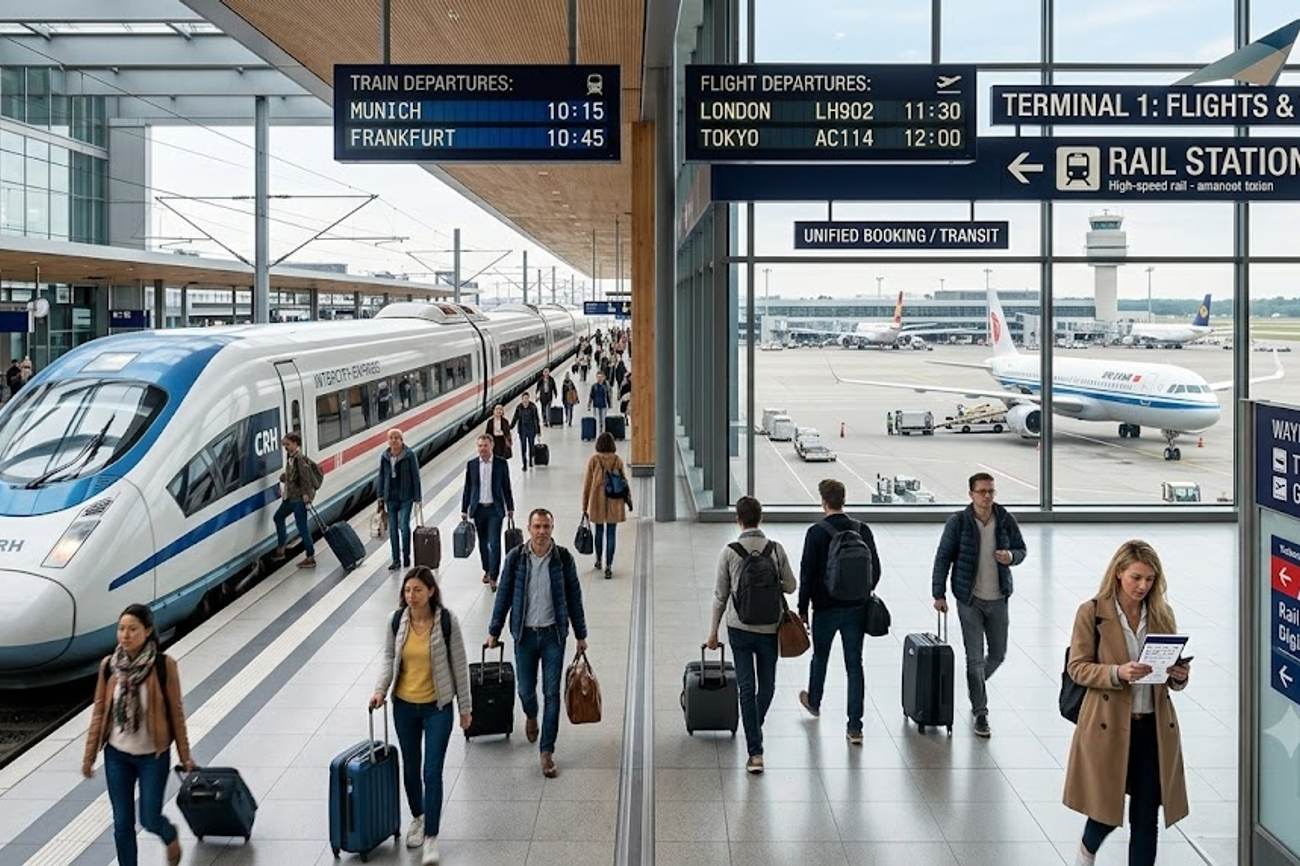
Image generated by AI
Global Transit Overhaul Targets Short-Haul Aviation
[Geneva, September 7, 2026] — A revolutionary partnership between European nations and key Asian economies is fundamentally restructuring the aviation sector by integrating rail and air networks. This systemic change is forcing airlines to abandon traditional short-haul flight paths, replacing them with high-speed rail connections. As governments tighten carbon emission regulations, millions of passengers are seeing their travel planning processes change overnight.
The transformation is centered on the integration of legacy airline inventories and national railway data into unified Passenger Name Records (PNRs). This technical alignment is currently being deployed across Germany, Spain, China, and South Korea to drastically reduce the carbon footprint of domestic travel.
Unified Booking Systems Eliminate Travel Friction
The integration of rail inventories into airline distribution networks has fundamentally changed how passengers move through domestic corridors. Under strict environmental mandates, legacy carriers are replacing high-emission regional flights with high-speed rail feeds. This allows for a seamless booking architecture where the traditional friction between different modes of transport is removed.
Travelers can now secure multi-modal journeys—combining a train and a plane—through a single digital transaction. This removes the need to manage separate ticketing systems or independent reservation references. By diverting short-distance traffic away from congested airspace and toward electrified ground infrastructure, these nations are balancing ecological requirements with passenger convenience.
European Strategies for Intermodal Connectivity
European transport authorities have identified rail-air partnerships as the primary mechanism for hitting climate targets without damaging regional economic links. Germany and Spain have emerged as leaders in this space, where national carriers coordinate directly with rail operators to feed traffic into major international hubs.
In Germany, Lufthansa maintains a close collaboration with Deutsche Bahn, offering integrated itineraries where one reservation covers both the high-speed rail leg and the subsequent long-haul flight. Similarly, Iberia in Spain utilizes codeshare agreements with Renfe to move regional passengers into Madrid-Barajas Airport more efficiently.
A critical component of this European model is the preservation of passenger rights. These networks ensure that travelers retain full legal protections and guarantees for missed connections, regardless of whether the delay occurred on the rail or air segment of the journey.
South Korea’s Innovation in City Terminals
South Korea has adopted a different approach by focusing on off-site processing infrastructure. This system decouples baggage handling and security from the physical airport terminal, reducing congestion at the gate.
Passengers using the Korea Express Train network can utilize dedicated city terminals in urban hubs like Seoul. At these locations, travelers can clear exit immigration and drop off checked luggage before they even leave the city. The baggage is tagged directly to the final international destination and transported via rail to Incheon International Airport.
By shifting administrative bottlenecks away from the airport, South Korea has maximized the throughput of its transit corridors and provided a blueprint for other nations struggling with urban airport overcrowding.
China’s Large-Scale Rail Substitution
China is utilizing the world’s most extensive high-speed rail network to systematically phase out redundant short-haul domestic flights. This move is driven by sweeping national carbon caps and centralized governance.
Rather than relying on standard global distribution systems, Chinese authorities use centralized digital platforms and advanced APIs to synchronize ticketing. Airlines and railway operators coordinate to eliminate flights on routes under 500 kilometers where rail transit is more efficient.
This allows the state to redirect aviation fuel toward long-haul international routes while absorbing domestic passenger volume through electrified rail. Additionally, the use of real-name digital identification embedded in the rail infrastructure ensures that security screening and passenger tracking remain seamless across the continental network.
Impact Analysis: The End of the Short-Haul Flight
The shift toward intermodal transport creates a significant ripple effect across the aviation industry. For airlines, the loss of short-haul routes means a total redesign of hub-and-spoke models. Instead of "feeding" hubs via regional jets, airlines are now dependent on the punctuality and capacity of national rail providers.
From a logistical standpoint, the move reduces the pressure on airport slots, potentially allowing for more long-haul international arrivals. However, it introduces new complexities regarding multi-party liability. When a passenger misses a flight due to a train delay, the legal framework for compensation must now span two entirely different industries.
Why This Matters: The Traveler's Experience
For the modern traveler, this transition represents a shift from "flight-centric" planning to "journey-centric" planning. The primary benefit is the removal of the "airport slog" for short distances. By bypassing the need to arrive three hours early for a one-hour flight, passengers save significant time.
From a legal and logistical perspective, the unification of the PNR is the most critical update. For decades, booking a train and a plane required two separate risks; if the train was late, the plane ticket was forfeited. The new integrated systems shift that risk back to the provider, offering a level of security previously unavailable in multi-modal travel.
Ultimately, this is not just about carbon footprints; it is about the efficiency of urban movement. The South Korean model of city terminals, in particular, suggests a future where the "airport" is no longer a single destination on the edge of town, but a series of distributed portals throughout the city.
Related Travel Guides
Disclaimer
This article is for informational and educational purposes only. It does not constitute legal, financial, or professional advice. While we strive to provide accurate and up-to-date information, travel policies, regulations, and conditions change rapidly. Always verify information with official sources before making travel decisions. Nomad Lawyer makes no representations about the accuracy, reliability, completeness, or suitability of the information provided. Readers should consult qualified professionals for advice specific to their circumstances. The views expressed in this article are those of the author and do not necessarily reflect the views of Nomad Lawyer.
Preeti Gunjan
Contributor & Community Manager
A passionate traveller and community builder. Preeti helps grow the Nomad Lawyer community, fostering engagement and bringing the reader experience to life.
Learn more about our team →