Suspended in the Clouds: The Complete Guide to Nepal's Record-Breaking Gandaki Golden Bridge

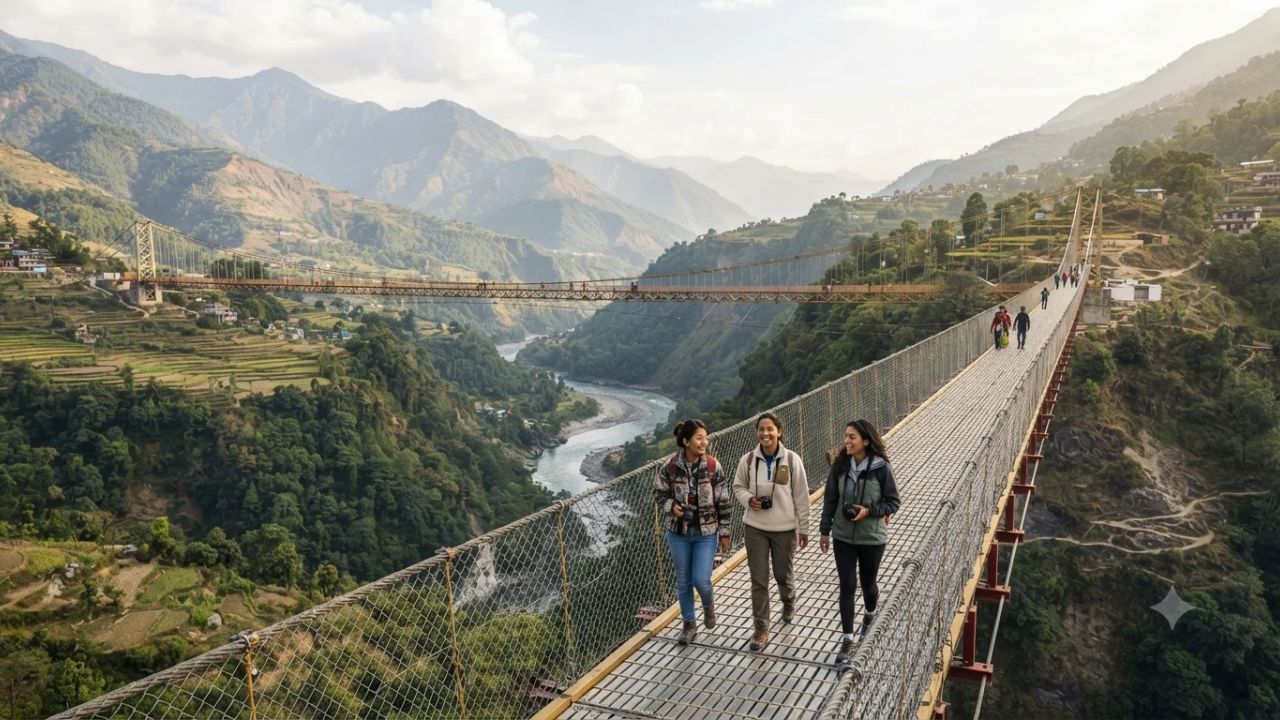
Suspended 122 meters above the roaring Kaligandaki River without a single intermediate pillar, the 567-meter Gandaki Golden Bridge has compressed a grueling three-hour mountain gorge descent into a breezy ten-minute walk between two Himalayan districts. Built at an investment of NPR 9.25 crore and operating since 2077 BS, this single-span suspension footbridge has quietly transformed the quiet borderland between Baglung Municipality-1 Bangechaur and Kushma Municipality-1 Pang into western Nepal's most captivating aerial crossing.
For generations, the deep canyon carved by the sacred Kaligandaki River formed an imposing barrier between the communities of Baglung and Parbat. Farmers carrying fresh produce, schoolchildren, and pilgrims heading toward sacred temples had to scramble down treacherous cliffside paths and claw their way up the opposite ridge. Today, this remarkable feat of Nepali engineering serves as both a lifeline for residents and a gateway for independent travelers heading deeper into the Annapurna and Mustang corridors.
The Engineering Feat Linking Baglung and Parbat
Known locally as Gandaki Sunaulo Jhula, the crossing represents a triumph of modern tensile design adapted to the challenging terrain of the central Himalayas. Stretching an uninterrupted 567 meters across the canyon, it ranks among the longest single-span pedestrian suspension bridges on Earth.
Unlike conventional multi-span bridges that require heavy concrete pillars anchored directly into volatile riverbeds, the Gandaki Golden Bridge relies entirely on high-tensile steel cables anchored into bedrock abutments high on either rim of the gorge. When wind currents funnel up the Kaligandaki Valley during mid-afternoon, the deck sways with a gentle, engineered rhythm that offers adrenaline without compromising structural stability.
The crossing has redefined travel dynamics in the Gandaki Province:
| Specification & Feature | Detail | Practical Traveler Impact |
|---|---|---|
| Total Span Length | 567 meters single span | One of the world's longest pillarless footbridges |
| Vertical Clearance | 122 meters above river | Sweeping panoramic views of the river canyon |
| Construction Cost | NPR 9.25 crore | High-tensile steel construction engineered in Nepal |
| Operating Era | Commissioned in 2077 BS | Reliable year-round crossing between districts |
| Transit Reduction | Reduced from hours to 10 minutes | Effortless pedestrian access between Bangechaur and Pang |
Before the bridge opened, traveling between the commercial center of Baglung Bazaar and the agricultural hamlets of Pang in Parbat district required navigating steep switchbacks that became dangerously slick during the summer monsoon. Today, foot traffic moves continuously from dawn until dusk, breathing economic life into small family-run tea shops and homestays on both sides of the canyon.
What Makes the Kaligandaki Crossing Extraordinary
The Kaligandaki River is one of the most storied waterways in South Asia. Flowing south from the Tibetan Plateau through the world's deepest river valley—flanked by the eight-thousand-meter giants Dhaulagiri and Annapurna—the river is revered as the sole source of sacred Shaligram ammonite fossils.
Standing at the midpoint of the bridge, visitors look directly into the dramatic gorge while snow-capped Himalayan peaks frame the northern horizon. The crossing creates a natural link for travelers exploring the wider cultural circuit of Baglung, which includes:
- Baglung Kalika Bhagwati Temple: An ancient Shakti Peeth shrine tucked within dense forest canopy near the riverbank, attracting thousands of Hindu devotees during Chaitra Ashtami and Dashain.
- Panchakot Dham: An expansive hilltop religious complex built to preserve Vedic heritage, offering sweeping vistas of the surrounding river bends and pine forests.
- Shaligram Museum: A specialized cultural center dedicated to the geological and spiritual history of the fossilized ammonites collected along the Kaligandaki riverbanks.
Travelers can research regional trekking permits and cultural routes via the official Nepal Tourism Board portal before heading up the highway from Pokhara.
Visitor Insider Tips for Crossing the Gandaki Golden Bridge
To experience the crossing at its best and explore the surrounding districts without the weekend crowds, keep these practical tips in mind:
- Timing the Wind and Light: Visit between 7:00 AM and 9:30 AM. Early mornings provide glassy calm conditions with minimal cable vibration and golden sunlight illuminating the Dhaulagiri range. By 2:00 PM, valley thermal winds kick up significant breeze across the open span.
- Getting There from Pokhara: Baglung sits approximately 72 kilometers west of Pokhara along the paved Mid-Hill Highway (Pushpalal Highway). Local microbuses depart every 30 minutes from Pokhara's Baglung Bus Park, completing the scenic drive past Kushma in roughly 2.5 to 3 hours. Private taxis offer a comfortable same-day return option.
- Footwear and Sensitivities: Wear enclosed walking shoes with rubberized grip. The open steel-mesh decking allows you to look straight down through your feet to the rushing river 122 meters below, which can trigger vertigo for those sensitive to heights.
- Local Culinary Specialties: Stop at a traditional eatery in Baglung Bazaar or Kushma for an authentic Thakali thali set, featuring slow-cooked black lentils (kalo daal), fragrant Mustang buckwheat flatbreads (dhindo), fermented leafy greens (gundruk), and fiery mountain timur pepper chutney.
- Circuit Planning: Combine your bridge visit with an excursion across Kushma's network of mega-suspension bridges, or continue northward along the highway toward Beni, the gateway to Myagdi hot springs and the lower Mustang trail toward Jomsom and Muktinath Temple.
Cultural and Environmental Context of the Kaligandaki Valley
Suspension bridges represent an integral element of civic life across Nepal's mountainous topography. In districts like Baglung, affectionately called "the district of suspension bridges" due to its hundreds of river crossings, these aerial footpaths are far more than photo spots—they are lifelines that sustain rural economies.
The Gandaki Golden Bridge illustrates how sustainable municipal infrastructure can spark local tourism without disrupting the fragile mountain environment. Rather than carving destructive new vehicle roads into fragile shale cliffs, the pedestrian suspension bridge encourages foot-based travel that preserves clean air and supports smallholder farmers selling organic oranges, honey, and hill vegetables directly to visitors.
Local community groups and temple trusts actively maintain the surrounding trails, organizing river cleanup drives to protect the sacred Kaligandaki ecosystem from plastic waste while ensuring that the spiritual sanctity of the river valley remains intact for future generations.
FAQ: Visiting Gandaki Golden Bridge 2026
Where is the Gandaki Golden Bridge located? The bridge spans the Kaligandaki River, connecting Baglung Municipality-1 Bangechaur in Baglung district with Kushma Municipality-1 Pang in Parbat district in western Nepal.
How long and high is the Gandaki Golden Bridge? The suspension footbridge measures 567 meters in length and hangs approximately 122 meters above the Kaligandaki River, making it one of the world's longest single-span pedestrian bridges.
How do I reach the bridge from Pokhara? Take a microbus or taxi from Pokhara's Baglung Bus Park along the Mid-Hill Highway. The 72-kilometer scenic drive takes about 2.5 to 3 hours.
Is there an entry fee to walk across the bridge? Pedestrian crossing is generally free and open to the public daily, serving as both a public transportation route for locals and an attraction for visitors.
Suspended high between two mountain ridges, this golden span proves that the shortest path between two communities is often an unforgettable walk across the sky.
Related Travel Guides
This article is for informational purposes. Flight routes, passenger regulations, visa rules, and transit advisories are subject to change by airlines and aviation authorities. Readers are advised to verify schedules and travel documentation with relevant carriers and border agencies before departure.
Related Stories
Nepal's Pokhara Seeks Tourism Breakthrough: Overcoming Highway Bottlenecks, Airport Debt, and Operating Cost Pressures
Ayodhya Deepotsav 2026 Logistics Guide: Attending the 30 Lakh Lamp Festival in India