
Frontier Airlines Flight 2538 Medical Emergency: Suspected Overdose Analysis at Philadelphia International Airport 2026
An analysis of the medical emergency on Frontier Airlines Flight 2538 to PHL, examining the rise of in-flight medical crises and the operational impact on Ultra-Low-Cost Carrier (ULCC) efficiency.

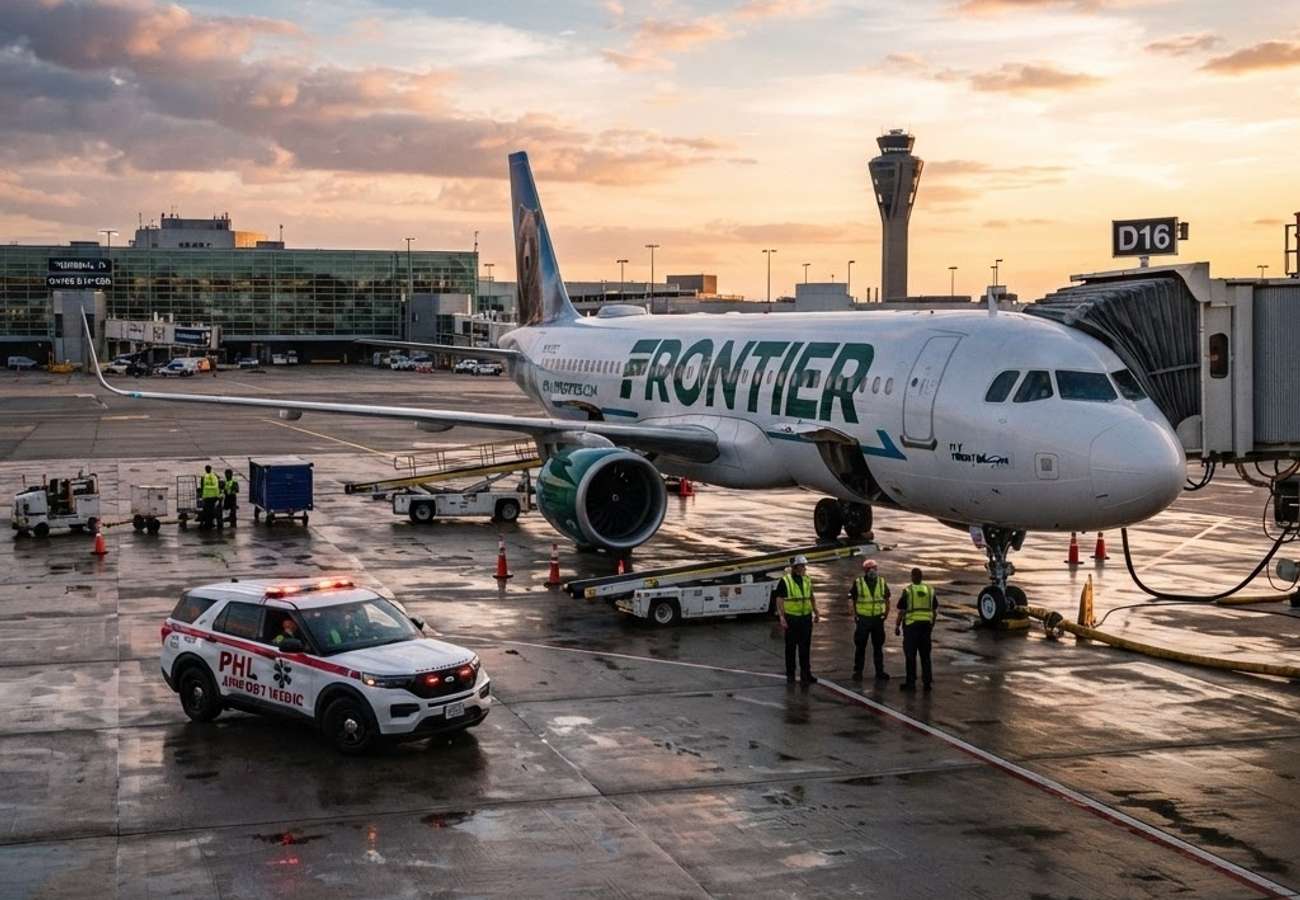
Image generated by AI
Frontier Airlines recorded 166 delays and 2 cancellations on September 14, 2026, a data point that coincides with a high-priority medical emergency on Flight 2538. This incident, involving a suspected overdose, highlights a growing intersection between public health crises and aviation operational stability, where a single medical event can trigger rapid gate changes and emergency resource deployment.
The Medical Crisis in Numbers — Flight 2538
The event occurred on Frontier Airlines Flight 2538, an Airbus A321neo operating a route from Tampa International Airport (TPA) to Philadelphia International Airport (PHL). The flight duration is typically 2 hours and 35 minutes. The critical window of this incident was remarkably narrow: the flight crew transmitted an urgent medical advisory at 4:08 p.m. ET, and the aircraft touched down on Runway 27R at 4:20 p.m. ET.
The data indicates the emergency was identified only 12 minutes prior to landing. The pilot's specific communication at 16:08 UTC identified a passenger in seat 22A as unresponsive due to a suspected overdose. Despite the urgency, the flight was not diverted, meaning the crew and onboard medical professionals managed the patient for the final descent. Upon arrival, the aircraft bypassed its scheduled arrival at Terminal E and proceeded directly to Terminal D to facilitate immediate access for the emergency medical services (EMS) team waiting at the gate.
Comparative Context: ULCC Stability vs. Systemic Delays
When analyzing this incident, it is necessary to separate the isolated medical event from the broader operational volatility seen at Philadelphia International Airport (PHL) on September 14. While the medical emergency on Flight 2538 was handled without diverting the aircraft, the overall network performance for Frontier Airlines on that day suggests deeper systemic friction.
According to data from FlightAware, PHL experienced 104 total delays on Monday. However, Frontier Airlines' specific performance was significantly more volatile, with 166 delays across its network and two cancellations specifically at PHL. This indicates that while the medical emergency was a localized crisis, the airline was already operating under significant stress.
The trend of "unruly" or "incapacitated" passengers is not limited to Ultra-Low-Cost Carriers (ULCCs). Recent patterns show a rise in behavioral and medical incidents across major US carriers. For instance, American Airlines has recently reported high-profile breaches of the "Contract of Carriage," including a passenger on Flight 1779 to Miami International Airport (MIA) who violated dress code policies by removing clothing, and another instance where passengers had to physically restrain an aggressive traveler with duct tape.
| Metric (Sept 14, 2026) | PHL Airport Total | Frontier Airlines Total |
|---|---|---|
| Total Delays | 104 | 166 |
| Total Cancellations | 2 | 2 |
| Emergency Diversions | 0 | 0 |
| Gate Changes (Flight 2538) | N/A | Terminal E $\rightarrow$ Terminal D |
What This Means for Travelers
For the modern traveler, these data points signal a shift in how in-flight emergencies are managed and how they impact scheduling.
First, the decision not to divert Flight 2538 suggests that airlines and the International Air Transport Association (IATA) are increasingly relying on the presence of trained medical volunteers onboard to stabilize patients until the destination is reached, rather than diverting to the nearest airport. This reduces the likelihood of massive cascading delays for other passengers but increases the pressure on onboard first responders.
Second, if you are flying with ULCCs like Frontier, the high ratio of delays (166 on a single day) compared to airport-wide averages (104) suggests that these carriers have less "buffer" in their schedules. A medical emergency that requires a gate change—such as the move from Terminal E to Terminal D—can disrupt ground transportation and connecting flights. Travelers should allow at least 3 hours for connections when flying ULCCs during peak volatility periods.
Third, the strict enforcement of the "Contract of Carriage" is increasing. Frontier's policy (Section 3, part 12) explicitly allows the airline to refuse transport or remove passengers appearing under the influence of drugs or alcohol without a refund. Travelers should be aware that airlines are increasingly utilizing these clauses to mitigate safety risks before the aircraft leaves the tarmac.
Forward Projection: Aviation Safety and Health Monitoring
Based on the current trajectory of in-flight incidents, we expect to see a push toward more advanced medical equipment on narrow-body aircraft like the Airbus A321neo. The 12-minute window between the pilot's report and landing on Flight 2538 demonstrates that the "golden hour" of emergency medicine is being compressed into the final minutes of flight.
We are likely to see an increase in partnerships between airlines and health organizations to standardize the response to suspected overdoses, potentially including the wider distribution of overdose-reversal agents in onboard medical kits. Furthermore, as the Federal Aviation Administration (FAA) continues to monitor "unruly passenger" data, we anticipate stricter pre-boarding screenings for intoxication to prevent the types of incidents seen on American Airlines and Frontier flights.
FAQ: In-Flight Medical Emergencies 2026
Will medical emergencies on my flight cause a diversion? Not always. As seen with Flight 2538, if medical personnel are onboard and the destination is within a short window (e.g., 12-20 minutes), pilots may prioritize landing at the destination to ensure a full hospital team is waiting at the gate.
How do airline "Contracts of Carriage" affect me? These contracts give airlines the legal right to remove passengers who are intoxicated or under the influence of drugs without providing a refund. This is a safety measure to prevent unresponsive passengers or behavioral outbursts during flight.
Why did Frontier have more delays than the PHL airport average? ULCCs often operate with tighter aircraft rotations and fewer spare planes. A single disruption, like a medical emergency or a mechanical issue, creates a ripple effect across their entire daily schedule, leading to higher delay counts.
The gap between medical crisis and touchdown is shrinking, leaving aviation safety in the hands of a few trained volunteers and a very fast descent.
Related Travel Guides
Disclaimer
This article is for informational and educational purposes only. It does not constitute legal, financial, or professional advice. While we strive to provide accurate and up-to-date information, travel policies, regulations, and conditions change rapidly. Always verify information with official sources before making travel decisions. Nomad Lawyer makes no representations about the accuracy, reliability, completeness, or suitability of the information provided. Readers should consult qualified professionals for advice specific to their circumstances. The views expressed in this article are those of the author and do not necessarily reflect the views of Nomad Lawyer.
Preeti Gunjan
Contributor & Community Manager
A passionate traveller and community builder. Preeti helps grow the Nomad Lawyer community, fostering engagement and bringing the reader experience to life.
Learn more about our team →